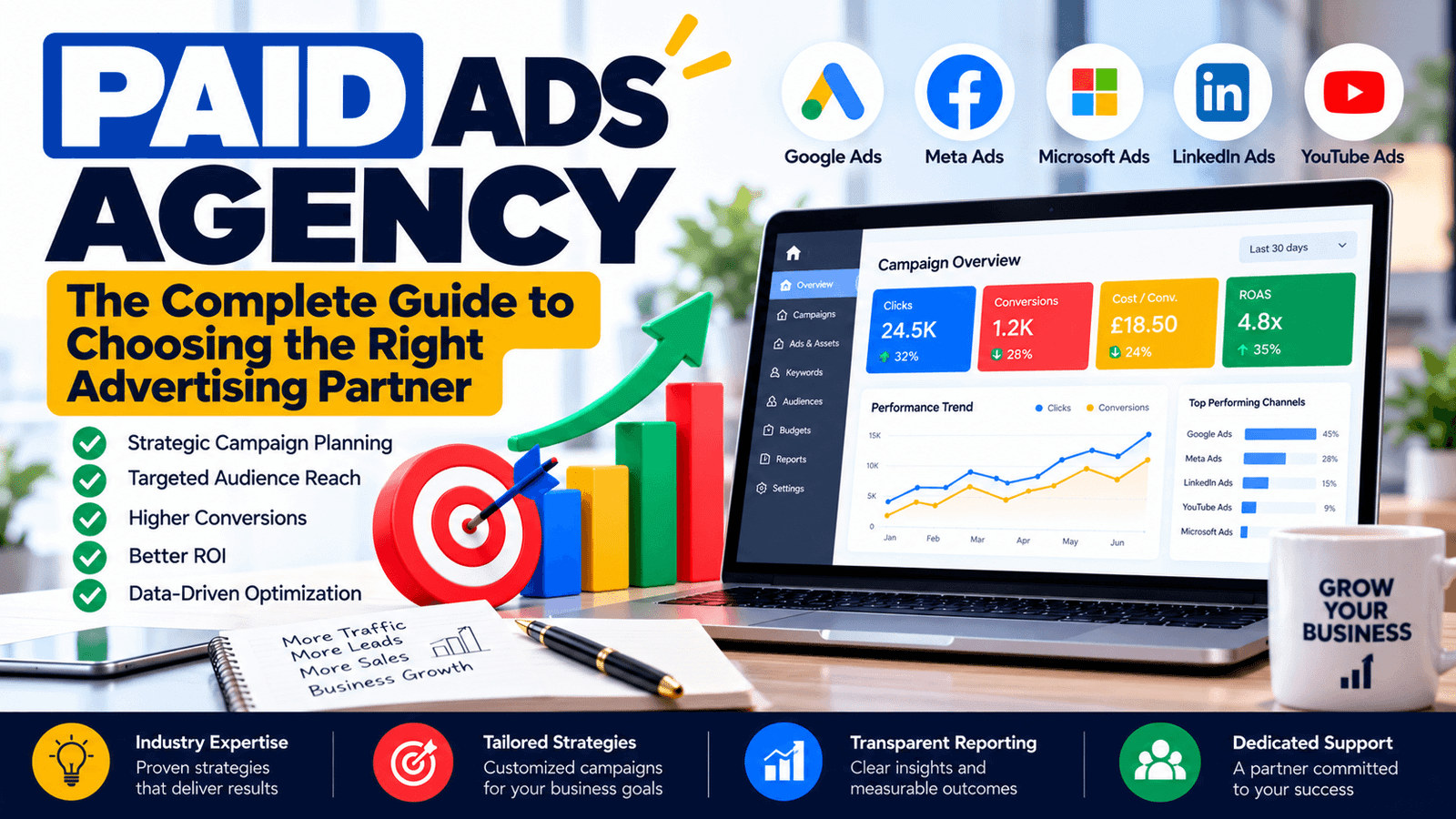
In today’s competitive digital marketplace, businesses need more than organic traffic to reach potential customers. Paid advertising can help companies place their products and services in front of relevant audiences across search engines, social media platforms, websites, and other digital channels.
However, managing paid advertising effectively requires more than creating an advertisement and setting a budget. Businesses need the right targeting, campaign structure, creative strategy, landing pages, conversion tracking, testing, and ongoing optimization.
A paid ads agency can help businesses manage these activities and build advertising campaigns around specific business objectives.
This comprehensive guide explains what a paid advertising agency does, the services it provides, how paid campaigns work, what metrics businesses should track, common mistakes to avoid, and how to choose an agency that fits your business needs.
What Is a Paid Ads Agency?
A paid ads agency is a digital marketing company that specializes in creating, managing, and optimizing paid advertising campaigns.
Depending on the agency, services may cover platforms such as:
- Google Ads
- Microsoft Advertising
- Meta Ads
- Instagram Ads
- LinkedIn Ads
- YouTube Ads
- TikTok Ads
- Display advertising
- Shopping advertising
- Remarketing campaigns
The agency’s role can range from campaign setup and advertisement creation to complete management, reporting, conversion tracking, and strategic optimization.
The exact services vary from one agency to another, so businesses should review the scope of work before signing a contract.
Why Do Businesses Use Paid Advertising?
Organic marketing can take time to develop. Paid advertising provides businesses with another way to reach potential customers through targeted campaigns.
Paid advertising can help businesses:
- Increase website traffic
- Generate leads
- Promote products
- Increase online sales
- Build brand awareness
- Reach specific audiences
- Promote events
- Generate app installations
- Drive phone calls
- Retarget previous website visitors
The objective should not simply be to generate as many clicks as possible. The campaign should be connected to a measurable business goal.
How Does a Paid Ads Agency Work?
A professional campaign generally follows a structured process.
1. Business Research
The agency first learns about:
- Products or services
- Target audience
- Competitors
- Geographic markets
- Customer journey
- Business objectives
- Previous campaigns
2. Audience Research
The agency identifies the types of people or organizations most relevant to the business.
3. Platform Selection
Different advertising platforms can serve different purposes.
For example:
- Google Ads can target search intent.
- Meta Ads can provide audience-based targeting.
- LinkedIn can be useful for certain B2B campaigns.
- YouTube can support video advertising.
4. Campaign Setup
Campaigns are structured according to objectives, audiences, products, services, locations, or other relevant categories.
5. Creative Development
Advertisements may include:
- Headlines
- Images
- Videos
- Descriptions
- Calls to action
- Offers
6. Conversion Tracking
Tracking is implemented to measure meaningful actions.
7. Optimization
Campaign data is analyzed and adjustments are made over time.
Major Services Offered by a Paid Ads Agency
Different agencies offer different packages, but common services include the following.
1. Paid Search Advertising
Search advertising allows businesses to reach people who are actively searching for relevant products and services.
For example:
“digital marketing agency”
“buy office furniture”
“PPC management services”
Search campaigns can be particularly useful when users have clear commercial intent.
2. Social Media Advertising
Social advertising can help businesses reach audiences based on factors such as:
- Interests
- Demographics
- Behaviors
- Location
- Previous interactions
- Website activity
Platforms may include Facebook, Instagram, LinkedIn, and TikTok.
Social advertising can support objectives such as awareness, traffic, lead generation, and sales.
3. Display Advertising
Display advertising uses visual advertisements across websites and digital properties.
Display campaigns can be used for:
- Brand awareness
- Remarketing
- Product promotion
- Audience engagement
Creative formats may include banners, responsive advertisements, and other visual formats.
4. Video Advertising
Video advertising can be used to communicate products and services through visual storytelling.
Businesses can use video advertisements for:
- Product demonstrations
- Tutorials
- Brand campaigns
- Customer testimonials
- Product launches
- Educational content
YouTube is one of the major platforms used for online video advertising.
5. Remarketing
Remarketing allows businesses to reach people who have previously interacted with their website, application, or other digital assets where supported.
For example, someone may:
- Visit a product page.
- Leave the website.
- See a relevant advertisement later.
- Return to the website.
Remarketing can help businesses reconnect with audiences that have already shown interest.
6. Shopping Advertising
eCommerce businesses can use shopping-focused advertising to promote products.
Campaigns can use product information such as:
- Product name
- Price
- Image
- Availability
- Brand
Shopping campaigns can be especially relevant for online retailers.
7. Lead Generation Advertising
Lead generation campaigns are designed to encourage potential customers to provide information or contact a business.
Common lead actions include:
- Contact forms
- Quote requests
- Demo requests
- Consultation bookings
- Phone calls
- Newsletter registrations
- Free trials
Lead quality should be monitored rather than focusing only on the number of leads generated.
Paid Ads Agency vs. In-House Advertising
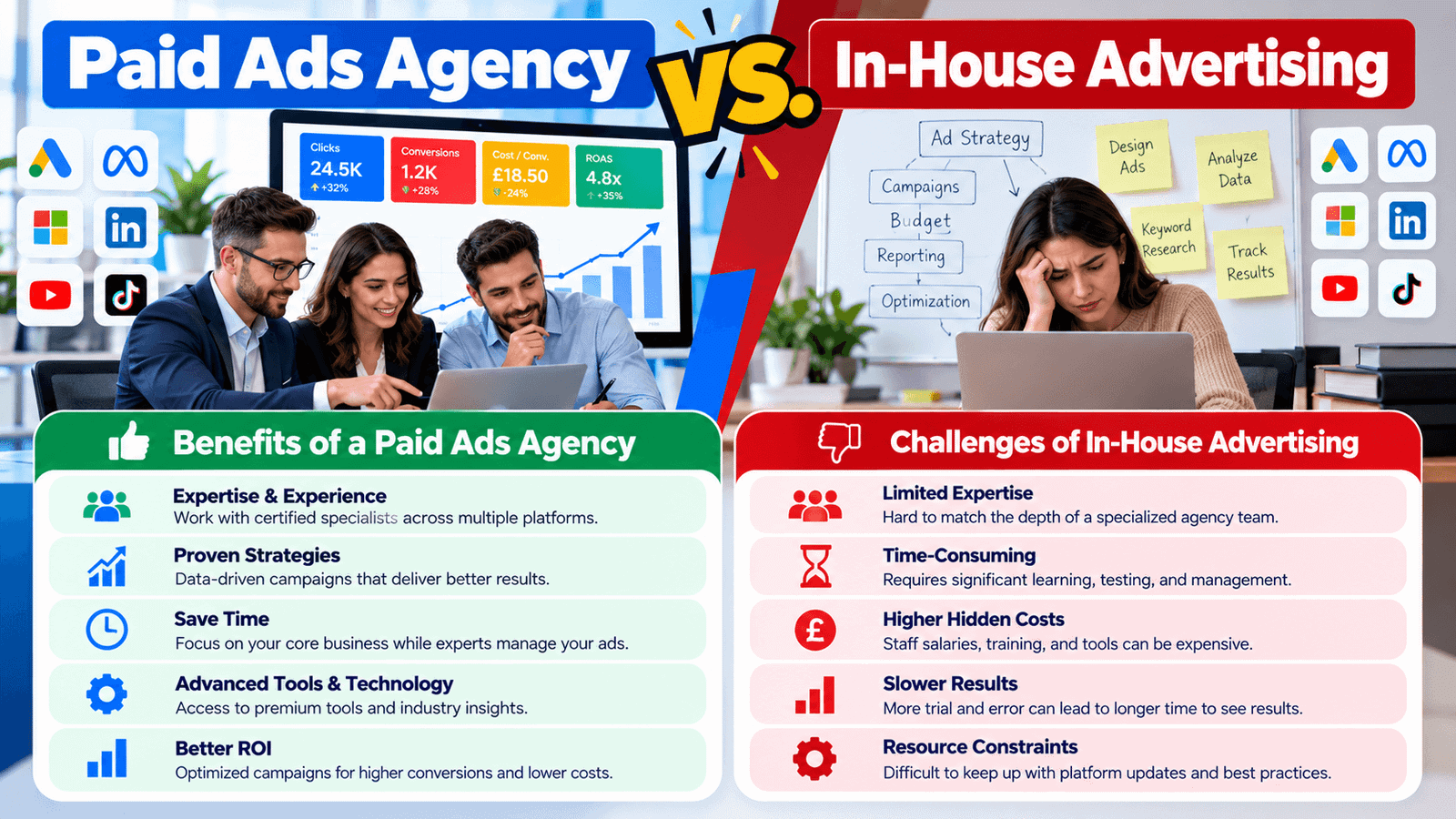
Businesses have several options for managing advertising.
In-House Team
An internal team provides direct control but requires employees with appropriate expertise.
Freelancer
A freelancer may provide specialized support and can be suitable for smaller campaigns.
Agency
An agency can provide access to multiple specialists, depending on its structure.
A business should consider:
- Budget
- Campaign complexity
- Internal expertise
- Advertising platforms
- Required creative work
- Reporting needs
- Long-term objectives
Benefits of Working With a Paid Ads Agency
1. Specialized Expertise
Paid advertising platforms can be complex. An experienced agency may have specialists working across strategy, creative development, analytics, and campaign management.
2. Better Campaign Structure
Campaigns can be organized around relevant audiences, products, locations, and objectives.
3. Ongoing Optimization
Campaign performance can change over time. Regular optimization can identify opportunities and potential problems.
4. Conversion Tracking
An agency can help implement tracking so businesses can measure meaningful actions.
5. Access to Multiple Platforms
Depending on the agency, businesses may be able to manage several advertising channels through one partner.
How to Choose the Right Paid Ads Agency
Choosing an agency should involve more than comparing monthly management fees.
1. Define Your Business Goals
Before contacting agencies, determine what you want advertising to achieve.
Possible objectives include:
- Generate leads
- Increase sales
- Increase website traffic
- Promote a new product
- Generate phone calls
- Increase bookings
- Build brand awareness
2. Check Platform Experience
Make sure the agency has experience with the advertising platforms relevant to your business.
For example:
eCommerce: Google Shopping, Meta Ads
B2B: Google Ads, LinkedIn Ads
Consumer products: Meta, TikTok, Google Ads
The appropriate mix depends on the business.
3. Ask About Their Strategy
A professional agency should be able to explain how it approaches:
- Audience research
- Keyword research
- Campaign structure
- Creative testing
- Budget allocation
- Conversion tracking
- Remarketing
- Reporting
Understanding Paid Advertising Costs
The cost of paid advertising has two main components.
Advertising Spend
This is the money paid to the advertising platform.
Agency Management Fee
This is the amount paid to the agency for managing the campaigns.
For example:
Advertising Budget: $2,000/month
Agency Fee: $500/month
Total marketing expenditure would be $2,500/month.
The exact pricing structure varies by agency.
Some agencies charge:
- Flat monthly fees
- Percentage of advertising spend
- Project fees
- Performance-based fees
- Customized retainers
Always ask for a clear pricing breakdown.
Important Paid Advertising Metrics
A good campaign should be measured using meaningful performance data.
Impressions
The number of times an advertisement is displayed.
Clicks
The number of times users interact with an advertisement.
Click-Through Rate
CTR measures the percentage of impressions that result in clicks.
Cost Per Click
CPC measures the average cost associated with a click.
Conversion Rate
The percentage of users who complete a desired action.
Cost Per Acquisition
The advertising cost associated with generating a conversion.
Return on Ad Spend
ROAS compares tracked advertising revenue with advertising expenditure.
For example, if a business spends $1,000 and generates $4,000 in tracked sales, the ROAS is 4:1.
However, ROAS does not represent total profit because other business costs are not necessarily included.
Why Conversion Tracking Matters
One of the biggest mistakes businesses make is focusing only on clicks.
A campaign can generate thousands of clicks without producing meaningful business results.
Conversion tracking can help businesses measure:
- Purchases
- Leads
- Calls
- Bookings
- Registrations
- Downloads
- Quote requests
- Demo requests
The correct conversion depends on the business model.
Landing Page Optimization
An advertisement is only one part of the customer journey.
If users click an advertisement and arrive on a confusing or irrelevant page, campaign performance can suffer.
A strong landing page should generally provide:
- Clear headline
- Relevant content
- Strong value proposition
- Easy navigation
- Trust signals
- Testimonials
- Clear call to action
- Mobile-friendly design
- Fast loading experience
The landing page should match the advertisement and user intent.
Paid Advertising for Small Businesses
Small businesses can use paid advertising with carefully controlled budgets.
A campaign might focus on:
- Specific geographic areas
- High-intent keywords
- Core products
- Best-performing services
- Retargeting
- Lead generation
Rather than trying to reach everyone, businesses can concentrate their budget on audiences most relevant to their objectives.
Paid Advertising for eCommerce Businesses
eCommerce advertising often focuses on sales and revenue.
Campaigns can include:
- Shopping advertising
- Product campaigns
- Dynamic remarketing
- Social media advertising
- Product retargeting
- Catalog advertising
Important metrics can include:
- Purchases
- Revenue
- Conversion rate
- Average order value
- Cost per acquisition
- ROAS
Paid Advertising for B2B Companies
B2B companies often have longer sales cycles.
A potential customer might:
- Discover the company.
- Research the product.
- Download information.
- Request a demonstration.
- Speak with sales.
- Compare suppliers.
- Become a customer.
Because of this, B2B campaigns should track qualified leads and sales opportunities rather than only immediate conversions.
Common Paid Advertising Mistakes
Mistake 1: No Clear Objective
Campaigns should have a defined purpose.
Mistake 2: Targeting Everyone
Broad targeting can waste budget.
Mistake 3: Ignoring Search Terms
Search-term analysis can identify irrelevant traffic.
Mistake 4: Poor Landing Pages
Relevant advertising should lead to relevant landing pages.
Mistake 5: No Conversion Tracking
Without tracking, it can be difficult to determine whether advertising is generating business results.
Mistake 6: Focusing Only on Clicks
Clicks are not the same as customers.
Mistake 7: Never Testing
Advertising performance can improve through structured testing of different messages, creatives, audiences, and landing pages.
Questions to Ask Before Hiring a Paid Ads Agency
Before signing an agreement, ask:
- Which advertising platforms do you specialize in?
- Do you have experience in my industry?
- How do you conduct audience research?
- How do you perform keyword research?
- How do you measure conversions?
- How often do you optimize campaigns?
- How often will I receive reports?
- Is advertising spend separate from your management fee?
- Who owns the advertising account?
- Do you provide landing-page recommendations?
- Do you create advertisement graphics and videos?
- How do you test advertisements?
- How do you handle remarketing?
- What metrics will you report?
- What happens if I cancel the contract?
How a Paid Ads Agency Measures Campaign Success
Success depends on the business objective.
For an eCommerce company, success might involve:
- Revenue
- Purchases
- ROAS
- Customer acquisition cost
For a service company:
- Qualified leads
- Phone calls
- Bookings
- Cost per lead
For a B2B company:
- Qualified leads
- Sales opportunities
- Pipeline value
- Customer acquisition cost
Therefore, there is no single metric that works for every business.
The Importance of Continuous Optimization
Paid advertising is not a “set it and forget it” activity.
Campaign performance can change because of:
- Competition
- Seasonal demand
- Consumer behavior
- New products
- Market conditions
- Advertising costs
- Creative fatigue
- Changes in landing pages
Regular analysis can help businesses identify opportunities to improve campaigns.
A typical optimization cycle may look like:
Research → Launch → Measure → Test → Optimize → Report → Improve
Paid Ads Agency and SEO: Can They Work Together?
Yes. Paid advertising and SEO can complement each other.
SEO focuses on organic visibility, while paid advertising provides paid exposure.
For example, PPC data may reveal high-performing keywords that can inform SEO content planning.
Similarly, SEO research can identify valuable search topics that could be tested through paid campaigns.
Using both channels can provide businesses with different ways to reach potential customers.
Frequently Asked Questions About Paid Ads Agencies
1. What is a paid ads agency?
A paid ads agency is a digital marketing company that creates, manages, and optimizes paid advertising campaigns across platforms such as Google Ads, Facebook, Instagram, LinkedIn, YouTube, and other advertising networks.
2. What does a paid ads agency do?
A paid ads agency can handle keyword research, audience targeting, campaign setup, advertisement creation, budget management, conversion tracking, remarketing, landing-page optimization, testing, and performance reporting.
3. How much does a paid ads agency cost?
The cost of a paid ads agency varies depending on the advertising budget, campaign complexity, industry, number of platforms, and services required. Agencies may charge a fixed monthly fee, a percentage of advertising spend, or a customized management fee.
4. Is a paid ads agency suitable for small businesses?
Yes. A paid ads agency can create campaigns specifically for small businesses with controlled budgets. Campaigns may focus on specific locations, products, services, or high-intent audiences.
5. Can a paid ads agency help generate leads?
Yes. Lead-generation campaigns can encourage potential customers to complete forms, request quotes, book consultations, call a business, or request product demonstrations.
6. Can a paid ads agency manage Google Ads?
Yes. Many agencies provide Google Ads management, including search campaigns, shopping campaigns, display advertising, remarketing, keyword research, advertisement testing, and conversion tracking.
7. Can a paid ads agency manage Facebook and Instagram Ads?
Yes. Agencies specializing in Meta advertising can manage Facebook and Instagram campaigns, including audience targeting, creative testing, remarketing, lead generation, and sales campaigns.
8. How quickly can paid advertising generate results?
Paid campaigns can begin generating impressions and clicks once they are approved and activated. However, meaningful results depend on the campaign budget, competition, targeting, advertisements, landing pages, and conversion rate.
9. What should I look for when choosing a paid ads agency?
When comparing agencies, consider their platform experience, industry knowledge, campaign strategy, conversion tracking, reporting, communication, pricing, account ownership, and experience with businesses similar to yours.
10. Can a paid ads agency improve my advertising performance?
A paid ads agency can analyze campaign data and identify opportunities for optimization. This may include adjusting targeting, keywords, advertisements, budgets, landing pages, and audience strategies.
11. What metrics should a paid ads agency track?
Important metrics can include:
- Impressions
- Clicks
- Click-through rate
- Cost per click
- Conversions
- Conversion rate
- Cost per acquisition
- Advertising spend
- Revenue
- Return on ad spend
12. Does a paid ads agency provide conversion tracking?
Many agencies provide conversion tracking as part of their services. Tracking can measure actions such as purchases, form submissions, phone calls, bookings, registrations, and quote requests.
13. Can paid ads work with SEO?
Yes. Paid advertising and SEO can complement each other. SEO focuses on organic search visibility, while paid advertising provides paid exposure. Keyword and conversion data from paid campaigns can also provide useful insights for SEO strategies.
14. Can a paid ads agency help eCommerce businesses?
Yes. eCommerce businesses can use search, shopping, social media, display, and remarketing campaigns to promote products. Key performance indicators may include purchases, revenue, conversion rate, CPA, and ROAS.
15. Can a paid ads agency help B2B companies?
Yes. B2B businesses can use paid advertising to generate leads, demo requests, consultations, and sales opportunities. B2B campaigns may require additional focus on lead quality and longer sales cycles.
16. How often should paid advertising campaigns be optimized?
Campaigns should be monitored regularly, although the ideal frequency depends on advertising spend, traffic volume, campaign complexity, and objectives. Active campaigns should be reviewed often enough to identify significant performance changes.
17. Do paid ads agencies guarantee sales?
Businesses should be cautious about agencies promising guaranteed sales or guaranteed returns. Advertising performance depends on many factors, including market demand, competition, pricing, targeting, creative quality, landing pages, and conversion rates.
18. Should advertising spend be separate from agency fees?
Usually, yes. The paid ads agency may charge a management fee while the business pays the advertising platform separately. Always request a complete pricing breakdown before starting a campaign.
19. How do I know if a paid advertising campaign is successful?
Success should be measured against the business objective. For an eCommerce company, this could mean revenue and purchases. For a service business, it could mean qualified leads and bookings. For a B2B company, sales opportunities and customer acquisition cost may be more useful.
20. Why should I hire a paid ads agency?
A paid ads agency can provide specialized campaign management, advertising strategy, conversion tracking, testing, optimization, and reporting. The potential value depends on the agency’s expertise and how well its services match the business’s objectives.
Final Thoughts
Choosing the right paid ads agency can help businesses manage their advertising campaigns more strategically. From Google Ads and social media advertising to remarketing, shopping campaigns, and lead generation, paid advertising provides businesses with multiple ways to reach potential customers.
However, successful advertising is not simply about spending more money. Effective campaigns require relevant targeting, strong creative, appropriate landing pages, accurate conversion tracking, ongoing testing, and careful budget management.
Before hiring an agency, define your objectives and understand exactly what services you need. Compare agencies based on their experience, strategy, reporting, pricing, communication, and ability to measure meaningful business outcomes.
The strongest advertising strategy is one that connects audience → advertisement → landing page → conversion → business result.