Google Ads is one of the most popular ways for UK businesses to reach potential customers through paid search advertising. Whether you run a small local business, an e-commerce store, a recruitment agency, or a professional services company, Google Ads can help you reach people who are actively searching for your products or services.
However, understanding the Google Ads cost UK businesses should budget for can be challenging. Advertising costs vary depending on your industry, target keywords, location, competition, campaign settings, and advertising goals.
Some businesses may start with a few hundred pounds per month in advertising spend, while companies targeting highly competitive keywords may need significantly larger budgets.
In this guide, we explain how Google Ads pricing works in the UK, what affects cost per click, how to plan a monthly budget, and how to reduce wasted advertising spend.
What Is Google Ads Cost UK?
Google Ads cost UK refers to the money a business spends to advertise its products or services through Google’s advertising platform.
For Search campaigns, businesses commonly use a pay-per-click (PPC) model. This means you generally pay when someone clicks your advertisement rather than simply when the advertisement appears.
There is no fixed monthly subscription price for Google Ads. You choose your budget, and the amount you spend depends on your campaign settings and the advertising activity generated.
Your total Google Ads costs may include:
- Advertising spend paid to Google.
- PPC management fees paid to an agency or freelancer.
- Landing page design and development.
- Conversion tracking and analytics setup.
- Creative production for display or video campaigns.
- Additional tools or services used to manage campaigns.
Understanding these costs separately makes it easier to plan a realistic advertising budget.
1. Understand the Average Google Ads Cost in the UK
The average Google Ads cost UK businesses experience depends heavily on their industry and the keywords they target.
For budgeting purposes, some UK industry benchmark reports published in 2026 suggest that Search advertising can average around £1.95 per click across industries. However, this is only an indicative benchmark, not an official Google price or a reliable prediction for every business. <Link url=”https://ridleydigital.co.uk/google-ads-costs-2026-uk-benchmarks” title=”Read an example of UK Google Ads benchmarks”/>.
Actual costs can be lower or substantially higher.
For example, a retailer advertising relatively inexpensive products may face different click costs from a law firm competing for high-value legal enquiries.
When estimating your costs, consider:
- Your industry and business model.
- The commercial intent behind your keywords.
- Your target locations.
- The number of competitors advertising.
- Your website and landing page quality.
- The number of qualified enquiries or sales you need.
Rather than relying entirely on a national average, use Google Keyword Planner and your own campaign data to develop a more relevant estimate.
2. Understand Cost Per Click (CPC)
Cost per click, commonly abbreviated as CPC, is the amount you pay when someone clicks your advertisement in a CPC-based campaign.
For example, if your advertising spend is £300 and you receive 150 clicks, your average CPC is £2.
This calculation is:
Average CPC = Total advertising spend ÷ Number of clicks
Your actual CPC may change from one click to another because Google Ads uses an auction system.
The auction considers factors such as your bid, the context of the search, competition, and the quality and relevance of your advertisement.
A higher CPC does not automatically mean that a campaign is performing badly. If more expensive clicks generate valuable customers, they may still be profitable.
The important question is whether the clicks lead to relevant enquiries, sales, or other business outcomes.
3. Learn How Industry Affects Google Ads Cost UK
Different industries experience different levels of advertising competition.
Businesses that compete for high-value customers may be willing to pay more for relevant clicks. Other industries may have less competition or lower customer acquisition values.
The following figures are illustrative planning ranges, not verified averages for every UK advertiser.
| Industry | Illustrative Search CPC range |
|---|---|
| Legal services | £4–£12+ |
| Financial services | £3–£10 |
| B2B services | £2–£7 |
| Home services and trades | £1.50–£5.50 |
| Healthcare and dental | £1.50–£5 |
| Recruitment services | £1–£4 |
| Retail and e-commerce | £0.40–£2.50 |
| Travel and hospitality | £0.80–£3.50 |
Actual costs may fall outside these ranges. Use keyword-level estimates and live campaign results to create a more accurate forecast for your business.
For example, a dental practice targeting a general local dentistry keyword may experience different costs from a clinic competing for cosmetic dentistry or specialist treatment searches.
Before setting your budget, identify your most valuable services and estimate how much you can afford to spend to acquire a customer.
4. Choose a Realistic Monthly Google Ads Budget
Your monthly advertising budget determines how much money you make available to attract clicks, leads, or sales.
A sensible budget should reflect your business objectives, customer value, competition, and ability to handle incoming enquiries.
The following table provides illustrative starting points for UK businesses.
| Monthly ad spend | Potential use |
|---|---|
| £300–£500 | Small-scale testing of a narrow keyword or local service campaign |
| £500–£1,000 | Testing local search demand and generating initial enquiry data |
| £1,000–£3,000 | Expanding into additional keywords, services, or locations |
| £3,000+ | Supporting broader campaigns or competitive markets where the economics justify it |
These are planning examples, not guaranteed minimums or recommended budgets for every industry.
A business spending £500 per month in a small local market may achieve useful results, while a business targeting highly competitive national keywords may need considerably more.
Google also provides an official Google Ads budget and cost calculator to help advertisers explore budgeting options.
5. Calculate How Many Clicks Your Budget Could Generate
Estimating potential clicks can help you understand what your advertising budget may deliver.
Use this formula:
Estimated clicks = Monthly ad spend ÷ Estimated average CPC
For example, suppose your business allocates £600 per month to Google Search advertising and your estimated average CPC is £2.
Your budget could generate approximately 300 clicks before considering changes in actual CPC, campaign delivery, or other factors.
Here are some illustrative scenarios:
| Monthly ad spend | £1 average CPC | £2 average CPC | £4 average CPC |
|---|---|---|---|
| £300 | 300 clicks | 150 clicks | 75 clicks |
| £600 | 600 clicks | 300 clicks | 150 clicks |
| £1,000 | 1,000 clicks | 500 clicks | 250 clicks |
| £2,000 | 2,000 clicks | 1,000 clicks | 500 clicks |
These are mathematical estimates, not guaranteed click volumes.
Actual results depend on keyword demand, competition, targeting, bidding, and campaign performance.
Also remember that clicks do not automatically become customers. Conversion tracking is essential for understanding whether the advertising spend is producing valuable results.
6. Include PPC Management Fees in Your Budget
If you hire a PPC agency or freelancer, management fees are usually separate from the advertising spend paid to Google.
A provider may charge a fixed monthly fee, a percentage of advertising spend, a one-off setup fee, or a combination of these models.
For illustration, a small business might receive a management quote of £250–£600 per month, while a more complex account may cost considerably more. These figures are examples for budgeting rather than a verified UK-wide pricing standard.
Before choosing a provider, ask what the service includes.
A management package might cover:
- Campaign setup and keyword research.
- Ad copywriting and extensions or assets.
- Conversion tracking configuration.
- Bid and budget management.
- Negative keyword management.
- Landing page recommendations.
- Regular performance optimisation.
- Monthly reporting and strategic recommendations.
Always confirm whether VAT, landing page development, creative production, and additional services are included.
A low management fee may not offer good value if the account receives little optimisation or reporting. Compare providers based on deliverables, transparency, experience, and the expected business value of their work.
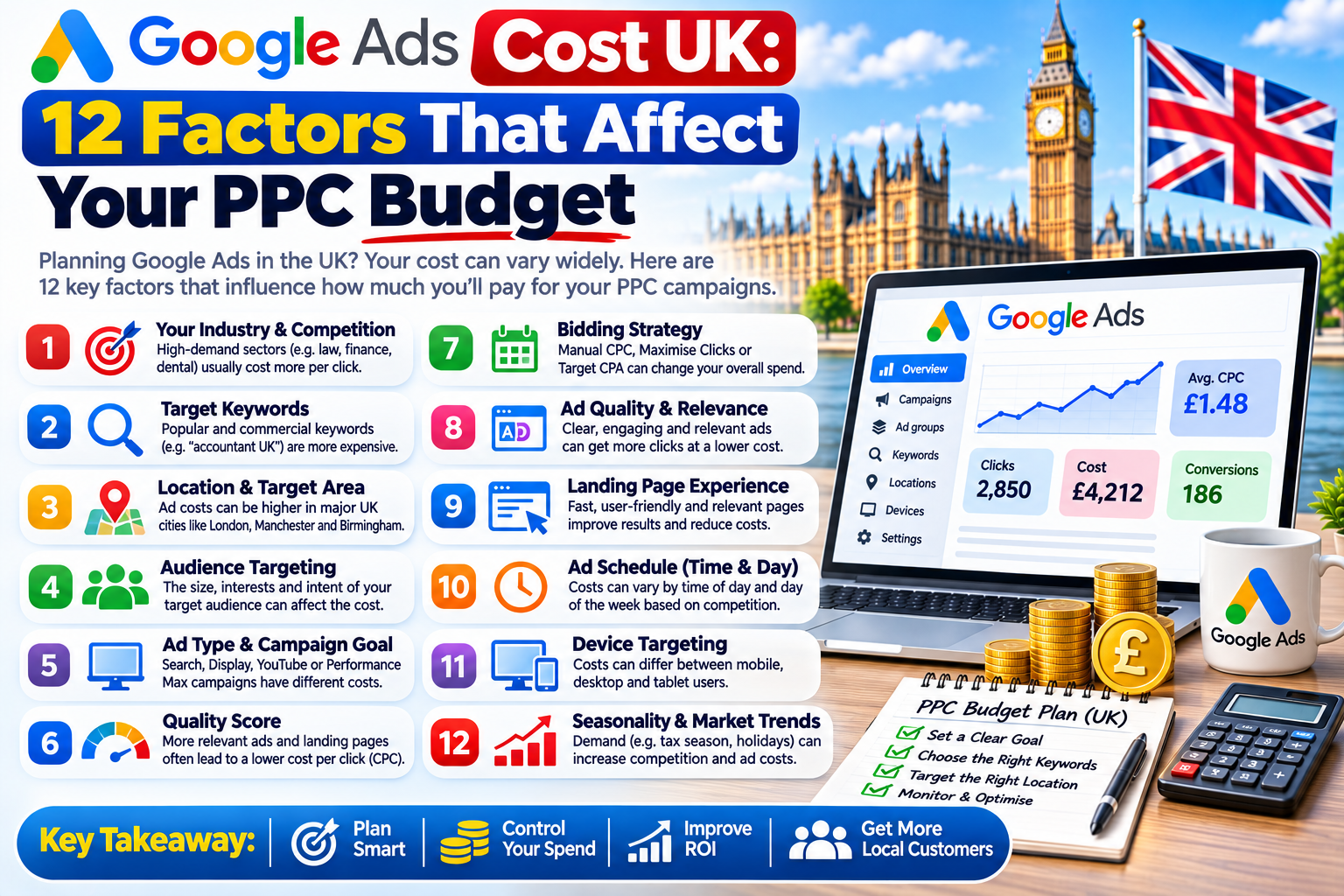
7. Understand What Affects Google Ads Cost UK
Several factors influence how much you pay for advertising.
Keyword competition
Popular commercial keywords can attract multiple advertisers, increasing competition in the auction.
Search intent
A search such as “hire an accountant in London” may have a different commercial value from a general search about accounting qualifications.
Location targeting
Costs can vary between locations because demand, competition, and customer value differ. A campaign targeting London may behave differently from one focused on a smaller town.
Ad relevance and landing page experience
Relevant advertisements and useful landing pages can improve campaign quality and help your ads compete more effectively.
Bidding strategy
Your selected strategy should match your campaign objective. For example, a campaign focused on qualified leads may require a different approach from one intended to generate website traffic.
Seasonality
Demand and competition can change during the year. Retail campaigns may face different conditions during major shopping periods, while other businesses may experience seasonal demand.
Understanding these factors helps you interpret campaign costs and identify opportunities to improve performance.
8. Improve Quality and Relevance to Control Costs
Google Ads uses auction-time signals to determine which ads appear and how they rank.
Quality Score is a diagnostic tool that evaluates expected click-through rate, ad relevance, and landing page experience. It is not itself a direct price or a guarantee of lower costs.
You can improve relevance by:
- Grouping closely related keywords into suitable ad groups.
- Writing ad copy that matches the searcher’s intent.
- Creating useful, relevant landing pages.
- Making calls to action clear.
- Ensuring landing pages work well on mobile devices.
- Improving page loading performance.
- Keeping the information in your ads accurate.
For example, if your advertisement promotes emergency plumbing services, the landing page should explain those services and make it easy to request assistance.
Avoid sending every advertisement to a generic homepage when a more relevant service page is available.
Improving relevance can support stronger campaign performance, although lower CPCs are not guaranteed.
9. Use Negative Keywords to Reduce Wasted Spend
Negative keywords help prevent your advertisements from appearing for searches that are irrelevant to your business.
For example, a company selling paid professional training may want to exclude searches related to free courses if those searches rarely lead to valuable customers.
Depending on your business, possible negative keyword themes might include:
- Free.
- Jobs.
- Careers.
- Salary.
- DIY.
- Used.
- Tutorial.
These are examples only. A term that is irrelevant to one business may be valuable to another.
Review your search terms report regularly to identify irrelevant queries and add suitable negative keywords.
Be careful not to exclude terms that may represent valuable customers. Negative keyword decisions should reflect your actual services and campaign goals.
10. Track Conversions, Not Just Clicks
Clicks show that people visited your website, but they do not tell you whether your advertising generated business.
Conversion tracking helps you understand which campaigns produce valuable actions.
Depending on your business, meaningful conversions might include:
- Completed purchases.
- Qualified enquiry forms.
- Appointment bookings.
- Telephone calls from potential customers.
- Consultation requests.
- Qualified sales opportunities.
For example, if your campaign generates 200 clicks and 10 enquiries, your conversion rate is 5%.
However, not all enquiries will necessarily become paying customers. Where possible, track qualified leads and completed sales as well.
Ensure that your tracking is configured correctly and complies with applicable UK privacy and data protection requirements.
Reliable conversion data allows you to make more informed decisions about budgets, keywords, and campaign optimisation.
11. Calculate Your Cost Per Lead and Return on Investment
Cost per lead (CPL) measures how much you spend to generate an enquiry or lead.
The formula is:
Cost per lead = Advertising spend ÷ Number of leads
For example, if you spend £600 and generate 20 leads, your cost per lead is £30.
Whether this is good or bad depends on your business model, lead quality, conversion rate, and profit margin.
Suppose your business generates 20 leads, and four become paying customers. Your advertising spend of £600 produces a customer acquisition cost of £150 per customer, before management fees and other business costs.
This calculation can help you determine whether your Google Ads campaigns are commercially sustainable.
For e-commerce businesses, return on ad spend (ROAS) may be useful. ROAS compares revenue attributed to advertising with the advertising cost, but revenue alone does not account for product costs, fulfilment, or profit margins.
Always assess advertising performance against the value your business actually receives.
12. Review and Optimise Your Campaign Regularly
Google Ads performance can change as competitors, search behaviour, and customer demand change.
Regular optimisation helps you identify problems and make better use of your budget.
Review the following:
- Search terms and negative keywords.
- Keyword performance and average CPC.
- Click-through and conversion rates.
- Location and device performance.
- Ad copy and landing page relevance.
- Daily and monthly budget delivery.
- Cost per qualified lead or sale.
- Conversion tracking accuracy.
Avoid making frequent changes based on very small amounts of data. Allow enough time and volume to evaluate performance, especially when campaigns are new.
Increase budgets gradually when the campaign is generating valuable results and your business can handle additional demand.
If a campaign is spending money without producing meaningful outcomes, investigate targeting, search intent, landing pages, and tracking before simply increasing the budget.
Common Google Ads Budgeting Mistakes to Avoid
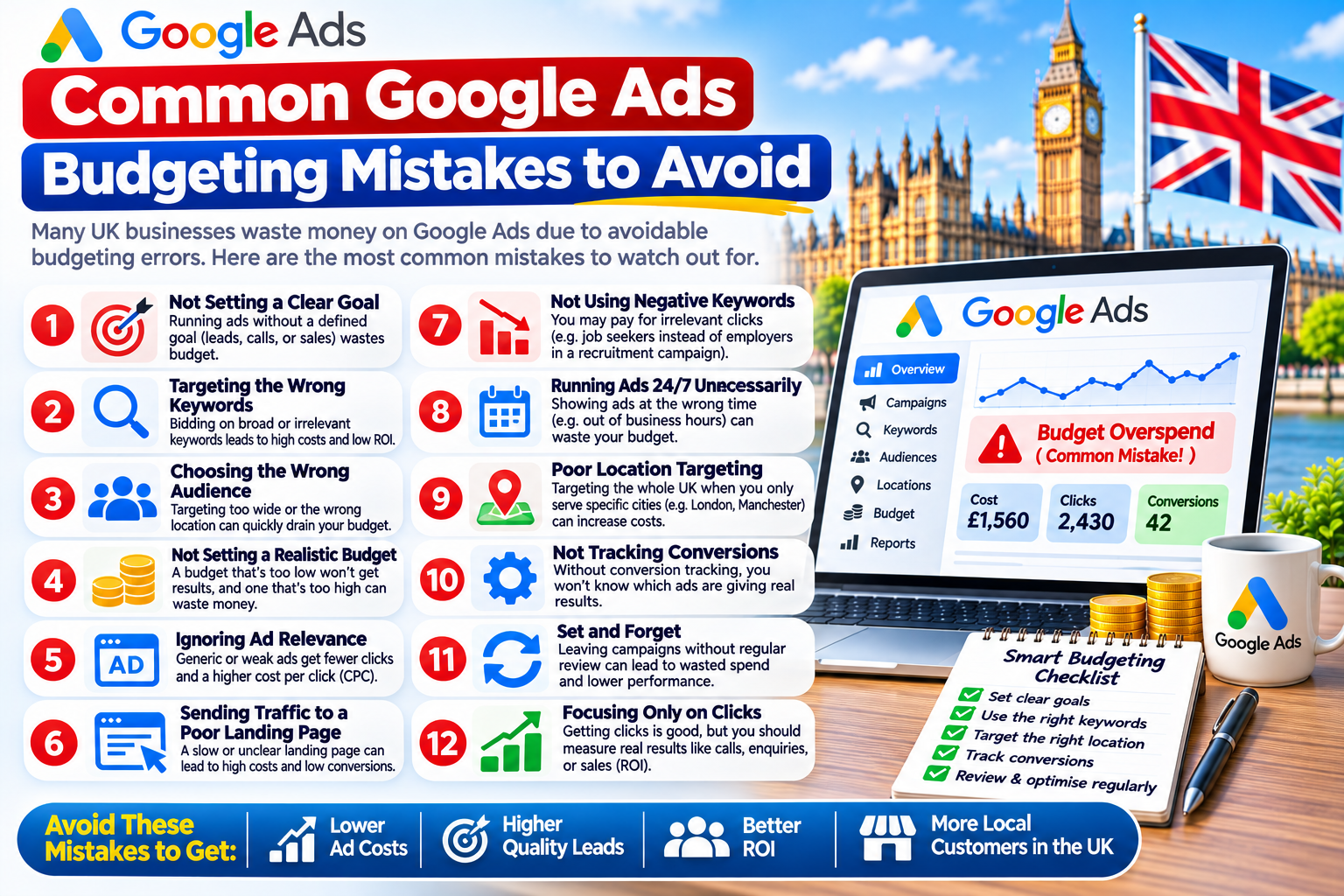
When planning Google Ads cost UK businesses should consider, avoid these common mistakes:
- Setting a budget without defining a business goal.
- Choosing keywords based only on search volume.
- Ignoring negative keywords.
- Sending all traffic to the homepage.
- Failing to track leads or sales.
- Confusing management fees with advertising spend.
- Assuming every click will generate a customer.
- Increasing the budget before checking campaign quality.
- Comparing CPC without considering lead quality.
- Treating industry averages as guaranteed prices.
A clear strategy and accurate tracking are more useful than simply spending more money.
Conclusion
Understanding Google Ads cost UK businesses may face is essential for planning an effective PPC campaign. Costs vary according to industry, keyword competition, location, campaign setup, and business goals, so there is no single budget that suits every company.
Start by identifying your most valuable services, researching relevant keywords, estimating CPC, and setting a budget that your business can afford. Then create relevant ads, improve landing pages, use negative keywords, and track conversions to understand whether your spend is generating worthwhile results.
With regular monitoring and evidence-based optimisation, Google Ads can become a useful channel for reaching potential customers and growing your UK business.
Frequently Asked Questions About Google Ads Cost UK
1. What is Google Ads cost UK?
Google Ads cost UK refers to the amount businesses spend on Google advertising, including clicks, campaign budgets, and any separate fees paid to PPC agencies or freelancers.
2. How much does Google Ads cost UK per month?
Google Ads cost UK per month depends on your industry, target keywords, competition, and goals. Some small businesses test campaigns with a few hundred pounds per month, while competitive markets may require larger budgets.
3. What is the average Google Ads cost UK per click?
The average Google Ads cost UK per click varies by keyword and industry. Some clicks may cost less than £1, while competitive commercial keywords can cost several pounds or more. Use Google Keyword Planner to estimate costs for your market.
4. Why does Google Ads cost UK vary by industry?
Google Ads cost UK varies because industries have different levels of competition, customer values, search demand, and conversion potential. Legal and financial services, for example, can have different CPCs from general retail.
5. What is a good Google Ads cost UK budget for small businesses?
A suitable Google Ads cost UK budget depends on the number of customers you want to acquire and what you can afford to spend. Start with a manageable test budget and increase it when the campaign produces worthwhile results.
6. Is Google Ads cost UK affordable for startups?
Google Ads cost UK can be manageable for startups when campaigns focus on a small number of relevant keywords, specific service areas, and clear business objectives. Careful tracking helps avoid wasting money.
7. Does Google Ads cost UK include management fees?
Google Ads cost UK may include advertising spend and separate PPC management fees. Agencies may also charge setup fees or additional costs for landing pages, tracking, and creative work. Always check what your quotation includes.
8. How can I reduce Google Ads cost UK?
You can manage Google Ads cost UK by improving keyword targeting, excluding irrelevant search terms, writing relevant ads, optimising landing pages, and monitoring conversions regularly.
9. How does cost per click affect Google Ads cost UK?
Cost per click directly affects how many visitors your budget can attract. For example, a £500 budget can generate approximately 250 clicks at a £2 average CPC, assuming the budget is fully spent at that average cost.
10. Is Google Ads cost UK higher in London?
Google Ads cost UK may be higher for some keywords in London because competition and customer demand can differ from other locations. However, actual costs depend on the specific service, keyword, and auction conditions.
11. How can I calculate Google Ads cost UK per lead?
To calculate Google Ads cost UK per lead, divide your advertising spend by the number of leads generated. For example, £600 spent to generate 20 leads results in a £30 cost per lead.
12. What factors influence Google Ads cost UK the most?
Key factors affecting Google Ads cost UK include keyword competition, industry, geographic targeting, bidding strategy, advertisement relevance, landing page experience, and seasonal demand.
13. Can better landing pages reduce Google Ads cost UK?
Better landing pages can improve user experience and advertising relevance, potentially helping campaign performance. However, improved landing pages do not guarantee a lower CPC or a particular advertising cost.
14. Is Google Ads cost UK different for Search and Display campaigns?
Yes. Google Ads cost UK can differ between Search, Display, Shopping, and Video campaigns because each format has different audiences, bidding options, and pricing dynamics.
15. How much should I spend on Google Ads cost UK testing?
Your Google Ads cost UK testing budget should be sufficient to gather useful performance data without putting unnecessary pressure on your finances. The right amount depends on expected CPC, conversion rates, and your business objectives.
16. Does Google Ads cost UK guarantee leads or sales?
No. Google Ads cost UK pays for advertising activity, not guaranteed customers. Results depend on targeting, demand, advertisement quality, landing pages, pricing, and the relevance of your offer.
17. How can I track Google Ads cost UK performance?
Track Google Ads cost UK performance using Google Ads reporting, conversion tracking, and suitable analytics tools. Monitor clicks, CPC, conversion rate, cost per lead, qualified enquiries, and sales.
18. Is hiring a PPC agency worth the Google Ads cost UK?
Hiring a PPC agency may be worthwhile if it improves campaign management, tracking, targeting, and lead quality. Compare management fees, deliverables, reporting, and business results before choosing a provider.
19. Where can I estimate Google Ads cost UK before launching a campaign?
You can estimate Google Ads cost UK using Google Keyword Planner, Google’s budget planning resources, and historical campaign data where available. Treat estimates as guidance rather than guaranteed prices.
20. What is the best way to manage Google Ads cost UK?
The best way to manage Google Ads cost UK is to set a realistic budget, target relevant searches, use negative keywords, improve landing pages, track meaningful conversions, and optimise campaigns based on reliable data.