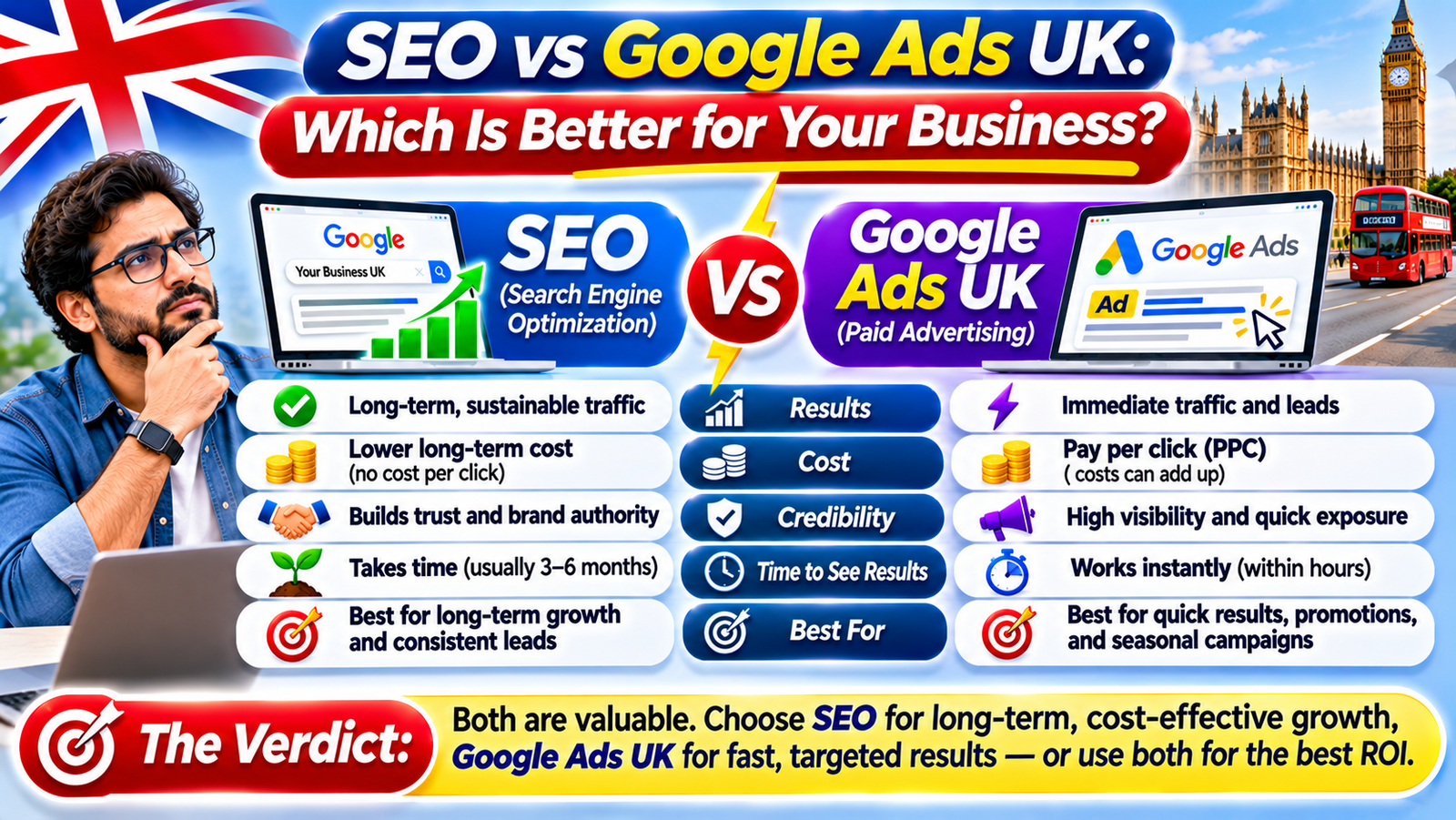
Choosing between SEO and Google Ads is an important decision for UK businesses that want to attract more customers online. Both digital marketing strategies can increase website traffic, generate enquiries and support business growth. However, they work differently and deliver results on different timescales.
If you are comparing SEO vs Google Ads UK, you need to understand the costs, benefits, limitations and long-term value of each strategy before investing your marketing budget.
SEO helps your website appear in organic search results without paying for every click. Google Ads allows businesses to pay for advertising placements and reach potential customers who are actively searching for products or services.
So, which option is better for your business? Let’s explore the differences and find the right approach.
What Is SEO?
Search Engine Optimisation (SEO) is the process of improving a website so that it appears more prominently in organic search engine results.
When someone searches Google for a service or product, search engines display relevant websites based on several factors, including content quality, website performance, relevance, authority and user experience.
SEO helps businesses improve their visibility without paying Google for each organic click.
Main Types of SEO
1. On-Page SEO
On-page SEO involves optimising individual website pages through:
- Relevant keywords and search intent
- SEO titles and meta descriptions
- High-quality website content
- Heading structure
- Internal linking
- Image optimisation
2. Technical SEO
Technical SEO focuses on website performance and search engine accessibility, including:
- Website loading speed
- Mobile-friendly design
- XML sitemaps
- Website indexing
- HTTPS security
- Fixing broken links and technical errors
3. Off-Page SEO
Off-page SEO improves website authority through activities such as:
- Quality backlinks
- Digital PR
- Brand mentions
- Relevant industry publications
- Online reputation building
4. Local SEO
Local SEO helps businesses appear in location-based searches. It is particularly useful for UK businesses targeting customers in specific towns and cities.
For example, a business may target searches such as “SEO agency in Luton”, “plumber in London” or “digital marketing company in Manchester”.
What Are Google Ads?
Google Ads is Google’s paid advertising platform. Businesses can create campaigns to display advertisements when users search for relevant keywords or browse participating websites and platforms.
Unlike SEO, Google Ads can generate visibility as soon as an eligible campaign is approved and begins serving.
Businesses commonly use Google Ads to promote:
- Products and services
- Local businesses
- Online stores
- Special offers
- Lead generation campaigns
- Website landing pages
How Google Ads Works
Google Ads commonly operates through a pay-per-click (PPC) model for Search campaigns.
This means advertisers generally pay when someone clicks on their advertisement, rather than simply when the advertisement appears.
The cost of advertising depends on factors such as keyword competition, bidding strategy, campaign quality, targeting and industry.
For example, a UK solicitor, financial service provider or competitive home improvement business may face different advertising costs from a small local retailer.
SEO vs Google Ads UK: Key Differences
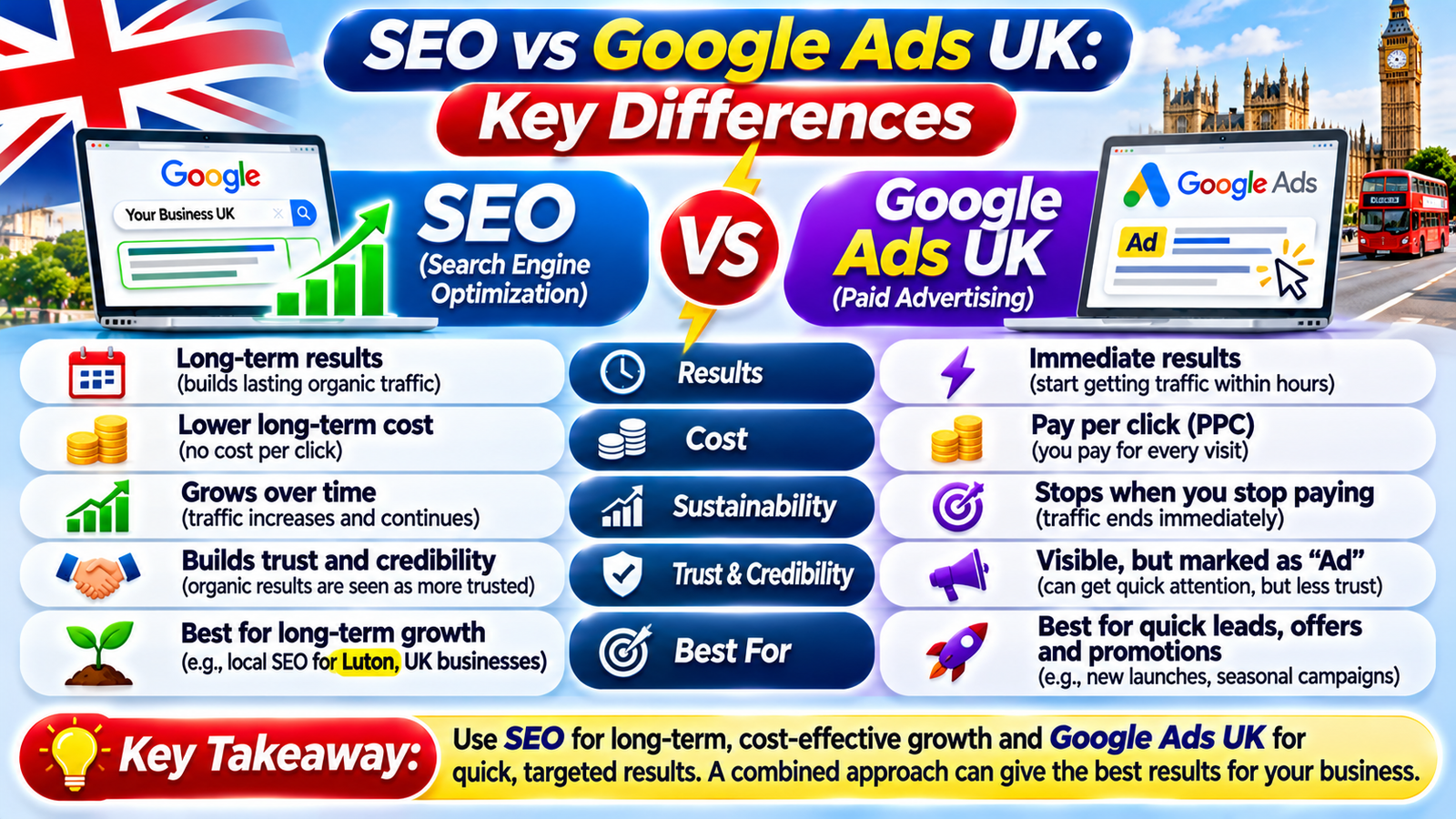
Understanding the differences between SEO and Google Ads can help you decide where to invest your marketing budget.
| Comparison | SEO | Google Ads |
|---|---|---|
| Traffic type | Organic | Paid |
| Initial visibility | Usually takes time | Can start quickly |
| Payment model | SEO investment and ongoing work | Advertising spend and management |
| Long-term value | Can build over time | Depends on continued advertising |
| Keyword targeting | Organic keyword strategy | Paid keyword targeting |
| Traffic after stopping investment | Rankings may continue, but can change | Paid campaign traffic generally stops |
| Best for | Sustainable organic visibility | Immediate campaign visibility |
| Competition | Compete for organic rankings | Compete in ad auctions |
The main difference is that SEO builds organic search visibility, while Google Ads purchases advertising opportunities.
10 Important Differences Between SEO and Google Ads
1. Speed of Results
Google Ads can generate traffic much faster than SEO once a campaign is approved, funded and eligible to serve.
SEO normally requires time for search engines to discover, crawl, understand and rank website content.
If your business needs enquiries quickly, Google Ads may be a suitable starting point. If you want to build sustainable organic visibility, SEO is an important long-term investment.
2. Marketing Costs
SEO does not charge businesses for every organic click. However, it still requires investment in content creation, technical improvements, keyword research, link building and professional SEO services.
Google Ads requires an advertising budget. Depending on your industry, each click may cost a different amount.
For an effective comparison, consider the total cost of acquiring a customer rather than looking only at the cost per click.
3. Long-Term Benefits
One of the biggest advantages of SEO is its potential to deliver ongoing organic traffic.
A well-optimised page may continue attracting visitors after publication, although rankings are never guaranteed and require regular maintenance.
Google Ads can produce immediate traffic, but that traffic generally stops when the advertising campaign is paused or the budget runs out.
4. Targeting Potential Customers
Google Ads offers detailed targeting options, including location, keywords, audiences and campaign settings.
SEO targets users through relevant content, search intent and organic search visibility.
For UK businesses serving specific locations, combining local SEO with geographically targeted Google Ads can help reach relevant customers.
5. Trust and Credibility
Many users recognise advertisements in Google search results. Others prefer organic listings because they want to explore relevant information without clicking on an advertisement.
Strong organic visibility can support brand credibility, but appearing organically does not automatically mean a business is more trustworthy.
Both strategies benefit from a professional website, clear service information, customer reviews and useful content.
6. Keyword Competition
Highly competitive keywords can be difficult to rank for organically.
Google Ads provides another opportunity to appear for relevant searches, although competitive keywords may require higher bids.
A balanced keyword strategy can identify which searches are worth targeting through SEO and which may be suitable for paid campaigns.
7. Measuring Performance
Both SEO and Google Ads offer performance measurement opportunities.
SEO performance can be monitored through Google Search Console and analytics tools.
Google Ads provides campaign reporting, including impressions, clicks, conversions and advertising costs.
Businesses should track meaningful results such as qualified enquiries, booked appointments and sales—not just website visits.
8. Website Content Requirements
SEO depends heavily on relevant, helpful and well-structured website content.
Google Ads also needs strong landing pages to convert visitors into customers.
A well-designed landing page with clear messaging, useful information and a visible call to action can improve the effectiveness of both strategies.
9. Local Business Visibility
Local SEO helps businesses improve their visibility in relevant local searches and Google Maps results.
Google Ads can also target customers in specific UK locations.
For example, a Luton-based cleaning company could use local SEO to attract organic searches while running Google Ads for high-intent cleaning service keywords.
10. Return on Investment (ROI)
The success of SEO and Google Ads should be measured through business outcomes.
SEO may offer growing returns as organic visibility improves, but results depend on competition, content quality and ongoing work.
Google Ads can deliver measurable campaign results, but profitability depends on advertising costs, conversion rates, lead quality and customer value.
Neither strategy guarantees a positive return.
SEO vs Google Ads UK: Which Is More Cost-Effective?
There is no single answer because costs depend on your business, industry, location, competition and marketing goals.
SEO usually requires an ongoing investment in website improvements, content and optimisation. Google Ads requires a separate advertising budget in addition to any campaign management fees.
Consider these examples:
Small local business: SEO can help build long-term visibility for location-based searches. A small Google Ads campaign may also help generate enquiries for specific services.
E-commerce business: SEO can attract organic visitors through product pages, category pages and informational content. Google Ads can promote products to people actively searching to buy.
Professional services: SEO can establish topical authority through useful content, while Google Ads can target high-intent searches for specific services.
The most cost-effective option is the one that generates valuable customers at a sustainable acquisition cost.
When Should UK Businesses Choose SEO?
SEO may be the better starting point when:
- You want sustainable organic traffic.
- Your business needs long-term online visibility.
- You regularly publish useful website content.
- You want to attract customers through informational searches.
- You operate in a local market and need stronger local visibility.
- You want to reduce dependence on paid advertising over time.
SEO is particularly valuable for businesses willing to invest consistently in their website and online presence.
When Should UK Businesses Choose Google Ads?
Google Ads may be more suitable when:
- You need traffic and enquiries quickly.
- You are launching a new product or service.
- You want to promote a limited-time offer.
- You need to test demand for a particular service.
- You have a clear advertising budget.
- You want to target specific locations and search terms.
However, running advertisements without conversion tracking or a properly optimised landing page can waste money.
Why Combining SEO and Google Ads Can Be More Effective
For many businesses, the best solution is not choosing only one strategy. Combining SEO and Google Ads can create a more balanced digital marketing approach.
Here is how they can work together:
1. Google Ads for Immediate Visibility
Use paid campaigns to reach potential customers while your SEO strategy develops.
2. SEO for Long-Term Growth
Optimise service pages, publish helpful articles and improve technical website performance to build organic visibility.
3. Keyword Research for Both Channels
Use search data and campaign performance to identify valuable keywords and understand customer intent.
4. Better Landing Pages
Create landing pages that provide clear information and encourage visitors to enquire, book or purchase.
5. Shared Performance Tracking
Measure organic and paid traffic separately, then compare leads, sales and acquisition costs.
This approach allows businesses to balance short-term marketing opportunities with long-term growth.
SEO vs Google Ads UK: Example Marketing Strategy for a Small Business
Imagine a small service business based in Luton that wants to attract more local customers.
A practical marketing strategy could include:
| Activity | Marketing Channel | Objective |
|---|---|---|
| Optimise service pages | SEO | Improve organic rankings |
| Improve Google Business Profile | Local SEO | Increase local visibility |
| Publish helpful blog articles | SEO | Attract relevant searches |
| Run targeted search campaigns | Google Ads | Generate enquiries |
| Create dedicated landing pages | Both | Improve conversions |
| Track leads and sales | Analytics | Measure performance |
The business could start with a controlled advertising budget while building its organic presence.
As organic visibility develops, the business can review which paid campaigns remain profitable and adjust its marketing investment accordingly.
Common Mistakes Businesses Make When Choosing SEO or Google Ads
Avoid these common mistakes:
- Expecting SEO to deliver instant rankings.
- Running Google Ads without a clear budget.
- Choosing keywords without understanding search intent.
- Sending paid traffic to irrelevant website pages.
- Ignoring mobile website performance.
- Failing to track calls, enquiries and sales.
- Judging success only by website traffic.
- Stopping SEO after publishing a few articles.
- Using the same strategy for every location.
- Expecting guaranteed rankings or sales.
A successful marketing strategy requires regular monitoring, testing and improvement.
How Much Should UK Businesses Spend on SEO and Google Ads?
Marketing budgets vary significantly across industries and business sizes.
There is no fixed amount that every UK business should spend.
When planning your budget, consider:
- Your business objectives.
- The competitiveness of your industry.
- Your target locations.
- The number of services or products you promote.
- Your website’s current SEO condition.
- The average value of a new customer.
- Your expected cost per lead or sale.
For Google Ads, separate your advertising spend from campaign management fees.
For SEO, understand exactly what your service provider includes, such as technical SEO, content optimisation, local SEO, reporting and link-building activities.
Always begin with measurable objectives and review performance before increasing your investment.
How to Choose the Right Digital Marketing Strategy
Before choosing SEO, Google Ads or both, ask yourself these questions:
Do you need immediate enquiries?
Google Ads may help generate traffic more quickly.
Do you want long-term organic visibility?
SEO is an important investment.
Do you serve customers in a specific location?
Consider local SEO and location-targeted advertising.
Do you have a limited marketing budget?
Prioritise the activities most likely to reach your target customers and generate profitable enquiries.
Can you measure conversions?
Set up conversion tracking before making major marketing decisions.
The right strategy should support your business goals rather than simply generate more clicks.
Conclusion: SEO vs Google Ads UK – Which Should You Choose?
When comparing SEO vs Google Ads UK, remember that both strategies have different strengths.
SEO is suitable for building long-term organic visibility, improving website authority and attracting relevant visitors over time. Google Ads is useful for reaching potential customers quickly through paid search campaigns.
For many UK small businesses, combining both strategies can provide a practical balance between immediate visibility and sustainable growth.
The key is to understand your customers, set a realistic budget, choose relevant keywords and measure the results that matter to your business.
If you want to grow your business online, invest in a digital marketing strategy built around your goals—not just traffic.
Frequently Asked Questions (FAQs)
1. What Is SEO vs Google Ads UK?
SEO vs Google Ads UK compares two digital marketing strategies. SEO improves organic search visibility, while Google Ads helps businesses reach customers through paid advertisements.
2. Which Is Better: SEO vs Google Ads UK?
SEO vs Google Ads UK depends on your business goals. SEO supports long-term organic growth, whereas Google Ads can generate traffic and enquiries more quickly.
3. Why Should UK Businesses Understand SEO vs Google Ads UK?
Understanding SEO vs Google Ads UK helps businesses choose the right marketing strategy, manage their budgets and attract potential customers.
4. Is SEO More Affordable Than Google Ads UK?
When comparing SEO vs Google Ads UK, SEO does not charge for every organic click. However, SEO still requires investment in content, optimisation and technical improvements.
5. Can SEO vs Google Ads UK Work Together?
Yes. SEO vs Google Ads UK does not have to be an either-or decision. Businesses can combine SEO for organic growth with Google Ads for immediate advertising opportunities.
6. How Long Does SEO Take Compared With Google Ads UK?
SEO vs Google Ads UK has different timelines. Google Ads can generate traffic once campaigns are eligible to run, while SEO generally requires ongoing work and time.
7. Is Google Ads Better Than SEO for New UK Businesses?
In SEO vs Google Ads UK, Google Ads may help new businesses gain early visibility. SEO is also important for building long-term organic search performance.
8. Does SEO vs Google Ads UK Depend on Business Size?
Yes. SEO vs Google Ads UK can vary depending on business size, competition, marketing budget and customer acquisition goals.
9. Which Strategy Generates More Leads: SEO vs Google Ads UK?
SEO vs Google Ads UK can both generate valuable leads. Results depend on keyword selection, website quality, campaign targeting and conversion optimisation.
10. Is SEO vs Google Ads UK Suitable for Small Businesses?
Yes. SEO vs Google Ads UK is particularly relevant to small businesses that want to attract customers while managing limited marketing budgets.
11. What Is the Main Cost Difference in SEO vs Google Ads UK?
The main difference in SEO vs Google Ads UK is the payment model. SEO involves investment in optimisation, while Google Ads requires an advertising budget and potentially management fees.
12. Can SEO vs Google Ads UK Improve Local Business Visibility?
Yes. SEO vs Google Ads UK can support local marketing. Local SEO improves organic visibility, while Google Ads can target customers in selected UK locations.
13. Should I Choose SEO or Google Ads UK for Immediate Traffic?
When comparing SEO vs Google Ads UK for immediate traffic, Google Ads is generally faster because paid campaigns can start serving once approved and eligible.
14. Is SEO vs Google Ads UK Important for E-commerce?
Yes. SEO vs Google Ads UK helps e-commerce businesses attract organic visitors and promote products through paid advertising campaigns.
15. How Does Keyword Research Affect SEO vs Google Ads UK?
Keyword research is essential for SEO vs Google Ads UK. It helps businesses identify relevant searches, understand customer intent and select suitable organic and paid keywords.
16. Can SEO vs Google Ads UK Increase Website Sales?
SEO vs Google Ads UK can support sales growth by attracting relevant visitors. However, actual sales depend on product quality, pricing, website experience and conversion rates.
17. Does SEO vs Google Ads UK Require a Professional Agency?
Professional support can help businesses manage SEO vs Google Ads UK more effectively. An experienced agency can develop strategies, optimise campaigns and monitor performance.
18. How Do I Measure SEO vs Google Ads UK Results?
You can measure SEO vs Google Ads UK using website analytics, Google Search Console, Google Ads reporting and conversion tracking. Focus on qualified leads and sales.
19. Can Google Ads Replace SEO in the UK?
No. SEO vs Google Ads UK involves two different channels. Google Ads can provide paid visibility, but it does not replace the long-term benefits of organic search optimisation.
20. Can SEO Replace Google Ads in the UK?
SEO can reduce dependence on paid advertising over time, but SEO vs Google Ads UK strategies serve different purposes. Some businesses benefit from using both.
21. Which Is Better for Local SEO vs Google Ads UK?
For local businesses, SEO vs Google Ads UK can be approached together. Local SEO supports organic visibility, while Google Ads can attract customers searching for specific local services.
22. What Are the Biggest Mistakes in SEO vs Google Ads UK?
Common SEO vs Google Ads UK mistakes include choosing irrelevant keywords, ignoring conversion tracking, using poor landing pages and expecting guaranteed results.
23. How Much Should I Invest in SEO vs Google Ads UK?
The right investment in SEO vs Google Ads UK depends on your business objectives, competition, customer value and available marketing budget.
24. Is SEO vs Google Ads UK Worth It for Service Businesses?
Yes. SEO vs Google Ads UK can help service businesses attract relevant customers, increase enquiries and improve their online visibility.
25. What Is the Best Long-Term Strategy for SEO vs Google Ads UK?
A balanced SEO vs Google Ads UK strategy can be effective. Invest in organic search optimisation while using carefully managed paid campaigns to support immediate business objectives.