In a competitive digital marketplace, businesses need effective ways to reach potential customers when they are actively searching for products and services. Google PPC management is one of the most widely used approaches for reaching those audiences through paid search advertising.
Google Pay-Per-Click advertising allows businesses to display advertisements to users based on relevant searches, audiences, products, and other targeting signals. However, simply launching a Google Ads campaign is not enough. Successful campaigns require careful planning, keyword research, campaign structure, compelling advertisements, conversion tracking, budget management, and continuous optimization.
This guide explains what Google PPC management involves, why it matters, how campaigns are structured, which metrics should be monitored, common mistakes to avoid, and how businesses can develop a more effective paid search strategy.
What Is Google PPC Management?
Google PPC management is the process of planning, creating, monitoring, analyzing, and optimizing paid advertising campaigns on Google’s advertising platforms.
PPC stands for Pay-Per-Click, meaning advertisers can pay when users click on certain advertisements, depending on the campaign and bidding model.
Professional campaign management may include:
- Keyword research
- Campaign setup
- Ad group organization
- Advertisement creation
- Audience targeting
- Bid management
- Budget management
- Negative keyword research
- Conversion tracking
- Landing-page analysis
- A/B testing
- Performance reporting
- Ongoing optimization
The purpose is not simply to generate clicks. The broader objective is to attract relevant users and encourage meaningful actions such as purchases, calls, bookings, or lead submissions.
Why Is Google PPC Management Important?
Businesses can create Google Ads campaigns themselves, but managing campaigns effectively can become increasingly complex as budgets and campaign structures grow.
Professional management can help businesses organize their campaigns and make decisions based on performance data.
1. Reach Customers With High Purchase Intent
People who search for specific products or services may already have a clear need.
For example:
- “emergency plumber near me”
- “buy office furniture”
- “PPC agency London”
- “book dental appointment”
These searches can indicate different levels of commercial intent.
A carefully structured campaign can target relevant searches while avoiding unnecessary traffic.
2. Control Advertising Budgets
One of the important advantages of PPC advertising is budget control.
Businesses can establish:
- Daily budgets
- Campaign budgets
- Geographic targeting
- Device targeting
- Audience settings
- Keyword targeting
However, budget control does not automatically mean budget efficiency. Campaigns still need monitoring to identify where advertising spend is producing useful results.
3. Generate Measurable Data
Google Ads provides a significant amount of campaign data.
Businesses can analyze:
- Impressions
- Clicks
- Click-through rate
- Cost per click
- Conversions
- Conversion rate
- Cost per conversion
- Advertising spend
- Conversion value
- Return on ad spend
This data can help marketers make informed campaign decisions.
How Does Google PPC Management Work?
A professional campaign usually follows several stages.
Step 1: Business and Audience Research
The first step is understanding:
- Products or services
- Target customers
- Locations
- Competitors
- Customer needs
- Buying behavior
- Business objectives
Without understanding the target audience, keyword and advertisement selection can become too broad.
Step 2: Keyword Research
Keywords are selected based on relevance, search intent, competition, and campaign objectives.
Step 3: Campaign Structure
Campaigns and ad groups are organized according to products, services, locations, or other meaningful categories.
Step 4: Advertisement Creation
Advertisers create relevant headlines and descriptions designed to match users’ search intent.
Step 5: Conversion Tracking
Tracking is configured so businesses can understand which campaigns and keywords contribute to desired actions.
Step 6: Campaign Launch
The campaigns are submitted and begin collecting performance data once approved and active.
Step 7: Continuous Optimization
Performance data is reviewed to identify opportunities for improvement.
Google PPC Campaign Types
Google Ads supports different campaign formats and advertising environments. The appropriate campaign type depends on the business and its marketing objectives.
Search Campaigns
Search campaigns display text-based advertisements when users conduct relevant searches.
They can be particularly useful for businesses targeting users who are actively searching for specific products or services.
Shopping Campaigns
Shopping advertising can be useful for eCommerce businesses.
Product information such as:
- Product name
- Price
- Image
- Merchant information
can be displayed to users searching for products.
Display Campaigns
Display advertising can reach audiences across websites and other digital environments within Google’s advertising ecosystem.
Display campaigns can be used for objectives such as awareness and remarketing.
Video Advertising
Google’s advertising ecosystem also supports video advertising, including campaigns that can reach audiences through YouTube.
Video can be useful for businesses that need to demonstrate:
- Products
- Services
- Brand stories
- Tutorials
- Customer experiences
Keyword Research for Google PPC
Keyword research is one of the most important components of Google PPC management.
A campaign should not simply target every keyword related to a business.
Instead, keywords should be evaluated based on factors such as:
- Relevance
- Search intent
- Competition
- Cost
- Potential commercial value
- Geographic relevance
Types of Search Intent
Informational Intent
Users are looking for information.
Examples:
- What is PPC?
- How does Google Ads work?
- PPC advertising guide
Commercial Intent
Users are researching options before making a decision.
Examples:
- Best PPC agency
- Google Ads management company
- PPC management pricing
Transactional Intent
Users are closer to taking action.
Examples:
- Hire PPC agency
- Google Ads management service
- Buy digital marketing service
Understanding intent can help advertisers create more relevant campaigns.
Negative Keywords
Negative keywords are an important part of campaign optimization.
They can help prevent advertisements from appearing for searches that are not relevant to the business.
For example, a company selling premium professional services may want to exclude searches containing terms such as:
- Free
- Jobs
- Careers
- Training
- Course
The appropriate negative keyword list depends on the business and campaign.
Regular search-term analysis can reveal additional irrelevant queries that should be excluded.
Creating Effective PPC Advertisements
Advertisements are often the first interaction between a potential customer and a business.
An effective advertisement should be:
- Relevant
- Clear
- Specific
- Concise
- Consistent with the landing page
- Focused on customer needs
A search advertisement may communicate:
Headline:
Professional Google Ads Management
Description:
Improve your paid search campaigns with targeted keywords, conversion tracking, campaign optimization, and detailed reporting.
The advertisement should accurately represent the service being offered.
Landing Pages and Google PPC
Driving traffic to the right landing page is an important part of Google PPC management.
A landing page should match the user’s search intent and advertisement.
For example, if an advertisement promotes “PPC management services,” sending users to a completely unrelated homepage may create unnecessary friction.
A relevant landing page can include:
- Clear headline
- Service information
- Benefits
- Trust signals
- Testimonials
- Pricing information where appropriate
- Relevant images
- Strong call to action
- Contact form
Conversion Tracking
Conversion tracking is essential for understanding campaign performance.
Depending on the business, conversions may include:
- Online purchases
- Contact forms
- Phone calls
- Appointment bookings
- Quote requests
- Newsletter registrations
- Downloads
- Account registrations
Without reliable conversion tracking, businesses may know how many people clicked their advertisements but not how many generated meaningful business outcomes.
Important Google PPC Metrics
Click-Through Rate
CTR measures the percentage of impressions that result in clicks.
It can provide information about how users respond to advertisements, although it should be evaluated alongside other metrics.
Cost Per Click
CPC represents the cost associated with a click.
CPC can vary according to competition, keywords, targeting, quality, and auction conditions.
Conversion Rate
Conversion rate measures the percentage of users who complete a defined conversion action.
Cost Per Acquisition
CPA helps businesses understand the advertising cost associated with acquiring a conversion.
Return on Ad Spend
ROAS compares tracked advertising revenue with advertising expenditure.
For example, if a campaign spends $1,000 and generates $4,000 in tracked sales revenue, the ROAS would be 4:1.
However, ROAS does not represent overall business profit because other costs may not be included.
Google PPC Budget Management
A PPC budget should be based on business objectives and available resources.
Businesses should consider:
- Average customer value
- Conversion rate
- Average CPC
- Target acquisition cost
- Competition
- Geographic market
- Product margins
For example, a company selling a high-value service may be able to justify a higher acquisition cost than a business selling a low-cost product.
Budget decisions should therefore be connected to business economics rather than clicks alone.
Google PPC Management for Small Businesses
Small businesses often need to be particularly careful about advertising budgets.
A focused strategy may involve:
- Limited geographic targeting
- High-intent keywords
- Specific services
- Negative keyword management
- Conversion tracking
- Focused landing pages
- Regular performance reviews
Instead of trying to reach everyone, a small business can concentrate its budget on searches that are closely related to its products or services.
Google PPC Management for eCommerce
eCommerce businesses have different requirements from service-based businesses.
An eCommerce campaign may focus on:
- Product advertising
- Shopping campaigns
- Product feeds
- Product-page optimization
- Remarketing
- Revenue tracking
- Product-level performance
- Conversion value
Businesses can analyze which products, categories, and campaigns generate meaningful sales data.
Local Google PPC Management
Local businesses can use paid search to target customers within specific geographic areas.
For example:
Location: London
Service: Emergency Plumbing
A business could target relevant searches within its service area.
Local PPC strategies may include:
- Geographic targeting
- Location-specific advertisements
- Call tracking
- Local landing pages
- Mobile-focused campaigns
- Location extensions where applicable
Google PPC and SEO: Can They Work Together?
Yes. SEO and PPC can support each other.
SEO focuses on organic visibility, while PPC provides paid advertising opportunities.
For example, PPC data can reveal:
- High-performing keywords
- Effective advertisement messaging
- Conversion trends
- Customer search behavior
These insights may inform SEO content strategies.
Similarly, SEO research can identify valuable topics and keywords that could be tested through paid campaigns.
Common Google PPC Management Mistakes
1. Targeting Too Many Keywords
Broad targeting can consume advertising budgets without producing relevant results.
2. Ignoring Search Terms
Regular search-term analysis can identify irrelevant queries and potential negative keywords.
3. Poor Conversion Tracking
Without accurate tracking, campaign decisions may be based on incomplete information.
4. Sending Every Visitor to the Homepage
Different searches often require different landing pages.
5. Ignoring Mobile Users
Many searches occur on mobile devices, so landing pages should provide a good mobile experience.
6. Focusing Only on Clicks
A campaign can receive many clicks without generating meaningful business results.
7. Not Testing Advertisements
Testing different messaging can provide useful performance data.
8. Setting and Forgetting Campaigns
PPC campaigns require ongoing monitoring because performance can change over time.
Benefits of Professional Google PPC Management
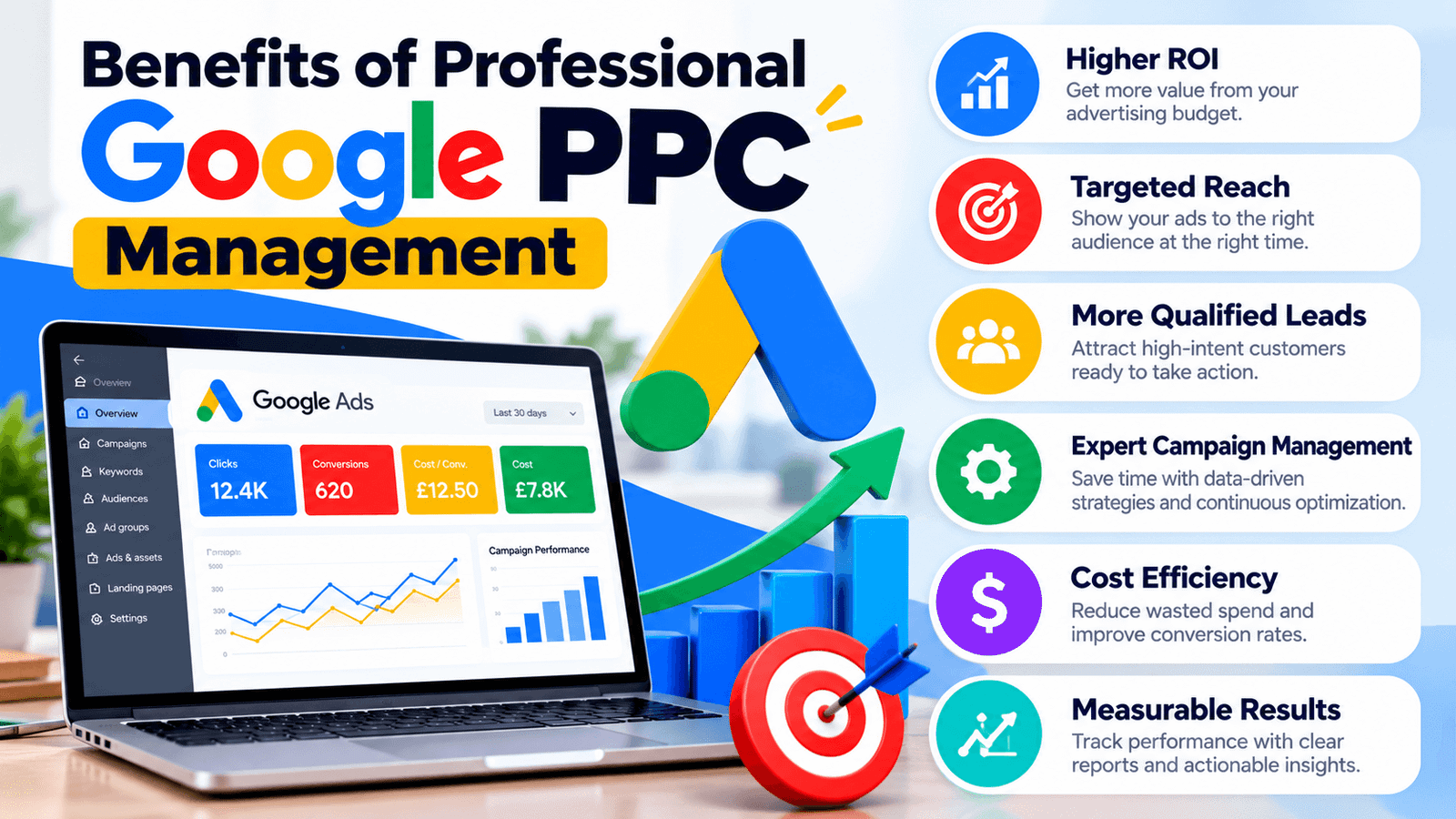
Businesses may choose to work with a PPC specialist or agency when they need help managing complex campaigns.
Potential benefits include:
- Professional campaign structure
- Better keyword research
- Ongoing optimization
- Conversion tracking
- Budget monitoring
- Advertisement testing
- Search-term analysis
- Performance reporting
- Landing-page recommendations
- Data-driven decision-making
The actual value of an agency depends on the quality of its work, the business context, and the campaign objectives.
How to Choose a Google PPC Management Company
Before hiring a PPC agency, consider several factors.
Experience
Ask about the agency’s experience with businesses similar to yours.
Transparency
Make sure you understand:
- Management fees
- Advertising spend
- Contract terms
- Reporting
- Account ownership
Tracking
Ask how conversions and campaign performance will be measured.
Communication
Determine how frequently you will receive updates and who will manage your account.
Strategy
Ask the agency to explain its approach to:
- Keyword research
- Campaign structure
- Negative keywords
- Ad testing
- Budget management
- Conversion optimization
Questions to Ask Before Hiring a PPC Manager
- How do you perform keyword research?
- How do you structure campaigns?
- How do you identify negative keywords?
- How do you track conversions?
- How often do you optimize campaigns?
- What metrics do you report?
- Is the advertising budget separate from your management fee?
- Who owns the Google Ads account?
- How frequently will you provide reports?
- How do you test advertisements?
- How do you evaluate landing pages?
- Do you provide competitor research?
- Can you manage local campaigns?
- Do you support eCommerce advertising?
- What happens if I cancel the contract?
Frequently Asked Questions About Google PPC Management
1. What is Google PPC management?
Google PPC management is the process of planning, creating, monitoring, and optimizing paid advertising campaigns on Google. It can include keyword research, campaign setup, ad creation, budget management, conversion tracking, and ongoing optimization.
2. Why is Google PPC management important for businesses?
Effective Google PPC management helps businesses organize their paid search campaigns, monitor advertising performance, control budgets, and identify opportunities to improve conversions and return on advertising spend.
3. How much does Google PPC management cost?
The cost depends on factors such as campaign size, industry competition, advertising budget, number of campaigns, and the services provided by the agency or specialist. Management fees are usually separate from the advertising budget.
4. Can small businesses use Google PPC management?
Yes. Small businesses can use PPC advertising with carefully controlled budgets. A focused strategy can target specific locations, services, products, and high-intent searches instead of trying to reach a broad audience.
5. How quickly can Google PPC campaigns generate results?
Paid search campaigns can begin generating impressions and clicks after they are approved and activated. However, useful business results depend on factors such as keywords, budget, competition, advertisements, landing pages, and conversion tracking.
6. What is included in Google PPC management services?
Services can include keyword research, campaign structure, ad creation, negative keyword management, bid and budget management, audience targeting, conversion tracking, landing-page analysis, A/B testing, reporting, and campaign optimization.
7. How does Google PPC management improve advertising performance?
Campaign managers can analyze search terms, keywords, advertisements, audiences, landing pages, and conversion data to identify areas that may need adjustment. Optimization decisions should be based on the campaign’s objectives and available performance data.
8. What is the difference between Google Ads and PPC?
Google Ads is Google’s advertising platform, while PPC describes an advertising model where advertisers can pay for clicks. Google Ads includes different campaign types and bidding approaches, so not every Google advertising campaign necessarily works in exactly the same way.
9. Do I need conversion tracking for Google PPC management?
Conversion tracking is highly useful because it helps businesses understand which campaigns, keywords, advertisements, and audiences contribute to actions such as purchases, leads, calls, or bookings.
10. Can Google PPC management help reduce wasted ad spend?
Campaign optimization can identify irrelevant search terms, poorly performing keywords, unsuitable targeting, and other areas where budget allocation may be adjusted. However, advertising costs depend on competition and auction conditions, so savings cannot be guaranteed.
11. Should I hire a Google PPC management agency?
Businesses may consider professional management when they lack internal PPC expertise, have multiple campaigns to manage, or need help with tracking, optimization, reporting, and strategy.
12. Can Google PPC management work together with SEO?
Yes. SEO and paid search can complement each other. SEO focuses on organic visibility, while PPC provides paid exposure. Keyword and conversion insights from one channel can sometimes inform strategy for the other.
13. What PPC metrics should I monitor?
Important metrics can include:
- Impressions
- Clicks
- Click-through rate (CTR)
- Cost per click (CPC)
- Conversions
- Conversion rate
- Cost per acquisition (CPA)
- Advertising spend
- Conversion value
- Return on ad spend (ROAS)
The most useful metrics depend on the business objective.
14. How often should Google PPC campaigns be optimized?
Active campaigns should be monitored regularly, but the appropriate optimization frequency depends on the campaign’s budget, traffic volume, goals, and complexity. Larger campaigns may require more frequent analysis.
15. What should I look for when choosing a PPC management company?
Look at the agency’s experience, campaign strategy, conversion tracking process, reporting, communication, pricing structure, account ownership, contract terms, and understanding of your industry.
16. Can Google PPC management help eCommerce businesses?
Yes. eCommerce businesses can use paid search and shopping-focused campaigns to promote products. Campaign performance can be measured using metrics such as purchases, conversion value, cost per acquisition, and return on advertising spend.
17. Can local businesses use Google PPC?
Yes. Local businesses can target specific geographic areas and relevant searches. Local campaigns can be particularly useful for services such as plumbing, legal services, healthcare, restaurants, home services, and professional services.
18. What are negative keywords in PPC?
Negative keywords are terms that can help prevent advertisements from appearing for unwanted or irrelevant searches. Reviewing search-term data regularly can help advertisers identify additional negative keywords.
19. Is PPC better than SEO?
PPC and SEO serve different purposes. PPC provides paid advertising opportunities, while SEO focuses on organic search visibility. Businesses can use either strategy or combine both depending on their goals, budget, audience, and timeframe.
20. How can I measure the success of Google PPC management?
Success should be measured against the campaign’s business objectives. Depending on the business, useful indicators may include qualified leads, sales, revenue, conversion rate, cost per acquisition, and return on advertising spend rather than clicks alone.
Final Thoughts
Effective Google PPC management involves much more than creating advertisements and setting a daily budget. It requires continuous research, campaign organization, keyword management, advertisement testing, conversion tracking, landing-page optimization, and performance analysis.
Businesses should focus on meaningful outcomes rather than simply maximizing clicks. By connecting PPC activity to conversions, revenue, customer acquisition costs, and business objectives, advertisers can make better-informed decisions about their campaigns.
Whether you manage campaigns internally or work with a professional agency, a structured approach to Google PPC management can help you understand where your advertising budget is going and identify opportunities for ongoing improvement.