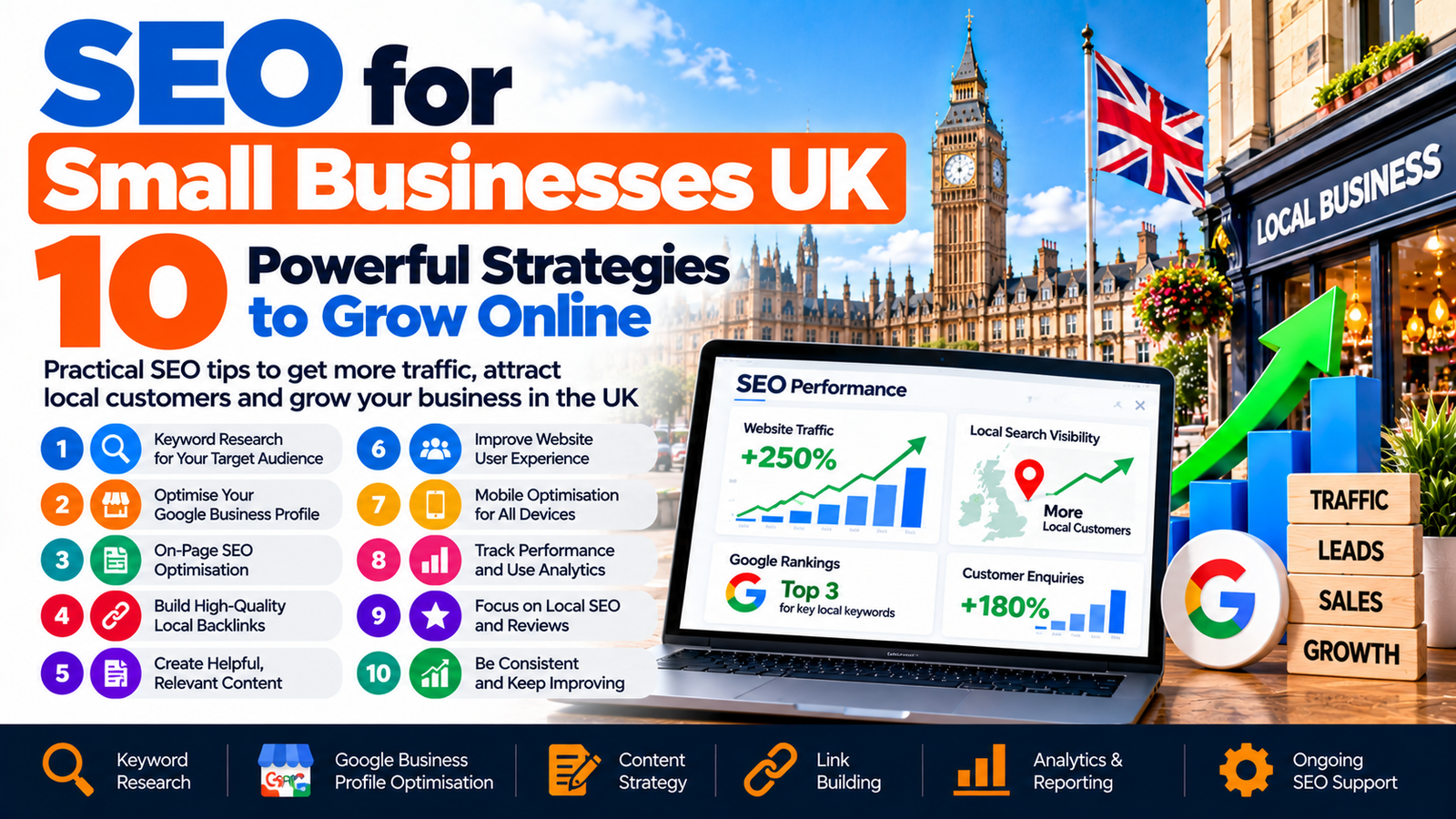
SEO for small businesses UK is one of the most effective ways for local companies to improve their Google visibility, attract potential customers, and generate consistent website traffic. Whether you run a local shop, professional service, eCommerce business, restaurant, construction company, or consultancy, a strong SEO strategy can help you compete with larger businesses.
Small businesses often have limited marketing budgets, which makes organic search particularly valuable. Instead of paying for every click, SEO helps your website appear naturally when people search for products and services you provide.
What Is SEO for Small Businesses UK?
SEO for small businesses UK involves optimising a website so it can rank higher in Google and other search engines for relevant searches made by UK customers.
A successful strategy can include:
- Keyword research
- Local SEO
- Google Business Profile optimisation
- On-page SEO
- Technical SEO
- Content marketing
- Link building
- Website speed optimisation
- Mobile optimisation
- Competitor research
- Conversion optimisation
The goal is not simply to generate more visitors. The goal is to attract relevant visitors who are likely to become customers.
Why SEO Is Important for Small Businesses in the UK
Competition online is increasing across almost every UK industry. Customers frequently use Google to research businesses before contacting or purchasing from them.
Effective SEO can help small businesses:
- Increase organic website traffic
- Improve Google rankings
- Reach customers searching locally
- Generate more enquiries
- Increase online sales
- Build brand visibility
- Reduce dependence on paid advertising
- Establish long-term online authority
For example, someone searching for “plumber near me”, “SEO consultant Bedfordshire”, or “accountant in Luton” already has a specific need. Ranking for these searches can put your business in front of potential customers at the right moment.
10 SEO Strategies for Small Businesses UK
1. Conduct Local Keyword Research
Keyword research should be the foundation of your SEO campaign.
Instead of targeting only broad keywords, small businesses should identify keywords that match their services, location, and customer intent.
For example:
- SEO services Luton
- Dentist Bedford
- Solicitor Milton Keynes
- Electrician Birmingham
- Web design Manchester
- Accountant London
- Restaurant near me
Long-tail keywords can also be valuable because they are usually more specific and can indicate stronger buying intent.
Focus on Search Intent
Consider what the customer actually wants when searching.
For example:
Informational:
“What is local SEO?”
Commercial:
“Best SEO agency in Bedfordshire”
Transactional:
“Hire SEO consultant Luton”
Targeting different types of search intent allows you to create content for customers at different stages of the buying journey.
2. Optimise Your Google Business Profile
Google Business Profile is extremely important for local businesses.
A properly optimised profile can help your business appear in:
- Google Maps
- Local Pack results
- Local search results
- Business searches
Make sure your profile contains accurate:
- Business name
- Address
- Phone number
- Website
- Opening hours
- Business category
- Services
- Photos
- Business description
Regularly adding updates, photos, and useful information can also help maintain an active business presence.
3. Create Location-Based Pages
If your business serves multiple towns or cities, location pages can help you target relevant searches.
For example, a UK digital marketing agency might create pages for:
- SEO Luton
- SEO Bedford
- SEO Milton Keynes
- SEO Watford
- SEO London
However, avoid creating dozens of almost identical pages. Each location page should provide genuinely useful, unique information.
Include:
- Local services
- Areas served
- Customer problems
- Local examples
- FAQs
- Testimonials
- Clear contact information
4. Improve Your Website’s On-Page SEO
On-page SEO helps Google understand what your pages are about.
Important elements include:
SEO Title
Create a clear title that includes your primary keyword.
Example:
SEO for Small Businesses UK: 10 Proven Strategies
Meta Description
Write a compelling description that explains the value of the page.
Headings
Use H1, H2, and H3 headings to organise your content.
URLs
Keep URLs short and descriptive.
Example:
/seo-small-businesses-uk/
Internal Links
Link related pages together to help users and search engines discover important content.
5. Publish Helpful Content
Content marketing is an important part of SEO for small businesses UK.
Create content that answers questions your potential customers are actually searching for.
Useful content formats include:
- Blog posts
- Guides
- FAQs
- Case studies
- Service pages
- Location pages
- Tutorials
- Industry reports
- Comparison articles
For example, an accountant could publish:
“10 Tax Mistakes Small Businesses Should Avoid in the UK.”
A local SEO agency could publish:
“How Local SEO Can Help Small Businesses Get More Customers.”
Helpful content can attract organic traffic while demonstrating your expertise.
6. Optimise for Mobile Users
A large number of customers browse websites using smartphones.
Your website should therefore provide a smooth mobile experience.
Check:
- Mobile page speed
- Font size
- Navigation
- Buttons
- Contact forms
- Images
- Page layout
A visitor should be able to quickly understand what you offer and contact your business without struggling with the website.
7. Improve Website Speed
Website performance can influence both user experience and search visibility.
Common ways to improve speed include:
- Compressing images
- Removing unnecessary plugins
- Improving hosting
- Using browser caching
- Minimising unnecessary scripts
- Optimising website code
- Using modern image formats
A faster website can also improve conversions because visitors are less likely to leave before the page loads.
8. Build High-Quality Backlinks
Backlinks are links from other websites pointing to your website.
Quality is more important than quantity.
Small businesses can earn backlinks through:
- Local directories
- Industry websites
- Business associations
- Local publications
- Supplier websites
- Partnerships
- Digital PR
- Expert contributions
- Useful research and resources
Avoid buying large numbers of low-quality links. Poor link-building practices can damage your website rather than helping it.
9. Collect Genuine Customer Reviews
Reviews can be particularly valuable for local businesses.
Encourage genuine customers to leave reviews on platforms relevant to your business, especially your Google Business Profile.
Positive reviews can:
- Build trust
- Improve credibility
- Influence purchasing decisions
- Support local visibility
- Increase enquiries
Never create fake reviews or incentivise customers to leave misleading feedback.
10. Track Your SEO Performance
SEO should be measured regularly.
Important metrics include:
| SEO Metric | Why It Matters |
|---|---|
| Organic Traffic | Measures visitors from search engines |
| Keyword Rankings | Shows search visibility |
| Impressions | Shows how often your pages appear |
| Clicks | Measures search traffic |
| CTR | Shows how often impressions become clicks |
| Leads | Measures potential customers |
| Conversions | Measures business results |
| Backlinks | Measures website authority |
| Local Visibility | Measures performance in local searches |
Google Search Console and Google Analytics can provide useful performance data.
SEO for Different Types of UK Small Businesses
SEO can work across many industries.
Local Service Businesses
Examples include:
- Plumbers
- Electricians
- Builders
- Cleaners
- Solicitors
- Accountants
- Estate agents
Local SEO can help these businesses reach customers searching for services in specific locations.
eCommerce Businesses
Online stores can use SEO to target:
- Product keywords
- Category searches
- Informational searches
- Comparison keywords
- Long-tail product searches
Professional Services
Consultants, accountants, lawyers, agencies, and other professionals can use informative content to demonstrate expertise and attract potential clients.
How Much Does SEO for Small Businesses UK Cost?
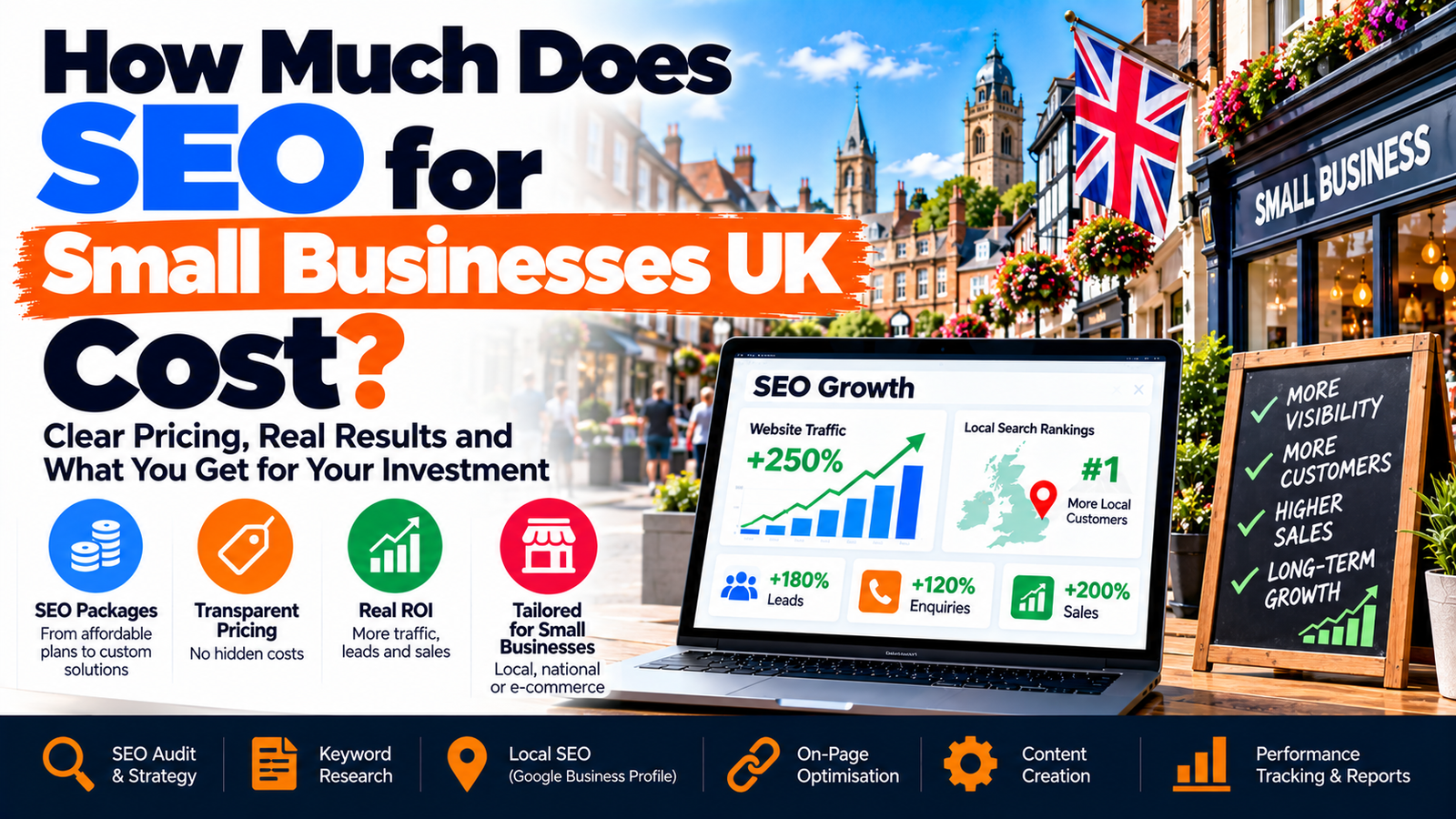
SEO pricing varies significantly depending on the business, industry, competition, website size, and services required.
A small local business may need a relatively simple campaign involving:
- Technical audit
- Keyword research
- Local SEO
- Google Business Profile optimisation
- On-page improvements
- Content creation
- Local link building
More competitive industries may require a larger monthly investment and a longer-term campaign.
Instead of choosing an SEO provider purely based on price, consider the potential return on investment.
How Long Does SEO Take for a Small Business?
SEO is a long-term marketing strategy rather than an instant solution.
Some improvements may become visible within a few months, while competitive keywords can take significantly longer.
Results depend on:
- Website authority
- Competition
- Industry
- Content quality
- Technical issues
- Backlinks
- Keyword difficulty
- Existing rankings
- SEO consistency
The best approach is to focus on sustainable growth rather than expecting overnight rankings.
Common SEO Mistakes Small Businesses Should Avoid
Some businesses make SEO more complicated than necessary.
Common mistakes include:
- Targeting extremely competitive keywords only
- Ignoring local SEO
- Using duplicate content
- Keyword stuffing
- Buying low-quality backlinks
- Having slow websites
- Ignoring mobile users
- Not tracking conversions
- Publishing content without keyword research
- Creating pages with little useful information
- Ignoring Google Business Profile
- Expecting immediate results
Avoiding these mistakes can give a small business a much stronger foundation for organic growth.
SEO vs PPC for Small Businesses
SEO and PPC can work together.
SEO can provide long-term organic visibility, while PPC can generate targeted traffic quickly.
For example:
A business could use PPC to test which keywords generate conversions and then create SEO content around the strongest-performing search terms.
Combining SEO and paid advertising can create a more complete digital marketing strategy.
How to Choose an SEO Agency for Your Small Business
Before hiring an SEO agency, ask:
- What SEO services are included?
- Do you have experience with UK businesses?
- Can you provide previous results or case studies?
- How will you measure success?
- Which keywords will you target?
- How often will you provide reports?
- Will you optimise Google Business Profile?
- What technical SEO work is included?
- How will you build backlinks?
- What happens if results take longer than expected?
Choose a provider that focuses on business results, not simply keyword rankings.
Final Thoughts
SEO for small businesses UK can provide a powerful way to increase online visibility, attract local customers, generate leads, and build long-term growth.
The most effective strategy combines keyword research, local SEO, quality content, technical optimisation, backlinks, Google Business Profile management, and conversion optimisation.
Small businesses do not necessarily need to compete with large companies across every keyword. By focusing on specific services, locations, and customer needs, they can build valuable search visibility and attract highly relevant traffic.
Frequently Asked Questions About SEO for Small Businesses UK
1. What is SEO for small businesses UK?
SEO for small businesses UK is the process of improving a small business website so it can appear higher in Google search results and attract relevant customers across the UK.
2. Why is SEO for small businesses UK important?
SEO for small businesses UK helps local companies increase organic traffic, improve online visibility, generate enquiries, and reach customers who are actively searching for their products or services.
3. How can SEO for small businesses UK increase customers?
A well-planned SEO for small businesses UK strategy targets relevant keywords, improves local search visibility, optimises website content, and helps potential customers find your business when they need your services.
4. How much does SEO for small businesses UK cost?
The cost of SEO for small businesses UK varies depending on competition, website size, target locations, services required, and the level of optimisation needed.
5. Can small businesses do SEO themselves?
Yes. Basic SEO for small businesses UK can be managed internally through keyword research, content creation, Google Business Profile optimisation, internal linking, and basic on-page SEO.
6. How long does SEO for small businesses UK take?
The results of SEO for small businesses UK depend on competition, website authority, content quality, technical performance, and backlinks. Some improvements may appear within a few months, while competitive keywords can take longer.
7. Is local SEO part of SEO for small businesses UK?
Yes. Local SEO is an important part of SEO for small businesses UK, particularly for companies that serve customers in specific towns, cities, or regions.
8. Does Google Business Profile help small businesses?
Yes. Optimising Google Business Profile can support SEO for small businesses UK by improving local visibility and helping customers find your business through Google Search and Maps.
9. Should small businesses use SEO and PPC together?
Combining SEO and PPC can strengthen SEO for small businesses UK by providing both long-term organic visibility and immediate paid search exposure.
10. What are the best SEO strategies for UK small businesses?
The most effective SEO for small businesses UK strategies include keyword research, local SEO, technical SEO, quality content, Google Business Profile optimisation, mobile optimisation, internal linking, and high-quality link building.
11. Can SEO help a new UK business?
Yes. SEO for small businesses UK can help new businesses establish online visibility, target location-specific searches, and build organic traffic over time.
12. What keywords should small businesses target?
Businesses should use SEO for small businesses UK to identify relevant service, location, long-tail, and commercial-intent keywords that match what their target customers search for.
13. Is mobile SEO important for UK businesses?
Yes. Mobile optimisation is an essential part of SEO for small businesses UK because many potential customers use smartphones to search for local products and services.
14. How do I measure SEO success?
You can measure SEO for small businesses UK using organic traffic, keyword rankings, impressions, clicks, click-through rate, leads, conversions, and local search visibility.
15. Should I hire an SEO agency?
If you don’t have the time or technical expertise to manage SEO for small businesses UK, hiring an experienced SEO consultant or agency can help you develop and maintain a consistent strategy.
Tip: After adding these FAQs, your focus keyword should appear naturally more often. Don’t add too many exact-match mentions elsewhere—keep the content readable and use variations such as small business SEO UK, UK small business SEO, and local SEO for small businesses.