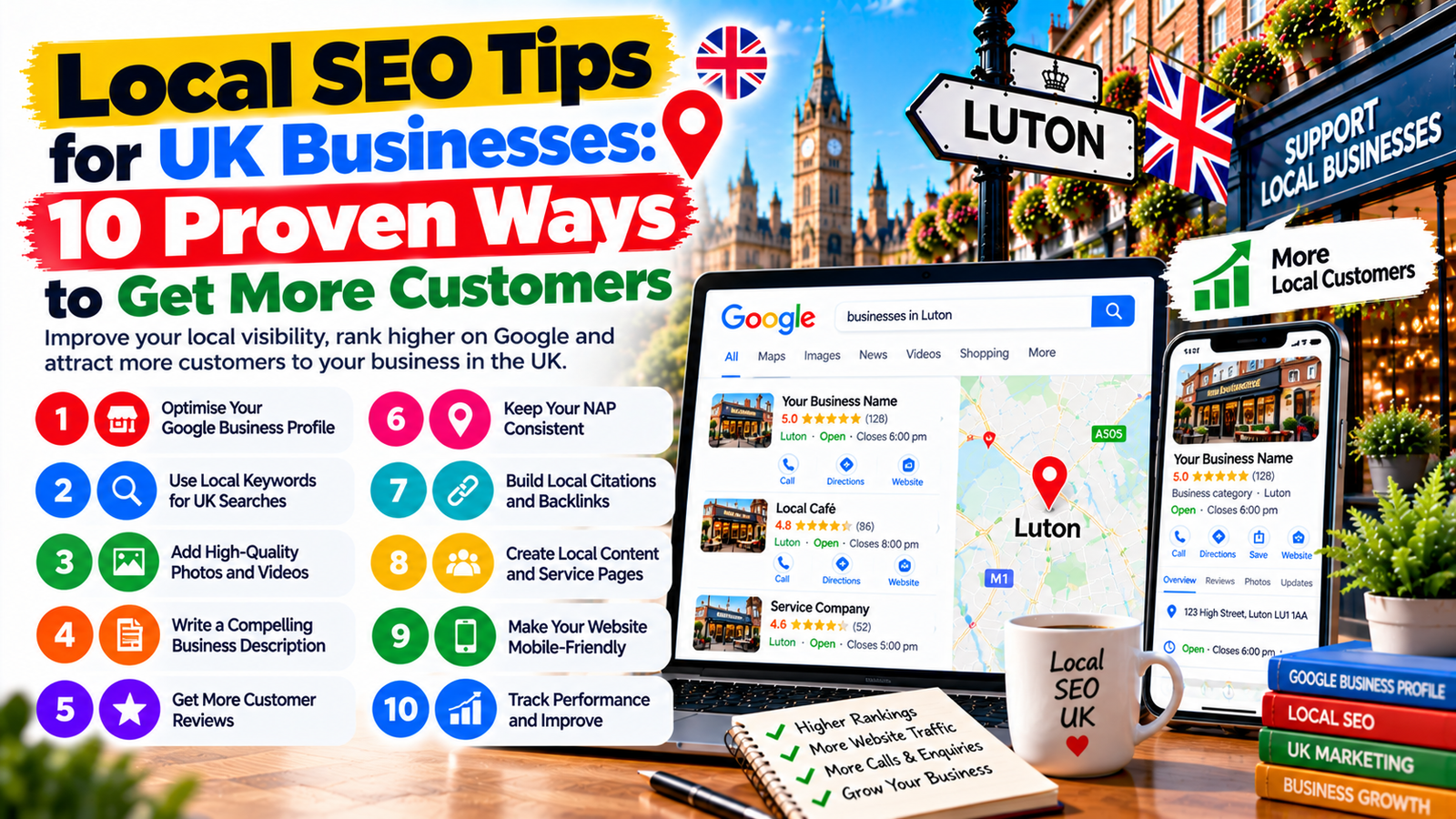
Local SEO tips for UK businesses can help small companies improve their visibility on Google, attract nearby customers, and generate more enquiries. Whether you run a restaurant, accounting firm, plumbing service, beauty salon, retail shop, or digital marketing agency, local search optimisation can help potential customers discover your services online.
Many UK customers search Google for local products and services before deciding which business to contact. If your business information is incomplete or your website is not optimised for local searches, you could miss valuable opportunities to reach potential customers.
In this guide, we explore 10 practical local SEO tips for UK businesses that can help you strengthen your online presence, improve your website, and build trust with local customers.
What Is Local SEO for UK Businesses?
Local SEO is the process of improving your online presence so your business can appear in relevant location-based search results. These searches often include a town, city, region, or phrase such as “near me”.
For example, customers might search for:
- Accountant in Luton
- Plumber in Birmingham
- SEO agency in London
- Restaurant near me
- Digital marketing services in Manchester
Local SEO helps search engines understand what your business offers and where it operates. It can involve Google Business Profile optimisation, local keyword research, website improvements, customer reviews, and relevant local backlinks.
Following effective local SEO tips for UK businesses can help you connect with customers who are actively searching for your services.
Why Is Local SEO Important for UK Small Businesses?
Local SEO can help small businesses compete for attention in their service areas. A strong local online presence makes it easier for customers to discover your services, compare options, and contact your company.
Here are some important benefits:
- Improved local visibility: Help customers discover your business through relevant searches.
- More relevant website traffic: Reach people looking for your products or services.
- Increased customer trust: Provide accurate information and build a positive online reputation.
- More enquiries: Make it easier for customers to call, visit your website, or request information.
- Better local marketing: Focus your efforts on the geographical areas you genuinely serve.
- Long-term growth opportunities: Build a stronger online presence through consistent optimisation.
Local SEO does not guarantee a particular Google ranking. Results depend on competition, relevance, distance, prominence, and the quality of your overall online presence.
10 Proven Local SEO Tips for UK Businesses
1. Optimise Your Google Business Profile
One of the most important local SEO tips for UK businesses is to complete and maintain an accurate Google Business Profile.
Google Business Profile allows eligible businesses to manage information displayed on Google Search and Google Maps.
To optimise your profile:
- Use your real business name.
- Select the most accurate primary business category.
- Add relevant additional categories where appropriate.
- Provide accurate contact information.
- Keep opening hours updated.
- Add your business address or service area, where applicable.
- Upload genuine, high-quality photographs.
- Describe your services clearly.
- Complete Google’s verification process.
Review your profile regularly and update it when your business information changes.
Avoid adding keywords or location names to your business name unless they are genuinely part of your real-world business name.
2. Research Local Keywords
Keyword research helps you understand how potential customers search for your products and services.
For example, a business in Bedfordshire might target relevant phrases such as:
- Local SEO services in Luton
- Small business SEO UK
- Accountant in Bedford
- Digital marketing agency Luton
- Website design services London
- Emergency plumber in Birmingham
Choose keywords based on your services, target locations, and customer search intent.
Use relevant keywords naturally in your page titles, headings, service descriptions, and website content. Avoid repeating the same keyword excessively.
The best local SEO tips for UK businesses focus on attracting relevant customers rather than targeting keywords simply because they have high search volumes.
3. Create Useful Location-Specific Pages
If your business genuinely serves multiple towns or cities, location pages can help explain your services in each area.
For example, an agency serving Bedfordshire might create dedicated pages for Luton, Bedford, and Dunstable.
Each location page should include:
- Services available in that area.
- Relevant information for local customers.
- Genuine project examples or customer results.
- Useful answers to common questions.
- Clear contact information.
- Relevant internal links.
Avoid creating many nearly identical pages by changing only the location name. Every page should provide genuine value to visitors.
4. Collect Genuine Customer Reviews
Customer reviews can influence buying decisions and help people evaluate your business before contacting you.
Encourage customers to leave honest feedback after receiving your services or products.
To manage reviews effectively:
- Ask customers for honest feedback.
- Make your review link easy to access.
- Respond professionally to positive reviews.
- Address negative feedback constructively.
- Never purchase fake reviews.
- Do not offer incentives in exchange for positive ratings.
Reviews can help build customer trust and contribute to local search prominence. Always follow Google’s review policies.
5. Keep Your Business Information Consistent
Accurate business information helps customers contact your company and understand where you operate.
Check that your business name, address where applicable, phone number, website, and opening hours are correct across your website, Google Business Profile, and important online directories.
Correct outdated details and remove duplicate listings where appropriate.
For businesses with multiple legitimate locations, maintain accurate information for each location.
Consistent business details support a reliable customer experience and are a practical part of local SEO.
6. Make Your Website Mobile-Friendly
Many customers search for local services on smartphones. If your website is difficult to use on mobile devices, potential customers may leave before contacting you.
Make sure your website:
- Loads quickly.
- Displays properly on different screen sizes.
- Uses readable text and clear navigation.
- Makes contact details easy to find.
- Includes clickable phone numbers where appropriate.
- Provides simple enquiry forms.
- Uses a secure HTTPS connection.
Tools such as Google PageSpeed Insights can help you identify website performance issues, while Google Search Console can help you monitor search visibility.
A mobile-friendly website makes it easier for customers to learn about your business and take the next step.
7. Build Relevant Local Backlinks
Backlinks are links from other websites to your website. Relevant links from trustworthy sources can support your wider SEO strategy.
Potential opportunities for UK businesses include:
- Local business associations.
- Chambers of commerce.
- Relevant industry organisations.
- Local news websites.
- Community events and sponsorships.
- Partnerships with complementary businesses.
- Useful articles for reputable industry publications.
Focus on building genuine relationships and earning links through useful content or legitimate business activities.
Avoid purchasing spammy backlinks or participating in manipulative link schemes.
8. Publish Helpful Local Content
Content marketing can help you answer customer questions, demonstrate your expertise, and attract relevant website visitors.
For example:
- An accountant could publish a guide to bookkeeping for UK small businesses.
- A plumber could explain common causes of leaking pipes.
- A marketing agency could write about local SEO for small businesses.
- A restaurant could publish information about its menu and local events.
Include local references when they genuinely help readers. Link relevant blog posts to your service pages so visitors can explore your offerings.
Publishing useful content consistently can support long-term search visibility and customer engagement.
9. Improve Your Website’s Technical SEO
Technical SEO helps search engines crawl, understand, and index your website.
Review the following areas:
- Important pages are accessible to search engines.
- Your XML sitemap is available and submitted through Google Search Console.
- Page titles and meta descriptions are clear and relevant.
- Internal links work correctly.
- Broken pages are fixed or redirected appropriately.
- Website navigation is straightforward.
- Structured data is accurate where applicable.
- Mobile performance is monitored regularly.
Eligible local businesses may benefit from appropriate LocalBusiness structured data, provided the information matches the content displayed on their website.
Technical improvements should support a useful website experience rather than replace quality content and relevant services.
10. Track and Improve Your Local SEO Performance
One of the most valuable local SEO tips for UK businesses is to measure results regularly.
Useful tools include Google Search Console, Google Analytics, and available Google Business Profile performance reports.
Monitor metrics such as:
- Organic search impressions and clicks.
- Relevant search queries.
- Website visits from organic search.
- Website clicks from your business profile.
- Phone calls and enquiry form submissions.
- Requests for directions, where reported.
- Conversions from local landing pages.
Review your performance and identify which activities are generating meaningful customer interest.
Do not measure success through rankings alone. Qualified leads, customer enquiries, and conversions can provide a clearer picture of business growth.
Common Local SEO Mistakes UK Businesses Should Avoid
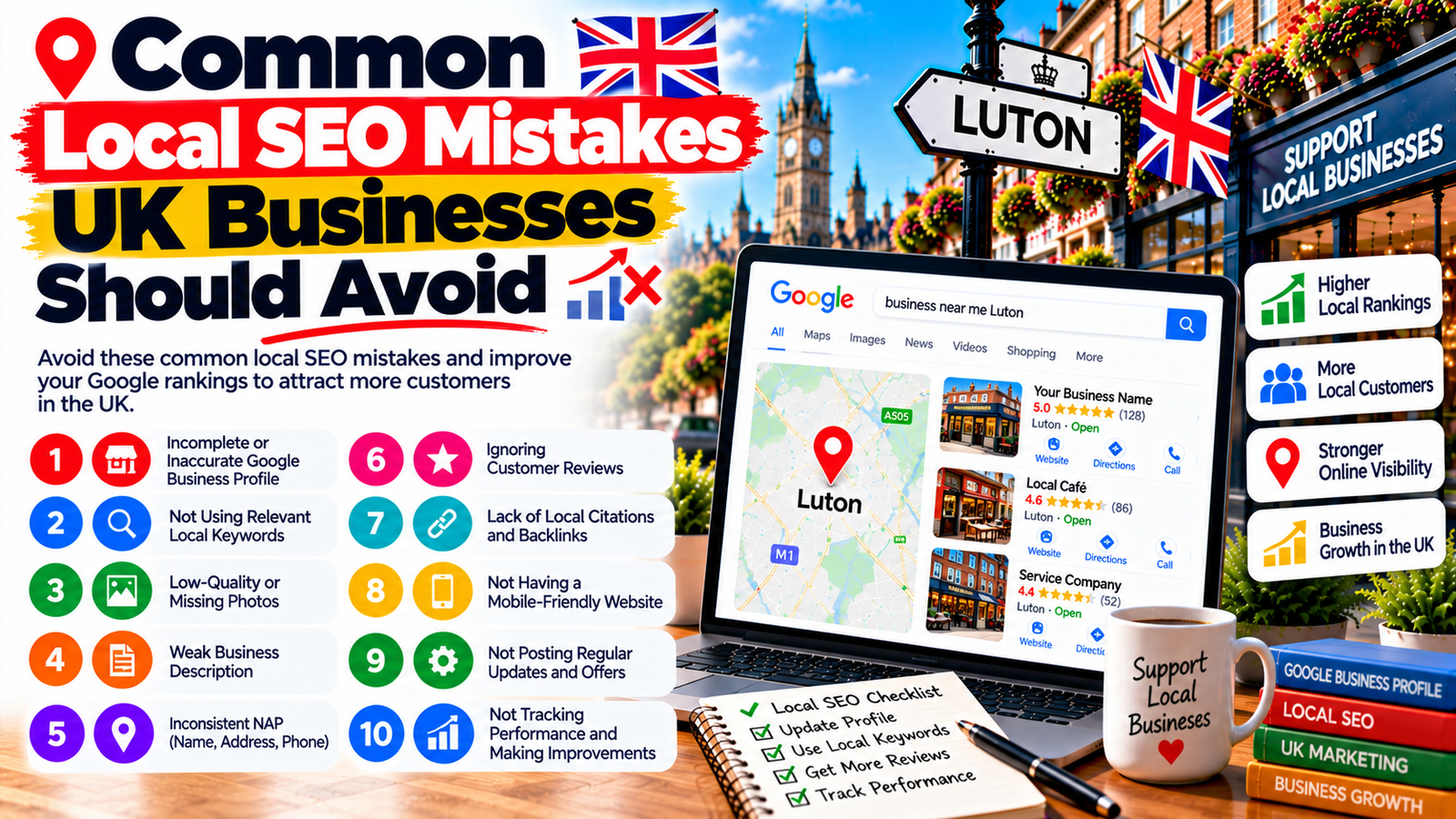
Even businesses investing in SEO can miss opportunities by making avoidable mistakes.
Common problems include:
- Leaving Google Business Profile incomplete.
- Choosing irrelevant business categories.
- Adding excessive keywords to the business name.
- Creating duplicate profiles.
- Publishing low-quality location pages.
- Buying fake reviews.
- Ignoring website speed and mobile usability.
- Building spammy backlinks.
- Using inaccurate business information.
- Failing to measure enquiries and conversions.
A customer-focused strategy built around accurate information, useful content, and consistent improvement is generally more sustainable than shortcuts.
How Much Does Local SEO Cost in the UK?
The cost of local SEO depends on your industry, competition, target locations, website condition, and the services required.
Some small businesses manage basic SEO themselves, while others hire an SEO consultant or digital marketing agency.
Professional services may include:
- Google Business Profile optimisation.
- Local keyword research.
- Website SEO audits.
- Location page creation.
- Content writing.
- Technical SEO improvements.
- Review management guidance.
- Local link-building outreach.
- Performance reporting.
Before hiring an agency, ask for a clear scope of work, transparent pricing, and realistic expectations. Be cautious of providers that guarantee specific Google rankings.
Frequently Asked Questions About Local SEO Tips for UK Businesses
1. What Are the Best Local SEO Tips for UK Businesses?
The best local SEO tips for UK businesses include optimising your Google Business Profile, researching relevant local keywords, collecting genuine customer reviews, and improving your website. These local SEO tips for UK businesses can help you strengthen your online presence and reach potential customers searching for your services.
2. Why Are Local SEO Tips for UK Businesses Important?
Local SEO tips for UK businesses are important because they help companies improve their visibility in relevant local searches. By following effective local SEO tips for UK businesses, you can help customers discover your services, find accurate contact information, and learn more about your company before making a decision.
3. How Can Local SEO Tips for UK Businesses Improve Google Rankings?
Following local SEO tips for UK businesses can help search engines understand your services, location, and website content. Optimising your Google Business Profile, using relevant local keywords, and maintaining accurate business information can support your local search visibility. However, no local SEO strategy can guarantee a specific Google ranking.
4. How Does Google Business Profile Support Local SEO Tips for UK Businesses?
Google Business Profile is an important part of local SEO tips for UK businesses. An accurate profile helps eligible businesses display their services, contact details, opening hours, photographs, and customer reviews. Keeping your profile updated can help potential customers find useful information about your business.
5. Can Local SEO Tips for UK Businesses Help Small Companies?
Yes, local SEO tips for UK businesses can help small companies improve their visibility in the areas they serve. Small businesses can focus on relevant keywords, useful website content, genuine customer reviews, and accurate business listings to reach potential customers without relying entirely on paid advertising.
6. How Long Do Local SEO Tips for UK Businesses Take to Work?
The results of local SEO tips for UK businesses depend on competition, website quality, location, and the work completed. Some improvements can be implemented quickly, while stronger search visibility may take several months. Consistent optimisation and regular performance monitoring are important for long-term progress.
7. What Keywords Should I Use for Local SEO Tips for UK Businesses?
When applying local SEO tips for UK businesses, research keywords that combine your services with relevant locations. Examples include “local SEO services UK”, “SEO agency in Luton”, and “small business SEO London”. Use keywords naturally in your page titles, headings, and service content.
8. Do Customer Reviews Matter for Local SEO Tips for UK Businesses?
Yes, genuine customer reviews can help potential customers evaluate your business and contribute to local search prominence. Effective local SEO tips for UK businesses include requesting honest feedback, responding professionally to reviews, and following Google’s review policies.
9. Are Local SEO Tips for UK Businesses Useful Without a Website?
Some local SEO tips for UK businesses can be implemented without a website, particularly through an eligible Google Business Profile. However, a useful website can provide additional service information, support organic search visibility, and make it easier for customers to submit enquiries.
10. How Much Do Local SEO Tips for UK Businesses Cost?
Many local SEO tips for UK businesses, such as researching keywords and maintaining accurate business information, can be implemented independently. Professional SEO services may cost extra depending on competition, website condition, target locations, and the amount of work required.
11. Can Local SEO Tips for UK Businesses Help Generate More Leads?
Local SEO tips for UK businesses can help potential customers discover relevant services and contact your company. An optimised profile, helpful website content, clear contact details, and a positive customer experience can support lead generation, although results depend on several factors.
12. How Can I Measure the Results of Local SEO Tips for UK Businesses?
Measure local SEO tips for UK businesses using Google Search Console, Google Analytics, and available Google Business Profile performance reports. Track search clicks, impressions, website visits, customer interactions, calls, and enquiry form submissions to understand which activities support your business goals.
13. Should I Hire an Agency for Local SEO Tips for UK Businesses?
Hiring an agency may be useful if you need professional support with technical SEO, keyword research, content creation, or Google Business Profile optimisation. When comparing local SEO services for UK businesses, look for transparent pricing, clear reporting, realistic expectations, and a practical strategy tailored to your company.
14. What Mistakes Should I Avoid When Following Local SEO Tips for UK Businesses?
Avoid keyword stuffing, fake reviews, inaccurate business information, duplicate profiles, low-quality location pages, and spammy backlinks. The most effective local SEO tips for UK businesses focus on accurate information, useful content, genuine customer feedback, and a positive website experience.
15. What Is the Best Long-Term Strategy for Local SEO Tips for UK Businesses?
The best long-term strategy for local SEO tips for UK businesses combines Google Business Profile optimisation, relevant local keywords, useful content, genuine reviews, technical website improvements, and regular performance tracking. Consistent improvements can support local visibility and help your business reach relevant customers over time.
Final Thoughts: Local SEO Tips for UK Businesses
Applying the right local SEO tips for UK businesses can help you improve your online presence and connect with customers searching for your products or services.
Start with an accurate Google Business Profile, research relevant local keywords, create useful website content, collect genuine customer reviews, and maintain a technically sound website.
Local SEO requires consistency and ongoing improvement. By monitoring your performance and focusing on customer needs, you can build a stronger online presence and create more opportunities to attract relevant enquiries.
Want to improve your local search visibility? Review your Google Business Profile and website to identify practical opportunities to help potential customers discover and contact your business.