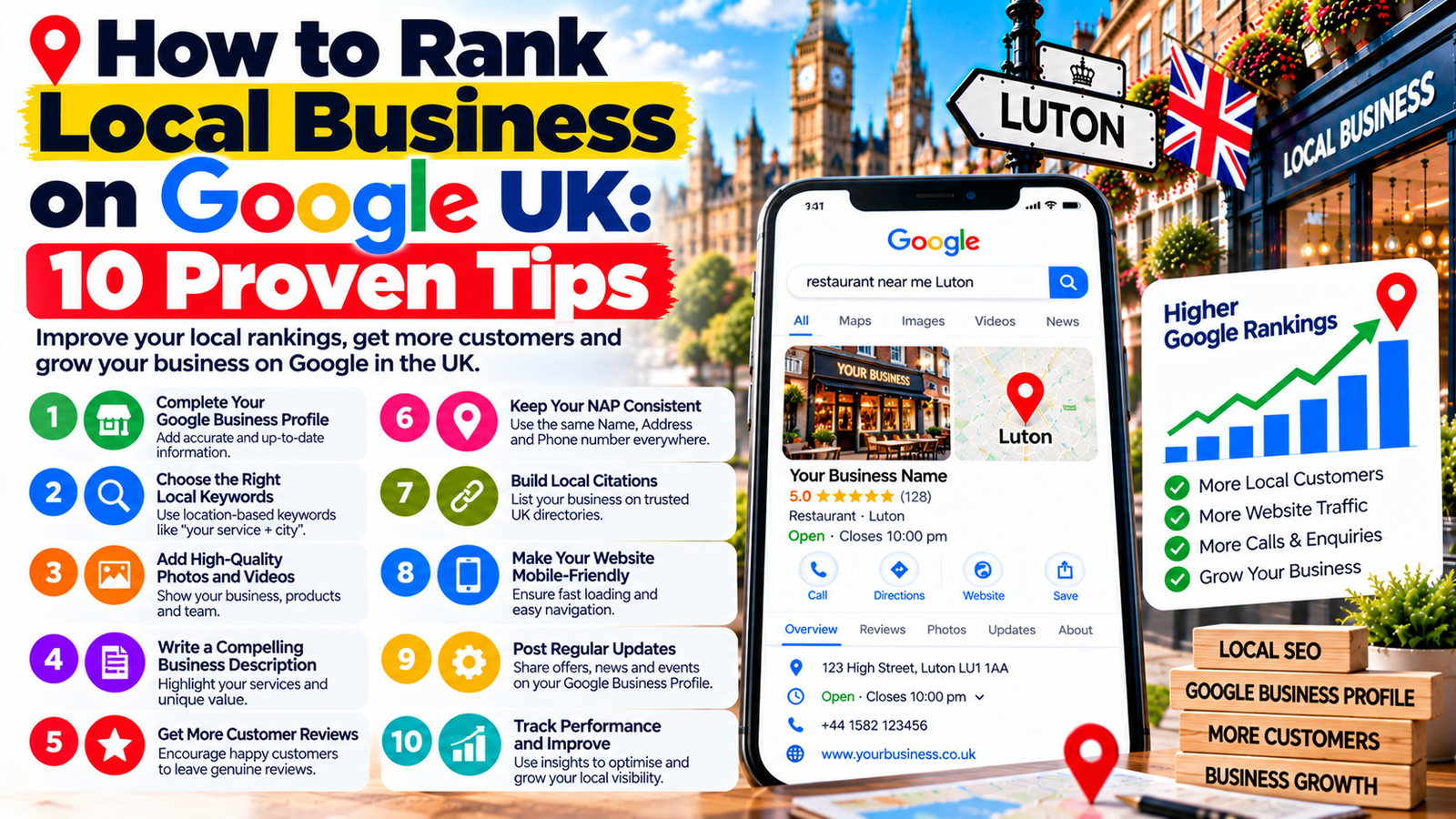
Learning how to rank local business on Google UK is essential for small businesses that want to attract local customers, increase website traffic, and generate more enquiries. Whether you operate a restaurant, accounting firm, plumbing service, beauty salon, or digital marketing agency, improving your local search visibility can help potential customers discover your business online.
In the UK, people often use Google Search and Google Maps to find nearby products and services. If your business information is incomplete or your website is poorly optimised, you may miss opportunities to connect with customers who are actively searching for what you offer.
In this guide, you will learn how to rank local business on Google UK using practical SEO strategies, Google Business Profile optimisation, local keyword research, customer reviews, and website improvements.
Why Is Local SEO Important for UK Businesses?
Local SEO helps businesses improve their visibility when people search for products and services in specific locations.
For example, customers might search for “accountant in Luton”, “plumber in Birmingham”, or “SEO agency in London”. Businesses with relevant information and a strong local online presence may have better opportunities to appear in these searches.
Understanding how to rank local business on Google UK can help you:
- Improve local search visibility.
- Attract relevant website visitors.
- Build trust with potential customers.
- Generate more calls and enquiries.
- Promote your services in your target areas.
- Compete more effectively with other local businesses.
Google does not guarantee rankings to any business. Local results depend on several factors, including relevance, distance, and prominence.
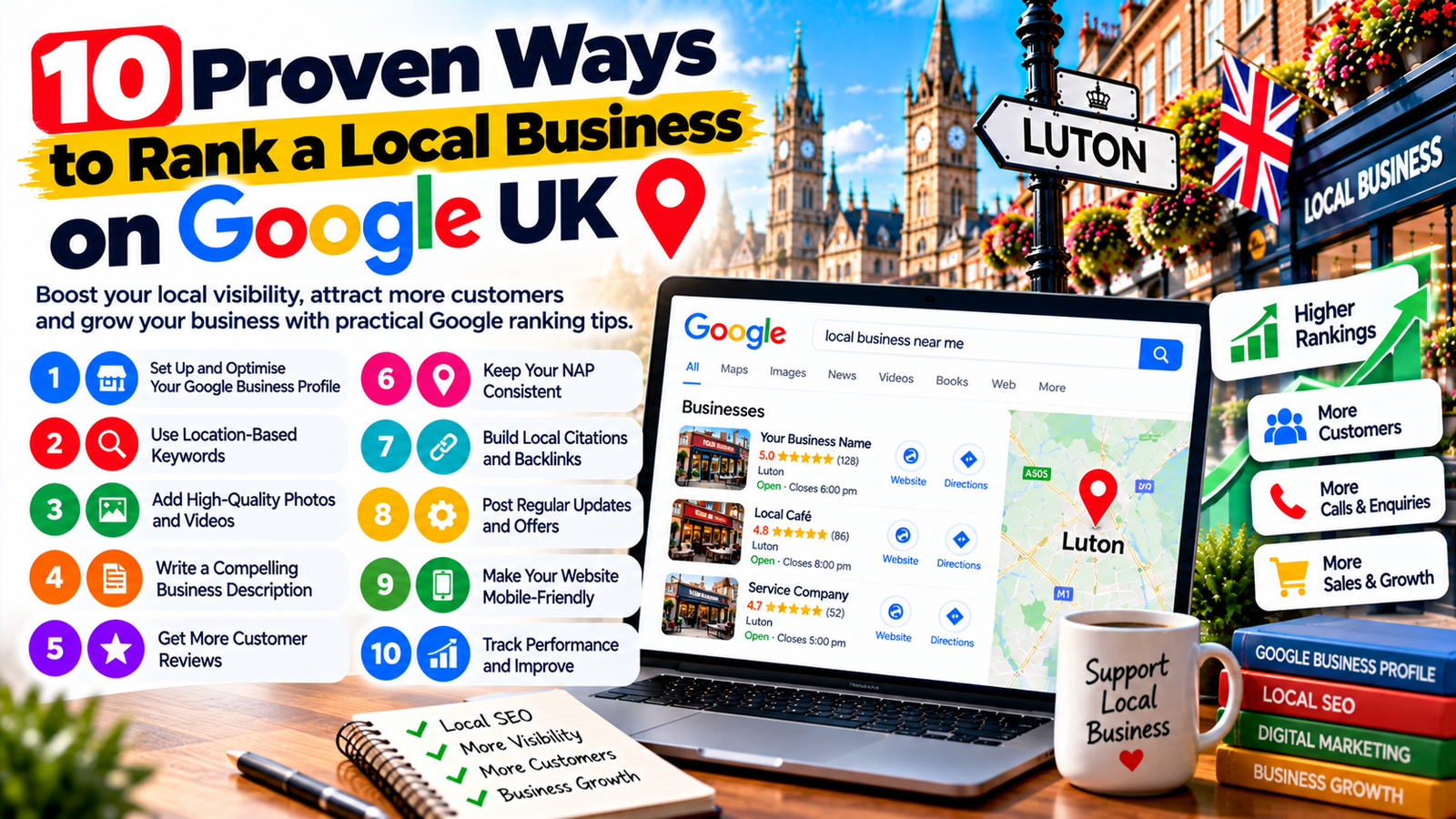
10 Proven Ways to Rank a Local Business on Google UK
1. Optimise Your Google Business Profile
One of the first steps in learning how to rank local business on Google UK is creating or improving your Google Business Profile.
This free tool allows eligible businesses to manage the information customers see on Google Search and Google Maps.
To optimise your profile:
- Use your real business name.
- Select the most accurate primary business category.
- Add relevant additional categories where appropriate.
- Provide an accurate phone number and website.
- Keep opening hours updated.
- Add your business address or service area, where applicable.
- Upload genuine, high-quality business photos.
- Describe your products and services clearly.
Complete the verification process provided by Google and regularly review your business information.
Avoid adding location keywords to your business name unless they are genuinely part of your real-world business name.
2. Research the Best Local Keywords
Keyword research helps you understand what potential customers type into Google when looking for your services.
For example, a business serving Luton might target relevant phrases such as:
- Local SEO services in Luton
- Accountant in Luton
- Digital marketing agency Luton
- Small business SEO UK
- Emergency plumber in Bedford
- Website design services in London
Choose keywords based on your services, locations, and customer search intent.
Include relevant terms naturally in your website titles, headings, service descriptions, and blog articles. Avoid repeating the same phrase excessively, as keyword stuffing can harm readability.
When deciding how to rank local business on Google UK, focus on keywords that attract relevant customers rather than simply targeting terms with high search volumes.
3. Create Helpful Location-Specific Pages
If your business genuinely serves multiple towns or cities, location-specific pages can help explain your services in each area.
For example, an agency serving Bedfordshire might create useful pages for Luton, Bedford, and Dunstable.
Each page should include:
- Services available in that location.
- Relevant local information.
- Genuine project examples or customer results.
- Useful answers to customer questions.
- Clear contact information.
- Relevant internal links.
Do not create dozens of nearly identical pages by changing only the town name. Each location page should provide unique, useful information for visitors.
4. Collect Genuine Customer Reviews
Reviews can help potential customers evaluate your business before contacting you. They can also contribute to your local search prominence.
Encourage customers to leave honest feedback after receiving your products or services.
For better review management:
- Make it easy for customers to find your review link.
- Ask for honest feedback without pressure.
- Respond professionally to positive reviews.
- Address negative feedback constructively.
- Never buy fake reviews.
- Do not offer incentives in exchange for positive ratings.
Customer reviews can strengthen trust and help people make informed decisions. Always follow Google’s review policies.
5. Keep Your Business Information Consistent
Accurate business information helps customers contact you and find your business.
Check that your business name, address where applicable, phone number, website, and opening hours are correct across your website, Google Business Profile, and important online directories.
Update outdated information and correct duplicate listings where possible.
If your business operates from a physical location, make sure the address is accurate. Service-area businesses should configure their service areas according to Google’s eligibility rules.
Consistent information supports a better customer experience and is an important part of local SEO.
6. Improve Your Website’s Mobile Experience
Many people search for local services on smartphones. A website that is difficult to navigate can discourage potential customers from making contact.
Make sure your website:
- Loads quickly.
- Displays correctly on mobile devices.
- Uses readable text.
- Has clear navigation.
- Provides easy-to-find contact details.
- Includes simple enquiry forms.
- Uses a secure HTTPS connection.
You can use Google PageSpeed Insights to identify performance issues and Google Search Console to monitor search performance.
A mobile-friendly website makes it easier for local customers to learn about your services and take the next step.
7. Build Relevant Local Backlinks
Backlinks are links from other websites to your website. Relevant links from trustworthy websites can support your broader SEO strategy.
Potential opportunities for UK businesses include:
- Local business associations.
- Chambers of commerce.
- Relevant industry organisations.
- Local news websites.
- Community events and sponsorships.
- Partnerships with complementary businesses.
- Useful contributions to reputable industry publications.
Focus on building genuine relationships and earning links through useful content or legitimate business activities.
Avoid buying spammy backlinks or participating in manipulative link schemes.
8. Publish Useful Content for Local Customers
Helpful content can answer customer questions, demonstrate your expertise, and attract relevant visitors.
For example:
- An accountant could publish a guide to bookkeeping for UK small businesses.
- A plumber could explain common causes of leaking pipes.
- A marketing agency could write about local SEO for small businesses.
- A restaurant could publish information about its menu and local events.
Use local references where they genuinely help the reader. Link relevant articles to your service pages so visitors can easily discover your offerings.
Publishing useful content consistently can support a long-term local SEO strategy.
9. Improve Your Website’s Technical SEO
Technical SEO helps search engines crawl, understand, and index your website.
Review the following areas:
- Important pages are accessible to search engines.
- Your XML sitemap is available and submitted through Google Search Console.
- Page titles and meta descriptions are clear and relevant.
- Internal links work correctly.
- Broken pages are fixed or redirected appropriately.
- Website navigation is easy to use.
- Structured data is accurate where applicable.
- Mobile performance is regularly checked.
Eligible local businesses may benefit from appropriate LocalBusiness structured data, provided the information matches the content displayed on their website.
Technical SEO should support a useful website experience rather than replace high-quality content and relevant services.
10. Track Your Local SEO Results
Understanding how to rank local business on Google UK also means measuring the results of your SEO work.
Useful tools include Google Search Console, Google Analytics, and available Google Business Profile performance reports.
Monitor metrics such as:
- Organic search impressions and clicks.
- Relevant local search queries.
- Website visits from organic search.
- Phone calls and enquiry form submissions.
- Website clicks from your business profile.
- Requests for directions, where reported.
- Conversions from local landing pages.
Review performance regularly and identify which activities generate meaningful customer interest.
Do not measure success through rankings alone. Relevant enquiries, qualified leads, and new customers are often more valuable indicators of business growth.
Common Local SEO Mistakes to Avoid
When trying to rank a local business on Google UK, avoid these common mistakes:
- Leaving your Google Business Profile incomplete.
- Choosing irrelevant business categories.
- Adding keywords unnaturally to your business name.
- Creating duplicate profiles.
- Publishing low-quality location pages.
- Buying fake customer reviews.
- Ignoring website speed and mobile usability.
- Building spammy backlinks.
- Using inaccurate business information.
- Failing to measure leads and conversions.
A consistent, customer-focused strategy is generally more sustainable than shortcuts designed to manipulate search rankings.
How Long Does It Take to Rank a Local Business on Google UK?
The time required to improve local rankings varies depending on your industry, competition, location, website condition, and existing online presence.
Correcting business information and completing a profile can be done relatively quickly. More competitive search terms may require several months of ongoing optimisation.
Focus on improving your profile, publishing useful content, building a trustworthy reputation, and monitoring results over time.
No agency or SEO professional can legitimately guarantee a specific Google ranking or a fixed timeframe for achieving it.
How Much Does Local SEO Cost in the UK?
The cost of local SEO depends on the services required, competition, target locations, and the condition of your website.
Some small businesses manage basic SEO themselves, while others hire an SEO consultant or agency.
Professional services may include:
- Google Business Profile optimisation.
- Local keyword research.
- Website SEO audits.
- Local landing page development.
- Content creation.
- Technical SEO improvements.
- Review management guidance.
- Local link-building outreach.
- Performance reporting.
Before hiring an agency, request a clear scope of work, transparent pricing, and realistic performance expectations.
Frequently Asked Questions About How to Rank Local Business on Google UK
1. How to Rank Local Business on Google UK?
To understand how to rank local business on Google UK, you need to optimise your Google Business Profile, use relevant local keywords, collect genuine customer reviews, and improve your website. Learning how to rank local business on Google UK also involves creating helpful content, maintaining accurate business information, and monitoring your SEO performance consistently.
2. Why Is It Important to Know How to Rank Local Business on Google UK?
Knowing how to rank local business on Google UK helps small businesses improve their local online presence and connect with potential customers. A strong strategy for how to rank local business on Google UK can help businesses attract relevant visitors, build customer trust, increase enquiries, and compete more effectively in local search results.
3. How Does Google Business Profile Help Rank Local Business on Google UK?
Google Business Profile is an important tool for businesses learning how to rank local business on Google UK. An accurate and complete profile helps customers discover your services, check opening hours, read reviews, and contact your business. Optimising your Google Business Profile can support your overall approach to how to rank local business on Google UK.
4. What Are the Best Keywords to Rank Local Business on Google UK?
Choosing relevant keywords is an important step in how to rank local business on Google UK. Research phrases related to your services and locations, such as local SEO services UK, accountant in London, or plumber in Luton. Use relevant keywords naturally throughout your website to support your strategy for how to rank local business on Google UK.
5. Can Reviews Help Me Rank Local Business on Google UK?
Yes, genuine customer reviews can contribute to local search prominence and help potential customers evaluate your business. If you want to understand how to rank local business on Google UK, encourage honest feedback, respond professionally to reviews, and maintain a positive customer experience. Never buy fake reviews or offer rewards for positive ratings.
6. How Long Does It Take to Rank Local Business on Google UK?
The time required to rank local business on Google UK depends on competition, location, website quality, and your existing online presence. Some improvements can be made quickly, but stronger search visibility may take several months. A consistent strategy for how to rank local business on Google UK is more sustainable than relying on shortcuts or ranking guarantees.
7. Can I Rank Local Business on Google UK Without a Website?
Yes, eligible businesses can use Google Business Profile without a website. However, a useful website can provide additional information about your services and support your wider SEO efforts. When researching how to rank local business on Google UK, consider combining profile optimisation with a well-structured, mobile-friendly website whenever possible.
8. How Important Is Local SEO for How to Rank Local Business on Google UK?
Local SEO is central to understanding how to rank local business on Google UK. It includes Google Business Profile optimisation, location-specific content, relevant keywords, accurate business details, customer reviews, and local authority building. These activities help establish a stronger online presence, although they cannot guarantee a specific Google ranking.
9. How Much Does It Cost to Rank Local Business on Google UK?
The cost to rank local business on Google UK varies according to competition, the number of target locations, and the work required. Business owners can manage basic optimisation themselves or hire an SEO professional. Understanding how to rank local business on Google UK helps you decide which tasks to handle internally and where expert support may be beneficial.
10. Do Backlinks Help Rank Local Business on Google UK?
Relevant backlinks from trustworthy websites can support your broader SEO strategy. Businesses exploring how to rank local business on Google UK can build genuine relationships with local organisations, industry publications, and community groups to earn relevant links. Avoid buying spammy backlinks or participating in manipulative link schemes.
11. How Can a New Company Rank Local Business on Google UK?
A new company can improve its chances of appearing in relevant local search results by providing accurate business information, setting up an eligible Google Business Profile, creating useful service pages, and collecting genuine customer reviews. These steps provide a practical starting point for how to rank local business on Google UK, even in competitive markets.
12. How Can I Measure Results When Learning How to Rank Local Business on Google UK?
To measure how to rank local business on Google UK effectively, monitor organic search clicks, impressions, relevant keyword performance, website enquiries, phone calls, and available Google Business Profile interactions. Google Search Console and Google Analytics can help you understand progress and identify opportunities for improvement.
13. What Mistakes Should I Avoid When Trying to Rank Local Business on Google UK?
Common mistakes include keyword stuffing, fake reviews, inaccurate business details, duplicate profiles, low-quality location pages, and spammy backlinks. Anyone learning how to rank local business on Google UK should focus on useful content, accurate information, genuine customer feedback, and consistent optimisation.
14. Is Professional SEO Help Necessary to Rank Local Business on Google UK?
Professional SEO support is not essential for every business, but it can be useful when competition is high or technical issues require specialist knowledge. If you want to rank local business on Google UK, compare providers based on their methods, reporting, experience, and realistic expectations rather than promises of guaranteed rankings.
15. What Is the Best Way to Rank Local Business on Google UK Long-Term?
The best long-term approach to how to rank local business on Google UK is to maintain an accurate Google Business Profile, publish useful content, optimise your website, collect genuine reviews, earn relevant backlinks, and measure performance regularly. Consistent improvements can support stronger local visibility and help your business attract relevant customers over time.
Final Thoughts: How to Rank Local Business on Google UK
Learning how to rank local business on Google UK starts with understanding your customers and providing accurate, useful information online.
Optimise your Google Business Profile, research relevant keywords, create valuable location pages, collect genuine customer reviews, improve your website, and monitor your performance consistently.
Local SEO takes time and ongoing effort, but a customer-focused strategy can help your business build a stronger online presence and create more opportunities to attract local enquiries.
Want to improve your local visibility? Review your Google Business Profile and website to identify practical improvements that can help potential customers find and contact your business.