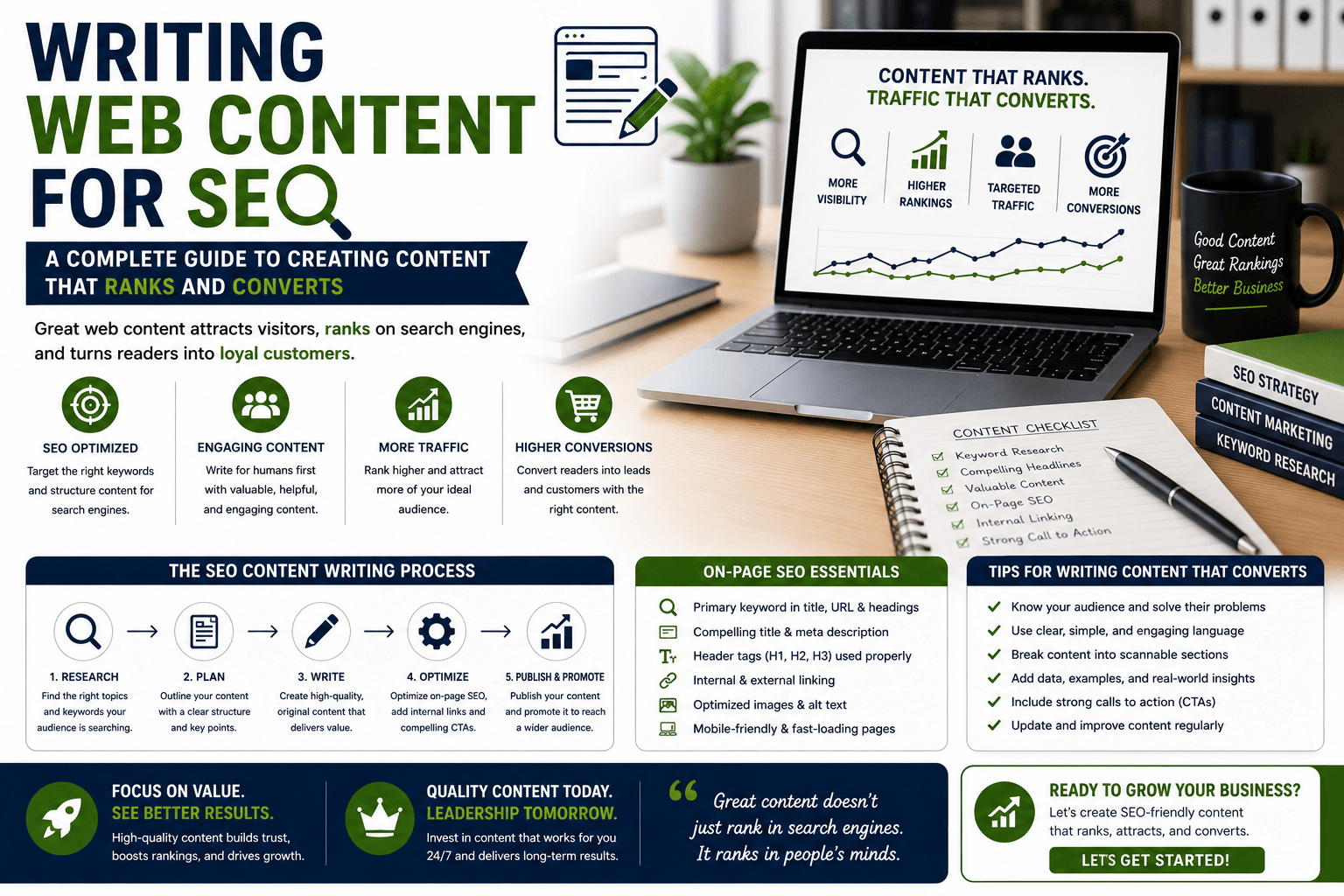
Writing web content for SEO is one of the most important skills for any business, marketer, blogger, or website owner. A website may look beautiful, load quickly, and offer excellent products or services, but without strong content, it can struggle to appear in search results. Search engines need content to understand what your website is about, and users need content to decide whether they can trust you.
SEO content writing is not only about placing keywords on a page. It is about creating useful, clear, and well-structured content that answers real questions. The best SEO content helps readers solve problems, learn something valuable, compare options, and take action with confidence.
Today, search engines are much better at understanding context, quality, relevance, and user intent. This means old-fashioned tactics like keyword stuffing, thin pages, and generic content no longer work well. Instead, websites need helpful, original, and reader-focused content that also follows SEO best practices.
Whether you are writing a blog post, service page, homepage, product description, landing page, or local business page, the goal is the same: create content that is easy for people to read and easy for search engines to understand.
What Is SEO Web Content?
SEO web content is content created for a website with the purpose of improving organic visibility in search engines. It is written to match what people are searching for while providing useful information that satisfies their needs.
SEO web content can include many types of pages, such as blog articles, service pages, product pages, category pages, landing pages, FAQs, guides, tutorials, case studies, comparison pages, and location-based pages.
For example, if a user searches for “writing web content for SEO,” they may want to understand how SEO writing works, how to use keywords, how to structure a page, and how to make content rank better. A strong article on this topic should answer these questions clearly and in detail.
Good SEO content should have a clear topic, a strong structure, natural keyword use, useful information, and a clear purpose. It should not feel robotic or over-optimized. It should feel like it was written for a real person who wants a helpful answer.
Why Writing Web Content for SEO Matters
Content is one of the main reasons people find websites through search engines. When your content is optimized properly, it can bring consistent organic traffic to your website over time. Unlike paid ads, which stop generating traffic when your budget ends, SEO content can continue attracting visitors for months or even years if it remains useful and relevant.
SEO-friendly web content helps your website in several ways. It improves your chances of ranking for important keywords. It helps users understand your products, services, or expertise. It builds trust by answering common questions. It supports internal linking and helps search engines discover other pages on your site. Most importantly, it can turn visitors into leads, customers, subscribers, or loyal readers.
For businesses, SEO content is especially valuable because it attracts people who are already searching for something related to their needs. A person who searches for “best accountant for small business,” “eco-friendly takeaway packaging,” or “how to clean flower vases” is already interested in a solution. If your content appears at the right moment and gives a helpful answer, your website has a better chance of earning that user’s trust.
SEO Content Is More Than Keywords
Many beginners think SEO writing means repeating a keyword many times. This is one of the biggest mistakes in web content writing. Keywords are important, but they are only one part of SEO.
Search engines now look at the overall meaning of a page. They try to understand whether the content is helpful, complete, relevant, and trustworthy. This means your article should cover the topic naturally instead of repeating the same phrase over and over.
For example, instead of using “writing web content for SEO” in every paragraph, you can also use related phrases such as “SEO content writing,” “SEO-friendly website copy,” “content optimization,” “search-focused writing,” and “website content strategy.” This makes the content sound more natural while still helping search engines understand the topic.
The main goal is to write for people first. SEO should improve the content, not make it awkward.
Understand Search Intent Before Writing
Search intent is the reason behind a search query. Before writing any SEO content, you need to understand what the user wants.
Some users want information. Some want to compare options. Some want to buy a product. Some want to find a local service. If your content does not match the user’s intent, it may not perform well, even if it includes the right keywords.
There are four common types of search intent.
Informational intent means the user wants to learn something. For example, “how to write SEO content” or “what is SEO web content.”
Commercial intent means the user is comparing options before making a decision. For example, “best SEO content writing tools” or “SEO writer vs copywriter.”
Transactional intent means the user is ready to take action. For example, “hire SEO content writer” or “buy SEO article writing service.”
Navigational intent means the user is looking for a specific website or brand.
When writing web content for SEO, always ask: what does the reader expect to find on this page? If the page gives them exactly what they need, they are more likely to stay, read, trust the content, and take action.
Start With Keyword Research
Keyword research helps you understand what people are searching for. It also helps you choose the right topic, structure, and content angle.
A primary keyword is the main phrase your page is targeting. For this article, the primary keyword is “writing web content for SEO.” Secondary keywords are related phrases that support the main topic, such as “SEO content writing,” “SEO-friendly content,” and “website content writing.”
Good keyword research is not only about search volume. A keyword with high search volume may be too competitive or too broad. Sometimes, lower-volume keywords are more valuable because they are more specific and easier to rank for.
For example, “SEO” is very broad. But “how to write service page content for SEO” is more specific and may attract a more targeted audience.
When choosing keywords, consider relevance, search intent, competition, and business value. The best keywords are not always the ones with the highest traffic. They are the ones that bring the right visitors to your website.
Create a Strong Content Outline
Before writing the full article, create an outline. A good outline keeps your content organized and prevents you from missing important points.
An SEO content outline should include a main title, introduction, key headings, subheadings, examples, FAQs, and conclusion. This structure helps both readers and search engines understand the page.
For example, an article about writing web content for SEO may include sections such as:
What is SEO web content?
Why SEO content matters
How to understand search intent
How to use keywords naturally
How to structure SEO content
How to optimize headings and meta tags
How to improve readability
Common SEO writing mistakes
FAQs
Conclusion
A clear outline also makes writing faster and more focused. Instead of writing randomly, you follow a logical path from introduction to conclusion.
Write a Compelling SEO Title
The title is one of the most important parts of your content. It tells users and search engines what the page is about.
A good SEO title should be clear, relevant, and attractive. It should include the primary keyword when possible, but it should still sound natural.
For example:
Writing Web Content for SEO: A Complete Guide
How to Write SEO-Friendly Web Content That Ranks
SEO Content Writing Guide for Better Website Traffic
Writing Web Content for SEO: Tips, Structure, and Examples
The title should not be too vague. A title like “Content Writing Tips” is less specific than “Writing Web Content for SEO: A Complete Guide.” Specific titles usually perform better because they match user intent more clearly.
Write an Introduction That Keeps Readers Interested
The introduction is where you convince visitors to keep reading. Many users decide within a few seconds whether a page is worth their time. If the introduction is boring, too long, or unclear, they may leave.
A strong introduction should explain the problem, show the value of the article, and give readers a reason to continue.
For SEO content, avoid starting with generic lines like “In today’s digital world…” or “SEO is very important…” These phrases are overused and do not add much value.
Instead, speak directly to the reader’s need. For example:
“Writing web content for SEO is not just about adding keywords to a page. It is about creating useful content that answers real questions, helps search engines understand your topic, and guides visitors toward action.”
This kind of opening is clear, relevant, and focused.
Use Headings to Organize the Page
Headings make your content easier to scan. Most website visitors do not read every word from top to bottom. They scan headings first to decide whether the page contains what they need.
Use one H1 heading for the main page title. Then use H2 headings for main sections and H3 headings for supporting details.
Headings should be descriptive. Instead of writing “Tips,” write “Tips for Writing SEO-Friendly Web Content.” Instead of “Mistakes,” write “Common SEO Content Writing Mistakes to Avoid.”
Clear headings improve readability and help search engines understand the structure of your page.
Use Keywords Naturally in Important Places
Keyword placement still matters, but it should be natural. You can include your main keyword in the page title, first paragraph, one or two headings, meta title, meta description, URL slug, and throughout the body where it fits.
However, avoid forcing the keyword into every section. Keyword stuffing makes content unpleasant to read and can reduce trust.
For example, this sentence sounds unnatural:
“Writing web content for SEO is important because writing web content for SEO helps websites rank when writing web content for SEO is done properly.”
A better version would be:
“Writing web content for SEO helps your website become more visible in search results while giving readers the information they need.”
The second version uses the keyword naturally and reads much better.
Focus on Readability
Readability is a major part of effective SEO content writing. If your content is hard to read, users may leave quickly, even if the information is useful.
To improve readability, use short paragraphs, clear sentences, simple language, and logical flow. Avoid unnecessary jargon unless your audience expects it. Break long sections into smaller parts. Use examples when explaining complex ideas.
Readable content does not mean basic or weak content. It means the content is easy to understand. Even expert topics can be explained clearly.
For most web content, paragraphs should be short. Long blocks of text can feel overwhelming, especially on mobile devices.
Make the Content Helpful and Complete
Helpful content answers the user’s question fully. If someone visits your page and still needs to search again for basic information, your content may not be complete enough.
For example, an article about writing web content for SEO should explain what SEO content is, why it matters, how to use keywords, how to structure the page, how to improve readability, and how to avoid mistakes. It should not only say, “Use keywords and write good content.”
Completeness does not mean adding unnecessary words. It means covering the topic properly. Every section should serve a purpose.
A helpful article gives the reader practical advice they can actually use.
Add Original Value
Many SEO articles repeat the same advice. To stand out, your content needs original value. This can come from real examples, personal experience, expert insights, unique frameworks, checklists, templates, or detailed explanations.
For example, instead of saying “write good headings,” you can show weak and strong heading examples.
Weak heading: “SEO Tips”
Strong heading: “SEO Content Writing Tips for Better Rankings”
Weak heading: “Keywords”
Strong heading: “How to Use Keywords Naturally in Web Content”
This kind of practical detail makes the content more useful.
Original value helps your content feel more trustworthy and less generic.
Write for Different Stages of the Buyer Journey
Not every visitor is ready to buy immediately. Some are just learning. Some are comparing. Some are ready to contact you. Your content should support different stages of the user journey.
A blog post may attract users who are looking for information. A service page may target users who are closer to making a decision. A comparison page may help users choose between options. A case study may build trust by showing results.
For example, a user searching “what is SEO content writing” may need education. A user searching “SEO content writing services for small business” may be ready to hire someone.
Understanding this journey helps you write content that matches the reader’s mindset.
Use Internal Links Strategically
Internal links connect one page of your website to another. They help users find more relevant information and help search engines understand the relationship between your pages.
For example, an article about writing web content for SEO could link to pages about keyword research, blog writing, SEO services, content strategy, or on-page SEO.
Internal links should feel natural. Do not add too many links just for SEO. Link when it genuinely helps the reader.
Use descriptive anchor text. Instead of writing “click here,” use text like “SEO content writing services” or “keyword research guide.” This gives users and search engines more context.
Use External Links When Helpful
External links can improve the usefulness of your content when they point to trustworthy sources. For example, if you mention search engine guidelines, statistics, laws, or technical standards, linking to reliable sources can support credibility.
However, do not overuse external links. Only link when it adds value.
For business content, external links are especially useful when discussing regulations, official guidance, research, or data.
Optimize the Meta Title and Meta Description
The meta title and meta description appear in search results. They help users decide whether to click your page.
A good meta title should include the main keyword and clearly explain the page topic. A good meta description should summarize the benefit of the page and encourage clicks.
Example meta title:
Writing Web Content for SEO: Complete Guide for Better Rankings
Example meta description:
Learn how to write SEO-friendly web content that attracts visitors, improves search visibility, builds trust, and turns website traffic into leads or sales.
The meta description does not directly guarantee rankings, but it can influence click-through rate. A clear and relevant description can attract more qualified visitors.
Create SEO-Friendly URLs
The URL should be short, clear, and descriptive. Avoid long URLs with unnecessary numbers, dates, or random characters.
Good URL:
/writing-web-content-for-seo/
Weak URL:
/blog/post?id=5829-content-writing-tips-new-final/
A clean URL helps users understand the page before they click. It also looks more professional when shared.
Optimize Images and Alt Text
Images can improve user experience, especially when they explain a concept, show examples, or make a page more visually attractive. But images should also be optimized.
Use descriptive file names instead of random names. For example, use seo-content-writing-guide.jpg instead of IMG_4568.jpg.
Alt text should describe the image clearly. It helps search engines understand the image and improves accessibility for users who rely on screen readers.
Example alt text:
“Example of an SEO content writing outline for a blog article”
Avoid stuffing keywords into alt text. Keep it accurate and natural.
Write Strong Calls to Action
A call to action, or CTA, tells the reader what to do next. Without a CTA, users may read your content and leave without taking action.
The CTA depends on the page goal. For a blog post, the CTA may invite readers to explore related guides. For a service page, it may encourage users to request a quote, book a consultation, or contact the business.
Examples:
Need SEO-friendly website content? Contact our team today.
Explore our SEO content writing services to improve your website visibility.
Ready to turn traffic into leads? Let’s create content that works.
A good CTA should be clear, relevant, and not too aggressive.
Avoid Thin Content
Thin content is content that provides little or no value. It may be too short, too generic, copied from other websites, or created only to target a keyword.
Thin pages often fail because they do not satisfy user intent. A 300-word article on a complex topic may not be enough to answer the reader’s questions.
However, length alone is not the goal. A long article filled with fluff is not better than a short article that answers the question clearly. The right length depends on the topic and search intent.
For competitive topics, longer and more detailed content is often useful because it covers the subject more completely. But every paragraph should add value.
Avoid Duplicate Content
Duplicate content happens when the same or very similar content appears on multiple pages. This can confuse search engines and reduce the uniqueness of your website.
For example, if a business creates 50 city pages with almost the same text and only changes the city name, those pages may not perform well. Each page should have unique, location-specific, and useful information.
When writing web content for SEO, always aim for originality. Even if the topic is common, your explanation, examples, structure, and insights should feel unique.
Match Content Type to the Keyword
Different keywords need different types of content. Some keywords are best answered with blog posts. Others need service pages, product pages, guides, comparison pages, or category pages.
For example:
“How to write SEO content” works well as a blog guide.
“SEO content writing services” works better as a service page.
“Best SEO content tools” works well as a comparison article.
“SEO copywriter near me” may need a local service page.
Choosing the right content type is important. If the user expects a service page but you give them a general blog post, the content may not convert well. If they expect a guide but you give them a sales page, they may leave.
Build Topical Authority
Topical authority means your website covers a subject deeply and consistently. Instead of writing one article about SEO, a website can build authority by publishing related content around keyword research, on-page SEO, technical SEO, content writing, local SEO, link building, and analytics.
This helps search engines understand that your website has depth in a topic area.
For example, a website offering SEO services could create articles such as:
How to Do Keyword Research for SEO
How to Write SEO-Friendly Blog Posts
On-Page SEO Checklist for Small Businesses
How Internal Linking Improves SEO
SEO Content Strategy for Service Businesses
Common SEO Mistakes to Avoid
These articles can link to each other and to relevant service pages. This creates a strong content ecosystem.
Write Better Service Page Content
Service pages are different from blog posts. A blog post usually educates, while a service page needs to persuade and convert.
An SEO-friendly service page should clearly explain what the service is, who it is for, what problems it solves, how the process works, why the business is trustworthy, and what action the visitor should take next.
For example, a service page for SEO content writing should include:
Clear headline
Short value-focused introduction
Service overview
Benefits of the service
What is included
Process or workflow
Industries served
Proof or trust signals
FAQs
CTA
The content should be persuasive but not exaggerated. Avoid empty claims like “we are the best” unless you support them with proof.
Write Better Blog Content
Blog content is useful for attracting informational traffic. A good blog post should answer a specific question or solve a specific problem.
Strong blog content usually includes a clear introduction, well-organized headings, practical advice, examples, and a conclusion. It should not feel like a sales pitch from beginning to end.
That does not mean blog posts cannot support business goals. They can include soft CTAs, internal links to service pages, and helpful recommendations. But the main purpose should be to help the reader.
For example, a blog post about “how to write SEO-friendly website content” can educate readers and then naturally link to a professional content writing service.
Write Better Product Descriptions
Product descriptions also need SEO. A good product description should include relevant keywords, but it should also help customers understand the product’s value.
Instead of only listing features, explain benefits. Tell customers how the product helps them, what problem it solves, what materials or specifications matter, and why it is worth buying.
For example, instead of writing:
“Wooden photo frame, 6×4, custom text.”
A better version would be:
“Display a favourite memory in a personalised 6×4 wooden photo frame, finished with custom engraved text for birthdays, anniversaries, weddings, or thoughtful home décor gifts.”
This version is more descriptive, emotional, and search-friendly.
Write Better Local SEO Content
Local SEO content helps businesses appear for location-based searches. This is especially important for service providers, restaurants, clinics, agencies, tradespeople, and local shops.
A local SEO page should include the target location naturally, but it should not simply repeat the city name many times. It should include local context, service details, areas covered, customer needs, and trust signals.
For example, a page targeting “accountants in East London” should discuss local business needs, compliance support, limited company accounting, tax deadlines, and nearby service areas.
Local SEO content works best when it feels genuinely relevant to the location.
Add FAQs to Improve Usefulness
FAQs are useful because they answer common questions directly. They can also help target long-tail keywords.
For an article about writing web content for SEO, FAQs may include:
What is SEO content writing?
How long should SEO content be?
How many keywords should I use?
Can AI write SEO content?
How often should I update SEO content?
What is the difference between SEO writing and copywriting?
FAQs should be short, clear, and genuinely helpful. Avoid adding irrelevant questions just to increase word count.
Common SEO Content Writing Mistakes
One common mistake is keyword stuffing. This makes content sound unnatural and can reduce quality.
Another mistake is writing without understanding search intent. Even well-written content can fail if it does not answer what users actually want.
A third mistake is publishing generic content. If your article says the same thing as hundreds of other pages, it may struggle to stand out.
Another mistake is ignoring structure. Long content without headings, short paragraphs, or clear sections can be difficult to read.
Many websites also forget to update old content. Outdated examples, broken links, old statistics, and irrelevant information can reduce trust.
Finally, some businesses write only for search engines and forget about conversion. Good SEO content should attract traffic, but it should also guide users toward the next step.
SEO Content Writing Checklist
Before publishing web content, check the following:
The page has one clear primary keyword.
The content matches search intent.
The title is clear and SEO-friendly.
The introduction explains the value quickly.
Headings are organized logically.
Keywords are used naturally.
The content is original and useful.
Paragraphs are easy to read.
Internal links are added where relevant.
Images have descriptive alt text.
The meta title and description are optimized.
The URL is short and clean.
The page includes a clear CTA.
The content is proofread before publishing.
This checklist helps make sure your content is ready for both users and search engines.
How Long Should SEO Web Content Be?
There is no perfect word count for SEO content. The ideal length depends on the topic, competition, and user intent.
A simple product description may only need 150 to 300 words. A service page may need 800 to 1,500 words. A detailed guide may need 2,000 words or more.
The goal is not to write as much as possible. The goal is to answer the topic completely. If a subject needs depth, write a longer article. If the answer is simple, keep it concise.
A very long article can perform well when it is well-organized and genuinely useful. But long content filled with repeated ideas will not help users.
How to Make SEO Content More Engaging
SEO content should not feel boring. Even technical topics can be written in an engaging way.
Use real examples. Speak directly to the reader. Explain why each point matters. Use smooth transitions between sections. Avoid repeating the same sentence structure. Include practical tips that readers can apply immediately.
For example, instead of writing:
“Keywords are important for SEO.”
You can write:
“Keywords help connect your content with the exact phrases people type into search engines. When used naturally, they make it easier for both users and search engines to understand your page.”
The second version gives more context and feels more helpful.
SEO Writing and Conversion Copywriting Should Work Together
SEO brings people to the page. Copywriting encourages them to take action. The best web content combines both.
A page can rank well but fail to convert if it does not build trust or explain the value clearly. Similarly, a persuasive page may not get traffic if it is not optimized for search.
Good SEO copy should include clear benefits, trust signals, proof, simple explanations, and strong CTAs. It should make the reader feel understood.
For example, a service page should not only say what you offer. It should explain why the service matters, what problems it solves, and why the reader should choose you.
Updating Existing Web Content for SEO
SEO content writing is not only about creating new pages. Updating old content can also improve performance.
Start by reviewing pages that have low traffic, outdated information, weak titles, missing keywords, or poor structure. Then improve the content by adding useful sections, rewriting unclear paragraphs, updating examples, improving internal links, and optimizing meta tags.
Sometimes, refreshing an existing page is more effective than publishing a new one. This is especially true if the old page already has some rankings or backlinks.
Content updates should focus on quality, not just adding more words.
Measuring SEO Content Performance
After publishing SEO content, you should track its performance. Important metrics include organic traffic, keyword rankings, impressions, clicks, click-through rate, time on page, bounce rate, conversions, and leads.
If a page gets impressions but few clicks, the title or meta description may need improvement. If a page gets traffic but no conversions, the CTA or page offer may need work. If users leave quickly, the content may not match search intent.
SEO content should be reviewed regularly. Performance data helps you understand what is working and what needs improvement.
Final Thoughts
Writing web content for SEO is about creating content that is useful, structured, search-friendly, and persuasive. It is not about tricking search engines. It is about helping people find the right information at the right time.
Strong SEO content starts with understanding the audience. Then it uses keyword research, clear structure, natural language, helpful information, and proper optimization to create a page that can rank and convert.
The most successful websites do not publish content just to fill space. They create content with a purpose. Every page should answer a question, solve a problem, explain a service, support a decision, or guide users toward action.
When your web content is written with both users and search engines in mind, it becomes more than just text on a page. It becomes a powerful tool for visibility, trust, and business growth.
FAQ Section: Writing Web Content for SEO
What is writing web content for SEO?
Writing web content for SEO means creating website content that is useful for readers and easy for search engines to understand. It includes using relevant keywords, clear headings, helpful information, internal links, and a user-friendly structure.
Why is writing web content for SEO important?
Writing web content for SEO is important because it helps your website appear in search results when people search for topics related to your business. Good SEO content can increase organic traffic, improve brand trust, and help turn visitors into customers.
How do I choose keywords for SEO web content?
To choose keywords for SEO web content, start by understanding what your audience is searching for. Use one main focus keyword and support it with related keywords, long-tail phrases, and common questions your readers may ask.
What is the ideal keyword density for SEO content?
There is no fixed perfect keyword density for SEO content. The focus keyword should appear naturally throughout the content without sounding forced. A keyword density of around 0.5% to 1.5% is usually acceptable if the content reads well and provides real value.
How many times should the focus keyword appear in an article?
The focus keyword should appear enough times to make the topic clear, but not so many times that the content feels repetitive. It is better to use the focus keyword naturally in the title, introduction, headings, body content, meta title, meta description, and conclusion.
Can too many keywords hurt SEO?
Yes, using too many keywords can hurt SEO if the content sounds unnatural or spammy. Keyword stuffing can make the page difficult to read and may reduce user trust. SEO-friendly content should always focus on helpful writing first.
Where should I place keywords in SEO web content?
Keywords should be placed in important areas such as the page title, first paragraph, headings, meta title, meta description, URL slug, image alt text, and naturally within the main content. However, every keyword placement should make sense for the reader.
How long should SEO web content be?
The ideal length depends on the topic and search intent. A simple service page may need 800 to 1,500 words, while a detailed guide may need 2,000 words or more. The content should be long enough to answer the user’s question clearly and completely.
What makes SEO content high quality?
High-quality SEO content is original, helpful, well-structured, easy to read, and written for real users. It should answer the search intent, provide practical value, and guide readers toward the next step.
How often should SEO content be updated?
SEO content should be reviewed regularly, especially if the topic changes over time. Updating old content with fresh information, better headings, improved internal links, and stronger FAQs can help improve search performance.
Is writing web content for SEO different from normal content writing?
Yes. Normal content writing focuses mainly on communication, while writing web content for SEO also considers search intent, keyword placement, headings, meta tags, internal linking, and page structure. The goal is to satisfy both readers and search engines.
Can SEO web content help generate leads?
Yes, SEO web content can help generate leads by attracting people who are already searching for information, services, or products. When the content is helpful and includes a clear call to action, it can encourage visitors to contact your business, request a quote, or make a purchase.
Why is writing web content for SEO important for business websites?
Writing web content for SEO is important because it helps business websites attract the right visitors from search engines. When your content answers customer questions clearly, users are more likely to trust your brand, explore your services, and take action.
How does writing web content for SEO improve website rankings?
Writing web content for SEO improves rankings by helping search engines understand your page topic. Clear headings, natural keyword placement, helpful answers, and strong page structure all make the content easier to crawl, index, and rank.
What should I avoid when writing web content for SEO?
When writing web content for SEO, avoid keyword stuffing, copied content, weak introductions, unclear headings, and thin information. The content should be useful, original, and written for real readers first.
Is writing web content for SEO useful for small businesses?
Yes, writing web content for SEO is very useful for small businesses because it helps them compete online without depending only on paid ads. Well-written SEO content can bring long-term organic traffic and generate leads over time.
How can beginners start writing web content for SEO?
Beginners can start writing web content for SEO by choosing one focus keyword, understanding search intent, creating a clear outline, using headings properly, and writing helpful content that answers the reader’s main questions.
Does writing web content for SEO help conversions?
Yes, writing web content for SEO can help conversions when the content is clear, trustworthy, and action-focused. Good SEO content attracts visitors, explains value, answers objections, and guides users toward contacting the business or buying a product.
Conclusion
Writing web content for SEO is a long-term strategy that helps websites grow organically. It requires planning, research, writing skill, and regular improvement. When done correctly, SEO content can bring targeted visitors to your website, answer their questions, build trust, and encourage meaningful action.
The key is to focus on people first. Understand what your audience wants, create content that genuinely helps them, and optimize the page so search engines can understand it clearly. This balance is what makes SEO content successful.