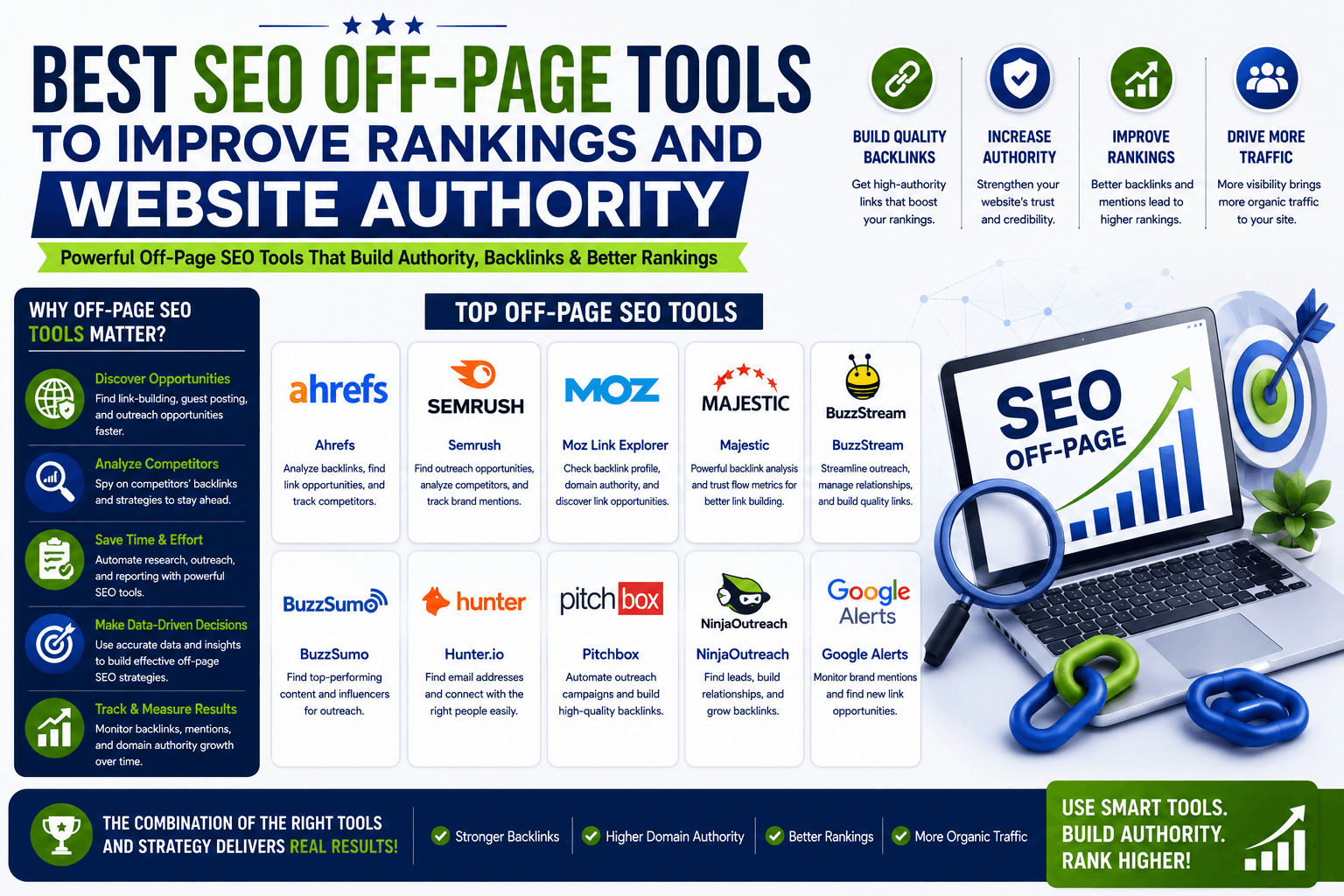
Off-page SEO plays an important role in improving a website’s search engine rankings, authority, and online reputation. While on-page SEO focuses on optimizing content and website structure, off-page SEO involves activities performed outside your website, such as link building, competitor analysis, brand mentions, outreach, and backlink monitoring.
Using the right SEO off-page tools can make these tasks faster and more effective. These tools help marketers discover backlink opportunities, analyze competitors, monitor links, find outreach prospects, and measure domain authority.
In this article, we will explore some of the most useful SEO off-page tools and explain how they can support your search engine optimization strategy.
What Are SEO Off-Page Tools?
SEO off-page tools are software platforms designed to help website owners and digital marketers manage activities that influence a website’s authority outside its own pages.
These tools are commonly used for:
- Backlink analysis
- Link-building research
- Competitor backlink analysis
- Brand mention monitoring
- Influencer and blogger outreach
- Guest-posting research
- Broken-link building
- Domain authority analysis
- Backlink monitoring
- Social and content promotion research
A strong off-page SEO strategy is not simply about generating large numbers of backlinks. The quality, relevance, authority, and natural placement of links are much more important.
Why Are Off-Page SEO Tools Important?
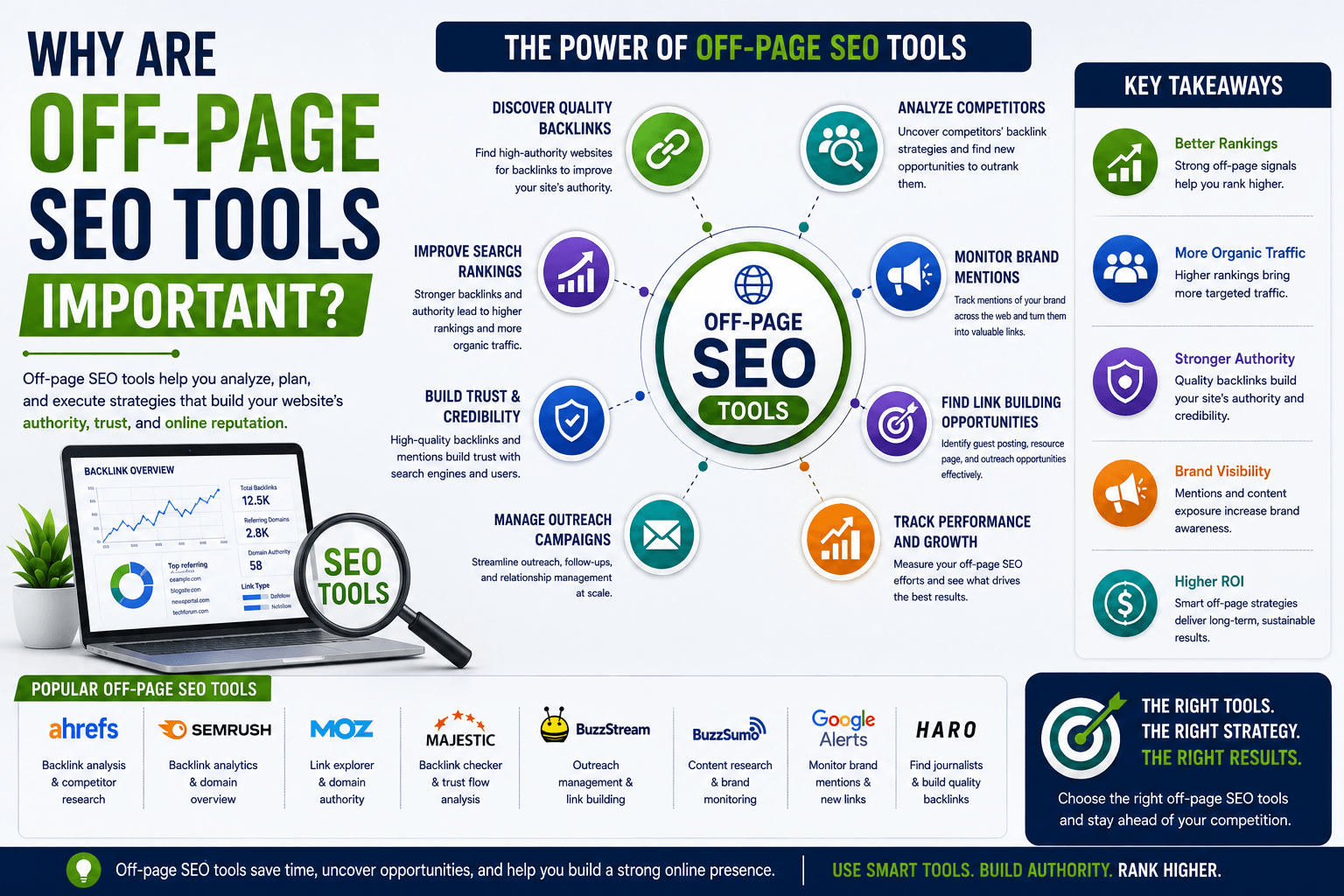
Managing an off-page SEO campaign manually can require significant time and effort. You may need to research hundreds of websites, analyze backlink profiles, identify relevant prospects, contact website owners, and monitor existing links.
SEO off-page tools simplify this process by providing useful data in one place.
They can help you:
Discover High-Quality Backlink Opportunities
Backlink tools allow you to identify websites that link to competitors but not to your website. These domains can become potential link-building targets.
Analyze Competitors
Competitor research can reveal which websites, articles, directories, and publications are helping competing websites rank successfully.
Monitor Your Backlinks
Links can disappear, change, or become broken over time. Monitoring tools help you identify lost or potentially harmful backlinks.
Improve Outreach
Some SEO tools help identify bloggers, journalists, website owners, and industry influencers who may be interested in your content or business.
Track Website Authority
SEO platforms often provide proprietary authority metrics that can help compare websites and evaluate potential link opportunities.
Top SEO Off-Page Tools
1. Ahrefs
Ahrefs is one of the most widely used tools for backlink analysis and competitor research.
Its Site Explorer feature allows users to investigate the backlink profile of almost any website. You can identify referring domains, anchor text, linked pages, lost backlinks, and competitors’ strongest links.
Ahrefs can be particularly useful for:
- Backlink analysis
- Competitor research
- Link-gap analysis
- Broken-link building
- Content research
- Monitoring new and lost backlinks
For businesses running serious link-building campaigns, Ahrefs can provide valuable data for identifying high-quality opportunities.
2. Semrush
Semrush is an all-in-one digital marketing platform with several features useful for off-page SEO.
Its backlink tools allow marketers to analyze referring domains, evaluate backlinks, compare competitors, and discover new opportunities.
Semrush can be used for:
- Backlink auditing
- Competitor backlink analysis
- Link-building prospect discovery
- Domain comparison
- Brand monitoring
- Outreach management
The platform is particularly useful for marketers who want to manage keyword research, technical SEO, content optimization, and off-page SEO from one dashboard.
3. Moz Link Explorer
Moz Link Explorer provides information about backlinks, linking domains, anchor text, and website authority.
Moz is also known for metrics such as Domain Authority and Page Authority, which many marketers use as comparative indicators when evaluating websites.
Useful features include:
- Backlink research
- Link-intersection analysis
- Spam-score analysis
- Domain Authority tracking
- Competitor link research
Moz can be a practical option for businesses looking for straightforward backlink intelligence.
4. Majestic
Majestic specializes heavily in backlink analysis.
It offers metrics such as Trust Flow and Citation Flow, which can help marketers evaluate the quality and quantity of links pointing to a domain.
Majestic is useful for:
- Analyzing backlink profiles
- Reviewing referring domains
- Studying link relationships
- Comparing competitor websites
- Evaluating potential link sources
Its focus on link data makes it especially relevant for advanced link-building research.
5. Google Search Console
Google Search Console is a valuable free tool for website owners.
Although it is not exclusively an off-page SEO platform, it provides information about links that Google has detected pointing toward your website.
You can use Google Search Console to review:
- Top linking websites
- Most-linked pages
- Internal links
- Search performance
- Indexing issues
It should be part of almost every SEO toolkit because its data comes directly from Google.
6. BuzzSumo
BuzzSumo is primarily a content research and influencer discovery platform, but it can also support off-page SEO.
Marketers can use it to identify popular content, influential authors, journalists, and websites within a particular industry.
BuzzSumo can assist with:
- Influencer research
- Content promotion
- Journalist discovery
- Competitor content analysis
- Linkable content research
Creating strong content is only one part of SEO. BuzzSumo can help you find people who may be interested in sharing or linking to that content.
7. Hunter
Hunter is an email discovery tool commonly used during link-building outreach.
Once you identify a website that could provide a relevant backlink, Hunter can help locate professional email addresses associated with that domain.
It can support campaigns such as:
- Guest-post outreach
- Broken-link outreach
- Resource-page link building
- Partnership outreach
- Content promotion
Personalized outreach generally performs better than sending identical messages to large lists of websites.
8. BuzzStream
BuzzStream is an outreach and relationship-management platform designed for digital PR and link building.
It helps marketers organize prospects, track conversations, and manage outreach campaigns.
BuzzStream can be useful for:
- Managing outreach lists
- Tracking emails
- Organizing link prospects
- Managing publisher relationships
- Monitoring campaign progress
This is especially helpful for agencies or teams handling large numbers of outreach prospects.
9. HARO Alternatives and Journalist Outreach Platforms
Digital PR can generate valuable editorial backlinks from news websites, blogs, and industry publications.
Journalist outreach platforms allow businesses and experts to respond to requests from writers looking for sources.
These opportunities can help businesses earn:
- Editorial backlinks
- Brand mentions
- Media exposure
- Expert citations
- Referral traffic
The key is to provide genuinely useful, credible information instead of treating journalist outreach purely as a backlink tactic.
10. Google Alerts
Google Alerts is a simple tool for monitoring new online mentions related to specific keywords or brand names.
For example, you can create alerts for:
- Your company name
- Product names
- Founder names
- Competitors
- Industry keywords
If another website mentions your brand without including a link, you may be able to contact the publisher and politely ask whether they would consider linking to your website.
How to Choose the Best SEO Off-Page Tools
The right tool depends on your goals, budget, and SEO strategy.
For backlink research, platforms such as Ahrefs, Semrush, Moz, and Majestic can provide extensive link data.
For outreach, tools such as BuzzStream and Hunter can help streamline communication.
For brand monitoring, Google Alerts and dedicated brand-monitoring platforms can help identify mentions.
Before selecting a tool, consider the following factors:
Backlink Database
A larger and frequently updated backlink database can help you discover more link opportunities.
Competitor Analysis
Choose a tool that makes it easy to compare your backlink profile against competitors.
Outreach Features
If outreach is a major part of your strategy, look for contact discovery, email tracking, and campaign-management functionality.
Reporting
Agencies and marketing teams may need customizable reports for tracking campaigns and demonstrating progress.
Pricing
Some professional SEO tools can be expensive. Smaller websites may benefit from starting with free tools before investing in advanced platforms.
Best Off-Page SEO Techniques to Use With These Tools
Tools alone will not improve rankings. They need to support a well-planned SEO strategy.
Some effective off-page SEO techniques include:
Guest Posting
Publishing valuable articles on reputable websites can help build authority, referral traffic, and relevant backlinks.
Broken-Link Building
Find broken external links on relevant websites and recommend useful replacement content from your own website where appropriate.
Digital PR
Publish original research, reports, surveys, data, or expert commentary that journalists and publishers may reference.
Linkable Assets
Create resources that naturally attract backlinks, such as:
- Statistics pages
- Industry reports
- Free tools
- Calculators
- Templates
- Research studies
- Infographics
- Comprehensive guides
Competitor Backlink Analysis
Analyze your competitors’ strongest backlinks and determine whether similar opportunities are available to your website.
Brand Mention Outreach
Identify websites that mention your brand without linking to your website and request a relevant link when it would improve the reader’s experience.
Avoid Low-Quality Off-Page SEO Practices
Not every backlink helps SEO.
Website owners should be cautious about tactics designed primarily to manipulate search rankings, including:
- Buying large quantities of low-quality backlinks
- Automated link-building software
- Spammy blog comments
- Irrelevant directory submissions
- Private link networks
- Excessive reciprocal linking
- Keyword-stuffed anchor text
- Mass-produced guest posts
A sustainable strategy focuses on earning relevant links from trustworthy websites through valuable content, relationships, expertise, and genuine promotion.
Free vs. Paid SEO Off-Page Tools
Free tools can be sufficient for beginners or small websites.
Google Search Console and Google Alerts, for example, can provide valuable information without subscription fees.
Paid SEO tools generally provide more extensive backlink databases, competitor intelligence, reporting features, and campaign-management capabilities.
Businesses running competitive SEO campaigns may benefit from combining free Google tools with one professional backlink analysis platform.
Final Thoughts
SEO off-page tools make it easier to analyze backlinks, research competitors, discover link opportunities, conduct outreach, and monitor website authority.
Tools such as Ahrefs, Semrush, Moz, Majestic, Google Search Console, BuzzSumo, Hunter, and BuzzStream can each support different parts of an off-page SEO campaign.
However, the tool itself is only part of the strategy. Successful off-page SEO depends on building genuine website authority through useful content, strong industry relationships, credible mentions, and relevant backlinks.
Instead of focusing on the highest possible number of links, prioritize backlinks that are relevant, trustworthy, and valuable to real users. Over time, this approach can strengthen your website’s search visibility, referral traffic, and overall online reputation.
Frequently Asked Questions About SEO Off-Page Tools
1. What are SEO off-page tools?
SEO off-page tools are software platforms that help website owners and digital marketers improve SEO activities outside their websites. These tools are commonly used for backlink analysis, competitor research, link building, outreach, brand monitoring, and tracking referring domains.
2. Which are the best SEO off-page tools?
Some of the best SEO off-page tools include Ahrefs, Semrush, Moz Link Explorer, Majestic, Google Search Console, BuzzSumo, Hunter, and BuzzStream. The best option depends on whether your primary goal is backlink research, outreach, competitor analysis, or brand monitoring.
3. Why should I use SEO off-page tools?
Using SEO off-page tools can save time and provide useful data for building a stronger SEO strategy. They help you discover backlink opportunities, analyze competitor links, monitor existing backlinks, find outreach prospects, and understand your website’s authority.
4. Are there free SEO off-page tools available?
Yes. Google Search Console and Google Alerts are useful free SEO off-page tools. Google Search Console can provide information about websites linking to your site, while Google Alerts can help you monitor online mentions of your brand, products, or target keywords.
5. Can SEO off-page tools help with backlink building?
Yes. Many SEO off-page tools are specifically designed to support backlink building. Tools such as Ahrefs, Semrush, Moz, and Majestic can help identify competitor backlinks, referring domains, broken links, and websites that may offer relevant link-building opportunities.
6. How do SEO off-page tools help with competitor analysis?
SEO off-page tools allow you to analyze the backlink profiles of competing websites. You can identify where competitors receive their links, which pages attract the most backlinks, and which domains may also be relevant prospects for your website.
7. What is the best SEO off-page tool for beginners?
Beginners can start with Google Search Console because it is free and provides useful information about website performance and backlinks. As your SEO requirements increase, platforms such as Semrush, Ahrefs, or Moz can provide more advanced competitor and backlink research.
8. How often should I use SEO off-page tools?
You should use SEO off-page tools regularly to monitor new and lost backlinks, identify competitor activity, discover new link-building opportunities, and track changes in your website’s backlink profile. Active SEO campaigns may require weekly monitoring, while smaller websites can review their data monthly.
9. Do SEO off-page tools improve Google rankings directly?
SEO off-page tools do not improve rankings automatically. Instead, they provide information and features that help you make better SEO decisions. Rankings may improve when you use these insights to earn relevant backlinks, strengthen brand authority, improve digital PR, and build a trustworthy online presence.
10. How do I choose the right SEO off-page tools?
Choose SEO off-page tools based on your goals, budget, and campaign size. For backlink analysis and competitor research, consider Ahrefs, Semrush, Moz, or Majestic. For outreach, tools such as Hunter and BuzzStream can be useful. For basic backlink and brand monitoring, free Google tools can be a good starting point.