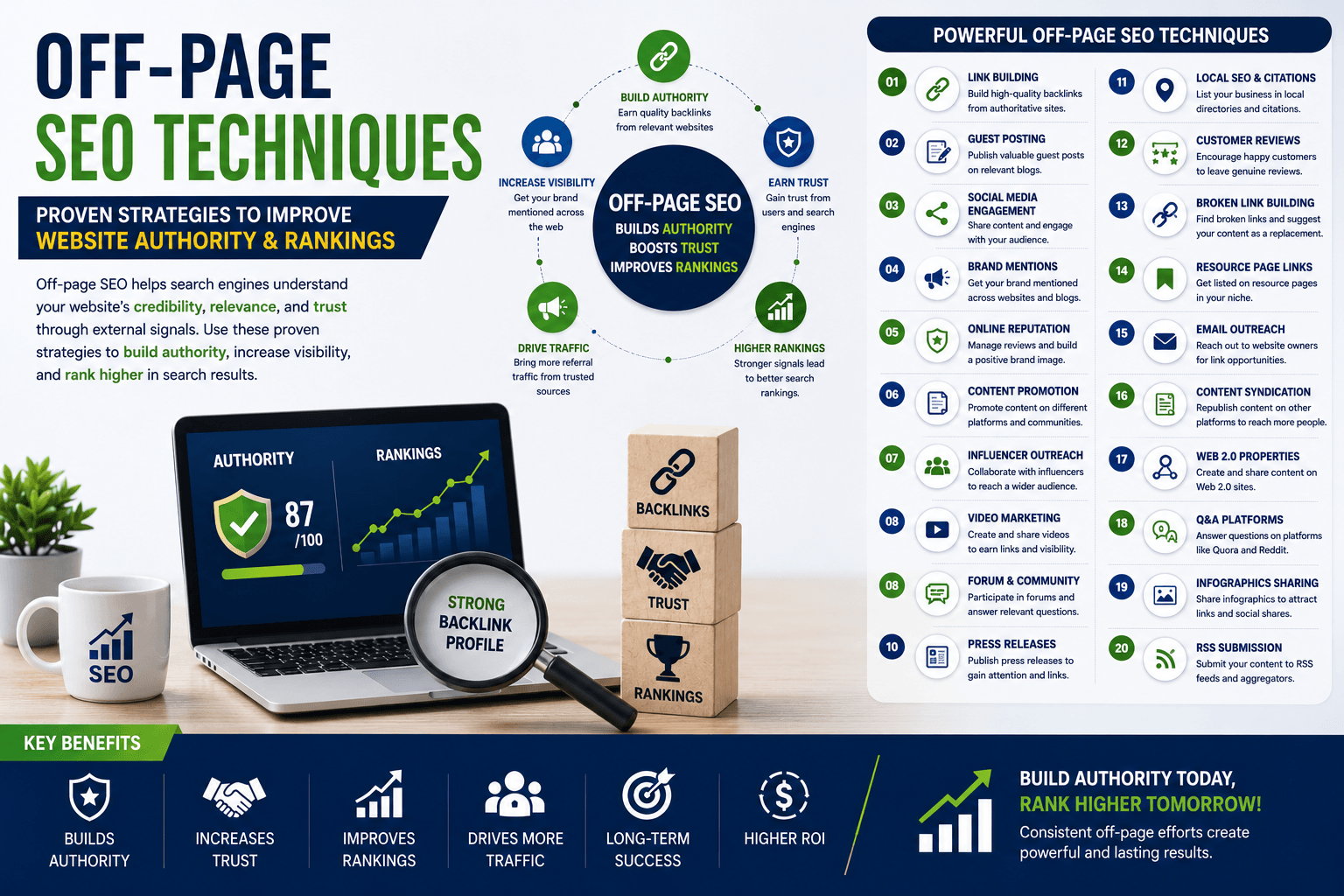
Getting your website to rank higher on search engines requires more than publishing optimized content. While on-page SEO focuses on improving elements within your website, off-page SEO techniques help strengthen your website’s reputation, authority, credibility, and online visibility.
Off-page SEO includes activities performed outside your website that can influence how users and search engines perceive your brand. Backlinks are an important part of this process, but modern off-page SEO goes much further. Brand mentions, digital PR, guest posting, community participation, reviews, partnerships, and content promotion can all contribute to a stronger online presence.
In this guide, we will explore some of the most effective off-page SEO techniques you can use to build authority and improve your website’s long-term organic performance.
What Is Off-Page SEO?
Off-page SEO refers to optimization activities conducted outside your own website to improve its authority, reputation, and visibility in search results.
For example, when a respected website links to one of your articles, that backlink can act as a signal that your content is useful or trustworthy. Similarly, positive reviews, brand mentions, media coverage, and discussions about your business can strengthen your online reputation.
The primary objectives of off-page SEO are to:
- Build website authority
- Earn relevant backlinks
- Increase brand awareness
- Generate referral traffic
- Strengthen online credibility
- Improve search visibility
- Develop relationships within your industry
A successful strategy focuses on quality and relevance rather than simply trying to create the largest possible number of links.
1. Build High-Quality Backlinks
Backlink building remains one of the most widely used off-page SEO techniques.
A backlink is created when another website links to your website. However, all backlinks are not equally valuable. A relevant link from a trusted industry publication can be far more useful than dozens of links from unrelated or low-quality websites.
Search engines encourage links that develop naturally because people genuinely find content useful, while artificial link schemes intended primarily to manipulate rankings can create SEO risks.
Focus on earning backlinks from websites that are:
- Relevant to your industry
- Trusted by their audience
- Publishing high-quality content
- Receiving genuine organic traffic
- Contextually related to the page being linked
You can attract backlinks by publishing original research, detailed guides, statistics, case studies, templates, tools, infographics, and other resources people naturally want to reference.
2. Use Guest Posting Strategically
Guest posting involves writing an article for another website within your niche.
When performed correctly, guest blogging can help you establish expertise, reach a new audience, generate referral traffic, develop industry relationships, and potentially earn relevant backlinks.
The key is to prioritize valuable content instead of treating guest posts solely as a link-building method.
Before approaching a website, check whether its content and audience are relevant to your business. Then pitch a specific article idea that provides genuine value to its readers.
Avoid publishing the same generic article across dozens of websites. Each guest contribution should be original, useful, and tailored to the publication.
3. Try Broken Link Building
Broken link building is another practical off-page SEO strategy.
Websites sometimes contain links pointing to pages that have been deleted or moved. These links create a poor user experience.
You can identify broken links on relevant websites and contact the website owner with a useful replacement resource from your own site.
A basic broken-link-building process looks like this:
- Find authoritative websites within your niche.
- Identify broken external links.
- Check what information the missing page originally provided.
- Create or identify a useful resource on your website.
- Contact the website owner and suggest your page as a replacement.
The technique works best when your replacement content genuinely matches the original resource.
4. Turn Unlinked Brand Mentions Into Links
Your company may already be mentioned on websites without receiving a backlink.
These are known as unlinked brand mentions.
Search for mentions of your:
- Company name
- Website name
- Products
- Founders or executives
- Proprietary research
- Tools or resources
When you find a relevant mention without a link, contact the publisher politely and ask whether they would consider linking the brand name to the appropriate page.
Because the publisher already knows and has mentioned your business, this can sometimes be easier than cold link outreach.
5. Invest in Digital PR
Digital PR combines public relations and online marketing to earn visibility from journalists, publishers, bloggers, and industry websites.
Instead of directly asking people for backlinks, businesses create stories or resources worth covering.
Examples include:
- Original surveys
- Industry research
- Data studies
- Expert commentary
- Trend reports
- Company announcements
- Unique statistics
- Interactive tools
- Newsworthy campaigns
A successful digital PR campaign can earn media coverage, authoritative backlinks, referral traffic, and greater brand recognition at the same time.
6. Create Linkable Assets
A linkable asset is a piece of content specifically valuable enough that other websites may want to reference it.
Examples of effective linkable assets include:
Original Research
Publish proprietary survey results, industry statistics, or data analysis.
Ultimate Guides
Create detailed resources that answer important questions within your niche.
Free Tools
Calculators, generators, templates, and interactive tools can attract consistent backlinks.
Infographics
Well-designed visual explanations can make complex information easier to understand and share.
Statistics Pages
Organizing useful industry statistics into one regularly updated resource can make your page valuable to writers searching for supporting data.
The objective is simple: create something more useful than what already exists.
7. Use Resource Page Link Building
Many websites maintain resource pages containing useful articles, organizations, tools, or guides related to a specific topic.
Find relevant resource pages and determine whether one of your existing resources would genuinely improve the list.
Instead of sending a generic message such as “Please add my website,” explain:
- Which resource you recommend
- Why it is relevant
- How it helps their readers
- Where it could logically fit
Personalized outreach generally creates a much stronger impression than mass emails.
8. Participate in Relevant Online Communities
Industry communities can help increase brand awareness and demonstrate expertise.
Depending on your niche, you may participate in:
- Reddit communities
- Quora discussions
- Professional forums
- Facebook groups
- LinkedIn communities
- Slack or Discord groups
- Specialized industry communities
Do not join communities simply to drop links.
Answer questions, provide useful information, share personal experience, and contribute to discussions. When a page from your website genuinely helps answer someone’s question, you can reference it naturally.
Community marketing should primarily build reputation and relationships.
9. Strengthen Your Social Media Presence
Social media promotion can extend the reach of your content.
Publishing a great article does not automatically mean journalists, bloggers, or potential customers will discover it. Sharing the content through relevant social channels can put it in front of people who may later reference, discuss, or link to it.
You can promote content through platforms such as:
- X
- YouTube
- Relevant niche platforms
Social media is particularly valuable for content distribution and brand discovery.
10. Collaborate With Industry Experts
Relationships are an important but sometimes overlooked part of off-page SEO.
Connect with:
- Bloggers
- Journalists
- Business owners
- Researchers
- Influencers
- Podcast hosts
- Industry experts
Possible collaborations include interviews, expert roundups, podcasts, webinars, co-created research, and joint campaigns.
These partnerships can introduce your brand to established audiences and create natural opportunities for mentions and links.
11. Appear on Relevant Podcasts
Podcast appearances can strengthen your professional reputation and expose your brand to new audiences.
Search for podcasts related to your area of expertise and pitch yourself as a potential guest.
Instead of sending a generic biography, suggest specific topics you could discuss.
For example:
Weak pitch:
“I would like to be a guest on your podcast.”
Better pitch:
“I can explain five common technical SEO problems that prevent e-commerce websites from getting indexed properly.”
A clear topic makes it easier for the podcast host to understand the value you can provide.
12. Encourage Genuine Customer Reviews
Online reviews contribute significantly to how potential customers perceive a company.
Encourage satisfied customers to leave honest reviews on appropriate platforms for your business.
Depending on your industry, these may include:
- Google Business Profile
- Industry directories
- Product review platforms
- Marketplace profiles
- Business review websites
Never manufacture reviews. Authentic feedback is far more valuable for long-term reputation management.
Respond professionally to both positive and negative reviews. Consistent engagement shows prospective customers that your company values its clients.
13. Use Local Citations for Local SEO
Businesses targeting local customers should maintain accurate listings across reputable online directories.
Important business information generally includes:
Name, Address, and Phone Number (NAP).
Make sure these details remain consistent across major directories and platforms.
Local businesses may also benefit from listings on:
- Relevant industry directories
- Local chambers of commerce
- Professional associations
- Local business organizations
- Regional directories
Choose reputable and relevant directories instead of submitting your website indiscriminately to hundreds of low-quality directories.
14. Reclaim Lost Backlinks
Websites occasionally lose backlinks.
A publisher may update an article, remove a page, change its URL, or accidentally delete your link.
Use an SEO backlink analysis tool to identify recently lost links.
Once you understand why a backlink disappeared, determine whether reclaiming it makes sense.
For example, if another site is linking to an old URL that now returns a 404 error, you may be able to redirect that page or ask the publisher to update the URL.
15. Monitor Competitor Backlinks
Competitor backlink analysis can reveal potential outreach opportunities.
Analyze websites ranking well for your target keywords and examine where their strongest backlinks originate.
Look for patterns such as:
- Guest articles
- Industry directories
- Resource pages
- Journalist mentions
- Podcast appearances
- Original research
- Business partnerships
Do not blindly copy every backlink your competitors have. Instead, identify legitimate sources that would also be relevant to your website.
Off-Page SEO Techniques to Avoid
Aggressive link-building shortcuts may produce temporary results, but they can also create unnecessary risk.
Avoid practices such as:
- Buying links purely to manipulate rankings
- Automated backlink generation
- Private link networks
- Excessive link exchanges
- Comment spam
- Forum link spam
- Low-quality directory submissions
- Mass-produced guest posts
- Irrelevant backlinks
- Keyword-stuffed anchor text
Both Google and Bing publish guidelines intended to discourage manipulative practices and encourage websites to earn visibility through useful content, genuine authority, and trustworthy promotion.
How to Measure Off-Page SEO Success
SEO campaigns should be measured regularly rather than judged only by the number of backlinks acquired.
Useful performance indicators include:
Referring Domains
Track how many unique websites link to your domain.
Backlink Quality
Evaluate the authority, relevance, and context of incoming links.
Organic Traffic
Monitor whether search traffic increases over time.
Keyword Rankings
Track improvements for important target keywords.
Referral Traffic
Measure visitors arriving through external websites.
Brand Mentions
Monitor how frequently your company or website is discussed online.
Conversions
Most importantly, measure whether your SEO efforts generate leads, sales, registrations, enquiries, or other valuable business actions.
Final Thoughts
Effective off-page SEO is about building authority, trust, relationships, and visibility beyond your website.
Backlinks remain important, but a complete off-page SEO strategy should include digital PR, guest posting, content promotion, brand mentions, reviews, community participation, partnerships, and reputation management.
Instead of asking, “How can I create more backlinks?” ask:
“How can I make my website and brand valuable enough that reputable people naturally want to mention, recommend, and link to it?”
That mindset leads to a more sustainable SEO strategy.
Focus on creating valuable resources, building genuine industry relationships, promoting your expertise, and earning relevant mentions from trustworthy sources. Over time, these efforts can strengthen your website’s authority and support sustainable organic growth.
Frequently Asked Questions About Off-Page SEO Techniques
1. What are off-page SEO techniques?
Off-page SEO techniques are strategies performed outside your website to improve its authority, credibility, reputation, and search engine visibility. They include link building, guest posting, digital PR, brand mentions, social media promotion, reviews, local citations, and influencer outreach.
2. Why are off-page SEO techniques important?
Off-page SEO techniques are important because they help search engines and users understand how trustworthy and authoritative your website is. When reputable websites mention or link to your content, it can strengthen your online reputation and support better organic search performance.
3. What are the best off-page SEO techniques in 2026?
Some of the best off-page SEO techniques include earning high-quality backlinks, publishing guest posts, using digital PR, reclaiming lost links, building brand mentions, participating in relevant communities, getting genuine customer reviews, and creating linkable content assets.
4. Is link building an off-page SEO technique?
Yes. Link building is one of the most popular off-page SEO techniques. It involves earning backlinks from other websites. The goal should be to obtain relevant and trustworthy backlinks naturally rather than creating large numbers of low-quality or spammy links.
5. How do off-page SEO techniques improve Google rankings?
Off-page SEO techniques can improve your overall search visibility by strengthening your website’s authority, reputation, and online presence. Quality backlinks, credible mentions, positive reviews, and industry recognition can help demonstrate that your website is a valuable resource.
6. What is the difference between on-page SEO and off-page SEO?
On-page SEO focuses on optimizing elements within your website, including content, title tags, headings, internal links, images, and page structure. Off-page SEO techniques focus on activities outside your website, including backlinks, digital PR, brand mentions, reviews, guest blogging, and external content promotion.
7. Can social media help with off-page SEO?
Yes. Social media can support off-page SEO techniques by increasing content visibility, generating referral traffic, improving brand awareness, and helping your content reach bloggers, journalists, businesses, and other people who may mention or link to it.
8. Is guest posting still effective for off-page SEO?
Guest posting can still be an effective part of an off-page SEO strategy when you publish valuable and original content on relevant, reputable websites. Focus on reaching the right audience and demonstrating expertise instead of using guest posts only to acquire backlinks.
9. How can I build backlinks using off-page SEO techniques?
You can build backlinks using off-page SEO techniques such as guest posting, broken link building, digital PR, resource page outreach, competitor backlink analysis, original research, infographics, statistics pages, free tools, and expert collaborations.
Creating useful content that other websites naturally want to reference is one of the strongest long-term approaches.
10. How long do off-page SEO techniques take to show results?
Results from off-page SEO techniques usually take time. The exact period depends on your website authority, competition, industry, content quality, backlink profile, and promotional strategy. SEO should be treated as a long-term process rather than a quick ranking solution.
11. Are backlinks the only part of off-page SEO?
No. Although backlinks are important, modern off-page SEO techniques include much more than link building. Brand mentions, digital PR, customer reviews, local citations, social media visibility, podcast appearances, influencer collaborations, and online reputation management can also strengthen your presence.
12. What off-page SEO techniques should beginners use?
Beginners can start with simple off-page SEO techniques such as creating high-quality content, reaching out to relevant websites, guest blogging, answering questions in industry communities, optimizing business listings, encouraging genuine reviews, and promoting useful content through social media.
13. Are local citations part of off-page SEO?
Yes. Local citations are an important off-page SEO activity for businesses targeting customers in specific locations. Maintaining accurate business information across trustworthy directories and local platforms can improve your online credibility and local search presence.
14. What off-page SEO techniques should I avoid?
Avoid off-page SEO techniques designed mainly to manipulate search rankings, such as buying large quantities of low-quality backlinks, automated link building, comment spam, irrelevant directory submissions, private link networks, and excessive link exchanges.
Instead, concentrate on earning relevant links and mentions through useful content and genuine relationships.
15. How can I create a successful off-page SEO strategy?
A successful off-page SEO strategy should combine high-quality content with link earning, digital PR, guest posting, relationship building, reviews, community engagement, brand mentions, and competitor research.
Track your backlinks, referring domains, referral traffic, brand visibility, keyword rankings, organic traffic, and conversions to understand which off-page SEO techniques are producing the best results.
16. How often should I use off-page SEO techniques?
Off-page SEO techniques should be implemented consistently rather than as a one-time campaign. Regular link outreach, digital PR, content promotion, brand monitoring, and relationship building can help your website develop authority over time.
17. Which off-page SEO techniques generate the best backlinks?
Some of the most effective off-page SEO techniques for earning quality backlinks include original research, digital PR, guest posting, broken link building, resource page outreach, expert contributions, and creating useful tools or statistics pages.
The best approach depends on your industry and the type of content your target audience finds valuable.
18. Can off-page SEO techniques increase website traffic?
Yes. Effective off-page SEO techniques can generate both organic and referral traffic. For example, backlinks from relevant websites can send visitors directly to your pages, while stronger authority and visibility may help improve your performance in organic search results.
19. How can small businesses use off-page SEO techniques?
Small businesses can use off-page SEO techniques by building relationships with local websites, earning customer reviews, creating local citations, joining industry communities, contributing guest articles, partnering with complementary businesses, and promoting useful content.
Local businesses should especially focus on reputable local directories, community organizations, and industry-specific websites.
20. Are off-page SEO techniques suitable for new websites?
Yes. New websites can benefit significantly from off-page SEO techniques, although building authority usually takes time. Start by creating valuable content and then promote it through relevant communities, outreach campaigns, guest contributions, partnerships, and digital PR.
Avoid trying to build hundreds of backlinks immediately. A smaller number of relevant and trustworthy links can be more valuable than a large number of low-quality links.
21. How do I know whether my off-page SEO strategy is working?
Measure the performance of your off-page SEO techniques by tracking referring domains, backlink quality, organic traffic, referral traffic, keyword positions, brand mentions, and conversions.
SEO tools such as Google Search Console and reputable backlink-analysis platforms can help you monitor progress and identify new opportunities.
22. What is the safest way to perform off-page SEO?
The safest approach is to focus on off-page SEO techniques that provide genuine value. Create useful resources, develop relationships with reputable publishers, earn editorial backlinks, encourage authentic reviews, and participate meaningfully in industry communities.
Avoid artificial backlink schemes or strategies designed primarily to manipulate search rankings.
23. Can off-page SEO techniques help improve domain authority?
Strong off-page SEO techniques can improve the overall authority and backlink profile of a website. Earning relevant links from reputable websites, gaining industry mentions, and building a trusted brand can strengthen third-party authority metrics and your broader online reputation.
Remember that metrics such as Domain Authority or Domain Rating are third-party SEO-tool metrics rather than direct Google ranking scores.