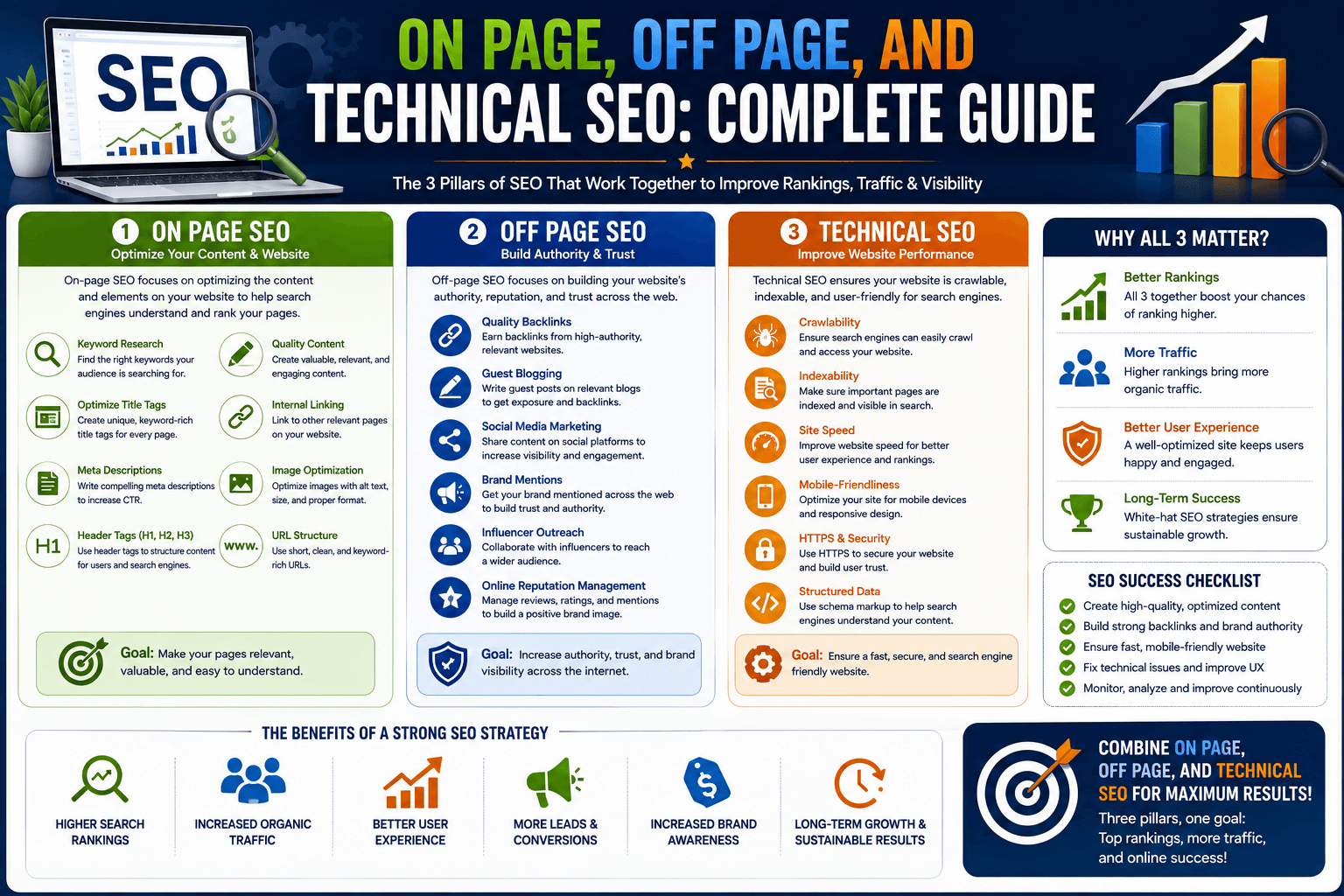
Search engine optimization is not just about adding keywords to a website. A successful SEO strategy combines three major areas: on-page SEO, off-page SEO, and technical SEO.
Each one plays a different role in improving website rankings, organic traffic, user experience, and search engine visibility.
Understanding the difference between on page off page technical SEO can help you build a stronger website and create a complete SEO strategy that supports long-term growth.
What Is SEO?
SEO, or Search Engine Optimization, is the process of improving a website so that it can appear higher in search engine results such as Google and Bing.
The main goal of SEO is to attract relevant organic visitors who are searching for your products, services, information, or solutions.
SEO can generally be divided into three core categories:
- On-page SEO
- Off-page SEO
- Technical SEO
A strong SEO campaign should include all three.
What Is On-Page SEO?
On-page SEO refers to optimization activities performed directly on your website and individual web pages.
Its purpose is to help search engines understand your content while also making the page useful and easy to navigate for visitors.
Important On-Page SEO Factors
1. Keyword Research
Keyword research helps you discover what your target audience is searching for.
You should identify:
- Primary keywords
- Secondary keywords
- Long-tail keywords
- Related search terms
- Search intent
The selected keywords should match the purpose of the page.
2. SEO Title Optimization
The SEO title is one of the most important on-page elements.
A good title should:
- Include the primary keyword
- Clearly describe the page
- Encourage users to click
- Avoid unnecessary keyword stuffing
For example:
On Page, Off Page & Technical SEO: Complete Guide
3. Meta Description
A meta description summarizes the content of a webpage.
Although it is not usually considered a direct ranking factor, a strong meta description can improve click-through rates from search results.
Keep it clear, relevant, and persuasive.
4. Heading Structure
Use headings such as H1, H2, and H3 to organize your content.
For example:
- H1: Main page topic
- H2: Major sections
- H3: Supporting topics
A logical heading structure improves both readability and search engine understanding.
5. High-Quality Content
Google aims to provide users with useful and relevant information.
Your content should:
- Answer the user’s question
- Match search intent
- Be easy to understand
- Provide meaningful information
- Avoid unnecessary repetition
- Include original insights when possible
Publishing large amounts of low-value content is unlikely to create sustainable SEO results.
6. Internal Linking
Internal links connect different pages within your website.
They help:
- Users discover related content
- Search engines crawl your website
- Distribute authority between pages
- Build topical relationships
For example, an SEO services page could internally link to pages about keyword research, local SEO, and technical SEO.
7. Image Optimization
Images should also be optimized.
Important practices include:
- Compressing image files
- Using descriptive filenames
- Adding relevant alt text
- Selecting appropriate image dimensions
- Using modern image formats where suitable
Optimized images can improve accessibility, performance, and image search visibility.
8. URL Optimization
URLs should be short, descriptive, and easy to understand.
Good example:
example.com/technical-seo/
Poor example:
example.com/page?id=8263547
What Is Off-Page SEO?
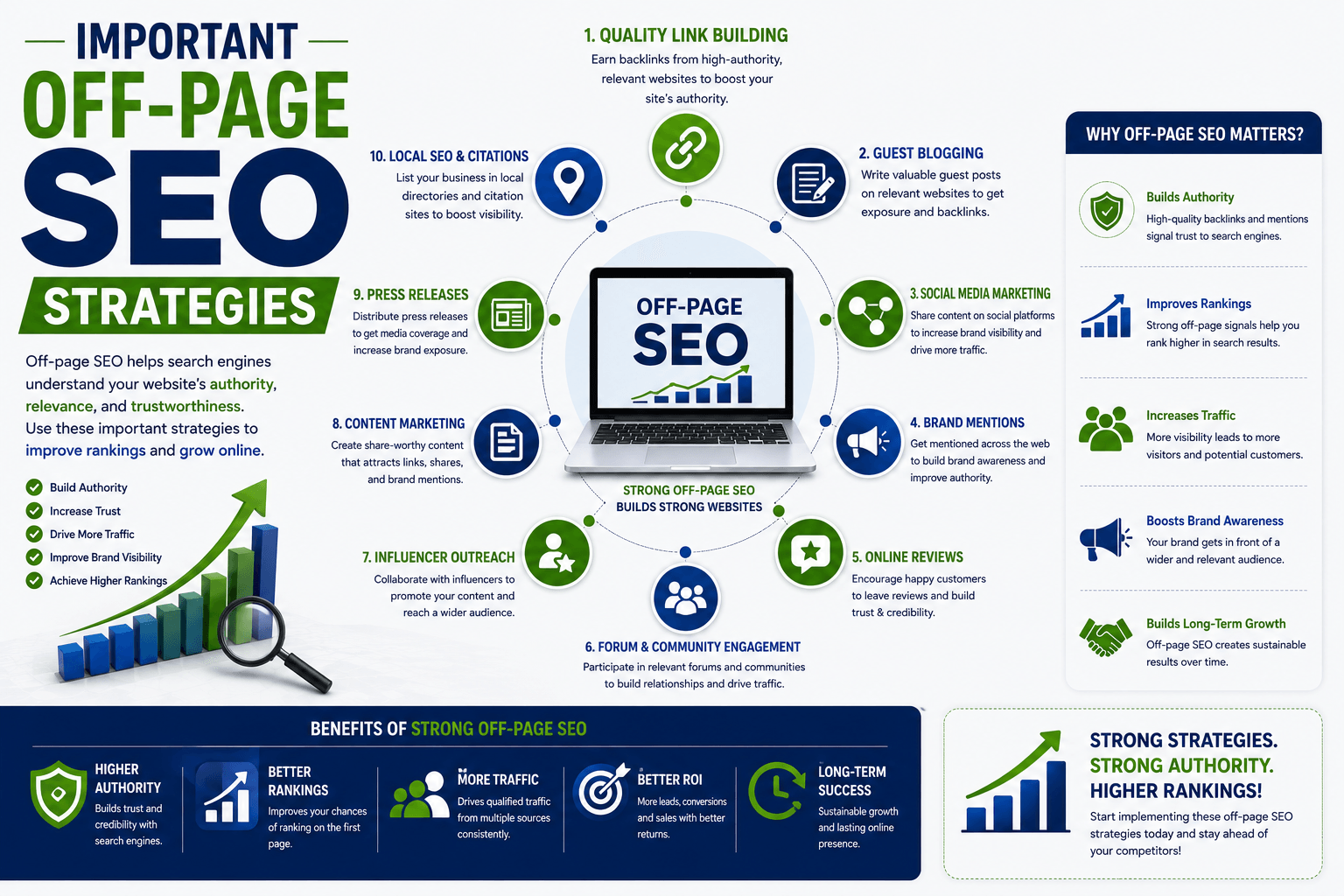
Off-page SEO refers to activities performed outside your website that help improve its authority, reputation, and visibility.
While on-page SEO focuses on your own website, off-page SEO focuses largely on how other websites, platforms, and users interact with or reference your brand.
Important Off-Page SEO Strategies
1. Backlink Building
Backlinks are links from other websites pointing to your website.
Quality backlinks can help search engines understand that other websites consider your content valuable or trustworthy.
However, backlink quality is more important than simply collecting a large number of links.
Strong backlinks typically come from:
- Relevant websites
- Authoritative publications
- Industry organizations
- Trusted blogs
- Genuine business partnerships
Avoid spammy or manipulative link-building practices.
2. Guest Posting
Guest posting involves publishing useful content on another relevant website.
When done properly, it can help with:
- Brand exposure
- Referral traffic
- Industry authority
- Relationship building
- Natural backlink acquisition
The focus should be on providing value rather than simply creating links.
3. Digital PR
Digital PR can help your company earn mentions and links from publishers, journalists, bloggers, and industry websites.
Examples include:
- Original research
- Surveys
- Industry reports
- Expert commentary
- Data studies
- Newsworthy campaigns
Digital PR can strengthen both brand visibility and authority.
4. Brand Mentions
Search engines may encounter mentions of your company even when those mentions do not contain direct links.
Building a recognizable and trusted brand across the web can support your overall online presence.
5. Social Media Marketing
Social media engagement does not automatically guarantee higher Google rankings, but it can increase the visibility and distribution of your content.
More visibility can lead to:
- Website visitors
- Brand awareness
- Natural links
- Content shares
- Business opportunities
6. Local Citations
For local businesses, citations are an important part of off-page SEO.
A citation usually includes information such as:
- Business name
- Address
- Phone number
- Website
Consistent business information across reputable directories can support local search visibility.
7. Reviews and Reputation
Customer reviews can influence trust and purchasing decisions.
For local businesses in particular, reviews can also play an important role in local search performance.
Encourage genuine customer feedback instead of purchasing or fabricating reviews.
What Is Technical SEO?
Technical SEO focuses on the technical structure and performance of your website.
Its goal is to make sure search engines can efficiently:
- Discover pages
- Crawl pages
- Render content
- Understand website structure
- Index eligible pages
A technically weak website can struggle to rank even when its content is excellent.
Important Technical SEO Factors
1. Website Crawlability
Search engine crawlers need access to important pages.
Check whether valuable content is accidentally blocked through:
- Robots.txt
- Noindex tags
- Authentication
- Broken navigation
- Incorrect redirects
Important pages should generally be accessible to search engines when you want them indexed.
2. XML Sitemap
An XML sitemap helps search engines discover important URLs.
Your sitemap should generally contain:
- Canonical URLs
- Indexable pages
- Valid URLs
- Updated pages
Avoid adding unnecessary redirects, errors, or non-indexable URLs.
3. Robots.txt
The robots.txt file provides crawling instructions to search engine bots.
Incorrect configuration can prevent important sections of your website from being crawled.
Always review robots.txt carefully before making major changes.
4. Website Speed
Page performance affects user experience and can influence search visibility.
Improve website speed by:
- Compressing images
- Reducing unnecessary scripts
- Using browser caching
- Improving server performance
- Removing unused code
- Using a content delivery network when appropriate
5. Mobile-Friendly Design
Most modern websites need to provide an excellent mobile experience.
Your site should work properly across:
- Smartphones
- Tablets
- Laptops
- Desktop computers
Responsive layouts, readable text, accessible buttons, and fast loading are particularly important.
6. HTTPS Security
Websites should use HTTPS to protect data transferred between visitors and the server.
An SSL/TLS certificate helps create a secure browsing experience.
7. Canonical Tags
Canonical tags help search engines understand which URL represents the preferred version of similar or duplicate pages.
For example:
If several URLs contain similar content, a canonical URL can indicate which version you prefer search engines to consolidate signals toward.
8. Broken Links and 404 Errors
Too many broken internal links can create a poor user experience and make crawling less efficient.
Regularly check for:
- Broken internal links
- Deleted pages
- Incorrect URLs
- Unnecessary redirect chains
Create appropriate redirects where they genuinely make sense.
9. Structured Data
Structured data provides search engines with additional information about entities and page content.
Depending on the website, appropriate schema markup may include:
- Organization
- LocalBusiness
- Product
- Article
- BreadcrumbList
- Event
- JobPosting
Only use structured data that accurately represents visible page content.
10. Core Web Vitals
Core Web Vitals are performance and user-experience measurements.
Important metrics include:
- Largest Contentful Paint
- Interaction to Next Paint
- Cumulative Layout Shift
Improving these areas can make a website faster, more stable, and easier to use.
On-Page SEO vs Off-Page SEO vs Technical SEO
| SEO Type | Main Focus | Example Activities |
|---|---|---|
| On-Page SEO | Content and webpage optimization | Keywords, titles, content, headings, internal links |
| Off-Page SEO | Authority and reputation | Backlinks, PR, mentions, citations, reviews |
| Technical SEO | Website infrastructure | Crawling, indexing, speed, sitemaps, schema |
The three areas are different, but they work together.
Why Do You Need All Three Types of SEO?
Imagine building a house.
Technical SEO is the foundation.
It makes sure the website functions correctly and can be accessed by search engines.
On-page SEO is the interior.
It provides useful information and makes each page relevant to specific searches.
Off-page SEO is the reputation of the house.
It helps establish credibility and authority beyond your website.
Ignoring any one of these areas can limit your overall SEO performance.
Which SEO Should You Do First?
A good SEO strategy usually follows this order:
Step 1: Fix Technical SEO Problems
Start by checking:
- Crawlability
- Indexing
- Website speed
- Mobile usability
- HTTPS
- Sitemaps
- Broken pages
- Redirects
- Canonical tags
There is little value in extensively optimizing pages that search engines cannot properly access or index.
Step 2: Optimize On-Page SEO
Next, improve:
- Keyword targeting
- Search intent
- Titles
- Headings
- Content quality
- Internal linking
- Images
- Conversion elements
Step 3: Build Off-Page Authority
Once your website has strong technical and content foundations, focus on:
- Quality backlinks
- Digital PR
- Partnerships
- Brand mentions
- Reviews
- Local citations
This creates a more sustainable SEO strategy.
Common SEO Mistakes to Avoid
Keyword Stuffing
Repeating keywords unnaturally can make content difficult to read.
Write naturally and cover the topic comprehensively.
Buying Low-Quality Backlinks
Large volumes of irrelevant or spammy links can create unnecessary risk.
Focus on earning relevant and credible links.
Ignoring Search Intent
A page will often struggle when its content does not satisfy what users actually want.
Analyze whether searchers want:
- Information
- A product
- A service
- A comparison
- A local business
- A tutorial
Then design the page accordingly.
Publishing Thin Content
Avoid producing pages that provide little additional value.
Aim to create content that genuinely helps the reader complete their task or make a decision.
Ignoring Technical Problems
Excellent content cannot perform at its full potential when important pages are blocked, extremely slow, duplicated, or incorrectly canonicalized.
How On-Page, Off-Page, and Technical SEO Work Together
Consider a company trying to rank for “digital marketing services.”
Its technical SEO ensures that the service page can be crawled and indexed.
Its on-page SEO ensures that the page contains helpful information about digital marketing services and matches relevant search intent.
Its off-page SEO helps establish authority through credible links, reviews, mentions, and industry relationships.
Together, these signals create a much stronger organic search presence than relying on one SEO category alone.
SEO Checklist
On-Page SEO Checklist
- Conduct keyword research
- Understand search intent
- Optimize SEO titles
- Write compelling meta descriptions
- Use proper heading structure
- Publish useful content
- Add internal links
- Optimize images
- Improve URLs
- Update outdated content
Off-Page SEO Checklist
- Earn quality backlinks
- Build industry relationships
- Use digital PR
- Publish strategic guest content
- Build brand awareness
- Generate genuine customer reviews
- Maintain local citations
- Promote useful content
Technical SEO Checklist
- Check crawlability
- Monitor indexing
- Create an XML sitemap
- Review robots.txt
- Improve website speed
- Optimize for mobile devices
- Use HTTPS
- Fix broken links
- Review canonical tags
- Implement appropriate schema markup
- Monitor Core Web Vitals
FAQs About On Page Off Page Technical SEO
What is on page off page technical SEO?
On page off page technical SEO refers to the three core areas of search engine optimization. On-page SEO improves the content and elements within a website, off-page SEO builds external authority, and technical SEO improves crawling, indexing, performance, and website infrastructure.
Why is on page off page technical SEO important?
On page off page technical SEO is important because ranking well requires more than optimized content. Search engines also need to crawl and understand your website, while your domain needs enough authority and credibility to compete for valuable keywords.
How does on page off page technical SEO work together?
On page off page technical SEO works together by improving relevance, authority, and technical accessibility. On-page SEO tells search engines what your pages are about, technical SEO helps them access and index those pages, and off-page SEO builds external trust and authority.
What is the main difference between on page off page technical SEO?
The main difference between on page off page technical SEO is the area being optimized. On-page SEO focuses on your webpages, off-page SEO focuses on external signals and authority, while technical SEO focuses on website infrastructure and search engine accessibility.
What are the main elements of on-page SEO?
Important on-page SEO elements include keyword research, search intent, title tags, meta descriptions, headings, URLs, internal linking, image optimization, content quality, topical relevance, and page structure.
What are the main elements of off-page SEO?
Off-page SEO includes backlinks, digital PR, brand mentions, guest posting, business citations, online reviews, partnerships, content promotion, and other activities that increase a website’s authority and reputation.
What are the main elements of technical SEO?
Technical SEO includes crawlability, indexing, XML sitemaps, robots.txt, canonical tags, redirects, HTTPS, mobile optimization, structured data, Core Web Vitals, website speed, and architecture.
Which should I do first: on page off page technical SEO?
When developing an on page off page technical SEO strategy, start by fixing critical technical problems that prevent crawling or indexing. Next, optimize important pages and content. Once the foundation is strong, build off-page authority through relevant links, mentions, reviews, and digital PR.
Can on page off page technical SEO improve Google rankings?
Yes. A properly implemented on page off page technical SEO strategy can improve a website’s ability to compete in organic search. It strengthens content relevance, technical accessibility, user experience, website authority, and overall search visibility.
Is keyword research part of on page off page technical SEO?
Keyword research primarily supports the on-page component of on page off page technical SEO. It helps identify what potential customers search for and allows you to create pages that match specific search terms and user intent.
Are backlinks part of on page off page technical SEO?
Yes. Backlinks belong to the off-page component of on page off page technical SEO. High-quality links from relevant and trustworthy websites can help establish authority, generate referral traffic, and strengthen a website’s overall search presence.
Is website speed part of on page off page technical SEO?
Yes. Website speed belongs mainly to the technical component of on page off page technical SEO. Faster websites can provide a better user experience and make it easier for search engines to efficiently crawl website content.
Is internal linking part of on page off page technical SEO?
Internal linking is mainly an on-page SEO activity, although it also supports technical SEO by helping search engines discover pages and understand relationships between different sections of a website.
Does content quality affect on page off page technical SEO?
Yes. Content quality is a major part of on page off page technical SEO, particularly on-page optimization. Useful, relevant, accurate, and well-structured content gives search engines more context while providing visitors with the information they need.
How can beginners improve on page off page technical SEO?
Beginners can improve on page off page technical SEO by starting with a website audit. Fix major crawling and indexing problems, conduct keyword research, optimize existing pages, improve internal links, publish valuable content, and gradually build relevant backlinks and brand mentions.
How do I audit on page off page technical SEO?
A complete on page off page technical SEO audit should evaluate content quality, keyword targeting, metadata, internal links, backlinks, domain authority signals, crawlability, indexability, site architecture, structured data, mobile usability, page speed, and Core Web Vitals.
What tools can help with on page off page technical SEO?
Several SEO tools can support on page off page technical SEO, including Google Search Console, Google Analytics, Semrush, Ahrefs, Screaming Frog, PageSpeed Insights, Bing Webmaster Tools, and keyword research platforms. Each tool provides different data for content, backlinks, rankings, crawling, or website performance.
How often should on page off page technical SEO be reviewed?
Your on page off page technical SEO performance should be monitored regularly. Technical problems can appear after website updates, rankings can change, competitors can publish new content, backlinks can change, and search behavior can evolve over time.
Can a website rank without complete on page off page technical SEO?
A website may rank for some keywords without a complete on page off page technical SEO strategy, particularly when competition is low. However, competitive websites generally benefit from combining strong content, technical foundations, and external authority.
How long does on page off page technical SEO take to work?
Results from on page off page technical SEO depend on website condition, competition, domain authority, content quality, technical issues, and keyword difficulty. Some improvements may produce results relatively quickly, while competitive SEO campaigns usually require consistent long-term work.
What is the best on page off page technical SEO strategy?
The best on page off page technical SEO strategy starts with a technically healthy website, followed by keyword-focused content that satisfies search intent. The next step is strengthening authority through relevant backlinks, digital PR, reviews, citations, and trusted brand mentions.
Is technical SEO more important than on-page SEO?
Technical SEO and on-page SEO serve different purposes. Technical SEO ensures search engines can access and process your website, while on-page SEO gives them relevant content to understand and rank. Both should be included in a complete on page off page technical SEO strategy.
Is off-page SEO still important?
Yes. Off-page SEO remains an important part of on page off page technical SEO because external links, mentions, reputation, and brand authority can help distinguish your website from competing sites with similar content.
What is an on page off page technical SEO checklist?
An on page off page technical SEO checklist typically includes keyword research, title optimization, meta descriptions, content optimization, internal links, image SEO, backlinks, brand mentions, reviews, crawl checks, XML sitemaps, canonical tags, structured data, mobile optimization, website speed, and indexing checks.
Why should businesses invest in on page off page technical SEO?
Businesses should invest in on page off page technical SEO because organic search visibility can attract potential customers throughout the buying journey. A balanced SEO strategy helps businesses increase visibility, strengthen authority, improve website usability, and generate sustainable organic traffic.
Final Thoughts
Understanding on page off page technical SEO is essential for building a complete search engine optimization strategy.
On-page SEO improves the relevance and quality of your webpages. Technical SEO ensures search engines can access, understand, and index those pages correctly. Off-page SEO strengthens your website’s authority, reputation, and visibility across the wider web.
Instead of treating these strategies separately, combine them into one integrated SEO process.
Start with a technically healthy website, create genuinely useful and well-optimized content, and then build authority through credible relationships, mentions, reviews, and backlinks.
That combination creates a stronger foundation for sustainable organic rankings, qualified website traffic, and long-term business growth.