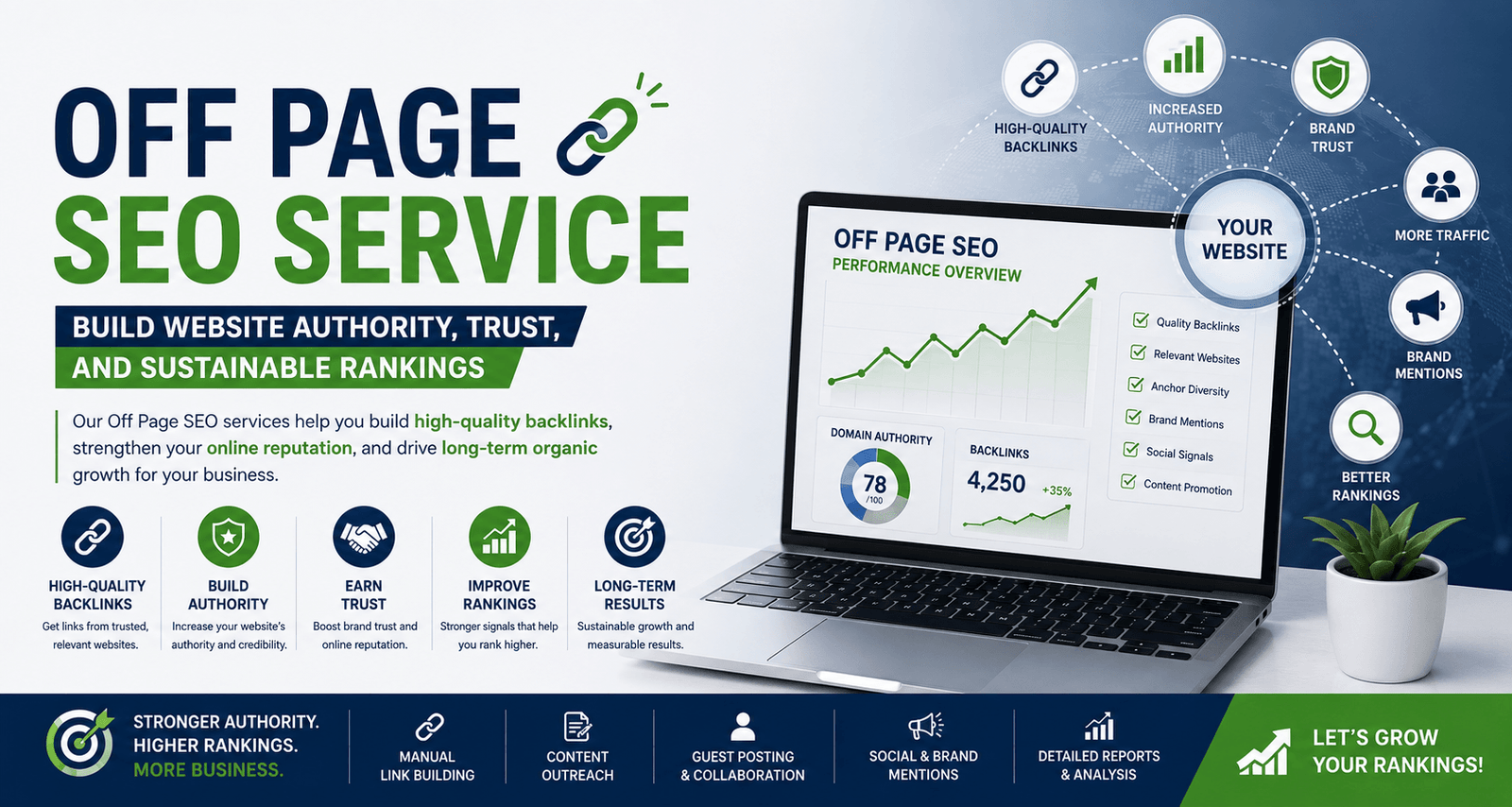
Publishing high-quality content and optimizing website pages are essential parts of SEO, but they are rarely enough to achieve strong rankings in competitive search results. Search engines also evaluate how the wider web perceives a website. They look at backlinks, brand mentions, topical authority, online reputation, and other external signals that indicate whether a website deserves visibility.
A professional off page SEO service focuses on developing these external authority signals. The objective is not simply to collect links. Effective off-page SEO strengthens the website’s reputation, improves its relevance within a specific industry, and creates a credible digital footprint that supports long-term organic growth.
For SEO professionals, agencies, website owners, and digital marketing teams, working with an experienced freelance SEO specialist can provide a more focused and transparent approach to authority building.
What Is an Off Page SEO Service?
An off page SEO service includes SEO activities performed outside the website to improve its search engine authority, credibility, and ranking potential.
On-page SEO deals with elements such as content, keywords, internal linking, metadata, page structure, and user experience. Technical SEO focuses on crawling, indexing, website speed, structured data, and technical performance. Off-page SEO strengthens the external signals that influence how search engines evaluate the website.
These external signals may include:
- Relevant backlinks from authoritative websites
- Brand mentions across trusted platforms
- Digital PR coverage
- Guest article placements
- Business citations and local listings
- Linkable asset promotion
- Expert contributions and interviews
- Review and reputation signals
- Community and industry participation
- Unlinked brand mention recovery
The strongest off-page SEO campaigns combine several of these methods instead of depending on one link-building tactic.
Why Off-Page SEO Matters for Search Rankings
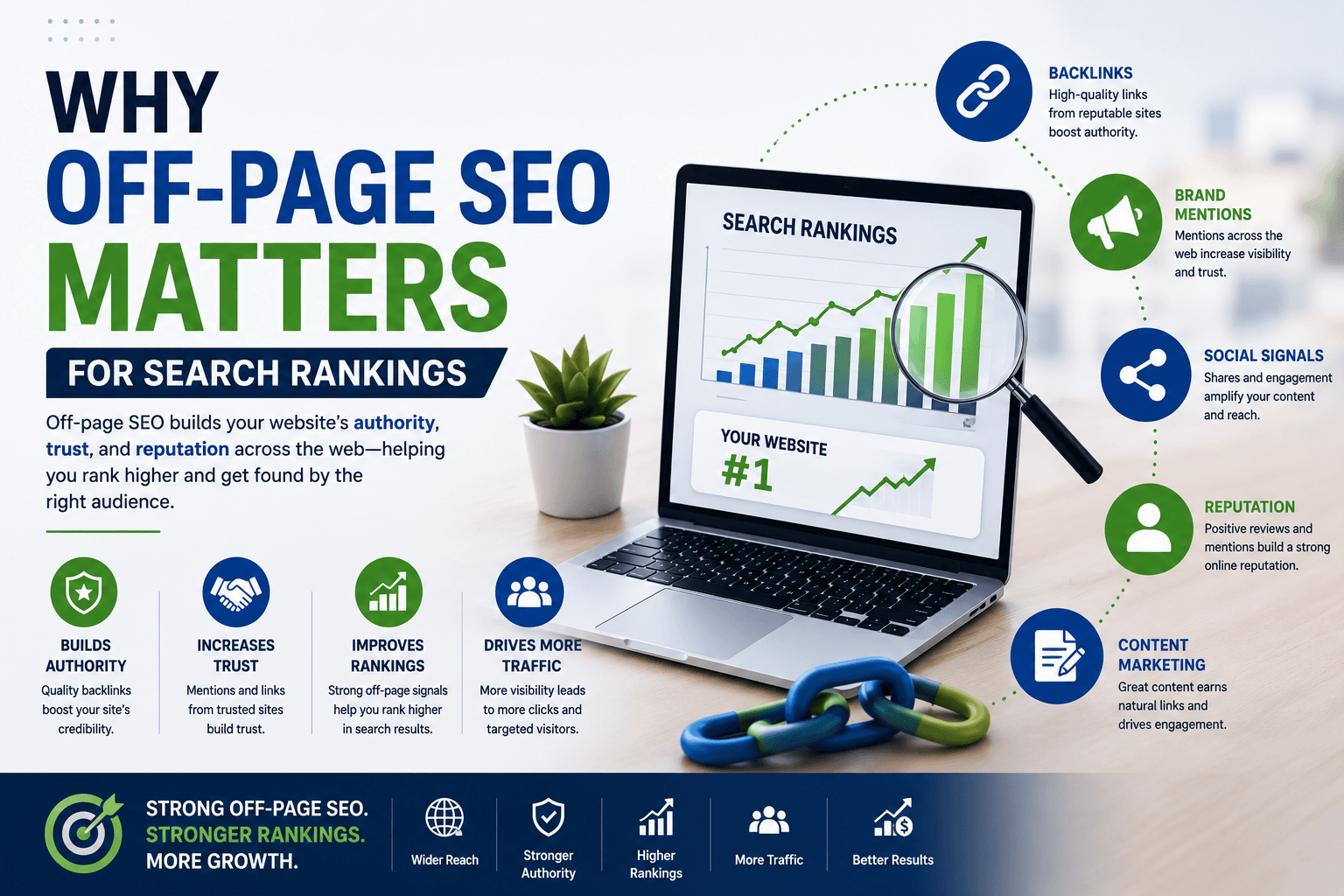
Search engines want to rank websites that demonstrate expertise, authority, relevance, and trust. A website may contain excellent content, but search engines still need external evidence that other people, publishers, companies, and industry professionals recognize its value.
Backlinks remain one of the most important external indicators because a relevant link can act as a recommendation from one website to another. However, the quality and context of the link matter significantly more than the total number of links.
For example, a backlink from a respected industry publication can provide more SEO value than dozens of links from unrelated directories or low-quality blogs. Search engines examine several factors, including:
- The authority of the linking domain
- The relevance of the referring page
- The topic surrounding the backlink
- The placement of the link within the content
- The anchor text profile
- The quality of the linking website
- The naturalness of link acquisition
- The diversity of referring domains
A strategic off page SEO service helps build these signals carefully, reducing the risk of manipulative or low-quality link patterns.
Off Page SEO Is More Than Link Building
Off-page SEO and link building are often treated as identical services, but off-page SEO has a broader scope.
Link building focuses specifically on acquiring backlinks. Off-page SEO includes link acquisition, but it also covers brand authority, online reputation, digital visibility, citations, publisher relationships, and topical recognition.
A complete off-page strategy may include:
Brand Mention Development
Search engines can identify when a brand is mentioned across websites, news platforms, industry discussions, and professional communities. Even when a mention does not include a clickable link, it may still contribute to brand recognition and entity understanding.
Digital PR
Digital PR involves creating newsworthy stories, research, expert commentary, reports, or industry insights that publishers may want to reference. This method can generate strong backlinks, brand exposure, and referral traffic.
Citation Building
For local businesses and service-based companies, consistent business information across trusted directories helps strengthen local relevance. Accurate name, address, phone number, website, and business category information can support local SEO performance.
Reputation Signals
Positive reviews, professional profiles, customer feedback, and trusted third-party references help build confidence around a business. Reputation management is particularly important for service companies, consultants, healthcare providers, legal professionals, and local businesses.
Industry Participation
Contributing useful answers, joining professional discussions, participating in interviews, or sharing expert insights can increase visibility within a niche. These activities may also create natural opportunities for mentions and backlinks.
Core Elements of a Professional Off Page SEO Service
A successful campaign should be based on research, relevance, and measurable objectives. It should not begin with mass outreach or random backlink orders.
1. Backlink Profile Audit
The first stage is reviewing the existing backlink profile. This reveals the website’s current authority, strengths, weaknesses, and possible risks.
A backlink audit usually examines:
- Total referring domains
- Link quality
- Topical relevance
- Follow and nofollow distribution
- Anchor text distribution
- Lost and newly acquired links
- Suspicious or irrelevant links
- Competitor backlink gaps
- Links pointing to important pages
- Domain and page-level authority indicators
This audit helps determine whether the website needs link cleanup, authority growth, anchor diversification, or stronger links to specific commercial pages.
2. Competitor Link Gap Analysis
Competitor analysis identifies websites that already link to competing domains but not to the target website.
These referring domains can reveal practical opportunities, such as:
- Industry publications
- Resource pages
- Business directories
- Partner websites
- Guest contribution platforms
- Review websites
- Trade associations
- News websites
- Niche blogs
- Professional organizations
The purpose is not to copy a competitor’s link profile. The purpose is to understand the authority standards within the search results and identify realistic placement opportunities.
3. Linkable Asset Planning
Publishers are more likely to link to content that offers unique value. A generic service page may be difficult to promote, while a useful resource can attract links naturally.
Examples of linkable assets include:
- Original research
- Industry statistics
- Detailed guides
- Free tools
- Templates
- Checklists
- Comparison studies
- Calculators
- Surveys
- Expert roundups
- Data visualizations
- Case studies
An off-page SEO specialist can identify which asset format is most suitable for the website’s niche, audience, and ranking goals.
4. Prospect Research
Effective outreach requires carefully selected prospects. Relevance should be prioritized over quantity.
Prospect evaluation may include:
- Website topic
- Organic visibility
- Content quality
- Publishing consistency
- Audience relevance
- Editorial standards
- Link placement history
- Website reputation
- Traffic quality
- Geographic relevance
- Spam indicators
A smaller list of highly relevant prospects usually produces better long-term results than a large list of random websites.
5. Personalized Outreach
Outreach should explain why the proposed content, resource, expert insight, or collaboration would benefit the publisher’s audience.
Strong outreach avoids generic templates that are sent to hundreds of websites without personalization. It considers:
- The publisher’s recent content
- Their audience
- Existing resource gaps
- Their editorial style
- The value of the proposed contribution
- The relevance of the target website
- The natural placement of the link
Personalized outreach improves response quality and supports genuine professional relationships.
6. Guest Posting and Expert Contributions
Guest posting can still be effective when the article is relevant, useful, editorially reviewed, and published on a credible website.
A quality guest article should:
- Match the publisher’s audience
- Provide original insights
- Avoid excessive self-promotion
- Include natural references
- Demonstrate real expertise
- Support the website’s topical authority
- Follow editorial guidelines
The goal should be to contribute valuable content rather than insert a backlink into a low-quality article.
7. Resource Page Link Building
Many websites maintain lists of useful tools, guides, organizations, or learning resources. When a website has a genuinely helpful asset, it may qualify for inclusion on these resource pages.
This tactic works best when the promoted page is detailed, accurate, and directly relevant to the resource list.
8. Broken Link Building
Broken link building involves finding outdated or unavailable resources that are still linked from other websites. A suitable replacement resource can then be suggested to the publisher.
This strategy provides value to both parties:
- The publisher can fix a broken reference.
- The target website may receive a relevant backlink.
- Readers gain access to a working and useful resource.
Success depends on having a strong replacement page rather than simply requesting a link.
9. Unlinked Brand Mention Recovery
A business or professional may already be mentioned on websites without receiving a backlink. These mentions may appear in articles, event pages, interviews, partnership announcements, or company profiles.
Contacting the publisher and requesting a link can be an efficient way to turn existing recognition into a valuable SEO signal.
10. Local Citation and Profile Optimization
For local SEO campaigns, citation consistency is important. Business information should be accurate across major directories, local platforms, industry listings, and map services.
A local off-page SEO campaign may include:
- Business profile optimization
- Local directory submissions
- Industry citation building
- Review platform optimization
- Location-specific mentions
- Local partnership links
- Chamber of commerce listings
- Regional publication outreach
These activities help strengthen geographic relevance and local trust.
Quality Backlinks Versus Low-Value Backlinks
Not every backlink improves SEO performance. Some links have little value, while others may create risk.
A quality backlink normally has several characteristics:
- It comes from a real website with useful content.
- The linking page is relevant to the target topic.
- The link appears naturally within the content.
- The website has genuine organic visibility.
- The anchor text is contextually appropriate.
- The placement provides value to readers.
- The website follows reasonable editorial standards.
Low-value backlinks often come from:
- Automated link networks
- Unrelated directories
- Spam blogs
- Scraped content websites
- Comment spam
- Forum profile links
- Private blog networks
- Repeated sitewide placements
- Irrelevant foreign-language websites
- Pages created only to sell links
A professional off page SEO service should clearly explain how websites are evaluated and how link quality is controlled.
The Importance of Topical Relevance
A backlink is more valuable when the linking website and page are related to the target website’s subject.
For example, a project management software company would benefit more from links on business technology, productivity, SaaS, operations, and management websites than from unrelated lifestyle or entertainment blogs.
Topical relevance helps search engines understand:
- What the website specializes in
- Which search topics it deserves to rank for
- How it relates to other recognized entities
- Whether industry sources consider it trustworthy
For this reason, off-page SEO should support a clearly defined topical strategy. Random links from high-metric websites are not a substitute for relevant authority.
Anchor Text Strategy and Link Profile Diversity
Anchor text is the clickable wording used in a hyperlink. Search engines use anchor text as a contextual signal, but over-optimization can create an unnatural backlink profile.
A healthy anchor profile usually contains a mixture of:
- Brand names
- Website URLs
- Generic phrases
- Page titles
- Partial-match keywords
- Descriptive phrases
- Occasional exact-match terms
For example, a freelance SEO consultant should not build every backlink using the exact phrase “off page SEO service.” A natural profile may include the consultant’s name, business name, website address, service description, and contextual phrases.
Link diversity is also important. A credible profile may include links from publications, niche websites, directories, partnerships, interviews, resource pages, and professional profiles.
Freelance Off Page SEO Service Versus SEO Agency
Both freelancers and agencies can deliver effective off-page SEO, but their working models are different.
A freelance SEO specialist often provides:
- Direct communication
- Greater campaign transparency
- Flexible project scope
- Lower operational overhead
- Customized strategy
- Faster decision-making
- Hands-on campaign management
- Easier collaboration with internal teams
An agency may provide a larger delivery team and broader service capacity. However, some agency campaigns involve multiple account managers, outreach coordinators, writers, and contractors, which can make communication less direct.
For SEO professionals who already manage strategy, content, or technical SEO internally, a freelancer can operate as a specialized extension of the existing team.
Who Can Benefit From Freelance Off Page SEO Services?
Freelance off-page SEO support can be useful for:
- SEO agencies requiring white-label link building
- In-house marketing teams
- SaaS companies
- E-commerce websites
- Local service businesses
- Affiliate website owners
- B2B companies
- Professional consultants
- Startups
- Established websites entering competitive markets
The service can be structured as a one-time campaign, monthly retainer, link acquisition project, competitor analysis, digital PR campaign, or ongoing authority-building program.
How an Off Page SEO Campaign Should Be Measured
Reporting should focus on meaningful progress rather than only the number of links acquired.
Useful performance indicators include:
- Growth in referring domains
- Quality of acquired links
- Relevance of linking websites
- Improvement in keyword positions
- Growth in organic visibility
- Increased authority of target pages
- Referral traffic
- Brand mentions
- Link acquisition rate
- Lost-link recovery
- Improvement in competitor link gaps
Rankings may not change immediately after a backlink is published. Search engines need time to discover, crawl, evaluate, and integrate the link into their ranking systems. Off-page SEO should therefore be treated as a long-term authority-building process.
Common Off Page SEO Mistakes
Several mistakes can reduce campaign effectiveness or create unnecessary risk.
Focusing Only on Domain Metrics
Third-party SEO metrics can be useful for comparison, but they should not be the only quality standard. A website may have a strong metric while receiving little organic traffic or publishing irrelevant content.
Buying Large Link Packages
Packages promising hundreds of backlinks at a low price usually prioritize volume over quality. These links are often automated, irrelevant, or placed on websites created primarily for link selling.
Using Exact-Match Anchor Text Repeatedly
Repeated keyword-rich anchor text can make the link profile appear manipulated. Anchor selection should be varied and contextually natural.
Ignoring Target Page Quality
Backlinks cannot fully compensate for weak content, poor search intent alignment, or technical problems. The target page should be useful, well-optimized, and capable of satisfying the search query.
Sending Generic Outreach
Publishers receive many poorly written link requests. Generic outreach has low response rates and can damage the sender’s professional reputation.
Building Links Without a Clear Page Strategy
Links should support specific business and SEO objectives. Building links only to the homepage may not improve the authority of important category, service, product, or content pages.
What to Expect From a Reliable Freelance SEO Specialist
A professional freelancer should provide clarity before the campaign begins.
The service should normally include:
- Initial website and backlink review
- Competitor research
- Target page selection
- Prospect qualification criteria
- Outreach strategy
- Link acquisition methods
- Anchor text planning
- Progress reporting
- Placement verification
- Recommendations for future authority growth
The freelancer should also be transparent about what cannot be guaranteed. No SEO professional can guarantee a specific ranking position because search results depend on competition, content quality, technical performance, algorithm changes, user behavior, and many other factors.
The correct objective is to improve the website’s authority and ranking potential through sustainable methods.
Why Customized Off Page SEO Performs Better
Every website has a different history, competitive environment, target market, and level of authority. A new website may need foundational citations, brand mentions, niche-relevant links, and a balanced anchor profile. An established website may need stronger editorial placements, digital PR, page-level links, or competitor gap closure.
A customized campaign considers:
- Current backlink strength
- Website age
- Industry competition
- Target keywords
- Geographic market
- Content assets
- Commercial priorities
- Link acquisition difficulty
- Budget
- Internal SEO resources
This approach creates a more efficient campaign because every activity is connected to a specific SEO objective.
Choosing the Right Off Page SEO Service
Before hiring a freelancer or agency, ask questions about their methodology.
Important questions include:
- How are backlink prospects selected?
- Are the websites manually reviewed?
- How is topical relevance evaluated?
- Which link-building methods are used?
- Are placements permanent?
- Will the campaign include content writing?
- How are anchor texts selected?
- What reporting will be provided?
- Are links acquired through genuine outreach?
- How are spam risks identified?
- Can the provider support specific landing pages?
- Are previous placement examples available?
Avoid providers who refuse to explain their process or promise unrealistic results within a very short period.
Build Authority With a Strategic Off Page SEO Service
Off-page SEO is an essential part of sustainable search growth. It helps search engines and users recognize a website as a credible source within its market.
The strongest campaigns are based on relevance, editorial quality, relationship building, useful content, and strategic link placement. They avoid shortcuts and focus on creating a backlink profile that can support rankings over the long term.
As a freelance SEO specialist, I provide customized off page SEO services for SEO professionals, agencies, businesses, and website owners who need transparent and research-driven authority building. Each campaign is designed around the website’s existing backlink profile, competitors, target pages, industry, and growth objectives.
The focus is not on collecting the highest possible number of links. The focus is on acquiring the right links, strengthening topical authority, and building a credible external SEO footprint.
Frequently Asked Questions About Off Page SEO Service
1. What is an off page SEO service?
An off page SEO service includes activities performed outside your website to improve its authority, credibility, and organic search visibility. It commonly includes backlink building, blogger outreach, guest posting, digital PR, brand mentions, citation building, competitor backlink analysis, and link profile monitoring.
2. Why does my website need an off page SEO service?
Your website needs an off page SEO service because optimized content alone may not be sufficient to rank for competitive keywords. Search engines evaluate external signals, such as relevant backlinks, brand mentions, online reputation, and industry references, to determine whether a website is trustworthy and authoritative.
3. What is included in a professional off page SEO service?
A professional off page SEO service may include:
- Backlink profile auditing
- Competitor link-gap analysis
- Manual outreach
- Guest post acquisition
- Niche edit opportunities
- Broken-link building
- Resource-page outreach
- Unlinked brand mention recovery
- Local citation building
- Digital PR campaigns
- Anchor-text planning
- Monthly backlink reporting
The exact deliverables should depend on the website’s industry, existing authority, target pages, competition, and SEO objectives.
4. Is off-page SEO the same as link building?
No. Link building is an important part of off-page SEO, but the two terms are not completely identical. Link building concentrates on acquiring backlinks, while an off page SEO service may also cover digital PR, brand authority, customer reviews, local citations, publisher relationships, expert contributions, and online reputation signals.
5. How does an off page SEO service improve rankings?
An off page SEO service improves ranking potential by obtaining external signals that demonstrate a website’s credibility and topical relevance. High-quality backlinks can strengthen the authority of the domain and individual pages, helping search engines evaluate the website as a reliable resource.
However, rankings also depend on content quality, technical SEO, search intent, user experience, competition, and website history.
6. How long does off-page SEO take to show results?
Off-page SEO usually requires several weeks or months to produce measurable results. The timeframe depends on:
- Current website authority
- Keyword competition
- Quality of existing content
- Technical website condition
- Number and quality of acquired links
- Search engine crawling and indexing
- Competitors’ SEO activities
A sustainable off page SEO service should focus on consistent authority growth rather than promising immediate rankings.
7. How many backlinks do I need to rank?
There is no fixed number of backlinks that guarantees a ranking. The required number depends on the quality and relevance of the backlinks already held by competing pages.
One authoritative and contextually relevant backlink may provide greater value than numerous low-quality links. A professional off page SEO service should therefore evaluate competitor profiles and prioritize link quality rather than setting an arbitrary backlink target.
8. What makes a backlink high quality?
A high-quality backlink normally comes from a credible website that is relevant to your industry or target topic. It should appear naturally within useful content and provide additional value to readers.
Important backlink quality factors include:
- Topical relevance
- Website reputation
- Organic search visibility
- Editorial content quality
- Natural link placement
- Appropriate anchor text
- Real audience engagement
- Referring-domain diversity
- Low spam risk
Third-party authority metrics can support backlink evaluation, but they should never be the only selection criteria.
9. Are paid backlinks safe for SEO?
Paying specifically for ranking-manipulating links can create risks, particularly when links come from spam websites, private blog networks, automated platforms, or websites created primarily to sell placements.
A reliable off page SEO service should focus on legitimate outreach, editorial opportunities, valuable content contributions, digital PR, partnerships, and relevant industry placements. Every prospective website should be manually reviewed before a link is acquired.
10. What is manual link building?
Manual link building is the process of researching relevant websites, identifying genuine opportunities, contacting publishers, and earning backlinks through personalized outreach.
Unlike automated link building, manual outreach considers the website’s audience, content quality, editorial standards, topic relevance, and potential value to readers. It is generally more time-consuming, but it produces more credible and sustainable opportunities.
11. Can an off page SEO service help a new website?
Yes. A new website can benefit from an off page SEO service, but the campaign should begin with foundational authority building. This may include professional profiles, trustworthy business citations, niche-relevant mentions, strategic partnerships, resource links, and targeted outreach.
The website should also contain useful, well-optimized content before an aggressive backlink campaign begins. Publishers are less likely to reference a website that offers limited information or weak resources.
12. Can off-page SEO improve local search rankings?
Yes. Off-page SEO can support local rankings through:
- Accurate business citations
- Google Business Profile optimization
- Local directory listings
- Customer reviews
- Regional media coverage
- Local sponsorships
- Community partnerships
- Location-relevant backlinks
- Chamber of commerce listings
A locally focused off page SEO service should maintain consistent business details across all trusted platforms.
13. Which pages should receive backlinks?
Backlinks should not point exclusively to the homepage. Depending on the campaign, links may be directed toward:
- Service pages
- Product or category pages
- Research reports
- Informational guides
- Original data
- Tools and calculators
- Case studies
- Location pages
- Linkable resources
The selected page must be useful, relevant, indexable, and aligned with the context of the referring content.
14. What anchor text should be used for backlinks?
A natural backlink profile should contain a diverse range of anchor texts, including:
- Brand-name anchors
- Website URLs
- Generic phrases
- Page titles
- Descriptive wording
- Partial-match keywords
- Limited exact-match keywords
An experienced off page SEO service provider should avoid repeatedly using the same keyword-rich anchor. Excessive exact-match anchor text can make a backlink profile appear unnatural.
15. Can off-page SEO work without quality content?
Off-page SEO is less effective when the website contains weak or incomplete content. Backlinks may bring authority and referral traffic, but visitors still need a valuable page that answers their questions and satisfies search intent.
Before starting an off page SEO service, important landing pages should be reviewed for content depth, relevance, internal linking, user experience, and conversion potential.
16. What is the difference between freelance and agency off-page SEO?
A freelance off-page SEO specialist usually offers direct communication, flexible campaign management, customized research, and hands-on execution. An agency may have a larger team and greater capacity, but communication can pass through several account-management layers.
For SEO professionals and agencies that already handle content or technical optimization, a freelance off page SEO service can function as an extension of the existing SEO team.
17. Do you provide white-label off page SEO services?
Yes, white-label off-page SEO can support agencies and independent SEO professionals that need backlink research, outreach, content coordination, publisher communication, placement verification, and client-ready reporting.
The service can be delivered under the agency’s branding while maintaining confidentiality and transparent quality standards.
18. How do I choose the right off page SEO service provider?
Before selecting a provider, ask about:
- Link-building methods
- Prospect qualification criteria
- Website relevance
- Manual review procedures
- Content-writing standards
- Anchor-text strategy
- Reporting frequency
- Placement examples
- Link replacement policies
- Communication process
Choose an off page SEO service provider that explains the strategy clearly and avoids unrealistic guarantees, secret link networks, or quantity-focused backlink packages.
19. How is off-page SEO performance measured?
Off-page SEO performance can be measured through:
- Growth in quality referring domains
- New relevant backlinks
- Improved keyword rankings
- Higher organic visibility
- Stronger target-page authority
- Referral traffic
- Brand mentions
- Competitor link-gap reduction
- Lost-link recovery
- Organic lead or conversion growth
Reports should explain the relevance and quality of each acquired placement rather than showing only the number of backlinks.
20. How can I get started with a freelance off page SEO service?
The process normally begins with a website review, backlink audit, competitor analysis, and discussion of your target pages and keywords. Based on these findings, a customized strategy can be created around relevant outreach, authority building, content promotion, and link acquisition.
A tailored off page SEO service ensures that backlinks support your wider SEO strategy instead of being acquired without a clear ranking or business objective.