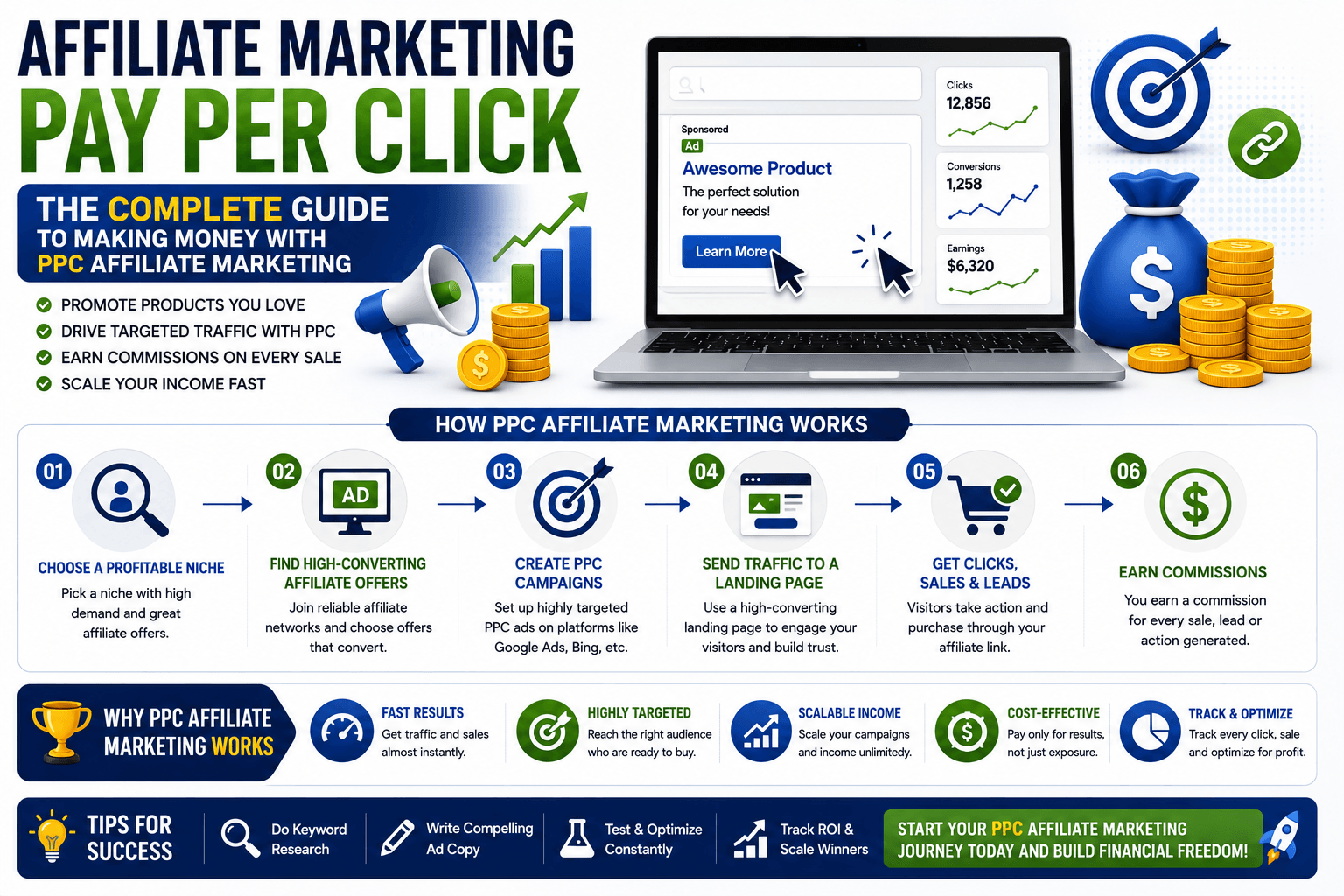
Affiliate marketing has become one of the most popular ways to make money online. At the same time, pay-per-click advertising has become one of the fastest methods of generating targeted website traffic. When these two strategies are combined, marketers can use paid advertising to promote affiliate products and potentially earn commissions from the resulting sales and leads.
This strategy is commonly known as PPC affiliate marketing or affiliate marketing pay per click.
Unlike traditional affiliate marketing, which often depends on free traffic from search engines, social media, email marketing, or content marketing, PPC affiliate marketing uses paid advertisements to bring potential customers to an affiliate offer.
However, simply paying for clicks does not guarantee profit. Successful PPC affiliate marketing requires careful research, proper keyword selection, effective advertising, conversion optimization, tracking, and financial management.
In this comprehensive guide, we will explain what affiliate marketing pay per click is, how it works, how to choose affiliate products, how to create PPC campaigns, how to calculate profitability, common mistakes to avoid, and strategies that can help beginners build a sustainable affiliate marketing business.
What Is Affiliate Marketing?
Affiliate marketing is a performance-based marketing system in which an affiliate promotes a company’s products or services in exchange for a commission.
The process is relatively simple. A company creates an affiliate program and provides affiliates with unique tracking links. The affiliate promotes those products through websites, blogs, social media, email, advertising, videos, or other marketing channels.
When a visitor clicks the affiliate’s tracking link and completes a qualifying action, the affiliate receives a commission.
Depending on the affiliate program, the desired action may include:
- Purchasing a product
- Signing up for a service
- Registering for a free trial
- Completing a lead form
- Downloading an application
- Creating an account
- Subscribing to a service
The commission structure varies from one affiliate program to another. Some programs offer a percentage of a sale, while others provide a fixed amount for each qualified lead or customer.
What Is Pay Per Click Advertising?
Pay-per-click advertising, commonly called PPC, is a form of digital advertising where an advertiser pays when someone clicks on an advertisement.
Search engines are one of the most common places where PPC advertising is used. When someone searches for a keyword, advertisements may appear above or below the organic search results.
For example, imagine a person searches for:
“best project management software”
Several companies may compete to display advertisements for that search. If the searcher clicks one of those ads, the advertiser may be charged for the click.
PPC advertising can also be used on other platforms, including social networks, display advertising networks, and shopping platforms.
The major advantage of PPC is that advertisers can reach people who are actively searching for specific products, services, or solutions.
What Is Affiliate Marketing Pay Per Click?
Affiliate marketing pay per click combines affiliate marketing with paid advertising.
Instead of waiting for people to discover affiliate content organically, an affiliate pays for advertisements designed to attract potential customers.
The basic process can be represented as:
Keyword or Audience → PPC Ad → Landing Page → Affiliate Offer → Conversion → Commission
For example, suppose an affiliate promotes a software product that pays a $50 commission for every new customer.
The affiliate creates a PPC campaign targeting people interested in that software category. Visitors click the advertisements and arrive at a landing page explaining the product. Some visitors click the affiliate link and purchase the product.
If the affiliate generates enough commissions to cover advertising costs and other expenses, the campaign can be profitable.
How Does PPC Affiliate Marketing Work?
A successful PPC affiliate campaign usually consists of several important stages.
The first step is selecting a niche.
A niche is a specific market or subject that you want to target. Instead of trying to promote every type of product, focusing on a particular category allows you to understand your audience more effectively.
Examples of affiliate marketing niches include:
- Software
- Web hosting
- Online education
- Personal finance
- Business services
- Technology
- Fitness
- Travel
- Home improvement
- Digital products
- Professional services
- E-commerce tools
The ideal niche should have enough customer demand and affiliate opportunities while still allowing you to compete effectively.
Step 2: Find a Suitable Affiliate Program
After selecting a niche, the next step is finding affiliate programs that offer relevant products.
When evaluating an affiliate program, consider several factors.
Commission Rate
The commission determines how much you can earn from each conversion.
A higher commission can make PPC advertising easier to manage, but commission rate alone should not determine whether an offer is suitable.
Product Price
A $10 product paying a 50% commission generates $5 per sale.
A $200 product paying a 20% commission generates $40 per sale.
The second product may provide more room for advertising costs.
Conversion Rate
A good product should have a strong ability to convert visitors into customers.
Even a high commission is not particularly useful if almost nobody buys the product.
Cookie Duration
Some affiliate programs track referrals for a specific period. If a visitor clicks your affiliate link today but purchases several days later, the affiliate program may still credit you with the sale if the referral remains valid.
Reputation
Always consider whether the company has a reliable reputation. Promoting poor-quality products can damage your credibility and make it difficult to build a long-term audience.
Advertising Rules
This is especially important for PPC affiliate marketing.
Some affiliate programs restrict certain forms of paid advertising. They may prohibit bidding on trademarked brand names, direct linking, certain search terms, or specific advertising platforms.
Always read the affiliate program’s terms before launching a campaign.
Understanding Search Intent
One of the most important concepts in PPC affiliate marketing is search intent.
Search intent describes the reason behind a user’s search.
For example, someone searching:
“What is project management software?”
may simply want information.
Someone searching:
“best project management software for small business”
is more likely to be researching potential products.
Someone searching:
“buy project management software”
may have an even stronger purchasing intention.
For affiliate PPC campaigns, commercial and transactional keywords can be especially valuable because they may attract people who are closer to making a purchasing decision.
Types of Keywords for Affiliate PPC
Keyword selection can have a major effect on campaign performance.
Informational Keywords
These keywords are usually used by people looking for information.
Examples include:
- What is email marketing?
- How does accounting software work?
- What is web hosting?
These searches can generate traffic, but they may not always produce immediate sales.
Commercial Investigation Keywords
These searches indicate that the user is comparing options.
Examples include:
- Best email marketing software
- Best hosting for WordPress
- Top accounting software
- Software comparison
- Best CRM for small business
These keywords can be valuable for affiliate marketers.
Transactional Keywords
Transactional searches indicate stronger purchase intent.
Examples include:
- Buy accounting software
- Purchase SEO software
- Email marketing software pricing
- CRM software discount
These keywords may be highly competitive, but they can also attract valuable visitors.
Why Keyword Research Matters
Not every click is equally valuable.
Suppose you spend $1 per click.
If 100 people click your advertisement, you spend $100.
If none of those visitors purchase the product, your revenue is $0.
But if five visitors make purchases and each sale generates $30 in commission, you earn $150.
Your advertising cost is $100, and your commission revenue is $150, producing $50 before other expenses.
This simple example shows why traffic quality matters more than traffic volume.
Creating a PPC Affiliate Landing Page
A landing page is a page designed to guide visitors toward a specific action.
Instead of immediately sending visitors to an affiliate merchant, an affiliate may use an informative landing page that explains the product and helps the visitor make an informed decision.
A good affiliate landing page may include:
- A clear headline
- A description of the problem
- The product’s main benefits
- Important features
- Advantages and disadvantages
- Comparisons
- Frequently asked questions
- Customer considerations
- A clear call to action
- Appropriate affiliate disclosure
The goal should be to provide genuine value rather than simply forcing visitors to click an affiliate link.
Writing Effective PPC Advertisements
Your advertisement is often the first thing potential customers see.
A strong PPC ad should be relevant to the user’s search and clearly communicate what the visitor can expect after clicking.
For example, instead of using a vague advertisement such as:
“Great Software Available Now”
a more relevant message might communicate the specific benefit:
“Compare Business Accounting Software — Features, Pricing & Reviews”
The exact advertising format and available features depend on the advertising platform.
Your advertisement should also comply with the platform’s advertising policies.
Understanding Cost Per Click
CPC stands for Cost Per Click.
It represents the amount paid for each click.
For example, if you spend $100 and receive 200 clicks:
CPC = $100 ÷ 200 = $0.50
Your average cost per click would be $0.50.
CPC can vary significantly depending on the niche, keyword, competition, location, audience, platform, and other factors.
Understanding Conversion Rate
Conversion rate measures the percentage of visitors who complete a desired action.
The basic formula is:
Conversion Rate = Conversions ÷ Visitors × 100
Suppose 500 people visit your landing page and 20 purchase the product.
Your conversion rate is:
20 ÷ 500 × 100 = 4%
A higher conversion rate can make a PPC campaign more profitable because you generate more conversions from the same amount of traffic.
Understanding Earnings Per Click
EPC stands for Earnings Per Click.
It is commonly used in affiliate marketing to estimate how much revenue is generated per click.
For example, if an affiliate generates $200 in commissions from 400 clicks:
EPC = $200 ÷ 400 = $0.50
If your advertising cost per click is $0.30 and your average EPC is $0.50, the campaign may have positive economics before other expenses.
However, EPC figures can be calculated differently by different affiliate networks, so always understand how the number is defined.
Understanding Return on Advertising Spend
ROAS stands for Return on Advertising Spend.
It compares advertising revenue with advertising costs.
For example, if you spend $500 on PPC advertising and generate $1,500 in affiliate commissions:
ROAS = $1,500 ÷ $500 = 3
This means you generated $3 in revenue for every $1 spent on advertising.
A positive ROAS does not automatically mean a campaign is profitable because you may have additional expenses.
Understanding Break-Even CPC
One of the most useful calculations in PPC affiliate marketing is determining your maximum break-even cost per click.
Suppose your affiliate offer produces an average commission of $100 per conversion.
If your conversion rate is 2%, then approximately two out of every 100 visitors convert.
Your expected revenue per visitor would be:
$100 × 0.02 = $2
Therefore, paying less than $2 per visitor could potentially leave room for profit before other costs.
This calculation is simplified, but it demonstrates the basic relationship between commission, conversion rate, and advertising cost.
Direct Linking vs. Landing Pages
Some affiliate marketers send PPC visitors directly to the merchant’s website using their affiliate tracking link.
This is known as direct linking.
Other marketers send visitors to their own landing page first.
Both approaches have advantages and disadvantages.
Direct Linking
Advantages may include:
- Simple setup
- Faster campaign launch
- Fewer pages to maintain
Disadvantages may include:
- Less control over the customer experience
- Limited ability to educate visitors
- Possible restrictions from affiliate programs or advertising platforms
Landing Pages
Advantages may include:
- More control over messaging
- Ability to educate visitors
- Better opportunity to pre-qualify traffic
- More testing opportunities
Disadvantages may include:
- Additional development work
- Additional costs
- More elements to optimize
The best approach depends on the affiliate program, advertising platform, product, audience, and campaign rules.
How to Track PPC Affiliate Campaigns
Tracking is essential.
Without tracking, it can be difficult to determine which keywords, advertisements, audiences, and landing pages are producing results.
Useful metrics include:
- Impressions
- Clicks
- CPC
- Click-through rate
- Conversion rate
- Affiliate commissions
- Earnings per click
- Cost per acquisition
- Return on advertising spend
- Profit
- Revenue
You can use tracking systems and analytics tools that are permitted by the relevant advertising platform and affiliate program.
A/B Testing in Affiliate PPC
A/B testing means comparing different versions of an element to determine which performs better.
For example, you could test:
- Two headlines
- Two landing pages
- Two calls to action
- Different keyword groups
- Different audience segments
- Different advertisement messages
The goal is not simply to make changes randomly. Test one meaningful variable at a time when practical so you can better understand what caused the performance difference.
Common PPC Affiliate Marketing Mistakes
Many beginners make avoidable mistakes when starting affiliate PPC campaigns.
Mistake 1: Focusing Only on Clicks
A large number of clicks does not necessarily mean a successful campaign.
The real objective is profitable conversions.
Mistake 2: Choosing Products Only Because of High Commission
A high commission does not guarantee a profitable offer.
A lower commission product with a strong conversion rate may outperform a high-commission product that rarely converts.
Mistake 3: Ignoring Advertising Costs
Always calculate how much you can afford to pay for traffic.
If your average commission is $20, you cannot continuously spend $30 to generate a sale.
Mistake 4: Ignoring Search Intent
Broad keywords can attract many visitors who have no intention of purchasing.
Targeting relevant commercial intent can help improve traffic quality.
Without reliable tracking, you may continue spending money on campaigns that lose money.
Mistake 6: Violating Affiliate Program Rules
Affiliate programs may have specific restrictions regarding paid traffic.
Breaking those rules can result in rejected commissions or account termination.
Mistake 7: Making Misleading Claims
Do not make unrealistic income claims, fake product claims, or misleading statements just to generate clicks.
Trust is essential for long-term affiliate marketing success.
How Much Money Can You Make With PPC Affiliate Marketing?
There is no fixed amount that an affiliate can earn.
Income depends on several variables, including:
- Affiliate commission
- Product price
- Conversion rate
- Advertising costs
- Traffic quality
- Keyword competition
- Landing page performance
- Audience targeting
- Campaign optimization
- Affiliate program terms
One affiliate may lose money while another marketer promoting a similar product may generate a profit because of better targeting and optimization.
For this reason, PPC affiliate marketing should be treated as a business model that requires testing and financial discipline rather than a guaranteed method of making money.
Is PPC Affiliate Marketing Good for Beginners?
PPC affiliate marketing can be attractive to beginners because it provides a relatively direct way to purchase targeted traffic.
However, beginners should understand that paid traffic carries financial risk.
If you spend $100 on advertising, you may not necessarily earn $100 back.
For this reason, beginners should start with controlled budgets, understand the numbers, follow platform policies, and learn how to analyze campaign performance before increasing spending.
Free traffic strategies such as SEO, content marketing, and social media can also complement PPC and reduce reliance on paid advertising.
PPC Affiliate Marketing vs. SEO Affiliate Marketing
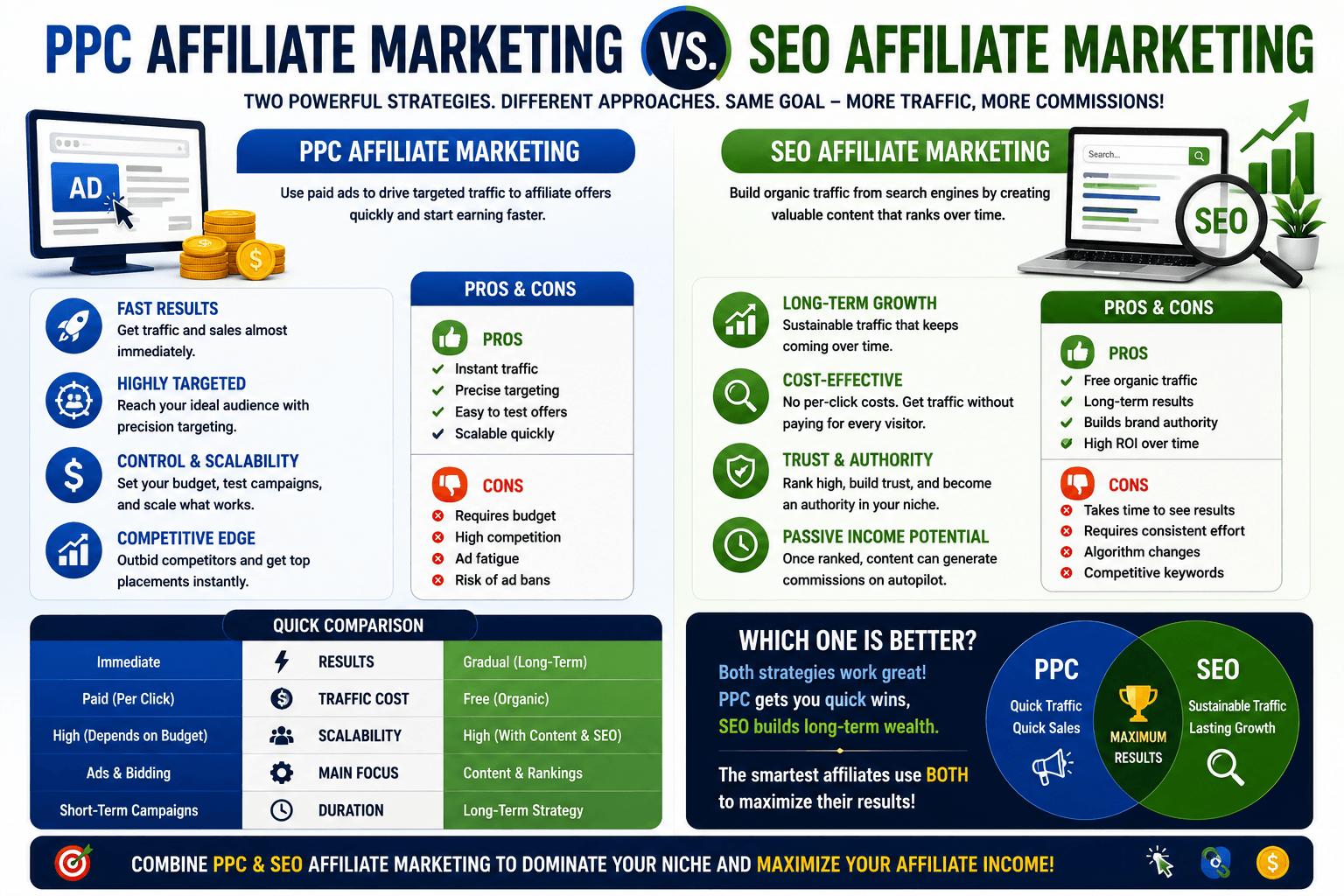
Both PPC and SEO can be used to promote affiliate products, but they operate differently.
PPC Affiliate Marketing
PPC can provide traffic quickly, but you pay for each click or other advertising action depending on the platform.
SEO Affiliate Marketing
SEO focuses on earning organic search traffic by creating useful content and improving website visibility.
SEO can take longer to produce meaningful results, but successful organic rankings may continue generating traffic without paying for every individual visitor.
Many successful affiliate marketers use a combination of both strategies.
How to Build a Long-Term PPC Affiliate Business
Building a sustainable affiliate business requires more than launching advertisements.
Start by understanding your target audience. Learn what problems they have, what products they are considering, and what questions they ask before making a purchase.
Create useful content that helps them make better decisions.
Then use PPC advertising to reach people who are most likely to benefit from your content or affiliate offers.
As you collect data, optimize your campaigns.
Over time, you may discover:
- Which keywords convert best
- Which advertisements generate quality traffic
- Which landing pages perform best
- Which products produce the highest revenue
- Which audiences are most valuable
- Which campaigns should receive more budget
- Which campaigns should be paused
This data-driven approach can make your affiliate business more efficient.
Budgeting for PPC Affiliate Marketing
Budget management is one of the most important skills for paid advertising.
Never assume that a campaign will be profitable simply because the affiliate product has a high commission.
Start with a test budget that you can afford to lose.
For example, you might establish a daily advertising limit and monitor the campaign until enough data has been collected to make an informed decision.
Do not dramatically increase spending simply because a campaign produces a few early conversions.
Likewise, do not immediately shut down every campaign after a small amount of data.
PPC optimization requires sufficient data to identify meaningful patterns.
Scaling a Profitable Campaign
Once you identify a campaign that consistently generates profitable results, you can consider scaling it.
Scaling may involve:
- Increasing the budget gradually
- Expanding keyword coverage
- Testing additional audiences
- Creating new advertisements
- Improving the landing page
- Testing related affiliate offers
- Expanding into additional markets where permitted
Scaling should be controlled.
Increasing spending too quickly can change campaign economics and cause performance to decline.
The Importance of Landing Page Optimization
Even excellent advertisements cannot compensate for a poor landing page.
A visitor may click your ad because the advertisement matches their needs, but if the landing page is confusing, slow, irrelevant, or untrustworthy, they may leave without taking action.
A strong landing page should be:
Relevant: The content should match the advertisement.
Clear: Visitors should quickly understand the offer.
Useful: The page should answer important questions.
Trustworthy: Avoid exaggerated or misleading claims.
Easy to navigate: Visitors should know what to do next.
Mobile-friendly: Many users access websites from mobile devices.
Building Trust With Affiliate Audiences
Affiliate marketing works best when visitors trust the person or website making the recommendation.
Instead of promoting every product that offers a commission, focus on products that are genuinely relevant to your audience.
Provide balanced information.
For example, an affiliate review could explain:
- What the product does
- Who it is suitable for
- Important features
- Pricing considerations
- Advantages
- Limitations
- Alternatives
- Frequently asked questions
This type of content can help visitors make informed decisions while also supporting affiliate conversions.
Affiliate Disclosure
Affiliate marketers should be transparent when they may earn a commission from recommendations.
An affiliate disclosure helps readers understand the commercial relationship between the publisher and the company being promoted.
The exact legal and platform requirements can vary depending on the marketer’s location, audience, advertising platform, and applicable regulations. Therefore, affiliates should understand the requirements that apply to their business.
The Future of PPC Affiliate Marketing
Digital advertising continues to evolve, and affiliate marketers need to adapt.
Search behavior is changing, advertising platforms are introducing new technologies, and consumers increasingly expect useful and trustworthy information before purchasing products.
Artificial intelligence, automation, audience targeting, improved analytics, and personalization may continue to influence PPC advertising.
However, the fundamental principles remain important:
Reach the right audience.
Provide genuine value.
Track performance.
Control costs.
Optimize based on data.
Follow advertising and affiliate policies.
These principles can help marketers build campaigns that are more sustainable over time.
Affiliate Marketing Pay Per Click FAQ
What is affiliate marketing pay per click?
Affiliate marketing pay per click is a strategy that combines affiliate promotions with paid advertising. Affiliates use PPC ads to attract targeted visitors to products or services. When those visitors complete a qualifying action, the affiliate can earn a commission.
How does affiliate marketing pay per click work?
Affiliate marketing pay per click works by selecting an affiliate offer, researching relevant keywords, creating advertisements, and directing potential customers to a landing page or affiliate website. When a visitor purchases the promoted product or completes a required action, the affiliate receives a commission.
Is affiliate marketing pay per click profitable?
Yes, affiliate marketing pay per click can be profitable when the commission earned is higher than the total cost of advertising. Marketers need to carefully monitor CPC, conversion rates, commissions, and campaign expenses to determine whether their campaigns are generating a positive return.
How do I start affiliate marketing pay per click?
To start affiliate marketing pay per click, choose a profitable niche, find a suitable affiliate program, select products with good earning potential, research buyer-intent keywords, create relevant advertisements, and build a useful landing page. Start with a small advertising budget and track your results.
What are the best PPC platforms for affiliate marketing?
The best PPC platform depends on your niche, audience, products, and advertising goals. Search advertising can be useful for reaching people who are actively looking for products, while other paid advertising platforms can help reach audiences based on interests and behavior. Always check the current advertising policies before promoting affiliate offers.
How much does affiliate marketing pay per click cost?
There is no fixed cost. PPC costs depend on the platform, keyword competition, niche, audience, location, and campaign settings. Some clicks may be inexpensive, while competitive commercial keywords can cost significantly more.
What is CPC in affiliate marketing?
CPC means cost per click. It represents the amount an advertiser pays when a user clicks an advertisement. In affiliate marketing, keeping CPC under control is important because advertising costs directly affect the potential profit from affiliate commissions.
What is EPC in affiliate marketing?
EPC means earnings per click. It is a useful affiliate marketing metric that estimates how much revenue is generated from clicks. Comparing EPC with your average PPC cost can help you understand whether your paid traffic strategy may be profitable.
What keywords should I target for affiliate PPC?
Focus on keywords that closely match the product and show commercial or transactional intent. Examples include “best,” “review,” “comparison,” “pricing,” “alternative,” and “buy” keywords. The best keyword strategy depends on the product and target audience.
Can beginners use affiliate marketing pay per click?
Beginners can use affiliate marketing pay per click, but they should understand that paid advertising involves financial risk. Start with a small test budget, learn how campaign tracking works, and avoid increasing spending until you have reliable performance data.
Do I need a website for PPC affiliate marketing?
A website is not always required, depending on the affiliate program and advertising platform. However, a landing page can provide valuable information, improve visitor trust, and give you greater control over the customer journey.
Can I use Google Ads for affiliate marketing?
This depends on the current Google Ads policies and the rules of the specific affiliate program. Some promotional methods may be restricted. Affiliates should review the relevant policies before creating advertisements or bidding on branded keywords.
How can I increase my affiliate PPC conversion rate?
You can improve conversion rates by targeting relevant keywords, matching advertisements with search intent, creating useful landing pages, testing different headlines and calls to action, and removing poorly performing traffic sources.
What is the difference between PPC and SEO affiliate marketing?
PPC affiliate marketing uses paid advertising to attract visitors, while SEO affiliate marketing focuses on generating organic search traffic. PPC can produce traffic quickly, whereas SEO generally takes longer to develop but can generate ongoing organic visitors.
How can I reduce PPC costs?
To reduce unnecessary PPC costs, improve keyword targeting, use relevant advertisements, monitor search terms, remove irrelevant traffic, improve landing-page quality, and regularly analyze campaign performance. Better targeting can help you spend your budget more efficiently.
How much money can I make with affiliate marketing pay per click?
There is no guaranteed income level. Earnings depend on your affiliate commission, traffic volume, conversion rate, CPC, product price, and campaign optimization. Some marketers may generate profits, while others may lose money if their advertising costs are too high.
What are common affiliate PPC mistakes?
Common mistakes include choosing poor-quality affiliate products, targeting irrelevant keywords, ignoring search intent, spending too much too quickly, failing to track conversions, using weak landing pages, and violating affiliate or advertising platform policies.
How do I know if my PPC affiliate campaign is profitable?
Compare your total affiliate revenue with your advertising and other campaign expenses. Metrics such as conversion rate, CPC, EPC, cost per acquisition, and return on advertising spend can help you understand campaign performance.
Can I scale affiliate marketing pay per click campaigns?
Yes, profitable campaigns can potentially be scaled gradually. You can test additional keywords, increase budgets carefully, expand relevant audiences, and create new advertisements. Scaling should be based on performance data rather than assumptions.
Is affiliate marketing pay per click a good long-term strategy?
It can be a useful long-term strategy when campaigns are managed carefully. Sustainable results require continuous testing, accurate tracking, quality affiliate products, controlled advertising costs, and compliance with advertising and affiliate program policies.
What is the most important factor in affiliate marketing pay per click?
The most important factor is profitability. Choosing the right offer, targeting the right audience, controlling PPC costs, improving conversion rates, and tracking results all contribute to building a successful affiliate marketing pay per click campaign.
Conclusion
Affiliate marketing pay per click can be a powerful digital marketing strategy when paid traffic and affiliate commissions are managed carefully.
The concept is straightforward: choose a suitable affiliate offer, identify potential customers, create relevant advertisements, send targeted traffic to a useful destination, track conversions, and optimize the campaign based on real performance data.
However, PPC affiliate marketing is not a guaranteed shortcut to online income. Advertising costs can quickly reduce profits if campaigns are poorly targeted or inadequately tracked.
The most successful approach is to treat PPC affiliate marketing as a measurable business process. Research your niche, understand search intent, select quality affiliate products, create useful landing pages, monitor your numbers, follow advertising policies, and make decisions based on reliable data.
With patience, testing, and disciplined budget management, PPC can become an important part of a broader affiliate marketing strategy.