Running a small business in Luton comes with exciting opportunities, but attracting new customers in a competitive market can be challenging. Whether you operate a local shop, restaurant, construction company, salon, or professional service business, having a strong online presence is essential for long-term growth.
Today, customers often search on Google before choosing a local business. They might look for a nearby plumber, compare digital marketing agencies, or search for the best restaurant in their area. If your business does not appear in relevant search results, potential customers may choose your competitors instead.
This is why SEO for Luton small businesses is an important part of a successful digital marketing strategy. Search engine optimisation helps local companies improve their website visibility, reach relevant audiences, and generate more enquiries without relying entirely on paid advertising.
In this guide, we will explore ten practical SEO strategies, explain common mistakes, and show how small businesses in Luton can build a stronger online presence.
What Is SEO for Small Businesses?
Search engine optimisation, commonly known as SEO, is the process of improving a website so that it can appear more prominently in relevant search engine results.
For small businesses, SEO involves several activities, including:
- Keyword research
- Website optimisation
- Technical SEO
- Local SEO
- Content creation
- Google Business Profile optimisation
- Link building
- Performance monitoring
Unlike paid advertising, organic SEO focuses on earning visibility in unpaid search results. However, it requires consistent work and does not guarantee immediate rankings.
For a company serving customers in Luton, a targeted strategy should focus on the services it provides, the locations it genuinely serves, and the questions potential customers search for online.
Why Is SEO Important for Luton Small Businesses?
Small businesses often have limited marketing budgets. Therefore, investing in activities that attract relevant customers can make a significant difference.
Here are some important reasons to consider SEO.
1. Reach More Local Customers
Many customers search online when they need a nearby product or service. Optimising your website for relevant local searches can help your business become easier to discover.
2. Build Trust and Credibility
A professional website with helpful content, accurate business information, and genuine customer reviews can create a positive first impression.
3. Generate More Enquiries
SEO can bring visitors who are actively searching for your products or services. Clear contact details and useful service pages can encourage them to call or request a quotation.
4. Reduce Dependence on Paid Advertising
Paid advertising can deliver immediate visibility, but traffic generally depends on ongoing advertising spend. Organic search can provide another source of website visitors over time.
5. Compete With Larger Companies
A small business does not always need to compete nationally. By focusing on relevant local services and customer needs, it can target specific search opportunities in its area.
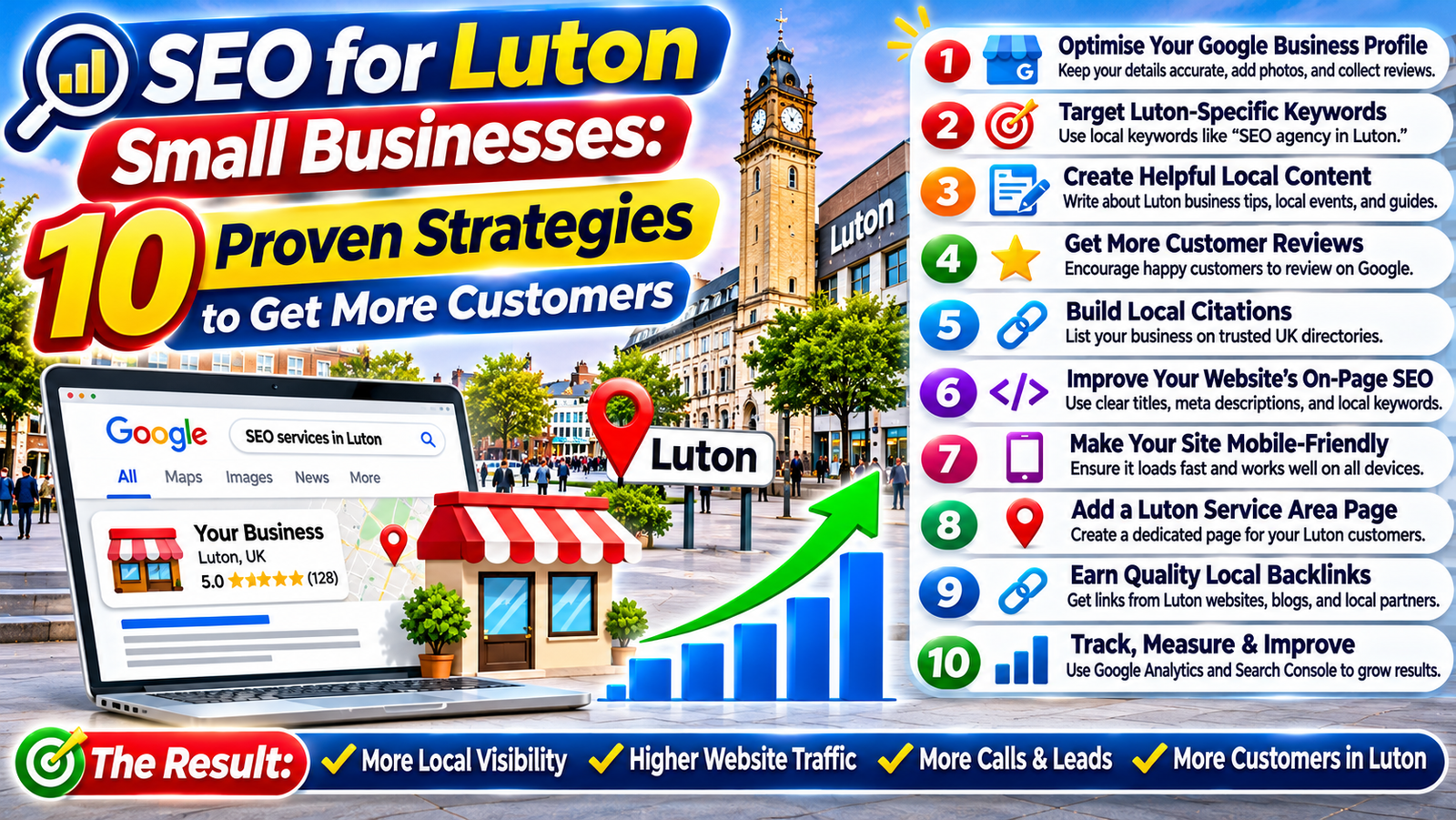
10 Proven SEO Strategies for Luton Small Businesses
A successful SEO campaign does not depend on one technique. Instead, several activities should work together to improve your website and online reputation.
1. Research the Right Local Keywords
Keyword research helps you understand what potential customers type into Google when looking for products or services.
For example, a small business in Luton may target keywords such as:
- SEO services Luton
- Web design Luton
- Plumber in Luton
- Electrician Luton
- Restaurant in Luton
- Accountant Luton
- Digital marketing agency Luton
However, do not choose keywords simply because they contain the word Luton. They should also match your actual services and customer search intent.
Use tools such as Google Keyword Planner, Google Search Console, and SEO platforms to identify relevant search terms.
Practical tip: Create a keyword list for each service. This makes it easier to build focused website pages instead of targeting every keyword on one page.
2. Optimise Your Google Business Profile
Google Business Profile is an important tool for eligible local businesses. It allows your business information to appear on Google Search and Google Maps.
To improve your profile:
- Use your real business name.
- Select the most relevant business category.
- Add accurate contact information.
- Include your actual address or service areas.
- Update opening hours regularly.
- Upload genuine business photographs.
- Add your website link.
- Respond professionally to customer reviews.
Keep your information accurate and avoid adding unnecessary keywords to your business name.
A complete and well-maintained profile can make it easier for potential customers to discover and contact your business.
3. Create Dedicated Service Pages
One common mistake among small businesses is placing every service on a single website page.
If your company offers several services, create individual pages explaining each one.
For example, a Luton-based digital marketing company could create:
- SEO Services in Luton
- Website Design in Luton
- WordPress Development in Luton
- Google Ads Management in Luton
- Social Media Marketing in Luton
Each page should include a clear description, benefits, relevant information, and a call to action.
Avoid creating multiple pages with almost identical content. Every page should provide genuine value to visitors.
4. Make Your Website Mobile-Friendly
Many customers use smartphones to search for local businesses. If your website is difficult to navigate on a mobile device, visitors may leave before contacting you.
Check that:
- Text is easy to read.
- Buttons are easy to tap.
- Contact details are visible.
- Images display correctly.
- Navigation works properly.
- Forms are simple to complete.
- Pages load efficiently.
A mobile-friendly website provides a better user experience and supports your wider SEO strategy.
5. Publish Helpful and Relevant Content
Content marketing allows small businesses to answer customer questions and demonstrate their expertise.
Instead of publishing only promotional articles, create useful content related to your services.
For example:
| Business Type | Suggested Blog Topics |
|---|---|
| Plumber | Common Plumbing Problems and When to Call a Professional |
| Restaurant | How to Choose a Restaurant for Family Dining in Luton |
| Digital Agency | SEO Tips for Small Businesses in Luton |
| Electrician | Electrical Safety Checks Every Homeowner Should Know |
| Accountant | Basic Tax Planning Tips for Small Business Owners |
| Web Designer | What Should a Small Business Website Include? |
Helpful content can attract relevant visitors and create opportunities to link readers to your service pages.
6. Build Consistent Business Listings
Online business listings, also known as citations, can help customers find and verify your business information.
Make sure your business name, address, and phone number are accurate across relevant platforms.
Potential listing opportunities include:
- Google Business Profile
- Bing Places
- Apple Business Connect
- Yell
- Thomson Local
- Relevant UK business directories
- Industry-specific directories
Do not submit your website to hundreds of low-quality directories. Focus on legitimate platforms that are relevant to your industry and customers.
7. Collect Genuine Customer Reviews
Customer reviews influence how people evaluate a business before making a purchase.
Encourage satisfied customers to share honest feedback on relevant platforms, particularly your Google Business Profile.
You can improve your review process by:
- Asking customers for feedback after completing a service.
- Sharing a direct review link.
- Responding politely to positive reviews.
- Addressing negative feedback professionally.
- Using feedback to improve customer service.
Never purchase fake reviews or offer rewards in exchange for positive ratings. Genuine customer experiences are more valuable for building long-term trust.
8. Improve Website Speed and Technical SEO
Technical problems can affect how search engines access and understand your website.
Important improvements include:
- Using HTTPS security.
- Fixing broken links.
- Creating an XML sitemap.
- Checking indexing issues.
- Compressing large images.
- Improving page loading performance.
- Using descriptive page titles.
- Writing unique meta descriptions.
- Maintaining a logical website structure.
If your website uses WordPress, plugins such as Rank Math can help manage several on-page SEO elements.
You should also use Google Search Console to monitor indexing, search performance, and technical issues.
9. Earn Relevant Backlinks
Backlinks are links from other websites pointing to your website. Relevant and trustworthy backlinks can support your website’s authority.
Small businesses can explore opportunities such as:
- Partnering with other local businesses.
- Sponsoring genuine community activities.
- Joining relevant business associations.
- Contributing expert articles.
- Supporting local events.
- Publishing useful resources that other websites may reference.
Focus on relevance and quality rather than the total number of links. Avoid buying large quantities of low-quality backlinks.
10. Track SEO Performance Regularly
SEO should be measured using meaningful performance data.
Useful tools include:
Google Search Console: Monitor search impressions, clicks, queries, indexing, and website performance.
Google Analytics 4: Understand website visitors, engagement, and conversion activity.
Google Business Profile Performance: Review available information about customer interactions, website clicks, calls, and other profile activity.
Rank Math SEO: Check on-page SEO elements, metadata, focus keywords, and technical recommendations within WordPress.
Review your performance every month. Identify pages that attract visitors, keywords that generate impressions, and areas that need improvement.
How Much Does SEO Cost for a Small Business in Luton?
The cost of SEO varies depending on your business size, website condition, competition, and marketing objectives.
A small business with a simple website may need basic optimisation. However, a company targeting several services or competitive search terms may require ongoing SEO management.
Common SEO services include:
- Website SEO audit
- Local keyword research
- On-page optimisation
- Technical SEO
- Google Business Profile management
- Service page development
- Content writing
- Citation management
- Link-building activities
- Monthly performance reports
When comparing SEO providers, ask for a clear breakdown of deliverables. Understand what work is included and how progress will be measured.
Be cautious of agencies that promise guaranteed first-page rankings or instant results.
Local SEO vs Traditional SEO for Small Businesses
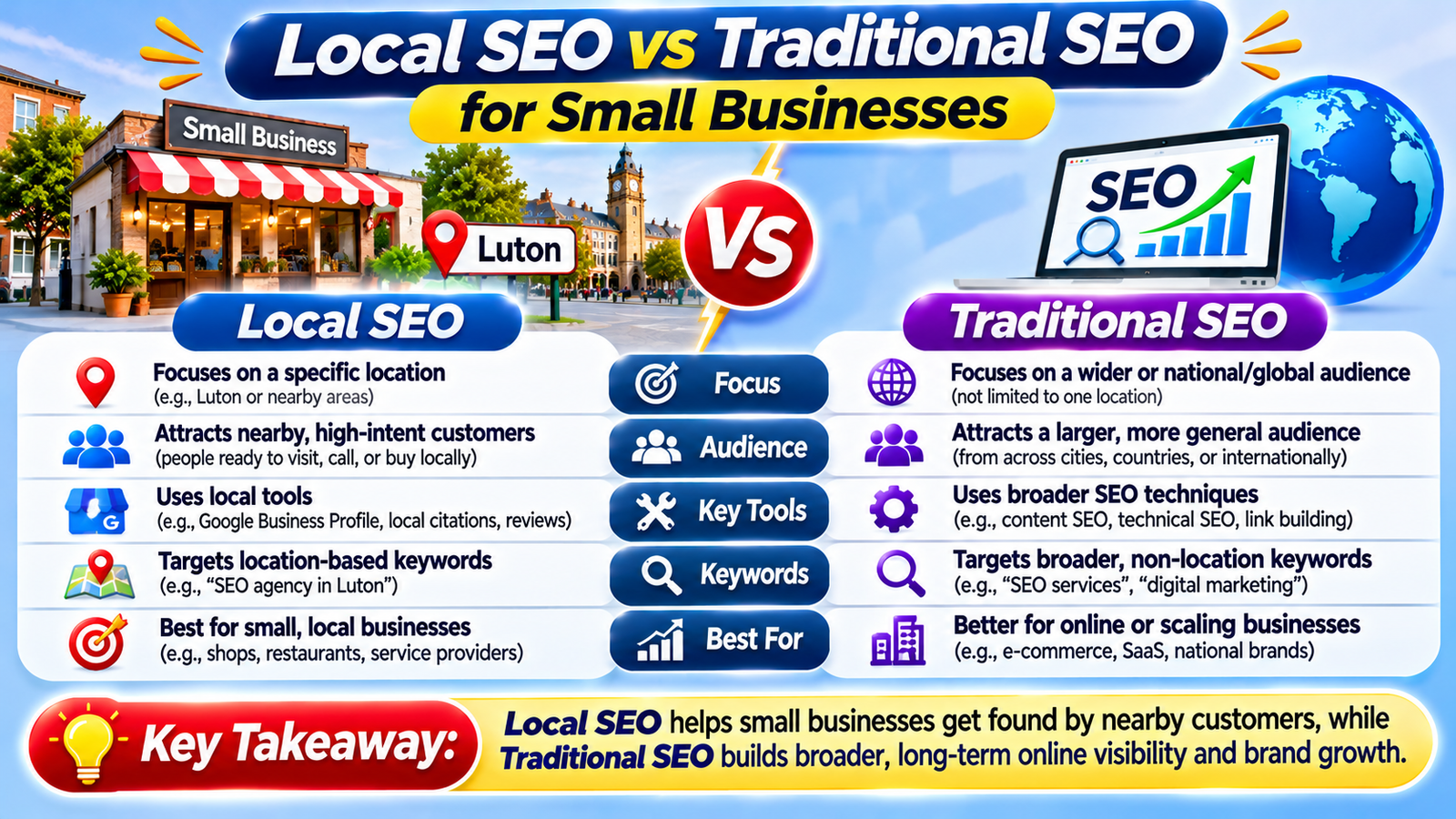
Both local and traditional SEO aim to improve organic search visibility, but they serve different purposes.
| Feature | Local SEO | Traditional SEO |
|---|---|---|
| Target Audience | Customers in specific areas | Wider audiences |
| Geographic Focus | Towns and cities | National or international |
| Google Maps | Important | Usually less important |
| Business Listings | Often important | Less central |
| Local Reviews | Useful for reputation | May support trust |
| Main Objective | Local enquiries and customers | Broader organic visibility |
A business that serves customers directly in Luton should generally include local SEO as part of its wider search strategy.
Common SEO Mistakes Small Businesses Should Avoid
Even a well-designed website can struggle to attract organic traffic if important SEO fundamentals are ignored.
Here are some common mistakes:
1. Targeting Too Many Keywords on One Page
Each page should have a clear purpose. Trying to target unrelated services and keywords on one page can make the content confusing.
2. Ignoring Local Search Intent
If your business serves Luton customers, make sure your website clearly explains your services and genuine service areas.
3. Publishing Low-Quality Content
Content should answer real customer questions. Avoid publishing repetitive articles created only to include keywords.
4. Neglecting Website Maintenance
Broken links, outdated contact details, slow pages, and technical problems can create a poor user experience.
5. Buying Low-Quality Backlinks
Unnatural link-building practices can create risks. Focus on earning relevant and trustworthy links.
6. Not Measuring Results
Website traffic and rankings are useful indicators, but businesses should also monitor enquiries, calls, quotation requests, and sales.
How to Choose an SEO Agency for Your Small Business
Managing SEO requires time, knowledge, and regular attention. Some business owners prefer to handle the basics themselves, while others choose professional support.
Before hiring an SEO agency, consider the following:
- Does the agency understand your industry?
- Can it explain its SEO strategy clearly?
- Does it provide transparent pricing?
- Are deliverables clearly defined?
- Does it use ethical SEO practices?
- Does it provide regular performance reports?
- Can it explain how success will be measured?
Choose a provider that understands your business objectives rather than one that focuses only on ranking reports.
A Simple 90-Day SEO Plan for Luton Small Businesses
A structured plan can help small business owners start improving their online visibility without trying to do everything at once.
| Period | Main Activities |
|---|---|
| Days 1–30 | Website audit, keyword research, Google Business Profile review, technical checks |
| Days 31–60 | Service page optimisation, local content, citation updates, review process |
| Days 61–90 | Relevant link-building, performance analysis, content improvements, conversion tracking |
This is a practical starting framework, not a guaranteed ranking timeline. The amount of work required will depend on your website and competition.
Conclusion
Building a strong online presence is important for small businesses competing in Luton. A well-planned SEO strategy can help potential customers discover your services, understand what makes your business valuable, and contact you when they need assistance.
SEO for Luton small businesses should combine relevant keyword research, Google Business Profile optimisation, useful website content, technical improvements, genuine customer reviews, and quality backlinks.
Start with the fundamentals, focus on your customers’ needs, and measure your progress consistently. With time and the right approach, your business can build stronger organic visibility and create more opportunities for sustainable growth.
Frequently Asked Questions About SEO for Luton Small Businesses
1. What Is SEO for Luton Small Businesses?
SEO for Luton small businesses is a digital marketing strategy that helps small companies improve their Google rankings and online visibility. SEO for Luton small businesses focuses on attracting local customers through relevant keywords, website optimisation, and local search strategies.
2. Why Is SEO for Luton Small Businesses Important?
SEO for Luton small businesses is important because it helps local companies reach potential customers who are actively searching for their services. A strong SEO for Luton small businesses strategy can increase website traffic, improve brand awareness, and generate more enquiries.
3. How Can SEO for Luton Small Businesses Increase Sales?
SEO for Luton small businesses can attract relevant visitors who are interested in purchasing products or services. By improving website content, service pages, and search visibility, SEO for Luton small businesses can create more opportunities to convert visitors into customers.
4. How Much Does SEO for Luton Small Businesses Cost?
The cost of SEO for Luton small businesses depends on competition, website condition, and campaign requirements. Professional SEO for Luton small businesses may include keyword research, technical SEO, content writing, local SEO, and monthly reporting.
5. How Long Does SEO for Luton Small Businesses Take to Show Results?
SEO for Luton small businesses requires consistent effort. Some improvements can be implemented quickly, but stronger rankings and organic traffic usually take time. A successful SEO for Luton small businesses campaign should focus on long-term growth rather than instant results.
6. What Are the Best SEO Services for Luton Small Businesses?
The best SEO services for Luton small businesses include local keyword research, on-page SEO, technical optimisation, content marketing, Google Business Profile management, and quality link building. These activities support an effective SEO for Luton small businesses strategy.
7. Can SEO for Luton Small Businesses Improve Google Rankings?
Yes. SEO for Luton small businesses can improve website relevance, content quality, and technical performance. A well-optimised website has a better opportunity to appear in relevant search results, although specific rankings cannot be guaranteed.
8. Is Local SEO Part of SEO for Luton Small Businesses?
Yes. Local SEO is an important part of SEO for Luton small businesses. It helps eligible businesses improve visibility in location-based searches and connect with customers searching for nearby services.
9. How Can SEO for Luton Small Businesses Generate More Website Traffic?
SEO for Luton small businesses can generate organic traffic through relevant keywords, helpful blog articles, optimised service pages, and technical improvements. These activities help potential customers discover your business through Google.
10. Should I Hire an Agency for SEO for Luton Small Businesses?
Hiring an agency for SEO for Luton small businesses can help manage keyword research, website optimisation, content creation, and performance monitoring. Choose a provider that understands your business goals and offers transparent SEO services.
11. Which Keywords Are Important for SEO for Luton Small Businesses?
Important keywords for SEO for Luton small businesses depend on the services you provide. Examples include SEO services Luton, web design Luton, digital marketing Luton, plumber in Luton, and accountant Luton.
12. Can SEO for Luton Small Businesses Generate More Leads?
Yes. SEO for Luton small businesses can attract people searching for specific products and services. Optimised landing pages, useful information, and clear contact details can help convert organic visitors into potential leads.
13. Does Google Business Profile Help SEO for Luton Small Businesses?
Yes. Google Business Profile supports SEO for Luton small businesses by helping eligible companies manage their information on Google Search and Maps. Accurate business details, relevant categories, and genuine reviews can improve customer discovery.
14. How Important Is Content Writing for SEO for Luton Small Businesses?
Content writing is an important part of SEO for Luton small businesses. Helpful articles, service descriptions, and frequently asked questions can answer customer queries and improve the usefulness of your website.
15. Can SEO for Luton Small Businesses Work Without Paid Advertising?
Yes. SEO for Luton small businesses focuses on improving organic search visibility without paying for every click. However, businesses still need to invest time and resources in website improvements, content, and optimisation.
16. What Is the Difference Between SEO and PPC for Luton Small Businesses?
SEO for Luton small businesses focuses on organic search visibility, while PPC uses paid advertisements to reach potential customers. Both can be included in a wider digital marketing strategy.
17. Do Customer Reviews Support SEO for Luton Small Businesses?
Customer reviews support SEO for Luton small businesses by contributing to business prominence and helping customers evaluate a company. Encourage genuine feedback and respond professionally to reviews.
18. How Can I Improve My Website for SEO for Luton Small Businesses?
To improve your website for SEO for Luton small businesses, use relevant keywords, create helpful content, optimise page titles, improve mobile usability, fix technical problems, and make contact information easy to find.
19. Which Tools Are Useful for SEO for Luton Small Businesses?
Useful tools for SEO for Luton small businesses include Google Search Console, Google Analytics 4, Google Keyword Planner, Google Business Profile, and Rank Math SEO. These tools help monitor website performance and identify optimisation opportunities.
20. Is SEO for Luton Small Businesses Worth the Investment?
SEO for Luton small businesses can be a valuable investment for companies that depend on online searches to attract customers. A consistent strategy can improve visibility, build credibility, and create long-term marketing opportunities.
21. Can New Companies Benefit From SEO for Luton Small Businesses?
Yes. New companies can benefit from SEO for Luton small businesses by building an online presence, researching relevant keywords, creating service pages, and publishing useful content from the beginning.
22. How Does Technical SEO Support SEO for Luton Small Businesses?
Technical SEO supports SEO for Luton small businesses by improving website speed, mobile usability, indexing, security, and site structure. These improvements help search engines access and understand website content.
23. Why Choose Professional SEO for Luton Small Businesses?
Professional SEO for Luton small businesses provides structured keyword research, technical optimisation, content planning, and performance reporting. It can help business owners manage their online marketing more effectively.
24. How Can SEO for Luton Small Businesses Compete With Larger Companies?
SEO for Luton small businesses can focus on specific services, local customer needs, relevant search terms, and niche markets. This approach allows smaller companies to target valuable opportunities within their local market.
25. How Do I Get Started With SEO for Luton Small Businesses?
Start SEO for Luton small businesses by auditing your website, researching local keywords, optimising your Google Business Profile, improving service pages, publishing helpful content, and monitoring results through Google Search Console. A consistent SEO for Luton small businesses strategy can support sustainable online growth.