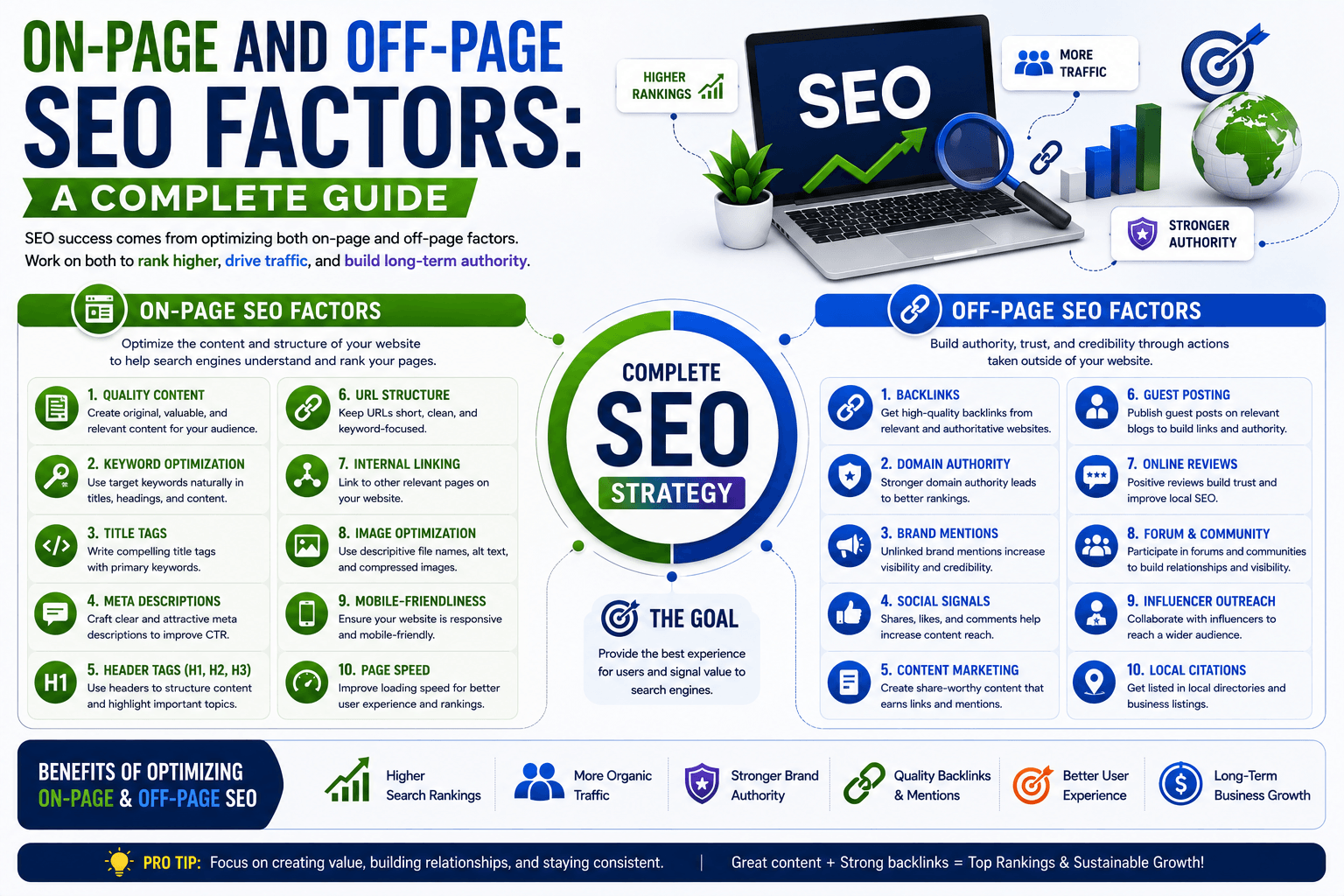
On Page and Off Page SEO Factors are essential elements of a successful search engine optimization strategy. Understanding these factors helps website owners improve search visibility, increase organic traffic, and build stronger online authority. On-page SEO focuses on optimizing elements within your website, such as content, keywords, title tags, headings, internal links, images, page speed, and user experience. Off-page SEO focuses on external activities such as backlinks, brand mentions, guest posting, digital PR, reviews, and social media promotion.
In this article, we will explore the most important On Page and Off Page SEO Factors, understand how they work, and explain how combining both strategies can help improve your website’s search engine performance.
Understanding both on-page and off-page SEO factors is essential for building a balanced and effective search optimization strategy.
What Is On-Page SEO?
On-Page SEO refers to all optimization activities performed directly on a website or webpage. Its purpose is to help search engines understand the content of a page while also improving the experience for visitors.
On-page SEO includes content optimization, keyword usage, headings, internal links, images, URLs, website speed, and several other elements.
Important On-Page SEO Factors
1. High-Quality Content
Content is one of the most important on-page SEO factors. Search engines aim to provide users with pages that answer their questions and satisfy their search intent.
Good website content should be:
- Original and useful
- Relevant to the target audience
- Easy to understand
- Well organized
- Accurate and trustworthy
- Updated when necessary
Instead of creating content only for search engines, websites should focus on providing genuine value to readers.
2. Keyword Research
Keyword research helps businesses understand what people are searching for online.
Choosing appropriate keywords allows website owners to create content around topics that potential customers are actively interested in.
Keywords may include:
- Primary keywords
- Secondary keywords
- Long-tail keywords
- Related terms
- Location-based keywords
For example, a digital marketing company may target keywords such as SEO services, digital marketing agency, or local SEO services.
3. Keyword Placement
After selecting appropriate keywords, they should be used naturally throughout the webpage.
Important places for keyword placement include:
- Page title
- H1 heading
- Subheadings
- First paragraph
- Main body content
- Image alt text
- URL
- Meta description
Keywords should never be inserted unnaturally simply to increase their frequency. Excessive repetition can reduce content quality and make a page difficult to read.
4. Title Tag Optimization
The title tag is an important element that describes the main subject of a webpage.
A strong title should be:
- Relevant to the page
- Easy to understand
- Descriptive
- Attractive to users
- Naturally optimized for the primary keyword
For example:
On-Page and Off-Page SEO Factors: Complete SEO Guide
A clear title can help users understand what the page offers before clicking it.
5. Meta Description
A meta description provides a short summary of the webpage and may appear below the page title in search results.
An effective meta description should clearly communicate the value of the page and encourage users to visit it.
For example:
Learn the most important on-page and off-page SEO factors, including content optimization, backlinks, keywords, internal links, website speed, and more.
6. Heading Tags
Proper heading structure helps organize content and makes pages easier to scan.
Common heading levels include:
- H1 for the main page title
- H2 for major sections
- H3 for supporting topics
- H4 for additional subsections
Headings should follow a logical structure and clearly describe the content that follows them.
7. SEO-Friendly URLs
URLs should be simple, descriptive, and relevant to the page.
For example:
Good URL:
example.com/on-page-off-page-seo-factors
Poor URL:
example.com/page.php?id=938472
Clear URLs help users understand the page topic and make website structures easier to manage.
8. Internal Linking
Internal links connect one webpage to another page on the same website.
For example, an article about SEO factors may link to additional pages about:
- Keyword research
- Technical SEO
- Link building
- Content marketing
- Local SEO
Internal linking helps users discover related information and helps search engines understand the relationships between different pages.
9. External Linking
External links point visitors from your website to relevant pages on other websites.
Linking to authoritative and trustworthy sources can provide readers with additional information and support claims made within an article.
External links should be relevant and useful rather than added unnecessarily.
10. Image Optimization
Images improve the visual quality of webpages, but they should also be optimized.
Important image SEO practices include:
- Using descriptive filenames
- Compressing large images
- Adding descriptive alt text
- Choosing appropriate file formats
- Using correctly sized images
- Avoiding unnecessary large files
Image optimization can improve accessibility, page performance, and overall user experience.
11. Website Speed
Page speed is an important part of website usability.
Visitors are more likely to leave a website when pages take too long to load.
Businesses can improve website performance by:
- Compressing images
- Reducing unnecessary scripts
- Using caching
- Improving hosting performance
- Minimizing unnecessary code
- Using efficient website technology
A faster website creates a better experience for both desktop and mobile users.
12. Mobile-Friendliness
A large percentage of internet searches happen on mobile devices.
Websites should therefore work properly across:
- Smartphones
- Tablets
- Laptops
- Desktop computers
Text should be readable, buttons should be easy to use, and layouts should adapt to different screen sizes.
13. User Experience
A well-optimized website should also be easy to navigate.
Important user experience factors include:
- Clear navigation
- Readable content
- Logical page structure
- Fast loading
- Mobile responsiveness
- Accessible buttons and links
- Helpful calls to action
A positive experience encourages visitors to explore additional pages and engage with the website.
14. Content Freshness
Some topics change over time, so older articles may need to be updated.
Website owners should periodically review important pages to:
- Update statistics
- Remove outdated information
- Improve explanations
- Add new sections
- Replace broken links
- Refresh examples
Keeping important content accurate improves its usefulness to readers.
What Is Off-Page SEO?
Off-Page SEO refers to optimization activities that happen outside your website.
Its main purpose is to improve the website’s authority, credibility, visibility, and reputation across the internet.
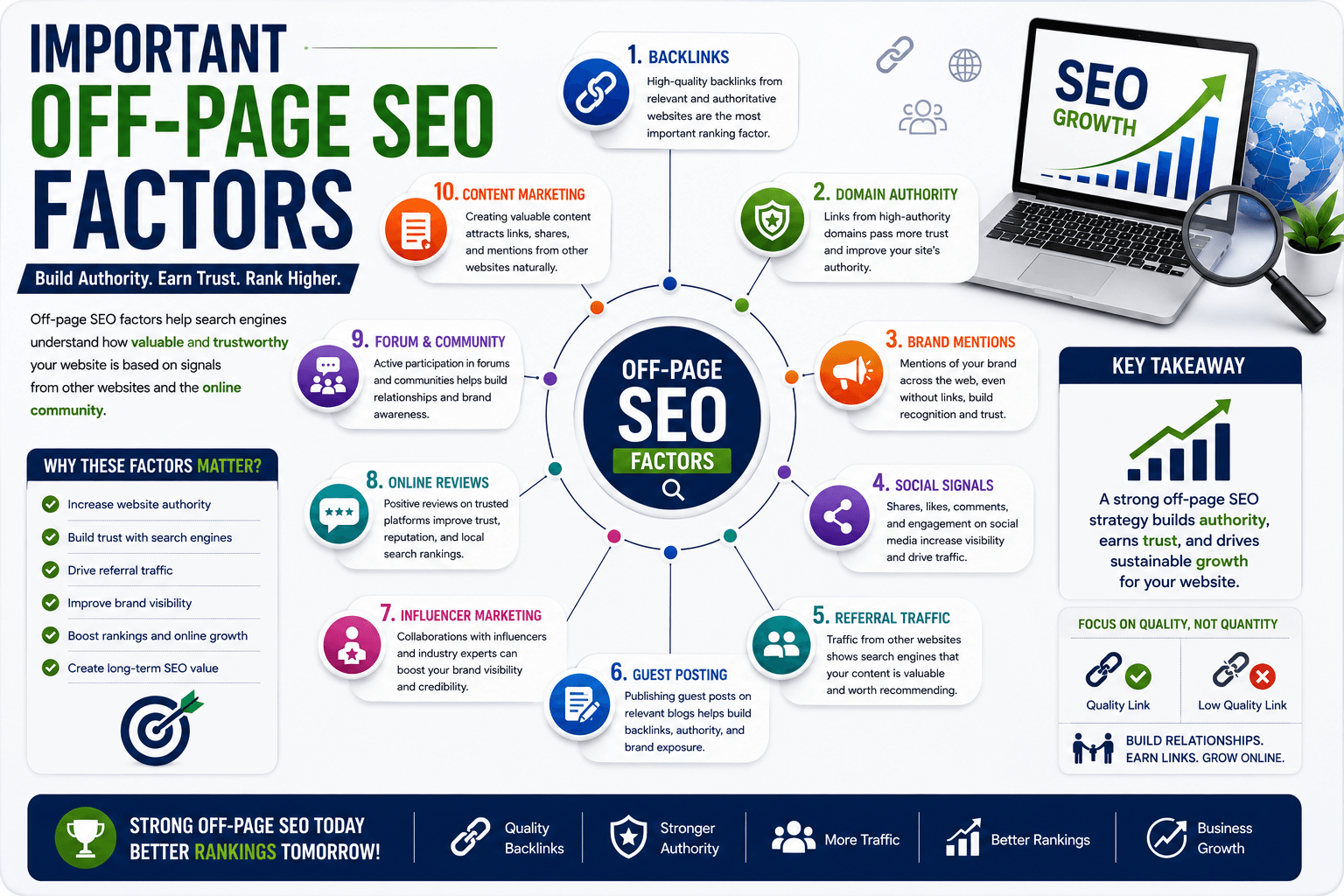
Off-page SEO includes backlinks, brand mentions, digital PR, reviews, social media promotion, guest posting, and other external activities.
Important Off-Page SEO Factors
1. Quality Backlinks
Backlinks are links from other websites that point to your website.
They are one of the best-known off-page SEO factors because they can act as indicators that other websites consider your content valuable or relevant.
However, quality is more important than quantity.
A valuable backlink usually comes from a website that is:
- Relevant to your niche
- Trustworthy
- Authoritative
- Legitimate
- Editorially appropriate
Hundreds of low-quality links may be less valuable than a smaller number of strong and relevant backlinks.
2. Referring Domain Quality
The websites linking to your pages also matter.
Links from respected industry websites, educational resources, recognized publications, professional organizations, and other credible sources can be more valuable than links from unrelated or low-quality websites.
A natural backlink profile usually contains links from multiple relevant domains.
3. Guest Posting
Guest posting involves creating content for another website.
A well-executed guest posting strategy can help businesses:
- Reach new audiences
- Build relationships
- Establish expertise
- Generate referral traffic
- Earn relevant links
Guest posts should be written for readers rather than created only for acquiring backlinks.
4. Brand Mentions
Brand mentions occur when other websites or online communities discuss a company, product, or website.
Even when every mention does not contain a direct backlink, increased brand visibility can support a company’s overall online reputation.
Businesses can earn mentions through:
- Useful content
- Public relations
- Events
- Research
- Partnerships
- Expert commentary
- Industry participation
5. Social Media Promotion
Social media can increase the reach of website content.
Businesses can distribute articles, videos, guides, infographics, case studies, and other resources through social platforms.
Greater exposure can lead to:
- More visitors
- More content shares
- Brand awareness
- New partnerships
- Potential backlink opportunities
Social media should therefore be considered part of a broader content promotion strategy.
6. Online Reviews
Customer reviews are especially important for businesses serving local customers.
Positive reviews can strengthen credibility and influence how potential customers perceive a company.
Businesses should encourage genuine customer feedback and respond professionally to reviews.
Review manipulation or fake reviews should be avoided.
7. Local Citations
Local citations are online references to business information such as:
- Business name
- Address
- Phone number
- Website
- Business category
Accurate and consistent information across relevant local directories and platforms can support local search visibility.
8. Digital PR
Digital PR involves earning online coverage from journalists, publications, bloggers, and industry websites.
Popular digital PR strategies include:
- Publishing original research
- Sharing expert opinions
- Creating industry reports
- Developing useful tools
- Providing journalists with data
- Announcing meaningful company developments
Successful digital PR campaigns can generate visibility, referral traffic, brand mentions, and valuable backlinks.
9. Influencer and Industry Outreach
Building relationships with influencers, bloggers, publishers, and industry experts can help a brand reach wider audiences.
Outreach may involve:
- Content collaborations
- Expert interviews
- Product reviews
- Joint campaigns
- Research partnerships
- Industry discussions
The goal should be to build genuine professional relationships rather than simply requesting backlinks.
10. Forum and Community Participation
Relevant online communities can help businesses build credibility and reach interested audiences.
This may include:
- Industry forums
- Professional communities
- Question-and-answer platforms
- Social groups
- Niche discussion communities
Businesses should contribute helpful information rather than repeatedly posting promotional links.
11. Content Marketing
High-quality content can naturally support off-page SEO because useful resources are more likely to be shared and referenced.
Examples of link-worthy content include:
- Research reports
- Tutorials
- Original statistics
- Case studies
- Infographics
- Industry guides
- Free tools
- Templates
Creating valuable resources can make backlink acquisition more natural.
12. Competitor Backlink Analysis
Analyzing competitor backlinks can help identify potential link-building opportunities.
Businesses may discover:
- Industry directories
- Resource pages
- Publications
- Blogs
- Partnership opportunities
- Relevant websites
Competitor analysis should be used for research rather than simply copying every backlink a competitor has earned.
Difference Between On-Page and Off-Page SEO Factors
The key difference is where the optimization activity takes place.
On-page SEO factors exist primarily on your own website. These include content, keywords, titles, headings, internal links, images, URLs, website speed, and mobile usability.
Off-page SEO factors involve external signals and activities. These include backlinks, brand mentions, reviews, guest posts, digital PR, social promotion, and citations.
For example, optimizing the title and content of a blog article is an on-page SEO activity. When another reputable website links to that article, the backlink becomes an off-page SEO factor.
Why Are Both Important?
On-page and off-page SEO complement each other.
A website with strong backlinks but poor content may struggle to provide a useful visitor experience. Similarly, a website with excellent content but little authority or external recognition may find it difficult to compete in highly competitive search results.
An effective SEO strategy should therefore combine:
- High-quality content
- Proper keyword optimization
- Strong website structure
- Good technical performance
- Quality backlink acquisition
- Brand-building activities
- Digital PR
- Reputation management
Frequently Asked Questions About On Page and Off Page SEO Factors
1. What are On Page and Off Page SEO Factors?
On Page and Off Page SEO Factors are optimization elements that help improve a website’s visibility in search engines. On-page factors include content, keywords, headings, URLs, internal links, images, and page performance. Off-page factors include backlinks, brand mentions, reviews, citations, guest posting, and digital PR.
2. Why are On Page and Off Page SEO Factors important?
On Page and Off Page SEO Factors are important because they help improve both the relevance and authority of a website. On-page SEO helps search engines understand your content, while off-page SEO helps establish your website’s reputation across the web.
3. What are the main On Page and Off Page SEO Factors?
The main On Page and Off Page SEO Factors include keyword optimization, quality content, title tags, meta descriptions, headings, internal links, page speed, mobile usability, backlinks, online reviews, brand mentions, local citations, and digital PR.
4. How do On Page and Off Page SEO Factors improve SEO?
On Page and Off Page SEO Factors support SEO in different ways. On-page optimization improves the structure, relevance, and usability of your webpages, while off-page optimization helps build authority, trust, and online visibility.
5. Which On Page and Off Page SEO Factors are most important?
Some of the most important On Page and Off Page SEO Factors are high-quality content, search intent, keyword placement, internal linking, website speed, mobile-friendliness, authoritative backlinks, brand mentions, and genuine customer reviews.
6. How can beginners improve On Page and Off Page SEO Factors?
Beginners can improve On Page and Off Page SEO Factors by starting with quality content and basic website optimization. Use relevant keywords naturally, optimize titles and headings, create internal links, improve website speed, and make pages mobile-friendly. For off-page SEO, focus on earning relevant backlinks and building a trustworthy online presence.
7. Are backlinks part of On Page and Off Page SEO Factors?
Yes. Backlinks are an important part of On Page and Off Page SEO Factors, specifically off-page SEO. A backlink is created when another website links to your website. Relevant and trustworthy backlinks can help strengthen a website’s authority.
8. Is content optimization part of On Page and Off Page SEO Factors?
Content optimization is one of the most important On Page and Off Page SEO Factors, particularly within on-page SEO. Useful, original, and well-structured content helps search engines understand the topic of a webpage and provides value to users.
9. How does keyword research support On Page and Off Page SEO Factors?
Keyword research supports On Page and Off Page SEO Factors by helping website owners understand what their audience searches for. These keywords can guide content creation, page optimization, link-building campaigns, and other SEO activities.
10. Can On Page and Off Page SEO Factors increase organic traffic?
Yes. Properly optimizing On Page and Off Page SEO Factors can increase a website’s potential to attract organic traffic. Strong content and website optimization help pages become more relevant to searches, while backlinks and other external signals can strengthen authority.
11. How often should On Page and Off Page SEO Factors be reviewed?
On Page and Off Page SEO Factors should be reviewed regularly as part of an ongoing SEO strategy. Website owners should update outdated content, check technical performance, improve internal links, review backlinks, and monitor changes in organic search performance.
12. What is the difference between On Page and Off Page SEO Factors?
The difference between On Page and Off Page SEO Factors is where the optimization takes place. On-page SEO involves improvements made directly to your website, while off-page SEO involves external activities designed to increase authority, visibility, and reputation.
13. Do On Page and Off Page SEO Factors work together?
Yes. On Page and Off Page SEO Factors work best when they are used together. Strong on-page optimization creates valuable and search-friendly pages, while off-page SEO helps those pages gain authority and exposure through links, mentions, reviews, and promotion.
14. How can small businesses use On Page and Off Page SEO Factors?
Small businesses can use On Page and Off Page SEO Factors to improve their visibility in relevant searches. They can optimize service pages, target local keywords, improve website performance, collect genuine reviews, build local citations, and earn links from relevant websites.
15. What are common mistakes with On Page and Off Page SEO Factors?
Common mistakes when optimizing On Page and Off Page SEO Factors include keyword stuffing, duplicate content, poor internal linking, slow page speed, low-quality backlinks, irrelevant guest posting, and focusing on search engines instead of users.
Conclusion
On-page and off-page SEO factors both play important roles in improving a website’s organic search performance.
On-page SEO focuses on optimizing content, keywords, titles, headings, URLs, internal links, images, speed, and user experience. Off-page SEO focuses on establishing authority and credibility through backlinks, brand mentions, reviews, guest posts, digital PR, citations, and content promotion.
Instead of focusing on only one side of SEO, businesses should develop a balanced strategy. Creating useful, well-optimized content establishes a strong foundation, while earning credible mentions and backlinks helps strengthen the website’s reputation.
When on-page and off-page SEO work together, a website has a stronger opportunity to increase organic visibility, attract qualified visitors, and achieve sustainable growth in search results.