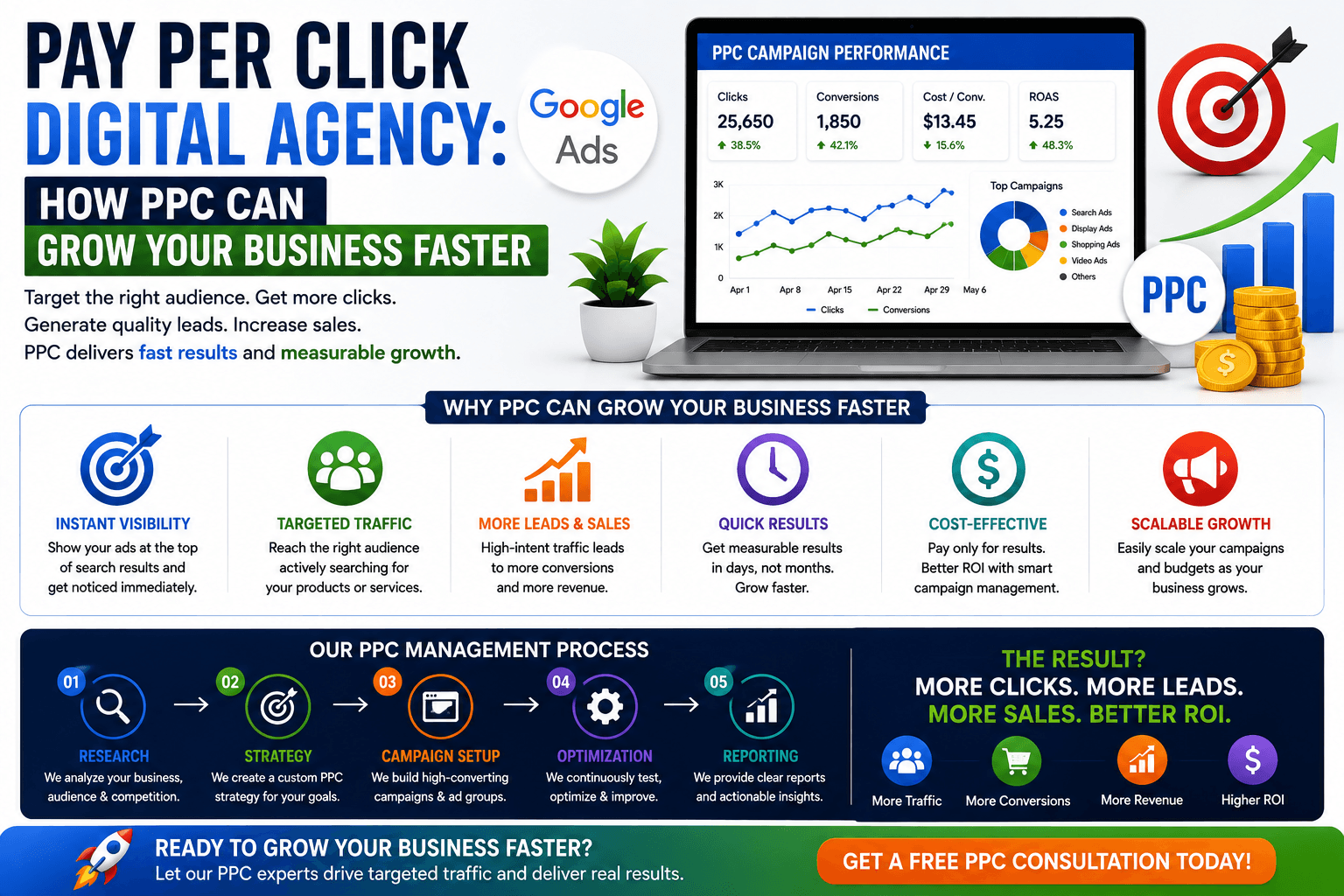
In a competitive digital market, businesses cannot always afford to wait months for customers to discover them organically. This is where a pay per click digital agency can make a significant difference.
Pay-per-click advertising, commonly known as PPC, allows businesses to place targeted ads in front of potential customers who are actively searching for their products or services. Instead of paying simply to display an advertisement, businesses generally pay when someone clicks on the ad.
When PPC campaigns are properly planned and managed, they can generate qualified website traffic, leads, phone calls, online sales, and measurable business growth.
What Is a Pay Per Click Digital Agency?
A pay per click digital agency is a marketing company that specialises in planning, creating, managing, and optimising paid advertising campaigns.
These agencies typically work across advertising platforms such as:
- Google Ads
- Microsoft Advertising
- Facebook Ads
- Instagram Ads
- YouTube Ads
- LinkedIn Ads
- Display advertising networks
- Shopping advertising platforms
The main goal is not simply to generate clicks. A professional PPC agency focuses on attracting the right people and converting that traffic into valuable business results.
For example, if you operate a plumbing company in Chicago, thousands of random website visitors may not be valuable. However, appearing when someone searches for “emergency plumber near me” could bring a potential customer who needs your service immediately.
That difference is what makes strategic PPC management important.
How Does Pay Per Click Advertising Work?
PPC advertising usually operates through an auction system.
Advertisers select keywords, audiences, locations, interests, demographics, or other targeting signals. When a relevant advertising opportunity appears, the platform determines which advertisements should be displayed.
Several factors can influence whether your ad appears, including:
- Your bid
- Ad relevance
- Landing page experience
- Competition
- Expected click-through rate
- Ad quality
- User search intent
This means the advertiser offering the highest amount does not necessarily win every advertising position.
A well-structured campaign with highly relevant advertisements and landing pages can often compete more effectively than a poorly optimised campaign with a larger budget.
Why Businesses Hire a PPC Digital Agency
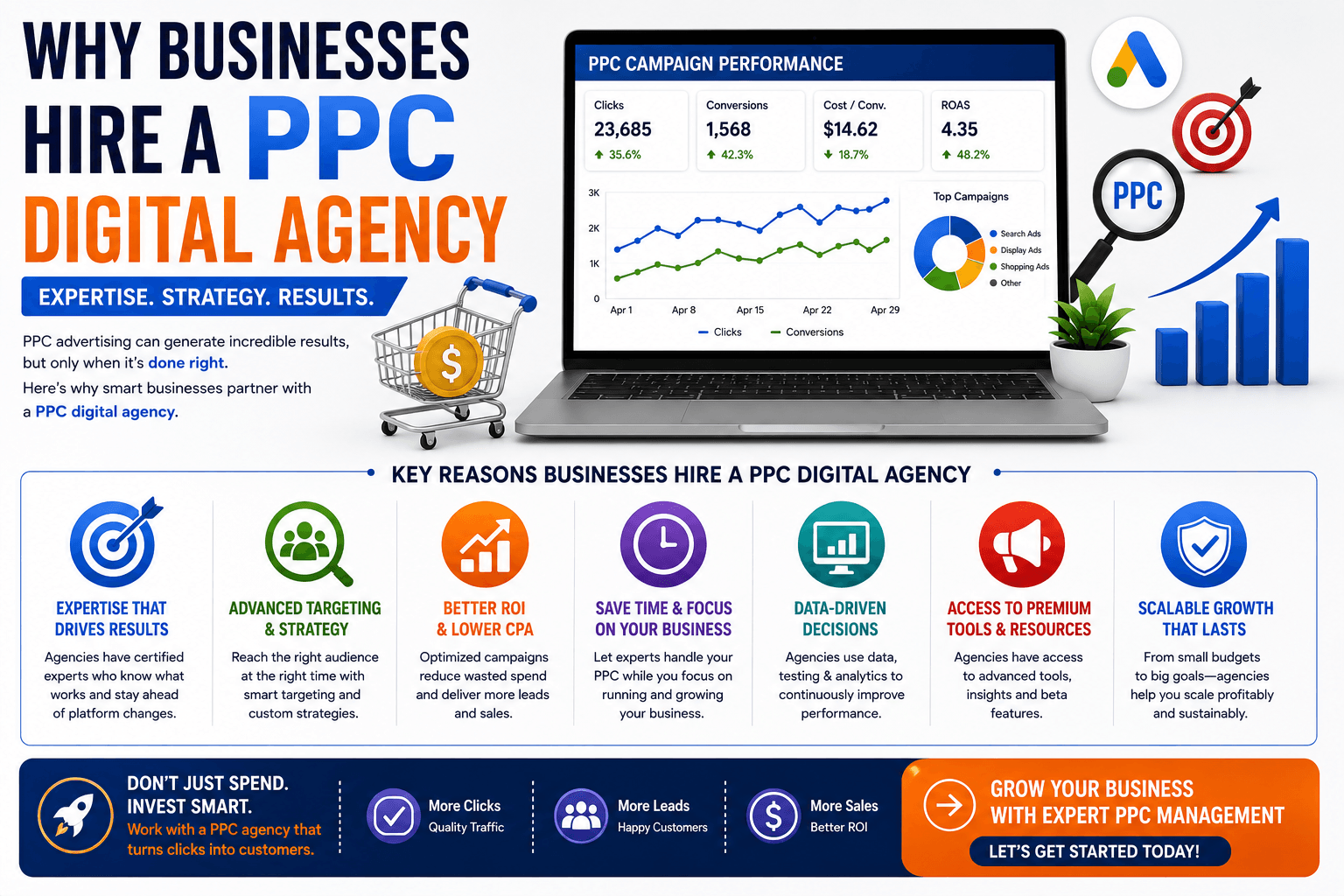
Managing PPC campaigns may appear simple at first. You create an advertisement, choose a budget, select some keywords, and launch the campaign.
In practice, successful PPC advertising requires continuous analysis and optimisation.
A professional pay per click digital agency can help businesses avoid common problems such as paying for irrelevant clicks, targeting the wrong audience, using ineffective keywords, or sending users to poorly designed landing pages.
1. Professional Keyword Research
Keyword selection is one of the foundations of successful PPC advertising.
An agency identifies keywords based on factors such as:
- Search intent
- Competition
- Search volume
- Cost per click
- Commercial value
- Conversion potential
The most popular keyword is not always the best keyword.
For example, a highly specific keyword with fewer searches may generate significantly more sales because the people searching for it are closer to making a purchase.
2. Better Audience Targeting
Modern PPC advertising goes far beyond keywords.
Campaigns can target users based on:
- Location
- Age
- Device
- Interests
- Previous website visits
- Purchasing behaviour
- Search activity
- Professional characteristics
Effective targeting helps reduce wasted advertising spend while increasing the chances of reaching people who are genuinely interested in your offer.
3. High-Quality Ad Copy
Your advertisements compete with other businesses for attention.
Strong PPC ad copy needs to quickly communicate why someone should choose your business.
A PPC agency may test different combinations of:
- Headlines
- Descriptions
- Offers
- Benefits
- Calls to action
- Promotional messages
Testing multiple variations helps identify which messages generate the strongest response.
4. Landing Page Optimisation
Generating a click is only the first step.
If visitors reach a slow, confusing, or poorly designed landing page, they may leave without taking action.
A good PPC landing page should provide:
- A clear headline
- Relevant information
- Strong benefits
- Trust signals
- Simple navigation
- A visible call to action
- Fast loading speed
- Mobile-friendly design
Professional PPC agencies often analyse the complete customer journey rather than focusing only on the advertisement.
Important PPC Metrics to Monitor
One major advantage of digital advertising is that performance can be measured.
A reliable PPC agency should regularly track important metrics.
Click-Through Rate
Click-through rate, or CTR, measures the percentage of people who click an advertisement after seeing it.
A higher CTR can indicate that the advertisement is relevant and appealing to the intended audience.
Cost Per Click
Cost per click, or CPC, shows how much you pay on average for each advertising click.
The goal is not always to achieve the lowest CPC. A more expensive click can still be valuable if it consistently produces profitable customers.
Conversion Rate
Conversion rate measures how many visitors complete the desired action.
A conversion could include:
- Purchasing a product
- Completing a contact form
- Calling your business
- Booking an appointment
- Registering for an account
- Requesting a quote
Cost Per Acquisition
Cost per acquisition shows how much advertising budget is required to generate a customer, lead, or another defined conversion.
This metric is especially important when measuring campaign profitability.
Return on Ad Spend
Return on ad spend, commonly called ROAS, measures how much revenue is generated for every dollar spent on advertising.
For ecommerce businesses, ROAS is often one of the most important PPC performance indicators.
Google Ads Management
Google Ads is one of the most widely used PPC advertising platforms because it allows businesses to reach people at the exact moment they are searching.
A PPC agency may manage several types of Google campaigns.
Search Ads
Search advertisements appear when users search for relevant terms on Google.
They are particularly effective for businesses offering products or services with clear search demand.
Shopping Ads
Shopping campaigns can display products with information such as images, prices, ratings, and store names.
They are commonly used by ecommerce businesses.
Display Ads
Display campaigns allow businesses to show visual advertisements across websites and apps.
They are often used for brand awareness and remarketing.
YouTube Ads
Video campaigns can reach audiences while they watch content on YouTube.
They can be valuable for increasing awareness, demonstrating products, and reaching new audiences.
Performance Max Campaigns
Performance Max allows advertisers to reach potential customers across several Google properties using one campaign.
However, successful Performance Max campaigns still require strong conversion tracking, creative assets, audience signals, and ongoing analysis.
PPC for Lead Generation
For service businesses, PPC is often designed to generate qualified leads rather than direct online purchases.
Industries that frequently use PPC lead generation include:
- Legal services
- Healthcare
- Home improvement
- Real estate
- Insurance
- Education
- Financial services
- B2B services
- Software companies
- Local professional services
A successful lead generation campaign should measure more than the number of forms submitted.
Lead quality matters.
A campaign producing 100 poor-quality enquiries may be less profitable than one generating 20 highly qualified prospects.
That is why experienced PPC agencies connect advertising performance with real business outcomes whenever possible.
PPC for Ecommerce Businesses
Ecommerce PPC campaigns often focus heavily on purchases and revenue.
A pay per click digital agency working with ecommerce brands may optimise campaigns based on:
- Product sales
- Revenue
- Average order value
- Cost per purchase
- ROAS
- Customer acquisition cost
- Product margins
- Repeat purchase potential
The agency may also analyse which products generate the highest profit rather than simply promoting the products receiving the most clicks.
Why Conversion Tracking Is Essential
Running PPC advertising without accurate tracking makes effective optimisation extremely difficult.
Conversion tracking helps identify what happens after someone interacts with an advertisement.
Businesses may track actions including:
- Purchases
- Calls
- Form submissions
- Appointment bookings
- Account registrations
- Downloads
- Email enquiries
Modern PPC measurement may involve tools such as Google Analytics 4, Google Tag Manager, advertising pixels, enhanced conversions, and server-side tracking.
Accurate data allows an agency to determine which campaigns, keywords, advertisements, and audiences are producing valuable results.
Common PPC Mistakes Businesses Make
Poorly managed advertising campaigns can quickly waste money.
Some common PPC mistakes include:
Using Broad Keywords Without Control
Broad targeting may generate clicks from people who have little interest in buying.
Negative keywords and search-term analysis can help prevent unnecessary spending.
Sending Every Ad to the Homepage
Users should ideally arrive on a page that closely matches what they searched for.
A dedicated landing page often creates a more relevant experience.
Ignoring Mobile Users
A large percentage of online searches happen on smartphones.
Landing pages, forms, buttons, and checkout processes should therefore work smoothly on mobile devices.
Focusing Only on Traffic
More clicks do not automatically mean more revenue.
PPC campaigns should be evaluated based on meaningful business outcomes.
Launching Campaigns Without Testing
Successful advertisers continuously test their campaigns.
This may include testing new:
- Headlines
- Landing pages
- Offers
- Images
- Videos
- Keywords
- Audience segments
- Calls to action
Ongoing testing helps campaigns improve over time.
PPC Agency vs Managing Advertising In-House
Some businesses manage PPC internally, while others hire an agency.
Managing PPC in-house may work well when a business has experienced advertising specialists and enough resources to monitor campaigns consistently.
Hiring an agency may make more sense when you need access to specialists without building an entire internal PPC team.
An agency can often provide expertise across areas such as:
- Campaign strategy
- Keyword research
- Copywriting
- Analytics
- Conversion tracking
- Landing pages
- Remarketing
- Ecommerce advertising
- Bid optimisation
- Performance reporting
The best option depends on your advertising budget, internal resources, business goals, and campaign complexity.
How to Choose the Right Pay Per Click Digital Agency
Not every PPC agency provides the same level of service.
Before choosing an agency, ask how they approach campaign strategy and measurement.
Look for an agency that can clearly explain:
- How campaigns will be structured
- Which advertising channels they recommend
- How conversions will be tracked
- Which KPIs will be monitored
- How frequently campaigns will be optimised
- How results will be reported
- Who will manage your account
Transparency is particularly important.
Your agency should be able to explain what is happening with your advertising budget without hiding behind complicated marketing terminology.
How Much Does PPC Management Cost?
PPC costs vary considerably between businesses and industries.
Your total investment may include two main expenses:
Advertising spend:
The money paid directly to advertising platforms.
Management fees:
The amount paid to the PPC agency for managing and optimising your campaigns.
Advertising costs depend on factors including:
- Industry competition
- Target location
- Keyword demand
- Campaign goals
- Customer value
- Advertising platform
- Audience size
Instead of selecting a budget based only on what competitors appear to spend, businesses should connect their PPC budget to realistic customer acquisition and revenue goals.
SEO vs PPC: Which Is Better?
SEO and PPC are often compared, but they serve different purposes.
SEO focuses on improving organic visibility in search engines. It can provide significant long-term value, but results may take time.
PPC provides immediate advertising visibility once campaigns are approved and launched.
For many businesses, the strongest strategy combines both.
PPC can help generate traffic and leads while an SEO strategy gradually builds organic rankings and authority.
Data from PPC campaigns can also reveal valuable information about high-converting keywords that may support future SEO campaigns.
Is PPC Worth It for Small Businesses?
Yes, PPC can be highly effective for small businesses when campaigns are properly targeted.
Small businesses do not necessarily need enormous advertising budgets.
A carefully focused campaign can target:
- Specific cities
- Specific neighbourhoods
- High-intent keywords
- Selected products
- Certain operating hours
- Highly relevant customer groups
This allows smaller businesses to compete strategically instead of trying to reach everyone.
Frequently Asked Questions About Pay Per Click Digital Agencies
What is a pay per click digital agency?
A pay per click digital agency is a marketing company that specialises in creating, managing, and optimising paid advertising campaigns. These agencies typically work with platforms such as Google Ads, Microsoft Advertising, Facebook, Instagram, LinkedIn, and YouTube to help businesses attract targeted traffic, leads, and sales.
What does a pay per click digital agency do?
A pay per click digital agency handles many parts of paid advertising, including keyword research, audience targeting, campaign setup, ad copywriting, bid management, conversion tracking, landing page optimisation, and performance reporting. The goal is to improve results while reducing unnecessary advertising costs.
Why should I hire a pay per click digital agency?
Hiring a pay per click digital agency gives your business access to experienced PPC specialists who understand how advertising platforms work. They can identify wasted spending, improve targeting, test different advertisements, and optimise campaigns to generate more valuable conversions.
How much does a pay per click digital agency cost?
The cost of working with a pay per click digital agency depends on your advertising budget, industry, campaign size, competition, and required services. Some agencies charge a fixed monthly management fee, while others charge a percentage of your total advertising spend.
Remember that your PPC management fee and your actual advertising budget are usually separate expenses.
Can a PPC agency help with Google Ads?
Yes. Google Ads management is one of the most common services offered by a pay per click digital agency. An agency can manage Search, Shopping, Display, YouTube, remarketing, and Performance Max campaigns depending on your business objectives.
How quickly can PPC advertising generate results?
PPC campaigns can begin generating traffic as soon as advertisements are approved and activated. However, strong results usually require ongoing testing and optimisation.
A professional pay per click digital agency will analyse early campaign data and improve keywords, audiences, bids, advertisements, and landing pages over time.
Is PPC suitable for small businesses?
Yes. PPC can work particularly well for small businesses because campaigns can be targeted by location, keyword, audience, device, schedule, and budget.
A pay per click digital agency can help small businesses focus their budget on people who are most likely to become customers instead of spending money reaching a broad, irrelevant audience.
How do I choose the best pay per click digital agency?
When choosing a pay per click digital agency, look for experience, transparent reporting, strong conversion tracking, clear communication, and a strategy based on your actual business objectives.
Ask potential agencies about:
- Their experience in your industry
- How they measure conversions
- How often campaigns are optimised
- Which PPC platforms they manage
- How they report performance
- Who will manage your account
- How they approach wasted ad spend
Avoid choosing an agency based only on promises of cheaper clicks. The quality and profitability of those clicks matter more.
What is the difference between PPC and SEO?
PPC involves paying for advertising placements, while SEO focuses on earning organic search engine visibility.
A pay per click digital agency can help businesses generate immediate targeted traffic through paid advertisements, while SEO usually requires more time to build rankings.
Many businesses use PPC and SEO together as part of a complete digital marketing strategy.
Can a pay per click digital agency improve ROI?
Yes, although results cannot be guaranteed. A skilled pay per click digital agency can improve return on investment by reducing wasted clicks, targeting higher-intent audiences, improving advertisements, optimising landing pages, and allocating more budget to campaigns that generate valuable conversions.
How do I know whether my PPC campaign is successful?
Success should be measured against your business goals rather than clicks alone.
Important PPC metrics can include:
- Conversion rate
- Cost per conversion
- Cost per acquisition
- Return on ad spend
- Revenue
- Lead quality
- Click-through rate
- Customer acquisition cost
A reliable pay per click digital agency should explain these metrics clearly and show how advertising performance contributes to your wider business goals.
Is a pay per click digital agency worth it?
A pay per click digital agency can be worth the investment when your business needs professional campaign management, accurate tracking, ongoing optimisation, and better control over advertising spend.
The greatest value comes from choosing an agency that focuses on conversions and profitability rather than simply increasing impressions and clicks.
Final Thoughts
Choosing the right pay per click digital agency can help turn paid advertising into a measurable customer acquisition channel rather than simply another marketing expense.
Successful PPC is built around more than keywords and clicks. It requires strong targeting, persuasive advertisements, accurate conversion tracking, effective landing pages, continuous testing, and careful budget management.
When these elements work together, PPC can help businesses reach customers at critical moments in their buying journey and generate measurable growth.
The most valuable PPC agency is therefore not necessarily the one that promises the most traffic. It is the one that understands your business goals, measures the right results, continuously improves campaign performance, and helps turn advertising investment into profitable growth.