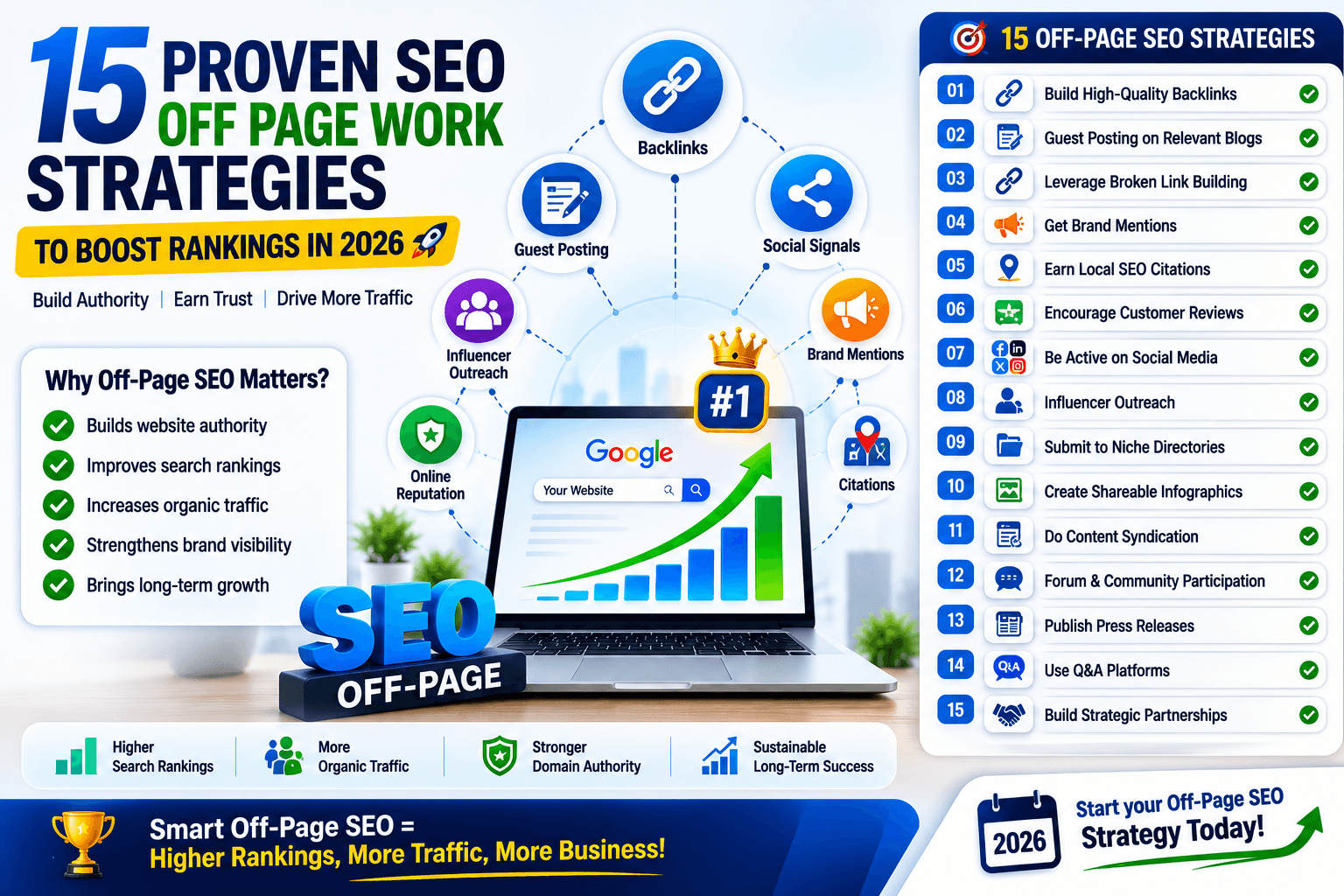
Ranking a website on search engines requires more than adding keywords, optimizing headings, and improving content. Activities performed outside your website can also play an important role in building authority, credibility, and online visibility. This is where SEO off page work becomes important.
SEO off page work includes strategies such as link building, guest posting, digital PR, brand mentions, business listings, customer reviews, social media promotion, and relationship building. These activities can help more people discover your website while strengthening its reputation across the web.
A successful off-page strategy should focus on quality rather than simply generating a large number of backlinks. Relevant links, genuine recommendations, and authoritative mentions generally provide more long-term value than spammy promotional tactics.
This guide explains 15 proven SEO off page work strategies that can help businesses, bloggers, marketers, and website owners improve their online presence.
What Is SEO Off Page Work?
SEO off page work refers to optimization activities performed outside your website to improve its visibility, reputation, authority, and organic search performance.
On-page SEO deals with elements that you directly control on your website, including:
- Page titles
- Content optimization
- Internal linking
- Headings
- Images
- URLs
- Keyword placement
Off-page SEO focuses on external signals and promotional activities, including:
- Backlinks
- Brand mentions
- Guest blogging
- Digital PR
- Online reviews
- Local citations
- Social media promotion
- Influencer partnerships
The goal is to demonstrate that your website and brand deserve attention, references, recommendations, and links from other sources.
Why Is SEO Off Page Work Important?
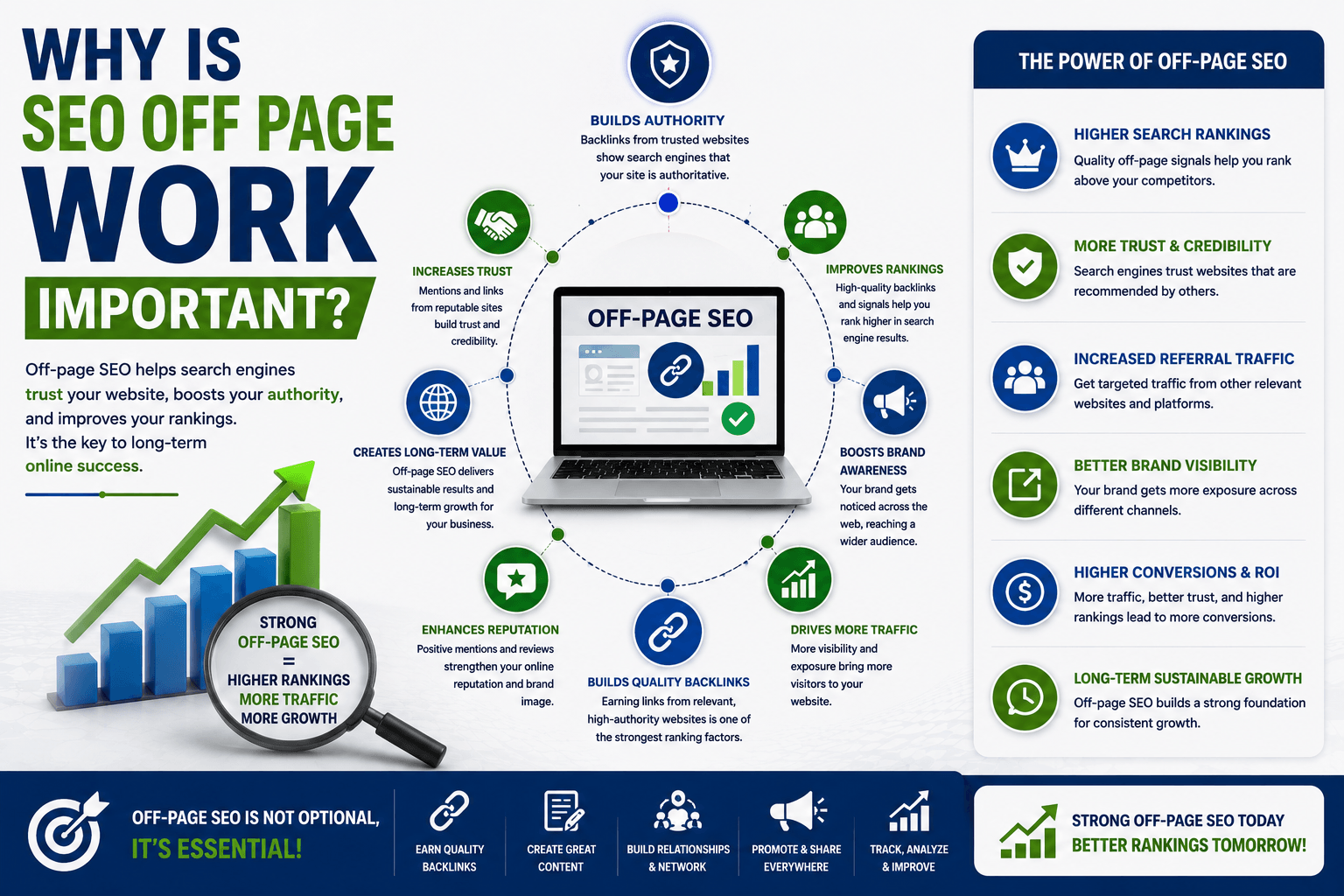
SEO off page work can support your overall search marketing strategy in several ways.
It can help you:
- Build website authority
- Earn high-quality backlinks
- Increase brand awareness
- Generate referral traffic
- Improve online reputation
- Reach new audiences
- Establish industry expertise
- Strengthen organic search visibility
For example, if several reputable websites naturally reference one of your articles, it can indicate that the content provides useful information.
However, off-page SEO should not be treated simply as a backlink-counting exercise. Relevance, quality, reputation, and context are much more important.
1. Build High-Quality Backlinks
Backlink building is one of the most recognized components of SEO off page work.
A backlink is created when another website links to your website.
The quality of the website providing the backlink matters significantly. A contextual link from a trusted website within your industry is generally much more valuable than numerous links from unrelated or low-quality websites.
Focus on earning links from:
- Industry publications
- Educational resources
- Trusted blogs
- Professional organizations
- News websites
- Relevant business websites
- Niche resource pages
Create content that gives publishers a genuine reason to link to your website.
2. Write Guest Posts
Guest posting involves creating content for another website.
It can help you introduce your expertise to a new audience while strengthening your professional reputation.
Guest posting may also generate referral traffic and relevant backlinks when appropriate.
For effective guest blogging:
- Find websites related to your niche.
- Study their existing content.
- Identify topics their audience needs.
- Pitch a specific and useful article.
- Create original, high-quality content.
- Avoid excessive promotional links.
Good guest posting focuses on helping readers rather than simply acquiring a backlink.
3. Create Linkable Content Assets
One of the strongest approaches to SEO off page work is creating resources people naturally want to reference.
These resources are often called linkable assets.
Examples include:
- Original research
- Industry surveys
- Statistics pages
- Infographics
- Free templates
- Calculators
- Checklists
- Detailed guides
- Case studies
- Interactive tools
- Research reports
For example, publishing original industry statistics can attract links from journalists, bloggers, researchers, and businesses that need supporting data for their own content.
4. Use Broken Link Building
Broken link building involves finding links on other websites that point to pages that no longer exist.
You then suggest a relevant resource from your website as a possible replacement.
The process typically involves:
- Finding relevant websites.
- Checking their pages for broken external links.
- Understanding what the missing resource covered.
- Finding or creating a suitable replacement.
- Contacting the website owner.
Your suggested page should closely match the original resource and provide genuine value to readers.
5. Reclaim Unlinked Brand Mentions
Sometimes another website mentions your company, product, research, or website without adding a link.
These are known as unlinked brand mentions.
Search online for mentions of your:
- Brand name
- Company name
- Website
- Products
- Services
- Founders
- Original research
If a legitimate website has mentioned your business without linking to it, you can contact the publisher and politely ask whether they would consider adding a relevant link.
This can be an efficient SEO off page work method because the website already knows your brand.
6. Use Digital PR
Digital PR focuses on earning online publicity from journalists, publishers, bloggers, and industry websites.
Businesses can create newsworthy stories around:
- Original research
- Surveys
- New products
- Industry trends
- Expert opinions
- Company milestones
- Data analysis
- Unique campaigns
- Market reports
Successful digital PR can produce brand mentions, referral traffic, media coverage, and authoritative backlinks.
Instead of asking publishers to link to your website, create something genuinely worth discussing.
7. Promote Content on Social Media
Social media promotion is another useful part of SEO off page work.
Publishing excellent content does not guarantee that people will discover it. Social platforms can help distribute your content to a larger audience.
Depending on your industry, you can use:
- X
- YouTube
- Industry-specific communities
Social media promotion can increase brand visibility and referral traffic while helping your content reach bloggers, journalists, business owners, and other people who may eventually mention or reference it.
8. Participate in Online Communities
Relevant online communities can be excellent places to demonstrate expertise.
These may include:
- Quora
- Professional forums
- Facebook groups
- LinkedIn communities
- Slack communities
- Discord communities
- Niche discussion boards
Avoid joining communities solely to publish links.
Instead, answer questions, contribute useful information, participate in discussions, and build a credible reputation.
When one of your articles directly helps answer someone’s question, you can reference it naturally where community rules allow.
9. Use Local Business Citations
Local businesses should include citations as part of their SEO off page work strategy.
A citation is an online reference to business information such as:
- Business name
- Address
- Phone number
- Website
Make sure important business details remain accurate and consistent across reputable platforms.
Useful citation opportunities can include:
- Local business directories
- Industry directories
- Professional associations
- Chambers of commerce
- Regional business websites
Avoid submitting your website to hundreds of low-quality directories simply for backlinks.
10. Encourage Genuine Customer Reviews
Reviews can influence how potential customers perceive your business.
Encourage satisfied customers to leave honest feedback on relevant platforms.
Positive reviews can improve:
- Brand reputation
- Customer trust
- Local visibility
- Click-through interest
- Purchase confidence
Respond professionally to reviews whenever appropriate, including negative feedback.
Never create fake reviews or pay people to post misleading customer experiences.
11. Analyze Competitor Backlinks
Competitor research can uncover new SEO off page work opportunities.
Analyze the websites that link to successful competitors within your industry.
Look for recurring sources such as:
- Guest posts
- Resource pages
- Directories
- Industry blogs
- News websites
- Podcasts
- Professional associations
- Research citations
The objective is not to copy every competitor backlink.
Instead, identify websites and strategies that are relevant to your own brand and determine whether you can earn similar or better coverage.
12. Reclaim Lost Backlinks
Websites can lose valuable backlinks for many reasons.
A publisher may:
- Delete an article
- Change a URL
- Remove your link
- Replace an old resource
- Restructure its website
Regular backlink monitoring can help you identify links that disappear.
If a backlink points to a deleted page on your website, consider redirecting the old URL to the most relevant existing page.
When appropriate, you can also contact the publisher and suggest an updated URL.
13. Build Relationships With Industry Experts
Relationship building is an important long-term component of SEO off page work.
Connect with relevant:
- Bloggers
- Journalists
- Influencers
- Researchers
- Business owners
- Content creators
- Podcast hosts
- Industry professionals
You can collaborate through:
- Interviews
- Expert roundups
- Webinars
- Podcasts
- Research projects
- Guest articles
- Co-marketing campaigns
Strong professional relationships can naturally create opportunities for brand mentions, referrals, collaborations, and backlinks.
14. Become a Podcast Guest
Podcast appearances can help establish expertise and introduce your business to a relevant audience.
Look for podcasts covering topics related to your industry.
When pitching yourself as a guest, suggest specific discussion topics instead of sending a generic message.
For example:
Instead of saying:
“I would like to appear on your podcast.”
Try:
“I can explain five common SEO mistakes that prevent small business websites from generating organic traffic.”
A specific pitch clearly demonstrates how you can provide value to the podcast’s audience.
15. Focus on Brand Authority
Modern SEO off page work should go beyond acquiring links.
Build a brand people recognize, search for, discuss, and trust.
You can strengthen brand authority through:
- Expert content
- Original research
- Public relations
- Social media
- Industry partnerships
- Customer service
- Community involvement
- Professional events
- Consistent branding
- Educational resources
When people begin searching directly for your business, mentioning it in discussions, recommending it to others, and referencing your content, your overall digital presence becomes stronger.
SEO Off Page Work Checklist
Use this checklist when planning your campaign:
- Audit your existing backlink profile
- Research competitor backlinks
- Create link-worthy content
- Find guest-posting opportunities
- Look for broken-link opportunities
- Monitor unlinked brand mentions
- Build relationships with journalists
- Invest in digital PR
- Promote content on social media
- Participate in niche communities
- Maintain accurate business citations
- Encourage genuine customer reviews
- Monitor lost backlinks
- Build industry partnerships
- Track campaign performance
Following a structured process makes your SEO off page work easier to manage and evaluate.
Common SEO Off Page Work Mistakes to Avoid
Not every backlink strategy is beneficial.
Avoid techniques such as:
- Buying large quantities of low-quality backlinks
- Automated link creation
- Spam comments
- Spam forum profiles
- Irrelevant directory submissions
- Excessive reciprocal linking
- Private link networks
- Keyword-stuffed anchor text
- Mass guest-post campaigns
- Fake reviews
These methods focus on manipulating signals rather than building genuine online authority.
Sustainable SEO off page work prioritizes quality, relevance, reputation, and user value.
How to Measure SEO Off Page Work Results
Tracking performance is essential.
Backlinks
Monitor the number and quality of links pointing to your website.
Referring Domains
Track how many unique websites link to you.
Organic Traffic
Check whether traffic from search engines increases over time.
Referral Traffic
Identify how many visitors arrive from other websites.
Keyword Rankings
Track search positions for important keywords.
Brand Mentions
Monitor how frequently your business is discussed online.
Conversions
Track leads, purchases, enquiries, registrations, and other valuable actions.
The ultimate goal of SEO is not simply to collect backlinks. Your campaign should contribute to meaningful business results.
On-Page SEO vs SEO Off Page Work
On-page and off-page SEO should work together.
On-page SEO includes:
- Keyword optimization
- Content creation
- Internal linking
- Meta titles
- Meta descriptions
- Image optimization
- Page structure
SEO off page work includes:
- Backlink building
- Guest posting
- Digital PR
- Reviews
- Brand mentions
- External promotion
- Community participation
A website with excellent content but no visibility may struggle to earn attention. Likewise, building backlinks to weak or unhelpful content is unlikely to create a strong long-term strategy.
Combining both approaches provides a stronger foundation for organic growth.
Conclusion
SEO off page work is an essential part of building website authority, increasing brand visibility, generating referral traffic, and strengthening your overall search presence.
Effective off-page SEO does not mean creating as many backlinks as possible. Instead, focus on earning relevant links and mentions from trustworthy websites by creating valuable resources and developing genuine industry relationships.
Use strategies such as linkable assets, guest blogging, digital PR, broken link building, brand mention reclamation, reviews, community engagement, competitor research, and professional partnerships.
Consistent SEO off page work combined with high-quality on-page content can help build a stronger, more trustworthy website and support sustainable organic growth.
Frequently Asked Questions About SEO Off Page Work
1. What is SEO off page work?
SEO off page work refers to activities performed outside your website to improve its authority, reputation, visibility, and search performance. Common activities include backlink building, digital PR, guest posting, reviews, brand mentions, and content promotion.
2. Why is SEO off page work important?
SEO off page work can help a website earn trustworthy backlinks, increase brand exposure, attract referral traffic, and build online credibility. It complements on-page SEO and content optimization.
3. What are the best SEO off page work techniques?
Some of the best SEO off page work techniques include quality link building, guest posting, digital PR, broken link building, competitor research, brand mention reclamation, social promotion, and relationship building.
4. Is backlink building part of SEO off page work?
Yes. Backlink building is one of the main components of SEO off page work. However, businesses should focus on relevant and trustworthy links rather than simply increasing backlink quantity.
5. How can beginners start SEO off page work?
Beginners can start by creating useful content, promoting it on relevant platforms, writing guest posts, finding reputable directories, engaging with industry communities, and developing relationships with other website owners.
6. How long does SEO off page work take?
Results vary depending on website authority, competition, industry, content quality, and the strategies being used. SEO off page work should generally be viewed as a long-term process rather than a quick ranking method.
7. Can social media help SEO off page work?
Yes. Social media can help distribute content, increase brand visibility, generate referral traffic, and put your resources in front of people who may eventually mention or link to them.
8. Are business directories useful for off-page SEO?
Relevant and reputable business directories can be useful, particularly for local businesses. Avoid submitting your website to low-quality directories simply to generate backlinks.
9. What tools can be used to monitor SEO off page work?
Website owners can use Google Search Console and backlink-analysis platforms to monitor links, referring domains, keyword rankings, competitor backlinks, and lost links.
10. What should I avoid when doing off-page SEO?
Avoid spammy link building, automated backlinks, fake reviews, irrelevant directory submissions, excessive link exchanges, paid link schemes, and other tactics designed primarily to manipulate search rankings.
11. Can SEO off page work increase organic traffic?
Yes. Effective SEO off page work can strengthen your website’s visibility and authority while also generating direct referral traffic from websites that mention or link to your content.
12. How often should SEO off page work be done?
SEO off page work should be performed consistently. Regular content promotion, outreach, backlink monitoring, PR, community engagement, and relationship building are more sustainable than occasional large link-building campaigns.