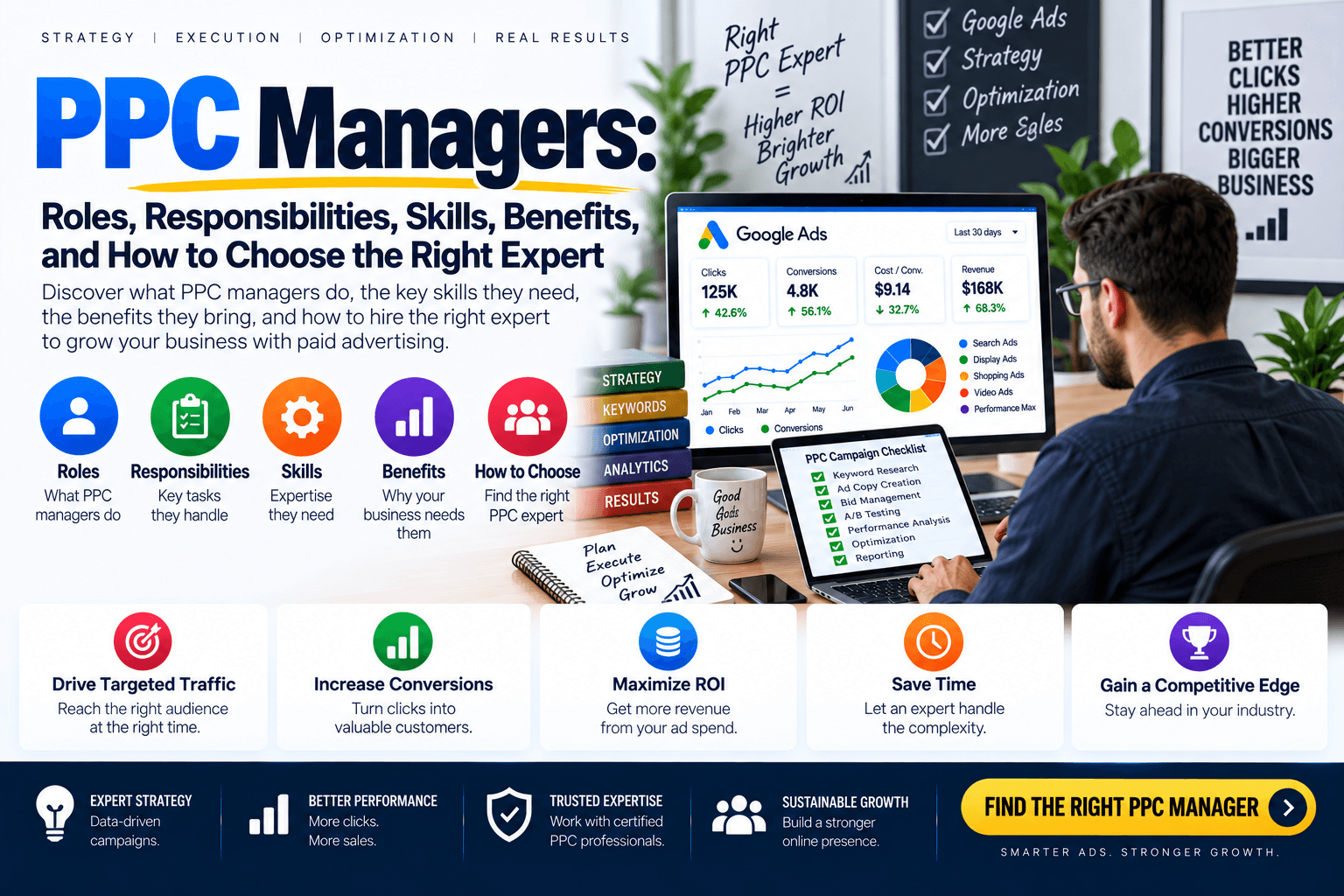
Pay-per-click advertising has become one of the most important digital marketing channels for businesses that want to generate traffic, leads, sales, phone calls, bookings, and other measurable results. Unlike many organic marketing strategies that can take months to gain momentum, PPC advertising can place a business in front of potential customers almost immediately.
However, running profitable paid advertising campaigns is not as simple as choosing a few keywords, writing an advertisement, and setting a daily budget. Successful PPC campaigns require research, planning, tracking, testing, budget control, data analysis, and continuous optimization.
This is where PPC managers become valuable.
PPC managers are responsible for planning, launching, monitoring, and improving paid advertising campaigns across platforms such as Google Ads, Microsoft Advertising, Meta Ads, LinkedIn Ads, YouTube, and other digital advertising networks.
Their main objective is not simply to increase traffic. Effective PPC managers focus on attracting the right visitors and converting those visitors into measurable business results while keeping advertising costs under control.
This guide explains what PPC managers do, the skills they need, how they manage campaigns, the benefits they provide, common PPC mistakes, important performance metrics, and how businesses can choose the right PPC professional.
What Are PPC Managers?
PPC managers are digital marketing specialists who manage pay-per-click advertising campaigns for businesses, agencies, organizations, or individual clients.
PPC stands for pay-per-click, a digital advertising model in which advertisers generally pay when someone interacts with or clicks on an advertisement.
A PPC manager oversees the entire advertising process, including campaign planning, keyword research, audience targeting, ad creation, bidding, budget allocation, tracking, reporting, and optimization.
The exact responsibilities of a PPC manager can vary depending on the company, industry, advertising platform, and campaign goals.
For example, an e-commerce PPC manager may focus heavily on product advertising, revenue, and return on advertising spend. A PPC manager working with a local service company may focus more on phone calls, lead generation, appointment bookings, and cost per lead.
Regardless of the industry, the goal is similar: maximize the value generated from the advertising budget.
Why PPC Management Matters
Paid advertising can become expensive very quickly when campaigns are poorly configured.
A business might spend money on:
- Irrelevant keywords
- Low-quality traffic
- Incorrect locations
- Unprofitable devices
- Poor audience targeting
- Weak advertisements
- Ineffective landing pages
- Keywords that generate clicks but no conversions
Without regular monitoring, these problems can continue for weeks or months.
PPC managers analyze campaign performance and make adjustments designed to improve efficiency.
They continuously ask questions such as:
- Which keywords generate the most qualified leads?
- Which advertisements have the highest conversion rates?
- Which audiences are most profitable?
- Which campaigns are wasting budget?
- Which geographic areas perform best?
- Which devices produce better conversions?
- What is the average cost to acquire a customer?
- Are advertising costs increasing or decreasing?
- Which landing pages produce better results?
By answering these questions through campaign data, PPC managers can make informed decisions rather than relying on assumptions.
What Do PPC Managers Do?
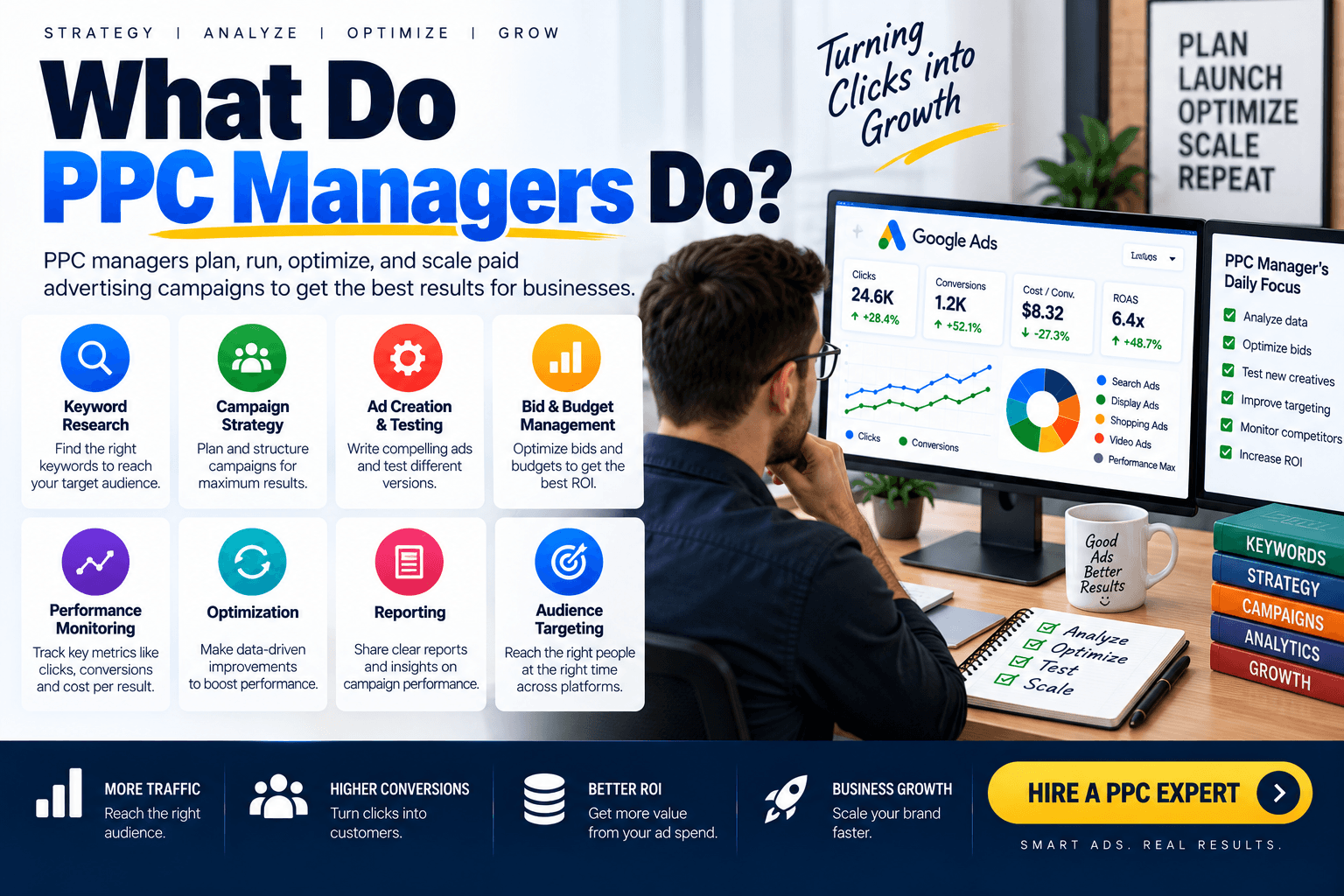
PPC management includes many different responsibilities. A campaign may require dozens or even hundreds of decisions before it becomes profitable.
Here are some of the most common responsibilities handled by PPC managers.
1. PPC Strategy Development
Before launching campaigns, PPC managers usually create an advertising strategy based on the company’s goals.
They may consider:
- Target audience
- Geographic market
- Advertising budget
- Competitor activity
- Products or services being promoted
- Customer acquisition goals
- Average customer value
- Profit margins
- Conversion targets
- Advertising platforms
A well-defined strategy helps determine where advertising money should be spent.
For example, a local plumbing company may prioritize Google Search campaigns because customers frequently search for emergency plumbing services.
A software company may combine Google Search, LinkedIn Ads, and remarketing campaigns to reach business decision-makers.
An online retailer may rely more heavily on Shopping campaigns, product feeds, remarketing, and performance-focused e-commerce advertising.
PPC managers choose strategies based on customer behavior rather than applying the same advertising approach to every business.
2. Keyword Research
Keyword research is one of the most important parts of search advertising.
PPC managers identify keywords potential customers use when searching for products or services.
For example, a company offering PPC management services might target searches such as:
- PPC managers
- PPC management services
- PPC agency
- Google Ads management
- PPC specialists
- Paid search management
- PPC advertising company
- Google Ads experts
However, not every keyword has the same value.
PPC managers evaluate keyword intent carefully.
Someone searching for “what is PPC” may simply be looking for information.
Someone searching for “hire PPC manager” may be much closer to making a purchasing decision.
Understanding search intent helps managers prioritize keywords that are more likely to produce leads or sales.
3. Negative Keyword Management
Negative keywords prevent advertisements from appearing for irrelevant searches.
This is one of the most effective ways PPC managers reduce wasted advertising spend.
For example, a company offering professional PPC management services may not want advertisements appearing for searches involving terms such as:
- Free
- Jobs
- Salary
- Course
- Training
- Internship
- Definition
If these searches are not relevant to the business, PPC managers may add them as negative keywords.
Negative keyword lists often grow over time as managers review actual search terms and identify irrelevant traffic.
4. Campaign Structure
Campaign organization can significantly affect performance and reporting.
PPC managers structure advertising accounts so campaigns, ad groups, keywords, and advertisements are organized logically.
A good structure may separate campaigns based on:
- Products
- Services
- Geographic locations
- Customer types
- Keyword themes
- Search intent
- Advertising objectives
For example, a digital marketing agency might have separate campaigns for:
- PPC management
- SEO services
- Social media advertising
- Web design
- Local marketing
This structure makes it easier to allocate budgets and measure performance independently.
5. Advertisement Creation
PPC managers create advertising copy designed to capture attention and encourage users to take action.
Strong PPC advertisements typically communicate:
- What the company offers
- Why the offer is valuable
- What makes the business different
- What action the user should take
Effective advertisements may include elements such as:
- Target keywords
- Product benefits
- Service benefits
- Discounts
- Guarantees
- Free consultations
- Pricing information
- Calls to action
- Unique selling points
PPC managers often create multiple advertisement variations and test them against each other.
This process helps identify which messages generate higher click-through rates and conversion rates.
6. Audience Targeting
Keyword targeting is only one form of PPC advertising.
Many platforms allow advertisers to target users according to characteristics such as:
- Interests
- Job titles
- Industries
- Demographics
- Online behavior
- Previous website visits
- Customer lists
- Purchase history
PPC managers use audience targeting to reach users more likely to become customers.
For example, a B2B software company may target managers, business owners, or senior executives.
A retail company may target customers who previously visited certain product pages but did not complete a purchase.
7. Geographic Targeting
Not every business wants customers from every location.
PPC managers configure campaigns to target specific geographic markets.
These may include:
- Countries
- States
- Cities
- Counties
- Postal codes
- Specific geographic areas
Geographic performance can also be analyzed over time.
If one city produces significantly more profitable leads than another, a PPC manager may increase advertising investment in that location.
8. Device Optimization
People interact with advertisements using smartphones, tablets, laptops, and desktop computers.
Performance can vary significantly across devices.
For example, mobile users may generate more phone calls, while desktop users may complete more detailed forms or larger purchases.
PPC managers analyze device-level performance and adjust campaigns accordingly.
9. Budget Management
Advertising budgets must be managed carefully.
PPC managers determine how much money should be allocated to each campaign based on performance and business priorities.
If one campaign consistently produces profitable conversions while another performs poorly, the manager may move additional budget toward the stronger campaign.
Budget allocation is not necessarily permanent.
It can change depending on:
- Seasonality
- Customer demand
- Promotions
- Competitor activity
- Conversion rates
- Business priorities
Effective budget management helps businesses get more value from their advertising spend.
10. Bid Management
PPC advertising platforms often use auction systems to determine which advertisements appear and where they are displayed.
PPC managers choose and manage bidding strategies based on campaign objectives.
Potential bidding objectives may include:
- Increasing website traffic
- Generating conversions
- Increasing conversion value
- Improving visibility
- Controlling cost per conversion
- Achieving a target return on advertising spend
Modern advertising platforms increasingly rely on automated bidding systems.
However, PPC managers still play an important role in determining appropriate targets, budgets, campaign structures, and performance expectations.
11. Conversion Tracking
One of the biggest differences between basic advertising and professional PPC management is accurate conversion tracking.
A click does not necessarily represent business value.
PPC managers track meaningful customer actions such as:
- Purchases
- Form submissions
- Phone calls
- Demo requests
- Bookings
- Registrations
- Downloads
- Quote requests
Without conversion tracking, businesses may mistakenly assume that campaigns generating large numbers of clicks are successful.
A campaign generating fewer clicks but more qualified customers may actually be much more valuable.
12. Landing Page Analysis
Advertisements do not work independently.
After users click an advertisement, they usually arrive on a landing page.
If the landing page is slow, confusing, irrelevant, or difficult to use, visitors may leave without converting.
PPC managers frequently evaluate landing pages for factors such as:
- Message relevance
- Page speed
- Mobile usability
- Call-to-action visibility
- Form length
- Trust signals
- Content quality
- Navigation
- Overall user experience
Improving landing pages can increase conversion rates without necessarily increasing advertising spend.
13. A/B Testing
PPC managers frequently test different versions of campaign elements.
Testing may include:
- Headlines
- Descriptions
- Calls to action
- Landing pages
- Images
- Offers
- Targeting
- Keywords
- Audiences
- Bidding strategies
These experiments help identify which combinations produce stronger results.
Successful PPC management is usually an ongoing process of testing, learning, and improving.
14. Remarketing Campaigns
Many users visit a website without purchasing or submitting a form.
Remarketing campaigns allow businesses to reconnect with people who previously interacted with their websites, applications, products, or content.
PPC managers may create remarketing audiences based on actions such as:
- Visiting a website
- Viewing a product
- Adding an item to a cart
- Starting a checkout
- Reading specific content
- Downloading a resource
Remarketing can help businesses remain visible while potential customers continue evaluating their options.
15. Competitor Analysis
PPC advertising is competitive.
Other companies may target the same keywords and audiences.
PPC managers analyze the competitive environment to understand:
- Which companies appear frequently
- Which offers competitors promote
- How competitive certain keywords are
- Where advertising opportunities may exist
Competitor analysis can help businesses differentiate their advertisements and identify areas where advertising budgets may be used more effectively.
Important PPC Metrics Managers Track
PPC managers monitor multiple metrics to understand campaign performance.
Impressions
Impressions measure how many times an advertisement is displayed.
A high number of impressions can indicate strong visibility, although impressions alone do not indicate campaign success.
Clicks
Clicks show how many users interacted with an advertisement and visited the associated website or landing page.
Click-Through Rate
Click-through rate measures the percentage of impressions that generate clicks.
It is calculated using:
Clicks ÷ Impressions × 100
Higher click-through rates can indicate that advertisements are relevant and attractive to users.
Cost Per Click
Cost per click shows the average amount paid for each click.
PPC managers monitor CPC because rising click costs can affect overall campaign profitability.
Conversion Rate
Conversion rate measures the percentage of visitors who complete a desired action after clicking an advertisement.
A strong conversion rate can help businesses generate more customers without increasing traffic.
Cost Per Conversion
Cost per conversion measures how much advertising spend is required to generate a conversion.
This is especially important for lead-generation campaigns.
For example, if a business spends $1,000 and generates 20 qualified leads, the average cost per lead would be $50.
Return on Ad Spend
Return on ad spend, often called ROAS, measures the revenue generated compared with advertising spend.
For e-commerce businesses, this can be one of the most important PPC performance metrics.
Impression Share
Impression share estimates how frequently advertisements appeared compared with the total number of opportunities in which they could have appeared.
Low impression share may indicate limited budgets, competitive bidding, or other campaign limitations.
Benefits of Hiring PPC Managers
Professional PPC management can provide several benefits.
Reduced Wasted Spend
Poor targeting can quickly consume advertising budgets.
PPC managers identify inefficient keywords, audiences, advertisements, and campaigns and adjust them accordingly.
Better Targeting
PPC managers use keyword, audience, geographic, device, and behavioral targeting to reach more relevant customers.
Improved Campaign Performance
Continuous testing and optimization can help improve click-through rates, conversion rates, and cost efficiency.
Better Tracking
Accurate tracking provides businesses with clearer information about which campaigns generate actual customers.
More Efficient Budget Allocation
Managers can move advertising budgets toward campaigns and audiences that produce stronger results.
Faster Identification of Problems
Experienced PPC managers monitor accounts regularly and can often identify issues such as declining conversions, rising costs, tracking errors, or unusual traffic patterns.
Better Reporting
Businesses need to understand what advertising investments are producing.
PPC managers create reports showing important metrics, trends, results, and areas for improvement.
PPC Manager vs. PPC Specialist
The terms PPC manager and PPC specialist are often used interchangeably.
However, the exact responsibilities may differ depending on the organization.
A PPC specialist may focus primarily on campaign execution and optimization.
A PPC manager may have broader responsibilities such as:
- Client communication
- Strategy development
- Budget planning
- Team management
- Reporting
- Forecasting
In smaller companies, one person may perform both roles.
PPC Manager vs. PPC Agency
Businesses often need to decide whether to hire an individual PPC manager or work with an agency.
A PPC manager may offer:
- Direct communication
- Dedicated account knowledge
- Greater integration with internal teams
A PPC agency may provide:
- Multiple specialists
- Designers
- Copywriters
- Analytics professionals
- Conversion optimization specialists
- Broader platform expertise
The best option depends on campaign complexity, budget, industry, and internal marketing resources.
In-House PPC Managers
Some companies hire full-time PPC managers as part of their internal marketing teams.
This approach can work well for businesses with large advertising budgets or complex ongoing campaigns.
In-house PPC managers often have deeper knowledge of:
- Products
- Customers
- Company goals
- Internal processes
- Sales teams
However, businesses must also consider salary, benefits, training, software, and recruitment costs.
Freelance PPC Managers
Freelance PPC managers can be suitable for smaller businesses or companies that do not require a full-time employee.
Freelancers may provide services such as:
- Campaign setup
- Campaign optimization
- Audits
- Monthly management
- Strategy consulting
- Reporting
Businesses should carefully evaluate experience and communication before choosing a freelancer.
Common PPC Management Mistakes
PPC campaigns can underperform for many reasons.
Here are some common mistakes PPC managers work to avoid.
Targeting Extremely Broad Keywords
Broad keywords can generate large amounts of traffic but may attract users with little purchasing intent.
Ignoring Search Terms
Search-term reports help identify the actual searches that triggered advertisements.
Ignoring these reports can lead to wasted spend.
Failing to Use Negative Keywords
Without negative keywords, advertisements may appear for irrelevant searches.
Sending All Traffic to the Homepage
Landing pages should match the user’s search and advertisement.
Sending every visitor to a generic homepage may reduce conversion rates.
Focusing Only on Clicks
Clicks are useful, but conversions and business results are more important.
Poor Conversion Tracking
Without accurate tracking, optimization decisions may be based on incomplete or incorrect information.
Setting Campaigns and Forgetting Them
PPC campaigns need ongoing attention.
Competition, search behavior, advertising costs, and conversion performance can change over time.
Skills Every PPC Manager Should Have
Effective PPC managers need a combination of analytical, technical, marketing, and communication skills.
Analytical Ability
PPC managers work with large amounts of performance data.
They need to identify patterns, compare results, and make decisions based on measurable evidence.
Keyword Research Skills
Understanding search behavior helps managers identify valuable opportunities and avoid irrelevant traffic.
Copywriting Skills
Strong advertisements require clear and persuasive messaging.
Understanding of Customer Intent
PPC managers must understand what users are trying to accomplish when they search or interact with advertisements.
Budget Management Skills
Managers need to allocate advertising budgets carefully and prioritize campaigns that produce the greatest value.
Tracking and Analytics Knowledge
Conversion tracking and analytics allow managers to measure actual business outcomes.
Communication Skills
PPC managers often need to explain campaign performance to business owners, executives, marketing teams, or clients.
Clear communication helps decision-makers understand what is working and what needs improvement.
How to Choose the Right PPC Manager
Choosing a PPC manager should involve more than comparing prices.
Businesses should evaluate experience, strategy, communication, and reporting.
Important questions include:
- How many years of PPC experience do you have?
- Which advertising platforms do you manage?
- Have you worked with businesses in our industry?
- How do you conduct keyword research?
- How do you measure campaign success?
- How often do you optimize campaigns?
- What reporting will we receive?
- How do you reduce wasted spend?
- How do you approach conversion tracking?
- How do you evaluate landing pages?
- How will you communicate campaign changes?
A strong PPC manager should be able to explain their approach clearly.
Businesses should be cautious of anyone guaranteeing specific results without first evaluating the campaign, market, budget, competition, and historical performance.
What Makes a Good PPC Manager?
A good PPC manager is not simply someone who knows how to use an advertising platform.
Strong PPC managers combine technical knowledge with business awareness.
They understand that advertising metrics must eventually connect to business outcomes.
For example, generating 100 leads may sound impressive.
However, if only two of those leads become customers, the campaign may have a lead-quality problem.
A skilled PPC manager looks beyond surface-level metrics and tries to understand the complete customer journey.
Industries That Use PPC Managers
PPC management is used across many industries.
Common examples include:
- E-commerce
- Software
- Healthcare
- Real estate
- Legal services
- Home services
- Financial services
- Education
- Travel
- Automotive
- Professional services
- Retail
- Hospitality
- B2B companies
The PPC strategy used for each industry can be very different.
For example, an online retailer may optimize primarily for sales and revenue.
A law firm may prioritize phone calls and qualified consultation requests.
A software company may focus on demos, trials, and subscriptions.
This is why industry knowledge can be valuable when selecting PPC managers.
How PPC Managers Improve ROI
Improving return on investment generally involves either increasing revenue, reducing advertising costs, or both.
PPC managers may improve ROI by:
- Removing poorly performing keywords
- Improving advertising copy
- Increasing conversion rates
- Adjusting geographic targeting
- Improving audience selection
- Reducing low-quality traffic
- Moving budget toward profitable campaigns
- Optimizing bidding strategies
- Improving landing-page relevance
- Testing new offers
Small improvements across several campaign areas can create significant performance gains over time.
How Often Should PPC Campaigns Be Optimized?
PPC campaigns should be reviewed regularly.
However, constant changes can also create problems because campaigns need sufficient data before reliable conclusions can be made.
PPC managers generally balance monitoring with patience.
Some campaign elements may require frequent attention, while others require longer testing periods.
Managers typically monitor:
- Spending
- Conversion tracking
- Budget limits
- Search terms
- Cost changes
- Conversion performance
- Disapproved advertisements
- Technical problems
Larger strategic changes may be made after enough data has accumulated.
The Role of Automation in PPC Management
Advertising platforms increasingly use machine learning and automated systems for bidding, targeting, and campaign optimization.
This does not necessarily eliminate the need for PPC managers.
Instead, the role of PPC professionals continues to evolve.
Managers still need to:
- Set campaign objectives
- Provide high-quality data
- Choose appropriate strategies
- Evaluate automation results
- Control budgets
- Monitor profitability
- Improve landing pages
- Analyze lead quality
- Develop creative strategies
Automation can perform certain tasks efficiently, but businesses still need strategic oversight.
PPC Management for Small Businesses
Small businesses can benefit significantly from PPC, but budget control is especially important.
A small business may not be able to compete for every keyword.
PPC managers can help prioritize high-intent searches and focus advertising on locations, services, and audiences most likely to generate customers.
Local PPC campaigns may include:
- Location-specific keywords
- Phone-call campaigns
- Local landing pages
- Geographic targeting
- Business-hour scheduling
This can help smaller companies compete more efficiently.
PPC Management for E-Commerce Businesses
E-commerce PPC campaigns often require a different approach.
PPC managers may monitor:
- Product revenue
- Shopping campaigns
- Product feeds
- Conversion value
- Return on ad spend
- Customer acquisition cost
- Best-selling products
- Profitability
The objective is usually not simply to increase the number of orders but to generate profitable revenue.
PPC Management for B2B Companies
B2B campaigns often involve longer sales cycles.
A user may click an advertisement, download a guide, request a demonstration, speak with a sales representative, and purchase several weeks or months later.
PPC managers working with B2B companies may focus on:
- Lead quality
- Cost per qualified lead
- Demo requests
- Target industries
- Job titles
- Account-based marketing
- Sales pipeline contribution
Close communication between PPC managers and sales teams can be especially important.
How Much Do PPC Managers Cost?
The cost of PPC management can vary significantly.
Pricing may depend on:
- Advertising spend
- Number of campaigns
- Number of platforms
- Industry competition
- Campaign complexity
- Reporting requirements
- Geographic markets
- Services included
PPC managers or agencies may charge:
- Monthly retainers
- Flat fees
- Hourly rates
- Percentage of advertising spend
- Performance-based fees
- Hybrid pricing models
Businesses should evaluate value and expertise rather than selecting PPC management based only on the lowest price.
Cheap PPC management that wastes advertising budget may ultimately cost much more than experienced professional management.
Questions to Ask Before Hiring PPC Managers
Before making a decision, businesses should ask potential PPC managers detailed questions.
Useful questions include:
- Which PPC platforms do you specialize in?
- How do you approach campaign audits?
- How do you identify wasted advertising spend?
- How often will you review the account?
- Which performance metrics will you report?
- How do you track conversions?
- How do you determine keyword strategy?
- How do you evaluate lead quality?
- Who will actually manage the campaigns?
- How often will we communicate?
- How do you test advertisements?
- How do you manage negative keywords?
- Do you provide landing-page recommendations?
- How do you allocate budgets between campaigns?
- How do you measure overall advertising profitability?
The answers can help businesses identify whether the manager understands both advertising platforms and broader business objectives.
When Should a Business Hire a PPC Manager?
A business may benefit from hiring a PPC manager when:
- Advertising spend is increasing
- Campaign performance is declining
- Cost per lead is too high
- The company lacks internal PPC expertise
- Conversion tracking is unreliable
- Campaigns have become too complex
- Advertising expansion is planned
- Management does not have time to optimize campaigns
- The business wants clearer reporting
Professional management becomes increasingly valuable as campaign size and complexity increase.
Can PPC Managers Guarantee Results?
No PPC manager can responsibly guarantee exact results in every situation.
Campaign performance depends on many variables, including:
- Market demand
- Competition
- Website quality
- Product pricing
- Brand reputation
- Advertising budget
- Customer behavior
- Sales processes
- Industry conditions
Experienced PPC managers can improve campaign strategy and efficiency, but advertising outcomes are influenced by factors outside their direct control.
Businesses should look for transparency, realistic expectations, and evidence-based decision-making.
Future of PPC Management
PPC advertising continues to evolve.
Automation, artificial intelligence, audience targeting, predictive bidding, privacy changes, and new advertising formats are changing how campaigns are managed.
As platforms automate more tactical tasks, PPC managers are likely to spend more time on:
- Strategy
- Data quality
- Creative testing
- Customer insights
- Conversion optimization
- Budget planning
- Profitability analysis
- Cross-channel advertising
The role is becoming increasingly strategic rather than simply operational.
Frequently Asked Questions About PPC Managers
What does a PPC manager do?
A PPC manager plans, creates, monitors, and optimizes paid advertising campaigns. Responsibilities can include keyword research, audience targeting, advertisement creation, bid management, budget allocation, conversion tracking, reporting, and campaign testing.
Why should I hire a PPC manager?
Hiring a PPC manager can help reduce wasted advertising spend, improve targeting, increase conversions, and provide better visibility into campaign performance.
What platforms do PPC managers use?
PPC managers may work with platforms such as Google Ads, Microsoft Advertising, Meta Ads, LinkedIn Ads, YouTube, and other digital advertising networks.
How do PPC managers measure success?
Success may be measured using metrics such as conversions, cost per lead, cost per acquisition, conversion value, return on ad spend, click-through rate, and overall profitability.
Do PPC managers write advertisements?
Many PPC managers write and test advertising copy as part of campaign management. Some companies also use dedicated copywriters or creative teams.
Can PPC managers reduce advertising costs?
PPC managers can often improve cost efficiency by removing low-performing keywords, improving targeting, adding negative keywords, adjusting budgets, and optimizing bidding strategies.
Are PPC managers useful for small businesses?
Yes. PPC managers can help small businesses focus limited advertising budgets on high-intent keywords, profitable services, and relevant geographic markets.
How long does PPC optimization take?
Some improvements can be identified quickly, while others require enough campaign data to evaluate accurately. PPC optimization is generally an ongoing process rather than a one-time task.
What is the difference between PPC and SEO?
PPC involves paid advertising, while SEO focuses on improving organic search visibility. Businesses often use both strategies together as part of a broader digital marketing plan.
Should I hire a freelancer or PPC agency?
The right option depends on budget, campaign complexity, communication preferences, and the level of support required. Freelancers may provide direct management, while agencies may offer access to larger teams and additional marketing services.
Conclusion
PPC managers play an important role in helping businesses generate measurable results from paid advertising.
Their responsibilities extend far beyond launching advertisements. They conduct keyword research, analyze audiences, structure campaigns, create ads, manage budgets, monitor bidding, implement conversion tracking, review landing pages, analyze performance, and continuously test opportunities for improvement.
Effective PPC management is built around data and business objectives.
The best PPC managers do not focus only on clicks or impressions. They examine whether advertising activity produces qualified leads, customers, revenue, and sustainable returns.
For businesses investing significantly in paid advertising, professional PPC management can help improve targeting, reduce wasted spend, increase conversion efficiency, and provide better understanding of advertising performance.
As digital advertising platforms continue to evolve, experienced PPC managers will remain important for businesses that need strategic oversight, accurate measurement, and disciplined advertising management.