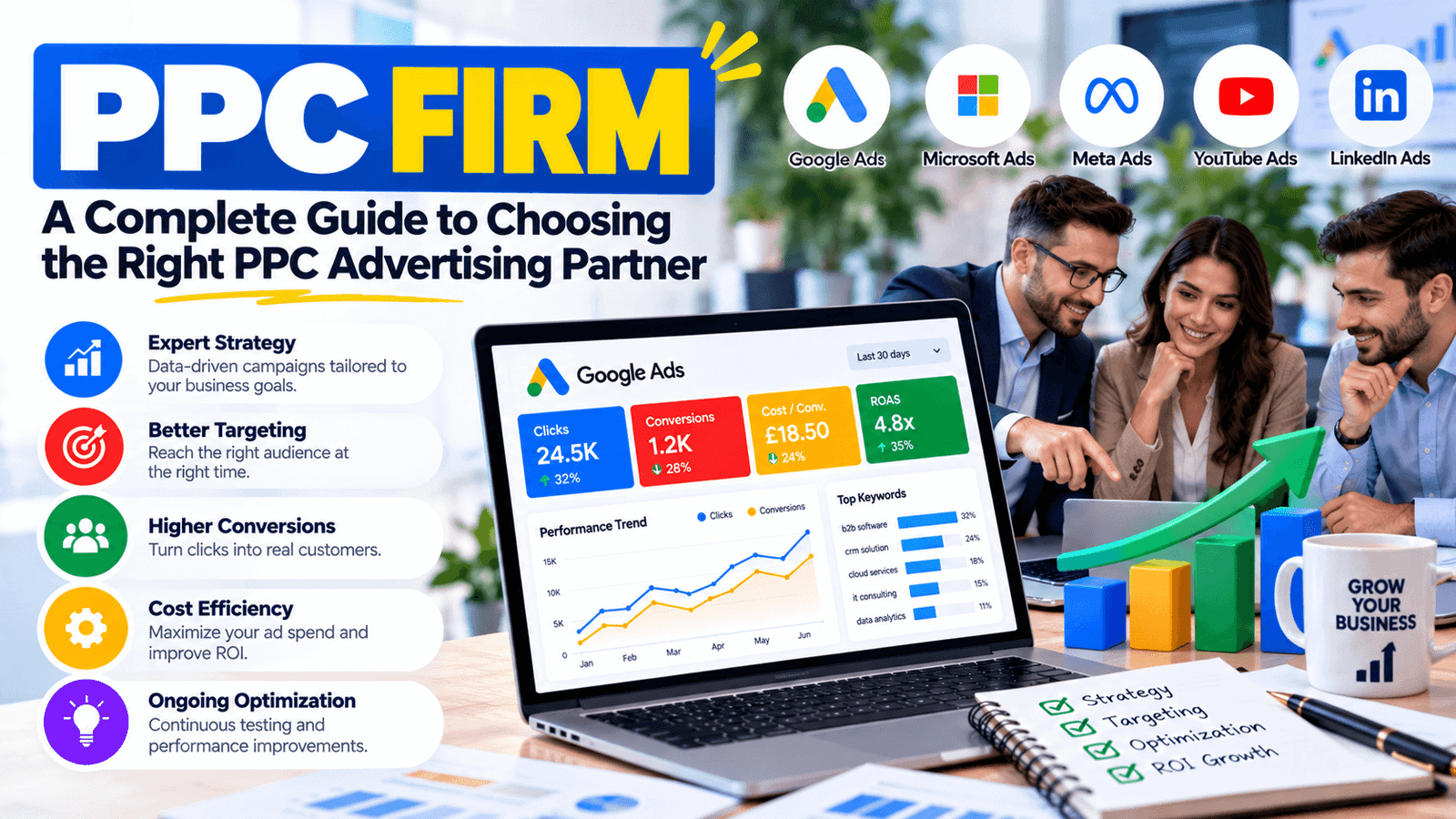
A PPC firm helps businesses create, manage, and optimize pay-per-click advertising campaigns across platforms such as Google Ads, Microsoft Ads, and social media advertising networks. Instead of paying for advertising without a clear strategy, businesses can work with PPC professionals to target relevant audiences, control budgets, generate leads, and increase sales.
With increasing competition in digital advertising, choosing the right PPC partner can have a major impact on campaign performance. This guide explains what a PPC firm does, its services, benefits, pricing factors, and how to choose the right agency for your business.
What Is a PPC Firm?
A PPC firm is a digital marketing company that specializes in pay-per-click advertising. These firms manage paid advertising campaigns where businesses typically pay when someone clicks on an advertisement.
PPC firms can manage campaigns across multiple platforms, including:
- Google Ads
- Microsoft Advertising
- Google Shopping
- YouTube Ads
- Meta Ads
- LinkedIn Ads
- Display advertising
- Remarketing campaigns
A professional PPC team generally handles everything from keyword research and campaign setup to ad creation, conversion tracking, optimization, and reporting.
What Does a PPC Firm Do?
A professional PPC firm can provide a wide range of services designed to improve paid advertising performance.
1. PPC Strategy Development
Before launching campaigns, a PPC team analyzes:
- Business goals
- Target customers
- Products and services
- Competitors
- Search behavior
- Advertising budget
- Conversion goals
The agency then develops a campaign strategy based on the company’s objectives.
2. Keyword Research
Keyword research is one of the most important parts of search advertising.
A PPC firm identifies keywords that potential customers may use when searching for products or services.
For example, a digital marketing business might target keywords such as:
- PPC agency
- PPC management services
- Google Ads agency
- paid advertising agency
- PPC firm
- Google Ads management
The goal is not simply to find high-volume keywords. A good strategy also considers search intent, competition, estimated costs, and conversion potential.
3. Google Ads Campaign Management
Google Ads can include several campaign formats, such as:
- Search campaigns
- Display campaigns
- Shopping campaigns
- Video campaigns
- Performance Max
- Remarketing campaigns
A PPC firm can create and manage these campaigns while continuously monitoring their performance.
4. Ad Copywriting
Getting users to click an advertisement requires relevant and persuasive messaging.
PPC professionals may create multiple versions of:
- Headlines
- Descriptions
- Calls to action
- Promotional messages
- Product benefits
- Offers
Different versions can then be tested to identify which messaging generates better engagement and conversions.
5. Landing Page Optimization
Getting clicks is only one part of PPC advertising.
If users arrive on a poorly designed landing page, they may leave without taking action.
A PPC firm may review landing pages for:
- Page speed
- Mobile usability
- Headlines
- Call-to-action placement
- Forms
- Product information
- Trust signals
- Page structure
- Conversion experience
Improving the landing page can help businesses get more value from their existing advertising traffic.
6. Conversion Tracking
Accurate tracking is essential for understanding whether PPC campaigns are actually producing business results.
A PPC firm may track:
- Form submissions
- Phone calls
- Purchases
- Sign-ups
- Bookings
- Downloads
- Leads
- Revenue
Tools such as Google Analytics and Google Ads conversion tracking can help connect advertising activity with business outcomes.
7. PPC Campaign Optimization
PPC campaigns require ongoing optimization.
A PPC team may regularly analyze:
- Click-through rate
- Conversion rate
- Cost per click
- Cost per conversion
- Search terms
- Impression share
- Return on ad spend
- Campaign profitability
Based on the data, the team can adjust bids, budgets, keywords, audiences, advertisements, and targeting.
Benefits of Working With a PPC Firm
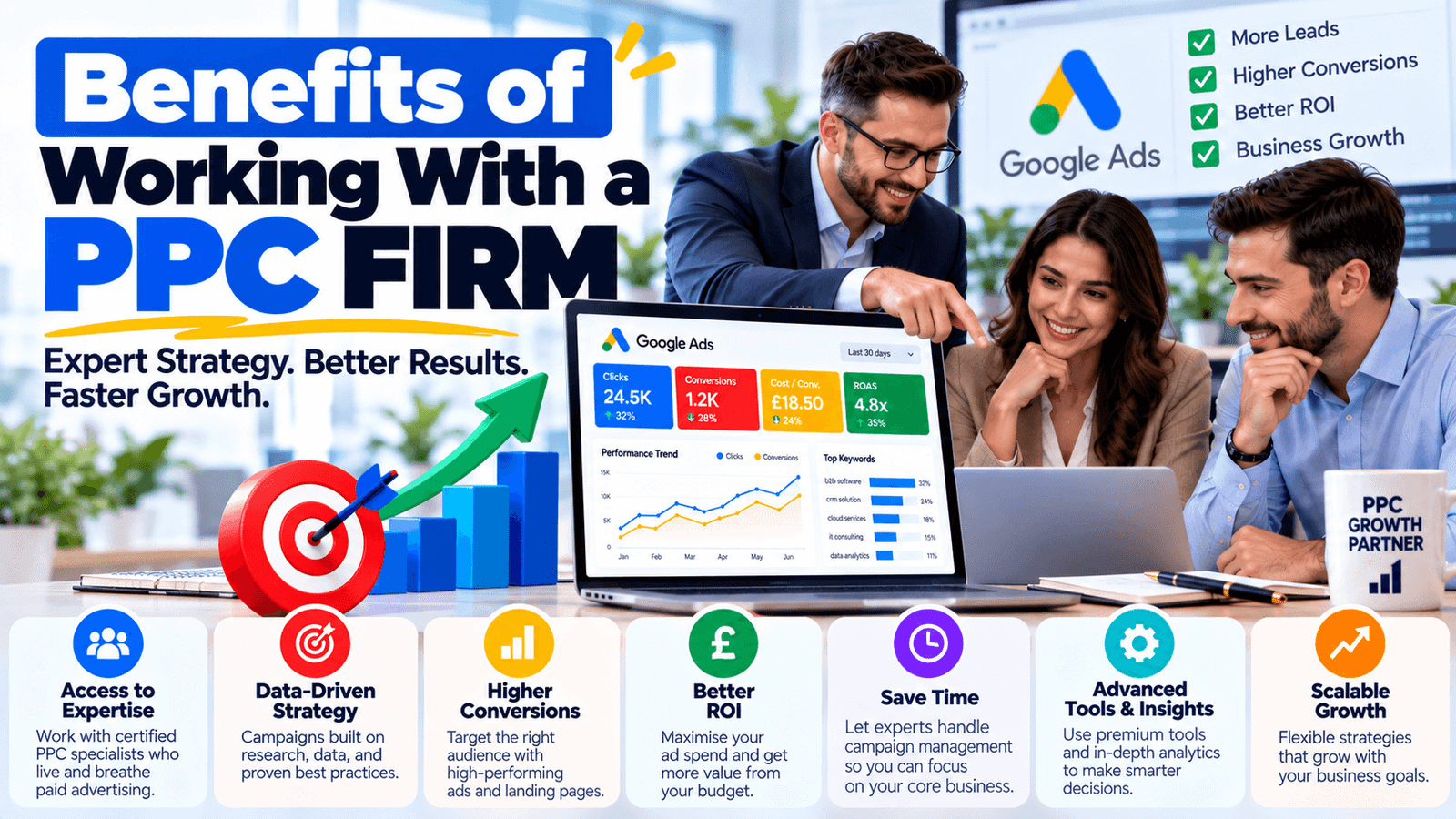
Businesses often hire PPC professionals because managing paid campaigns internally can require significant time and expertise.
1. Access to PPC Expertise
Experienced PPC professionals understand campaign structures, advertising platforms, targeting options, bidding strategies, and conversion tracking.
This can help businesses avoid common setup and management mistakes.
2. Better Budget Management
PPC advertising can become expensive when campaigns are poorly structured or targeted.
A PPC firm can monitor spending and identify areas where budget may be wasted.
For example, an agency may identify:
- Irrelevant search terms
- Poor-performing keywords
- Low-converting audiences
- Expensive campaigns
- Underperforming advertisements
The budget can then be adjusted based on campaign data.
3. Faster Campaign Testing
Professional PPC teams can run structured tests involving:
- Ad headlines
- Landing pages
- Keywords
- Audiences
- Offers
- Calls to action
- Campaign structures
Testing helps businesses understand what works with their target audience.
4. Access to Detailed Reporting
A professional PPC firm can provide regular reports showing campaign performance.
Common reporting metrics include:
| Metric | What It Measures |
|---|---|
| Impressions | How often ads were displayed |
| Clicks | Number of advertisement clicks |
| CTR | Percentage of impressions generating clicks |
| CPC | Average cost per click |
| Conversions | Desired actions completed |
| Conversion Rate | Percentage of clicks that convert |
| CPA | Cost per acquisition |
| ROAS | Revenue generated relative to ad spend |
These metrics can help businesses understand where their advertising budget is going.
PPC Firm vs. In-House PPC Management
Businesses can either manage PPC campaigns internally or work with an external PPC firm.
| Factor | PPC Firm | In-House Team |
|---|---|---|
| Expertise | Access to specialists | Depends on employees |
| Setup | Usually handled by experienced professionals | Internal responsibility |
| Scalability | Can scale with business needs | May require additional hiring |
| Tools | Agency may already use professional tools | Business must provide tools |
| Management | External specialists | Internal employees |
| Reporting | Structured agency reporting | Internal reporting |
| Flexibility | Can support multiple campaigns | Depends on team capacity |
The right approach depends on a company’s budget, internal resources, campaign complexity, and business objectives.
How Much Does a PPC Firm Cost?
PPC management pricing varies significantly depending on the agency and campaign requirements.
Common pricing structures include:
Monthly Management Fee
The business pays a fixed monthly fee for PPC management.
Percentage of Ad Spend
Some agencies charge a percentage of the advertising budget.
Project-Based Pricing
This may be used for campaign setup, audits, tracking implementation, or specific PPC projects.
Performance-Based Pricing
Some agencies may structure part of their fees around specific performance arrangements.
When comparing prices, businesses should look beyond the monthly fee and understand exactly what services are included.
How to Choose the Right PPC Firm
Choosing a PPC partner requires more than comparing prices.
1. Check Their Experience
Look for experience with businesses similar to yours.
For example, a B2B company may want a PPC firm experienced with:
- Lead generation
- Long sales cycles
- CRM integration
- High-value keywords
- B2B search intent
An eCommerce business may need expertise in:
- Google Shopping
- Product feeds
- Performance Max
- Remarketing
- Conversion optimization
2. Review Their Services
Check whether the agency provides the services your business actually needs.
These may include:
- PPC strategy
- Keyword research
- Campaign setup
- Ad copywriting
- Landing page optimization
- Conversion tracking
- Remarketing
- Shopping campaigns
- Reporting
- Ongoing optimization
3. Ask About Conversion Tracking
A PPC firm should be able to explain how it will measure meaningful business outcomes.
Ask questions such as:
- How will conversions be tracked?
- Will phone calls be measured?
- How will lead quality be evaluated?
- Can PPC data be connected with our CRM?
- How will revenue be attributed?
4. Understand the Reporting Process
Before signing a contract, ask how frequently you will receive reports.
A useful PPC report may include:
- Advertising spend
- Clicks
- Conversions
- Cost per conversion
- Top-performing campaigns
- Poor-performing campaigns
- Search-term insights
- Optimization actions
- Recommendations for the next period
Questions to Ask a PPC Firm Before Hiring
Before selecting a PPC partner, consider asking:
- How many years of PPC experience do you have?
- Which advertising platforms do you specialize in?
- Have you worked with businesses in my industry?
- How do you conduct keyword research?
- How do you structure campaigns?
- How do you track conversions?
- How frequently do you optimize campaigns?
- What reporting will I receive?
- Who will manage my account?
- Do you provide landing page recommendations?
- How do you handle negative keywords?
- How do you test advertisements?
- What PPC management fees do you charge?
- Is there a minimum contract period?
- How do you measure campaign performance?
Common PPC Mistakes Businesses Should Avoid
Even businesses with advertising budgets can experience poor results if campaigns are not managed correctly.
Common mistakes include:
Targeting Too Broadly
Broad targeting can generate traffic that has little relevance to the business.
Ignoring Negative Keywords
Negative keywords can help prevent advertisements from appearing for irrelevant searches.
Not Tracking Conversions
Without conversion tracking, businesses may not know which campaigns are producing meaningful results.
Sending All Traffic to the Homepage
Dedicated landing pages can often provide a more relevant experience than sending every visitor to the homepage.
Focusing Only on Clicks
A campaign can generate many clicks without producing enough leads or sales.
Businesses should consider the entire conversion journey rather than focusing only on traffic.
PPC for Different Types of Businesses
PPC for Small Businesses
Small businesses can use PPC to reach customers searching for specific products or services.
Local targeting can help businesses focus advertising on relevant geographic areas.
PPC for eCommerce
eCommerce businesses can use paid advertising to promote individual products and categories.
Campaigns may include:
- Google Shopping
- Search Ads
- Remarketing
- Performance Max
- Product-focused campaigns
PPC for B2B Companies
B2B businesses often need to focus on lead quality rather than simply generating large numbers of clicks.
Campaign strategies may include:
- High-intent keywords
- Lead-generation landing pages
- LinkedIn advertising
- Search campaigns
- CRM integration
- Remarketing
PPC and SEO: How They Work Together
PPC and SEO serve different purposes, but they can complement each other.
SEO focuses on earning organic visibility in search engines, while PPC provides paid visibility.
A business can use PPC to:
- Test keyword demand
- Generate immediate paid traffic
- Identify high-performing search terms
- Support product launches
- Generate leads while SEO develops
Data from PPC campaigns can also provide insights that may inform broader search marketing strategies.
Measuring PPC Campaign Success
There is no single metric that determines campaign performance.
Businesses may evaluate:
- Conversion volume
- Conversion rate
- Cost per lead
- Cost per acquisition
- Revenue
- ROAS
- Lead quality
- Customer acquisition cost
- Lifetime customer value
The most useful metrics depend on the business model and campaign objectives.
For example, an eCommerce company may focus heavily on revenue and ROAS, while a B2B company may place more emphasis on qualified leads and sales opportunities.
Frequently Asked Questions About PPC Firms
1. What is a PPC firm?
A PPC firm is a digital marketing company that specializes in managing pay-per-click advertising campaigns. It can handle strategy, keyword research, campaign setup, ad creation, optimization, conversion tracking, and reporting.
2. What services does a PPC firm provide?
A PPC firm may provide Google Ads management, keyword research, ad copywriting, landing page recommendations, remarketing, conversion tracking, campaign optimization, and performance reporting.
3. How does a PPC firm improve advertising campaigns?
A PPC firm can analyze campaign data and optimize keywords, bids, advertisements, audiences, budgets, and landing pages based on performance.
4. Is hiring a PPC firm worth it for a small business?
It can be useful for businesses that want professional PPC management but do not have the internal expertise or resources to manage campaigns themselves.
5. How much does a PPC firm charge?
Pricing varies based on advertising spend, campaign complexity, services, industry, and the agency’s pricing model. Some firms charge a monthly fee, while others use percentage-of-spend or project-based pricing.
6. What platforms can a PPC firm manage?
Depending on its expertise, a PPC firm may manage Google Ads, Microsoft Advertising, YouTube, Meta, LinkedIn, display advertising, shopping campaigns, and remarketing.
7. How long does PPC take to produce results?
PPC can generate traffic soon after campaigns become active, but meaningful performance analysis and optimization generally require ongoing data and testing.
8. Can a PPC firm manage Google Ads?
Yes. Google Ads management is one of the most common services provided by PPC firms.
9. Should I choose a PPC firm or manage PPC myself?
The decision depends on your budget, available time, technical knowledge, campaign complexity, and business goals.
10. What should I look for in a PPC firm?
Consider relevant experience, transparent reporting, conversion tracking, campaign strategy, communication, pricing, and the specific services included in the agreement.
Final Thoughts
A PPC firm can help businesses manage paid advertising campaigns more systematically through strategic targeting, keyword research, ad testing, conversion tracking, and ongoing optimization.
The right PPC strategy depends on your business model, audience, budget, products or services, and conversion goals. Before hiring an agency, compare its experience, services, reporting process, pricing structure, and approach to campaign optimization.
With proper tracking and continuous testing, PPC advertising can become an important part of a broader digital marketing strategy.