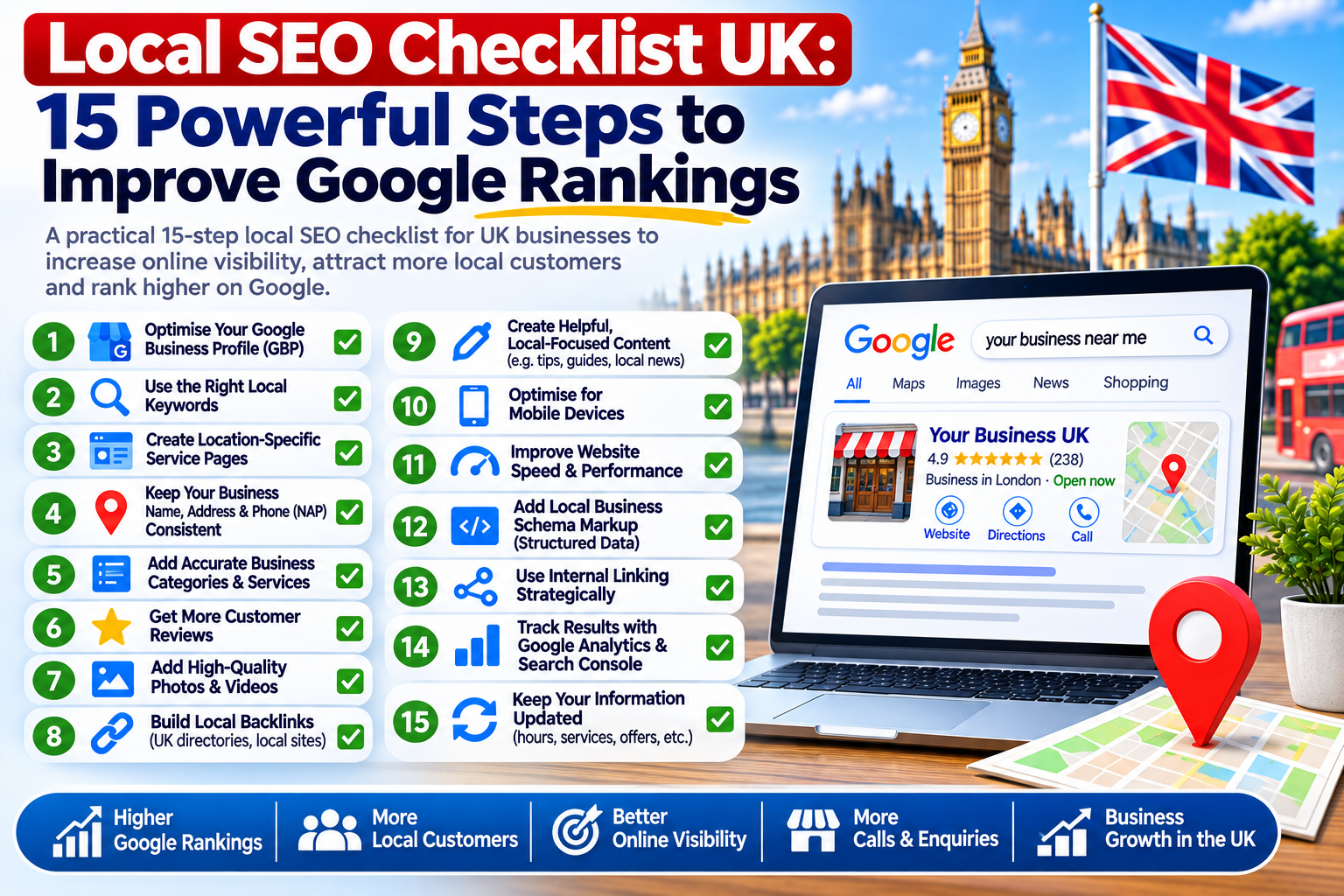
Local customers often use Google to find nearby businesses, compare services, read reviews, and decide where to spend their money. Whether you run a restaurant, dental practice, recruitment agency, accounting firm, shop, or digital marketing company, appearing in relevant local search results can help you reach more potential customers.
A practical Local SEO checklist UK businesses can follow helps improve Google visibility, strengthen local search presence, and attract more relevant website visitors.
Local SEO focuses on helping your business appear when people search for products and services in a particular town, city, or surrounding area. It includes Google Business Profile optimisation, local keyword research, website improvements, online reviews, and consistent business information.
In this guide, you will discover 15 essential local SEO steps to help your UK business build a stronger online presence and generate more local enquiries.
What Is Local SEO?
Local SEO is the process of improving your business’s online visibility for geographically relevant searches.
For example, potential customers may search for:
- Digital marketing agency in Luton
- Best accountant in Birmingham
- Dentist near me
- Electrician in Manchester
- Restaurant in London
- Recruitment agency in Leeds
Search engines use various signals to determine which businesses and web pages are relevant to these searches. Google’s local results are influenced by relevance, distance, and prominence.
Following a structured Local SEO checklist UK businesses can use helps ensure that important optimisation tasks are completed consistently.
15-Step Local SEO Checklist UK Businesses Should Follow
1. Optimise Your Google Business Profile
Google Business Profile is an important part of local SEO for eligible businesses. It helps customers discover business information through Google Search and Maps.
Start by claiming and verifying your profile if you are eligible.
Your checklist should include:
- Use your real-world business name.
- Choose the most appropriate primary category.
- Add relevant secondary categories where appropriate.
- Provide accurate contact details.
- Keep opening hours up to date.
- Describe your services clearly.
- Add genuine photographs of your premises, products, or work.
- Complete all relevant profile sections.
Avoid adding extra keywords to your business name unless they are genuinely part of the name used by your business.
A complete and accurate profile helps Google and potential customers understand what your business offers.
2. Research Local Keywords
Keyword research helps you understand how people search for your services in specific locations.
For example, a business based in Luton might target phrases such as:
- SEO agency Luton
- Digital marketing company Luton
- Website design Luton
- Local SEO services UK
- Small business marketing Luton
Your keywords should reflect your actual services and target market.
Use tools such as Google Keyword Planner, Google Search Console, and SEO research platforms to identify relevant search terms.
Consider three main keyword groups:
Service keywords: Describe what you offer, such as plumbing services or accounting services.
Location keywords: Include relevant places, such as Luton, London, or Birmingham.
Local-intent keywords: Include searches such as “near me”, “open now”, or “best service in [location]” where they genuinely match your customers’ search behaviour.
Avoid targeting locations where you do not offer services simply to attract extra traffic.
3. Add Your Business Information Consistently
Your business name, address, and phone number should be accurate wherever they appear online.
This information is often called NAP: Name, Address, and Phone Number.
Check your:
- Website contact page.
- Google Business Profile.
- Social media profiles.
- Relevant business directories.
- Industry-specific listings.
- Local business association profiles.
Correct outdated addresses, duplicate listings, and incorrect telephone numbers where possible.
Consistency helps customers contact you and reduces confusion about your business details.
If your business operates as a service-area business without serving customers at its registered address, follow Google’s guidelines for displaying your address.
4. Create Location-Specific Landing Pages
Location pages can help businesses explain which areas they serve and which services they provide in those locations.
For example, a company serving several parts of the UK might create useful pages for London, Luton, and Birmingham if it genuinely serves customers in those areas.
Each location page should include:
- The services available in that area.
- Relevant local information.
- Accurate contact or enquiry details.
- Examples of local projects, where available.
- Useful information about service coverage.
- Links to relevant service pages.
Avoid creating dozens of nearly identical pages by replacing only the city name. Thin or duplicated location pages offer little value to customers.
A strong Local SEO checklist UK strategy prioritises useful, original location content rather than producing large numbers of low-quality pages.
5. Improve Your Website’s On-Page SEO
Your website should make it clear what your business does, which services it offers, and where it operates.
Review each important page for the following:
- A unique SEO title.
- A useful meta description.
- One clear main heading.
- Relevant secondary headings.
- Natural use of target keywords.
- Descriptive image alt text.
- Helpful internal links.
- Clear contact information and calls to action.
For example, a page about plumbing services in Luton should explain the actual services available to customers in that area.
Do not force the same location keyword into every sentence. Write naturally for visitors while ensuring search engines can understand the page’s purpose.
6. Make Your Website Mobile-Friendly
Many people search for local services on their smartphones. If your website is difficult to use on a mobile device, potential customers may leave before contacting you.
Check that:
- Text is readable without zooming.
- Navigation menus work correctly.
- Telephone numbers can be tapped to call.
- Forms are easy to complete.
- Buttons are easy to use.
- Important contact details are easy to find.
- Pages load efficiently on mobile connections.
Test your website on different screen sizes and use Google’s PageSpeed Insights to identify potential performance improvements.
Mobile usability is an important part of delivering a good customer experience and supporting your wider SEO strategy.
7. Improve Website Speed and Technical SEO
Technical SEO helps search engines crawl and understand your website.
A technically sound website also makes it easier for potential customers to access your services and information.
Include these tasks in your Local SEO checklist UK plan:
- Use HTTPS.
- Submit an XML sitemap through Google Search Console.
- Check that important pages can be indexed.
- Fix broken internal links.
- Review unnecessary redirects.
- Resolve duplicate page issues.
- Optimise large images.
- Monitor Core Web Vitals.
- Check your robots.txt file where relevant.
If your website runs on WordPress, review your theme, plugins, caching, image sizes, and hosting performance.
Prioritise technical problems that affect important service pages and the experience of local visitors.
8. Collect Genuine Customer Reviews
Reviews can help potential customers compare local businesses and understand other people’s experiences.
Encourage customers to leave honest reviews through an appropriate, straightforward process.
Best practices include:
- Share a direct review link after a completed service.
- Ask customers for honest feedback.
- Respond professionally to positive and negative reviews.
- Address complaints through suitable customer service channels.
- Avoid buying fake reviews.
- Do not offer prohibited incentives in exchange for reviews.
- Protect customer privacy in public responses.
Reviews may contribute to local prominence and customer confidence, but no business can guarantee a particular Google ranking by collecting them.
Focus on delivering a good service and making it easy for customers to share genuine feedback.
9. Build Relevant Local Citations
Local citations are online mentions of your business information. They may appear in directories, industry websites, local business associations, and other relevant platforms.
For UK businesses, useful citation opportunities may include reputable business directories and relevant professional or trade associations.
To improve your citations:
- Check that business details are accurate.
- Correct outdated contact information.
- Remove or resolve duplicate listings where possible.
- Choose directories relevant to your industry.
- Prioritise reputable platforms.
- Avoid mass submissions to low-quality directories.
A smaller number of accurate, relevant listings is generally more useful than submitting your business to hundreds of unrelated websites.
10. Create Helpful Local Content
Publishing useful content can help your business answer customer questions and demonstrate local expertise.
Content ideas include:
- Local service guides.
- Answers to common customer questions.
- Case studies from completed projects.
- Guides to choosing a local service provider.
- Local industry news and updates.
- Frequently asked questions about your services.
- Practical advice relevant to your local audience.
For example, an accountant could publish a guide explaining how small businesses can organise their financial records. A home improvement company could share advice on choosing suitable materials for a renovation project.
Use local references only where they add genuine value. Avoid publishing generic articles with town names inserted solely to target keywords.
11. Use Local Business Schema Markup
Structured data helps search engines understand specific information about a website.
Depending on your business, relevant schema may include LocalBusiness or a more specific supported subtype.
Your structured data may describe details such as:
- Business name.
- Address.
- Telephone number.
- Website URL.
- Opening hours.
- Geographic coordinates, where appropriate.
Ensure that structured data accurately reflects information visible on your website and follows Google’s guidelines.
Do not add misleading details or expect schema markup to guarantee rich results or higher rankings.
You can use Google’s Rich Results Test and Schema.org documentation to help validate your implementation.
12. Build Relevant Local Backlinks
Backlinks are links from other websites to your website. Relevant links can help customers discover your business and contribute to your site’s overall reputation.
Potential local link opportunities include:
- Local news websites.
- Business associations.
- Community organisations.
- Relevant industry publications.
- Local events you genuinely support.
- Partnerships with complementary businesses.
- Useful local research or resources.
For example, sponsoring a legitimate community event may lead to a relevant mention on the organiser’s website.
Avoid buying spammy links or participating in schemes designed to manipulate search rankings. Focus on relationships and resources that provide genuine value.
13. Optimise Your Website’s Contact Page
Your contact page should make it easy for potential customers to reach your business.
Include relevant information such as:
- Your business name.
- Accurate contact details.
- Address, if you serve customers at that location.
- Opening hours.
- Service-area information.
- A simple enquiry form.
- Clear instructions for contacting your team.
If customers visit your premises, provide useful directions and accessibility details where appropriate.
If you operate as a service-area business, explain the areas you cover without misleading visitors about your physical location.
Clear contact information improves usability and helps turn relevant website traffic into enquiries.
14. Track Local SEO Performance
You need to measure performance to understand whether your local SEO activities are producing useful results.
Google Search Console can show search impressions, clicks, queries, and the performance of individual pages. Google Analytics or another suitable analytics tool can help you understand website engagement and conversions.
Monitor:
- Organic search clicks and impressions.
- Local service page performance.
- Relevant keyword trends.
- Website enquiries and form submissions.
- Telephone clicks.
- Booking or purchase conversions.
- Google Business Profile performance data where available.
- The quality of leads generated.
Do not rely on rankings alone. A page that attracts relevant customers and generates enquiries may be more valuable than a page receiving large amounts of unrelated traffic.
Review your results regularly and use the findings to improve your strategy.
15. Review and Update Your Local SEO Regularly
Local SEO is an ongoing process. Your business details, services, website, and competitors may change over time.
Use a regular review schedule to:
- Update opening hours and contact details.
- Check Google Business Profile information.
- Review customer feedback.
- Refresh outdated website content.
- Fix technical issues.
- Update service and location pages.
- Check for duplicate or incorrect citations.
- Review organic search performance.
- Identify new keyword opportunities.
A monthly review is a useful starting point for many small businesses, while important technical problems or incorrect business information should be addressed as soon as possible.
Following a structured Local SEO checklist UK businesses can repeat helps keep optimisation tasks organised and makes progress easier to measure.
Common Local SEO Mistakes to Avoid
Even a well-designed website may struggle to perform if it contains avoidable local SEO problems.
Common mistakes include:
- Inaccurate business contact details.
- An incomplete or misleading Google Business Profile.
- Duplicate or thin location pages.
- Keyword stuffing in website content.
- Fake reviews.
- Low-quality backlink schemes.
- Ignoring mobile usability.
- Leaving outdated opening hours online.
- Neglecting technical SEO.
- Failing to track enquiries and conversions.
Avoiding these mistakes can help your business build a more trustworthy online presence and provide a better experience for local customers.
Benefits of Following a Local SEO Checklist UK Businesses Can Use
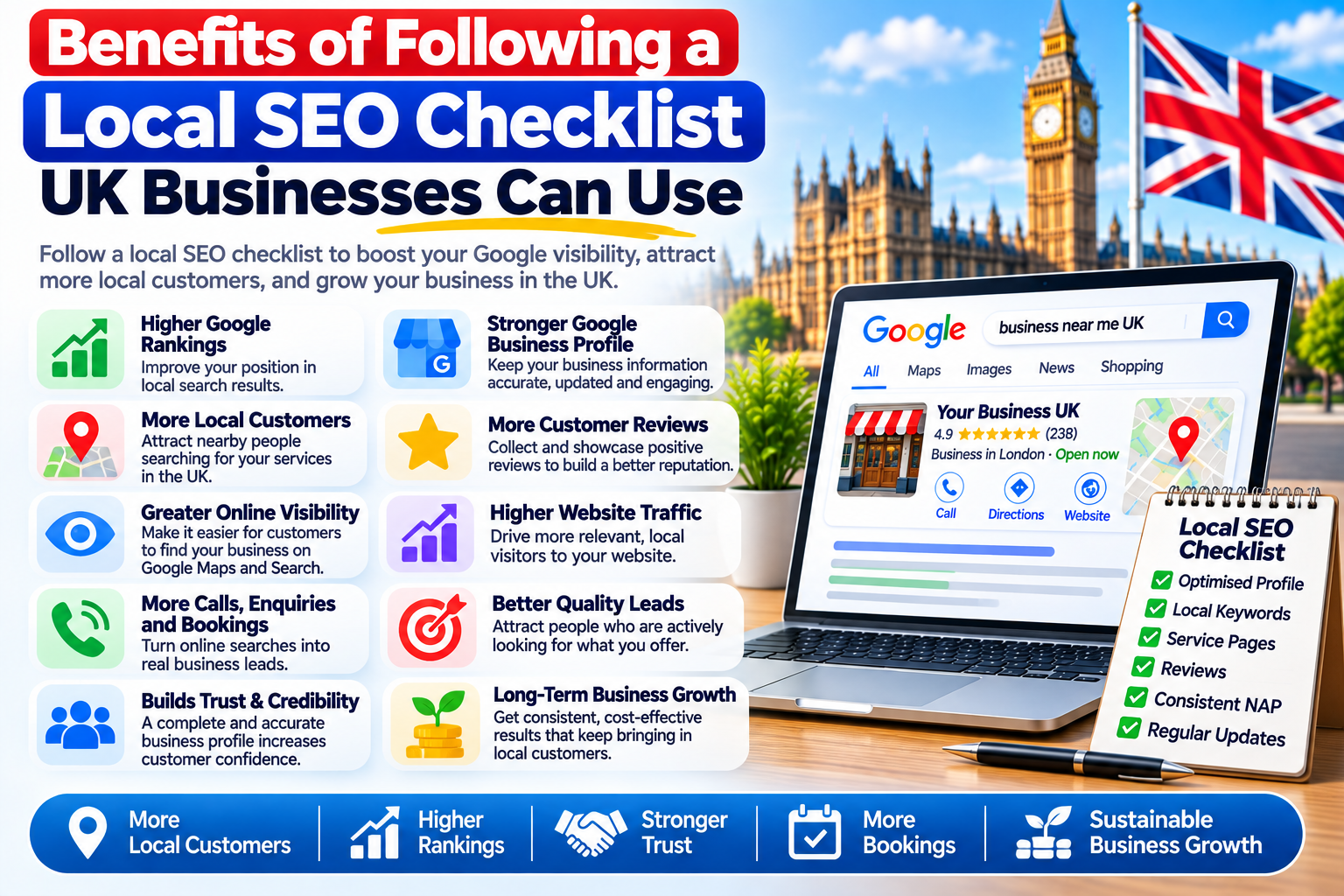
A structured checklist helps businesses organise their SEO work and focus on tasks that support local visibility.
Better local visibility: Improve opportunities to appear for relevant searches in your service areas.
More relevant website visitors: Help people searching for your products or services discover your business.
Stronger online reputation: Maintain accurate business information and encourage genuine customer feedback.
Improved website experience: Make it easier for customers to navigate your site and contact you.
More qualified enquiries: Connect local search visibility with clear service information and calls to action.
Consistent optimisation: Track completed tasks, identify problems, and maintain your online presence over time.
Results vary depending on competition, business relevance, location, website quality, and the consistency of your efforts. A checklist is a practical framework, not a guarantee of rankings.
Conclusion
A practical Local SEO checklist UK businesses can follow provides a clear way to improve local search visibility, strengthen website quality, and make business information easier to find.
Start with the essentials: optimise your Google Business Profile if eligible, research relevant local keywords, keep business details consistent, improve your website, and collect genuine customer reviews. Then build useful location pages, strengthen technical SEO, earn relevant links, and track the enquiries generated by your work.
By reviewing these 15 steps regularly, your business can maintain a stronger local online presence and build a sustainable foundation for attracting customers through Google.
Frequently Asked Questions About Local SEO Checklist UK
1. What should a Local SEO checklist UK include?
A Local SEO checklist UK should include Google Business Profile optimisation, local keyword research, accurate business information, website improvements, customer reviews, local citations, and performance tracking.
2. How can a Local SEO checklist UK help small businesses?
A Local SEO checklist UK helps small businesses organise optimisation tasks, improve local search visibility, reach relevant customers, and identify website improvements that may generate more enquiries.
3. How do I start a Local SEO checklist UK strategy?
Start your Local SEO checklist UK strategy by checking your Google Business Profile eligibility, researching local keywords, reviewing your website, correcting business details, and identifying the services customers search for.
4. Why is Google Business Profile included in a Local SEO checklist UK?
Google Business Profile is an important part of a Local SEO checklist UK because eligible businesses can use it to display accurate contact information, opening hours, services, and photographs on Google.
5. Can a Local SEO checklist UK improve Google Maps visibility?
A Local SEO checklist UK can help improve your local search presence by ensuring your business information is accurate, your website is relevant, and your eligible business profile is properly maintained. Rankings are not guaranteed.
6. How often should I review my Local SEO checklist UK?
Review your Local SEO checklist UK monthly as a starting point. Check business information, website performance, customer reviews, local keywords, and enquiries, and correct important errors as soon as possible.
7. What keywords should I include in a Local SEO checklist UK?
A Local SEO checklist UK should include relevant service keywords, location keywords, and customer-focused search phrases. Choose terms that accurately reflect your services and the areas you genuinely serve.
8. Does a Local SEO checklist UK require website optimisation?
Yes. A Local SEO checklist UK should cover page titles, meta descriptions, headings, internal links, mobile usability, website speed, and useful content for your services and locations.
9. How do customer reviews support a Local SEO checklist UK?
Customer reviews support a Local SEO checklist UK by helping potential customers assess your business. Encourage honest feedback, respond professionally, and avoid fake reviews or prohibited incentives.
10. Are local citations important in a Local SEO checklist UK?
Yes. A Local SEO checklist UK should include reviewing relevant business directories and correcting inaccurate names, addresses, and phone numbers to help customers find reliable business information.
11. Should a Local SEO checklist UK include location pages?
A Local SEO checklist UK should include useful location pages when a business genuinely serves those areas. Each page should provide original, relevant information instead of duplicating content with different town names.
12. How can technical SEO improve a Local SEO checklist UK?
Technical SEO strengthens a Local SEO checklist UK by addressing website security, mobile usability, indexing, broken links, XML sitemaps, and page performance.
13. Can a Local SEO checklist UK help service-area businesses?
Yes. A Local SEO checklist UK can help eligible service-area businesses explain where they operate, maintain accurate business information, and create useful service pages for the areas they genuinely cover.
14. What role does content marketing play in a Local SEO checklist UK?
Content marketing supports a Local SEO checklist UK by answering local customer questions, explaining services, publishing useful guides, and demonstrating genuine knowledge of the business’s industry.
15. Should backlinks be part of a Local SEO checklist UK?
Yes. A Local SEO checklist UK can include earning relevant links from reputable local organisations, industry publications, and community resources. Avoid spammy links and manipulative link-building schemes.
16. How can I measure the results of a Local SEO checklist UK?
Measure your Local SEO checklist UK results through Google Search Console clicks and impressions, relevant landing page traffic, enquiries, phone clicks, bookings, and other meaningful conversions.
17. Is a Local SEO checklist UK useful for businesses in London?
Yes. A Local SEO checklist UK can help London businesses improve their online presence by targeting relevant services and areas, maintaining accurate business details, and publishing useful local content.
18. Can a Local SEO checklist UK help businesses outside major cities?
Yes. A Local SEO checklist UK can help businesses in smaller towns target relevant local searches, explain their services clearly, and improve their online visibility among nearby customers.
19. What mistakes should I avoid when following a Local SEO checklist UK?
When following a Local SEO checklist UK, avoid keyword stuffing, fake reviews, inaccurate business information, duplicate location pages, low-quality backlinks, and ignoring website performance.
20. What is the best way to maintain a Local SEO checklist UK?
The best way to maintain a Local SEO checklist UK is to assign responsibility for regular reviews, update inaccurate information promptly, monitor performance, refresh useful content, and prioritise tasks based on business goals.