The dental industry in the UK is competitive, and patients increasingly use Google to find local dentists, compare dental treatments, and read reviews before booking an appointment. Whether you run a private dental practice, an NHS dental practice, or a specialist clinic, having a strong online presence can help you reach more potential patients.
SEO for dentists UK is an effective way to improve your website’s visibility in search results, attract relevant local visitors, and encourage more people to contact your dental practice.
From local keyword research to Google Business Profile optimisation, a well-planned dental SEO strategy can help your practice stand out in its local market.
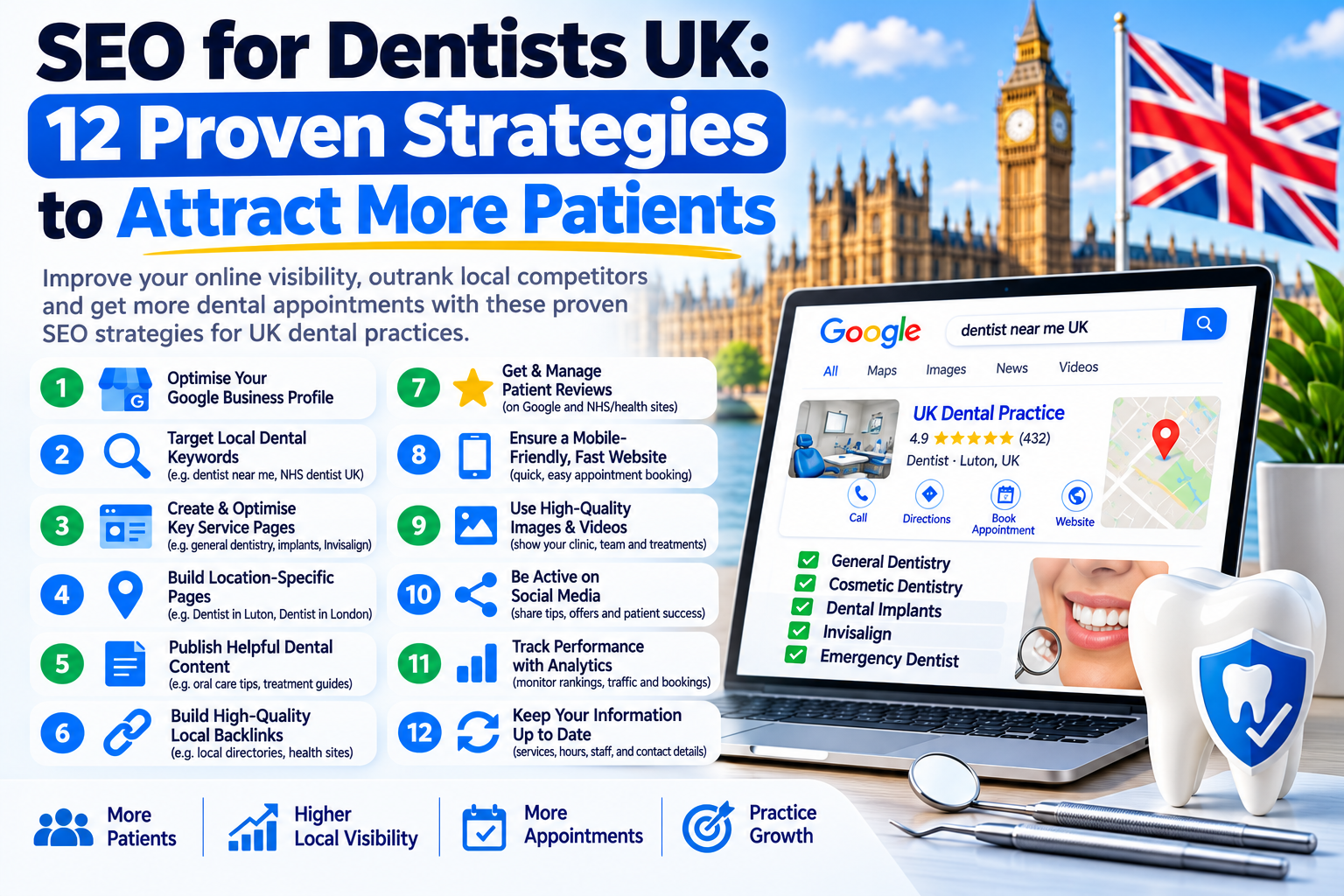
In this guide, we explore 12 proven SEO strategies for dentists in the UK.
What Is SEO for Dentists UK?
SEO for dentists UK is the process of improving a dental practice’s website and online presence to increase its visibility on search engines such as Google.
When someone searches for terms like “dentist near me”, “private dentist in London”, or “teeth whitening in Manchester”, effective SEO can help relevant dental practice pages appear in search results.
Dental SEO typically includes:
- Keyword research for dental treatments and locations.
- Website content and on-page optimisation.
- Local SEO and Google Business Profile management.
- Technical SEO and mobile optimisation.
- Online reputation management.
- Helpful dental content and relevant backlinks.
The main goal is to help potential patients discover your services and make it easier for them to contact your practice.
1. Conduct Keyword Research for Your Dental Practice
Keyword research is the foundation of successful SEO for dentists UK. It helps you understand what potential patients search for when looking for dental services.
Start by identifying keywords related to your treatments, location, and type of practice.
Examples include:
- Dentist in London
- Private dentist in Birmingham
- Emergency dentist in Manchester
- Teeth whitening in Leeds
- Dental implants in Bristol
- Cosmetic dentist in Luton
- Invisalign provider in London
- Family dentist near me
Use tools such as Google Keyword Planner, Google Search Console, and SEO research platforms to identify relevant search terms and assess their potential.
Focus on keywords that reflect the actual services you provide. A practice that offers cosmetic dentistry, for example, should prioritise relevant cosmetic treatment pages rather than targeting every dental keyword.
Tip: Combine treatment keywords with location terms where appropriate to reach people searching for specific dental services in your area.
2. Optimise Your Dental Practice Website
Your website should clearly explain who you are, where you operate, and which dental services you offer.
On-page optimisation helps search engines understand your content and helps visitors find the information they need.
To improve your website:
- Write unique page titles and meta descriptions.
- Use clear H1 and H2 headings.
- Include relevant keywords naturally.
- Display your address and contact details accurately.
- Make appointment booking and enquiry options easy to find.
- Use descriptive image alt text.
- Ensure your website works well on mobile devices.
- Provide clear information about your dentists and their professional qualifications.
Avoid using the same title and description across every page. Each page should describe its specific purpose, such as general dentistry, dental implants, or emergency appointments.
A clear website structure can improve the patient experience and support your SEO strategy.
3. Improve Local SEO for Dentists
Local SEO is particularly important because many patients prefer a dentist close to their home, workplace, or local area.
SEO for dentists UK should include a local strategy that helps people discover your practice when searching for nearby dental services.
Practical steps include:
- Optimise your Google Business Profile if your practice is eligible.
- Keep your business name, address, telephone number, and opening hours accurate.
- Select the most relevant business category.
- Add appropriate photographs of your practice.
- Create useful location-specific website content.
- Encourage genuine patient reviews without offering prohibited incentives.
- Maintain consistent business information across relevant directories.
For example, a dental practice in Luton could create a dedicated page explaining its dental services, location, appointment process, and accessibility information.
Avoid creating multiple nearly identical location pages for areas you do not genuinely serve. Every location page should provide useful, accurate information.
4. Optimise Your Google Business Profile
Google Business Profile can help eligible dental practices appear in local Google Search and Maps results.
A complete and accurate profile makes it easier for potential patients to find essential information about your practice.
Improve your profile by:
- Providing accurate opening hours and contact details.
- Selecting the most appropriate business category.
- Listing relevant services.
- Adding genuine photographs of the practice.
- Sharing updates when appropriate.
- Responding professionally to patient reviews.
- Keeping holiday opening hours up to date.
Make sure your profile follows Google’s guidelines and accurately represents your dental practice.
Do not use misleading business names or add keywords to your name unless they are genuinely part of your real-world business name.
Google Business Profile is one part of local SEO. Your website quality, relevance, location, and reputation also influence how patients discover your practice.
5. Create Dedicated Pages for Dental Treatments
A common SEO mistake is placing every treatment on a single services page. Dedicated treatment pages allow you to explain each service in greater detail and target relevant search queries.
Depending on the treatments you genuinely offer, you could create pages for:
- General dentistry
- Cosmetic dentistry
- Teeth whitening
- Dental implants
- Invisalign or other orthodontic treatments
- Dental hygiene appointments
- Emergency dental appointments
- Children’s dentistry
- Dentures and restorative dentistry
Each page should explain the treatment, who may be suitable for it, the appointment process, potential considerations, and how patients can contact your practice.
Dental content should be accurate, balanced, and easy to understand. Avoid guaranteeing treatment outcomes or making unsupported claims about clinical results.
Where appropriate, have treatment information reviewed by a suitably qualified dental professional.
6. Publish Helpful Dental Blog Content
Publishing useful articles can help your practice answer common patient questions and demonstrate relevant expertise.
Examples of dental blog topics include:
- How to Choose a Dentist in the UK
- What to Expect During a Routine Dental Check-Up
- Questions to Ask Before Dental Implant Treatment
- How to Maintain Good Oral Hygiene
- What to Know Before Teeth Whitening
- How to Find an Emergency Dentist
- Understanding Different Types of Dental Treatments
- How Often Should You Visit a Dentist?
For SEO for dentists UK, focus on content that addresses genuine patient concerns rather than writing articles solely to include keywords.
Use clear headings, explain dental terms in plain English, and link to relevant treatment pages where appropriate.
Because dental information can affect health decisions, ensure content is reliable, up to date, and consistent with relevant professional guidance. Do not use blog articles as a substitute for individual clinical advice.
7. Improve Mobile Usability and Website Speed
Many patients search for dentists using mobile phones, especially when they need to find contact details or enquire about an appointment.
A slow or difficult-to-use website can discourage visitors from contacting your practice.
To improve performance:
- Use a responsive website design.
- Compress images without reducing their usefulness.
- Remove unnecessary plugins and scripts.
- Enable appropriate caching.
- Use secure HTTPS connections.
- Make telephone numbers easy to tap.
- Keep appointment forms simple.
- Check your website’s Core Web Vitals.
- Test important pages on different mobile devices.
A mobile-friendly website should allow visitors to find treatment information, check opening hours, and contact the practice without unnecessary effort.
Use Google PageSpeed Insights and Google Search Console to identify performance issues and prioritise improvements.
8. Build Trust Through Reviews and Reputation Management
Patients often compare dental practices before deciding where to book. Genuine reviews can help them understand other patients’ experiences and assess whether a practice may suit their needs.
Reputation management is an important supporting part of SEO for dentists UK.
To maintain a strong reputation:
- Invite patients to leave honest feedback in an appropriate way.
- Make it easy to find your review profiles.
- Respond professionally to feedback.
- Address service concerns through suitable internal processes.
- Avoid buying fake reviews or posting misleading testimonials.
- Follow applicable confidentiality and professional requirements when responding publicly.
Never reveal confidential patient information in a public response. Even if a reviewer mentions personal details, your reply should protect their privacy.
Reviews may support patient confidence and local discovery, but they do not guarantee higher rankings or new bookings.
9. Use Dental SEO Content That Demonstrates Expertise
Dental websites should provide accurate information that helps patients make informed decisions.
Include useful details about your practice, such as:
- Dentist biographies and relevant qualifications.
- Professional registrations where appropriate.
- Treatment information and limitations.
- Appointment procedures.
- Accessibility information.
- Practice policies and contact details.
- Clear information about fees where available.
- References to reputable dental and health guidance when useful.
For SEO for dentists UK, trustworthy content is especially important because patients may rely on dental information when making decisions about their health.
Ensure that claims about treatments, experience, qualifications, and results are truthful and verifiable. Follow relevant General Dental Council standards and applicable UK advertising rules.
10. Build Relevant Backlinks to Your Dental Website
Backlinks are links from other websites to your dental practice website. Relevant, trustworthy links can help people discover your practice and contribute to your website’s overall authority.
Potential opportunities include:
- Local business organisations.
- Relevant community websites.
- Reputable dental publications.
- Professional associations where membership applies.
- Local news coverage for genuine community activities.
- Educational resources that other websites may find useful.
You can also publish original oral health guides or community resources that provide genuine value.
Avoid buying large volumes of low-quality links, using automated link schemes, or participating in manipulative exchanges designed to influence rankings.
Prioritise relevance, editorial quality, and genuine relationships over backlink quantity.
11. Track Appointment Enquiries and SEO Performance
SEO should help your dental practice achieve meaningful business goals, not just increase website traffic.
Use Google Search Console and appropriate website analytics tools to understand how people discover and use your website.
Monitor metrics such as:
- Organic search clicks and impressions.
- Search terms that bring visitors to your website.
- Performance of treatment and location pages.
- Clicks on telephone numbers.
- Appointment form submissions.
- Online booking completions.
- Calls and enquiries attributed to organic search where tracking is available.
- Conversion rates from relevant landing pages.
Make sure tracking is configured appropriately and respects applicable privacy and data protection requirements.
Review results regularly. If a treatment page receives relevant traffic but few enquiries, consider improving the clarity of the content, appointment options, and calls to action.
12. Maintain Your Dental Website and SEO Strategy
SEO requires regular attention because services, website content, search behaviour, and competitors can change over time.
A practical maintenance routine includes:
- Reviewing important page titles and meta descriptions.
- Updating treatment information when necessary.
- Checking broken links and technical errors.
- Keeping contact details and opening hours accurate.
- Reviewing Google Business Profile information.
- Updating outdated blog posts.
- Checking indexing and search performance.
- Reviewing enquiry and booking data.
- Removing or correcting inaccurate information.
For SEO for dentists UK, prioritise changes that improve accuracy, usability, visibility, and the experience of prospective patients.
A consistent strategy is generally more sustainable than making occasional changes solely to chase short-term ranking improvements.
Common Dental SEO Mistakes to Avoid
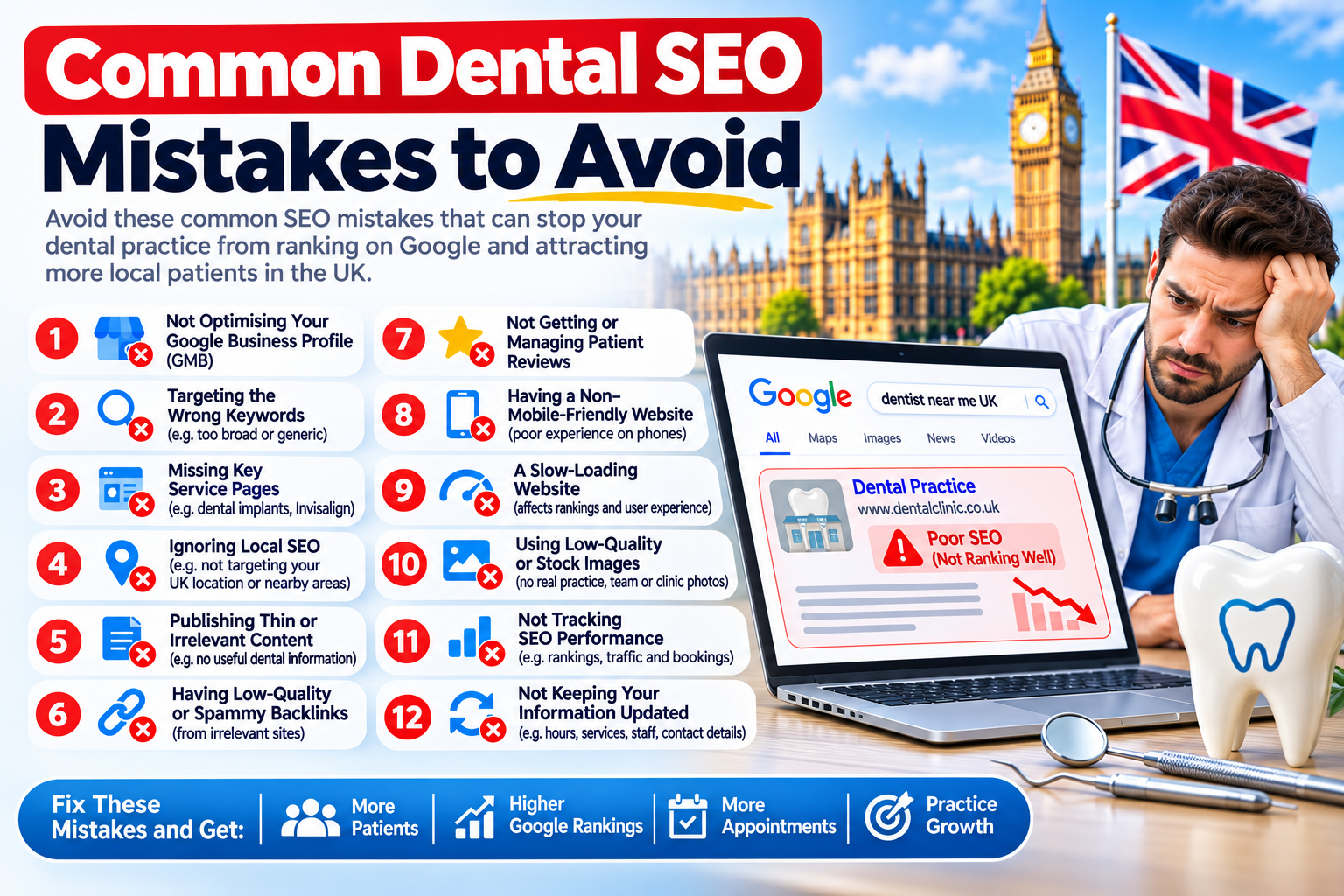
Even a well-designed dental website can struggle to attract relevant visitors if it has avoidable problems.
Common mistakes include:
- Targeting broad keywords without considering local intent.
- Using duplicate treatment page content.
- Ignoring mobile usability.
- Leaving outdated opening hours online.
- Publishing inaccurate or exaggerated treatment claims.
- Buying spammy backlinks.
- Neglecting website security and technical SEO.
- Creating low-quality location pages.
- Ignoring patient privacy when responding to reviews.
- Measuring traffic without tracking enquiries or bookings.
Avoiding these mistakes can help your practice build a more useful website and a stronger foundation for long-term search visibility.
Benefits of SEO for Dentists UK
A well-planned SEO strategy can support several goals for a dental practice.
Improved online visibility: Help potential patients discover relevant dental services through search engines.
More relevant website visitors: Reach people searching for the treatments and locations your practice serves.
Better local discovery: Make it easier for patients to find accurate practice information through local search.
Greater patient confidence: Provide clear information about treatments, qualifications, fees, and appointment procedures.
More appointment enquiries: Make it easier for interested visitors to contact your practice or use online booking.
Long-term marketing value: Build an online presence that can continue attracting relevant visitors over time, although results depend on competition and ongoing optimisation.
SEO cannot guarantee first-page rankings, a particular number of patients, or a specific return on investment. Results vary according to your location, competition, website quality, and strategy.
Conclusion
SEO for dentists UK can help dental practices improve their online visibility, reach potential patients, and generate relevant appointment enquiries. A strong strategy combines keyword research, local SEO, treatment-specific pages, helpful dental content, technical optimisation, reputation management, and performance tracking.
Start by reviewing your website, improving your most important treatment pages, and making sure your practice information is accurate. Then build a consistent content strategy and measure whether your search visibility is translating into meaningful enquiries.
With accurate information, a patient-focused website, and ongoing optimisation, your dental practice can build a stronger foundation for sustainable online growth.
Frequently Asked Questions About SEO for Dentists UK
1. What is SEO for dentists UK?
SEO for dentists UK helps dental practices improve their Google visibility, attract local patients, promote dental treatments, and generate more appointment enquiries through organic search.
2. Why is SEO for dentists UK important for dental practices?
SEO for dentists UK is important because it helps patients discover local dental services, find relevant treatment information, and contact practices when they need dental care.
3. How can SEO for dentists UK attract more patients?
SEO for dentists UK can attract patients by targeting relevant dental keywords, improving treatment pages, strengthening local SEO, and making appointment booking easier.
4. What keywords should dentists target in the UK?
SEO for dentists UK can target phrases such as dentist in London, private dentist in Birmingham, emergency dentist in Manchester, dental implants in Bristol, and cosmetic dentist in Luton.
5. How long does SEO for dentists UK take to show results?
SEO for dentists UK may take several months to deliver meaningful results. Progress depends on local competition, website quality, content, technical performance, and consistent optimisation.
6. Can SEO for dentists UK help small dental practices?
Yes, SEO for dentists UK can help smaller practices reach relevant local patients by focusing on specific treatments, service areas, and local search queries.
7. How does local SEO help dentists in the UK?
Local SEO supports SEO for dentists UK by improving a practice’s visibility in relevant local searches. Accurate business information, useful location pages, and a well-maintained Google Business Profile can help patients find the practice.
8. Is Google Business Profile important for SEO for dentists UK?
Yes, an eligible dental practice can use Google Business Profile to share accurate opening hours, contact details, services, and photographs. This supports local discovery through Google Search and Maps.
9. Should dentists create separate pages for dental treatments?
SEO for dentists UK can benefit from dedicated pages for genuine services such as teeth whitening, dental implants, cosmetic dentistry, and emergency appointments. Each page should provide accurate and useful treatment information.
10. How can SEO for dentists UK improve Google rankings?
SEO for dentists UK can improve search visibility through keyword research, relevant content, technical optimisation, mobile-friendly design, local SEO, and trustworthy backlinks.
11. Does blogging help SEO for dentists UK?
Yes, blogging can support SEO for dentists UK by answering common patient questions. Articles about oral hygiene, dental check-ups, and treatment options can attract relevant visitors when the information is accurate and useful.
12. How much does SEO for dentists UK cost?
The cost of SEO for dentists UK depends on the website, location, competition, and required services. A tailored package may include keyword research, technical SEO, content optimisation, local SEO, and performance reporting.
13. Can SEO for dentists UK increase appointment bookings?
SEO for dentists UK can help increase appointment enquiries by attracting relevant visitors and providing clear contact details, online booking options, and useful treatment pages. Actual bookings depend on several factors, including availability and patient needs.
14. Are patient reviews useful for dental SEO?
Genuine patient reviews can support reputation management and help potential patients assess a practice. As part of SEO for dentists UK, practices should request honest feedback appropriately and protect patient confidentiality in public responses.
15. What technical SEO improvements do dentists need?
Technical SEO for dentists UK should include secure HTTPS connections, mobile usability, fast page loading, accurate indexing, XML sitemaps, and fixing broken links that affect important pages.
16. Can dentists manage SEO without an agency?
Yes, dentists can start SEO for dentists UK by improving their website content, updating business information, publishing useful articles, and monitoring Google Search Console. Professional support may be helpful for complex technical problems or highly competitive locations.
17. How can dentists measure SEO performance?
SEO for dentists UK should be measured through organic search clicks, impressions, treatment page performance, phone clicks, appointment enquiries, online bookings, and relevant conversion rates.
18. What are common SEO mistakes dental practices should avoid?
Common SEO for dentists UK mistakes include duplicate treatment pages, keyword stuffing, inaccurate business details, poor mobile usability, misleading treatment claims, spammy backlinks, and ignoring patient privacy.
19. Does SEO for dentists UK help private dental practices?
Yes, SEO for dentists UK can help private practices promote the treatments they genuinely offer, improve local visibility, explain fees and services clearly, and attract relevant appointment enquiries.
20. What is the best strategy for SEO for dentists UK?
The best SEO for dentists UK strategy combines keyword research, local optimisation, dedicated treatment pages, accurate dental content, technical SEO, genuine reviews, and ongoing performance tracking.
21. How important is website content for dental SEO?
Useful website content is essential for SEO for dentists UK because it helps patients understand treatments, practice services, and appointment procedures. Dental content should be clear, reliable, and consistent with relevant professional guidance.
22. Can SEO for dentists UK help emergency dental services?
Yes, SEO for dentists UK can help eligible practices improve visibility for relevant emergency dental searches. Emergency service pages should clearly explain availability, contact procedures, and the services actually provided.
23. Why should dentists optimise their websites for mobile devices?
Mobile optimisation supports SEO for dentists UK because patients often use smartphones to find nearby practices, check opening hours, and request appointments. A mobile-friendly website makes these tasks easier.
24. How often should dental practices update their SEO?
Dental practices should review SEO for dentists UK regularly, checking search performance, technical issues, treatment information, opening hours, and appointment processes. Updates should prioritise accuracy and patient usefulness.
25. Can SEO for dentists UK help a practice compete locally?
Yes, SEO for dentists UK can help a practice compete by focusing on its genuine treatment specialisms, useful local information, accurate business details, and a website experience that makes contacting the practice straightforward.