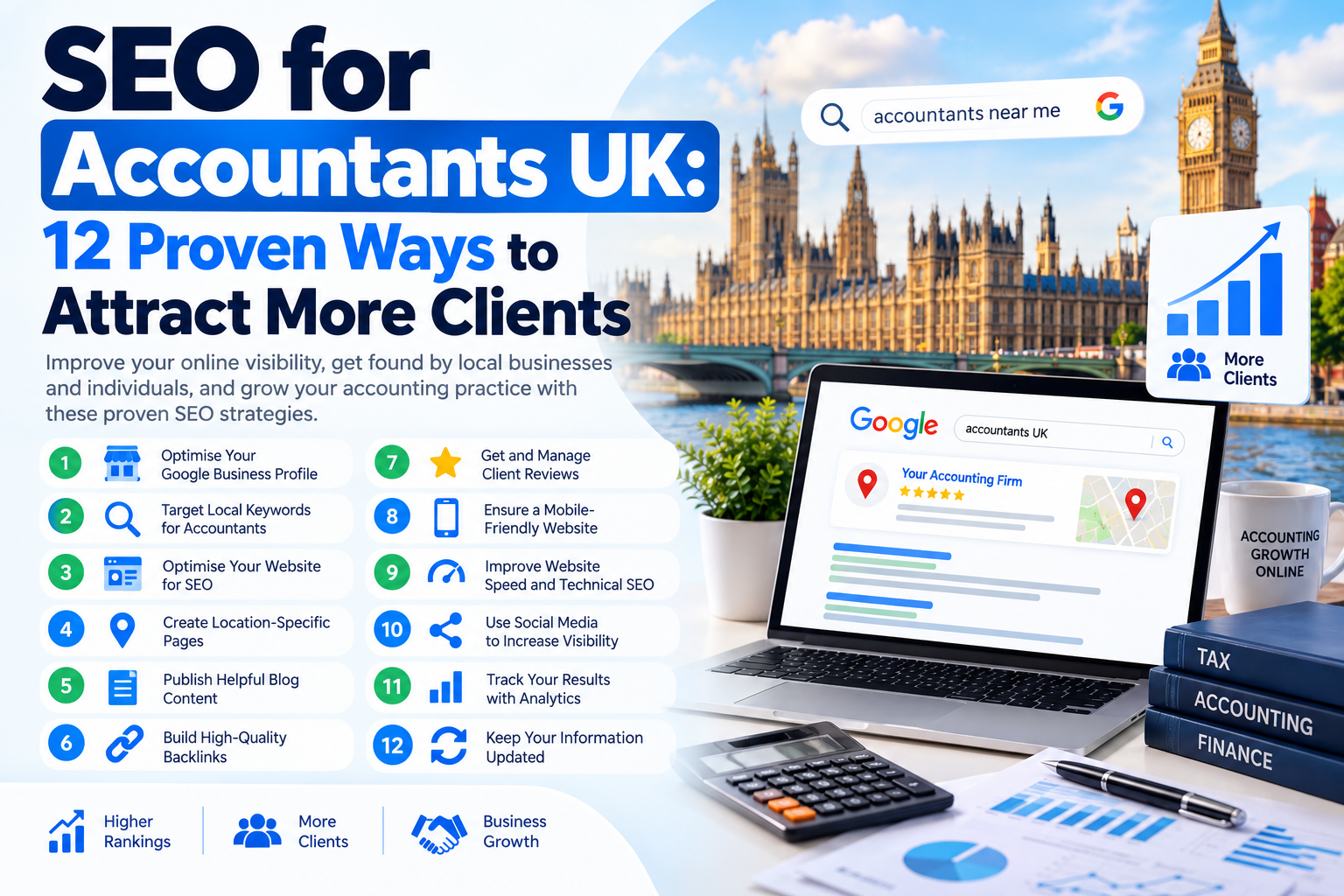
The UK accountancy market is competitive, and potential clients increasingly use Google to find accountants, tax advisers, bookkeeping services, and business accounting support. If your firm does not appear when people search for these services, you could miss valuable opportunities to attract new clients.
SEO for accountants UK helps accountancy firms improve their online visibility, reach relevant customers, and generate more enquiries through search engines. Whether you run an independent accountancy practice or manage an established accounting firm, an effective SEO strategy can help you compete in your local market.
In this guide, we explain 12 practical ways to improve your website, strengthen your local search presence, and attract more accounting clients in the UK.
What Is SEO for Accountants UK?
SEO for accountants UK is the process of improving an accounting firm’s website and online presence so potential clients can discover its services through relevant Google searches.
This can include optimising service pages, targeting accounting-related keywords, improving Google Business Profile, publishing helpful financial content, and earning relevant backlinks.
For example, potential clients may search for:
- Accountant in Luton
- Small business accountants in London
- Self-assessment tax return accountant UK
- VAT services for small businesses
- Payroll services for UK companies
- Online accountants for limited companies
A well-planned SEO strategy helps your firm reach people searching for services that match your expertise.
Why Is SEO Important for UK Accountants?
Accountants depend on trust, professional credibility, and long-term client relationships. Search engine optimisation can help your firm become more visible when potential clients are researching financial services.
The main benefits of SEO for accountants UK include:
- More relevant website traffic: Reach people searching for accounting and tax services.
- More client enquiries: Help potential clients find your contact details and request consultations.
- Improved local visibility: Appear for relevant searches in the towns and cities you serve.
- Stronger credibility: Demonstrate your expertise through helpful content and professional website pages.
- Long-term marketing value: Build organic visibility that can continue attracting visitors over time.
- Competitive advantage: Improve your online presence against other accounting firms targeting similar clients.
SEO does not guarantee rankings or new clients, but a consistent strategy can improve your opportunities to reach relevant audiences.
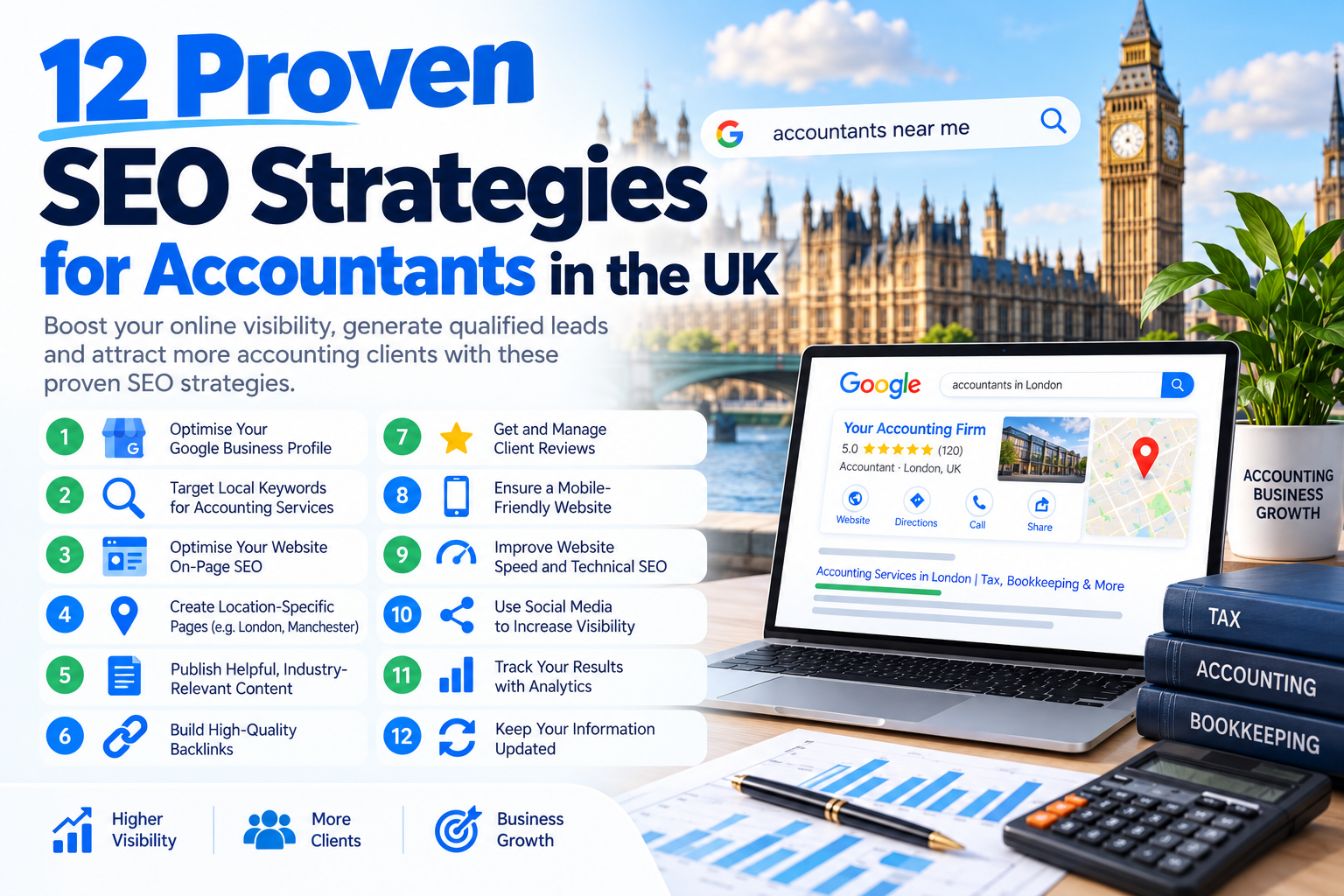
12 Proven SEO Strategies for Accountants in the UK
1. Research the Right Accounting Keywords
Keyword research is the foundation of a successful SEO campaign. Before optimising your website, identify the terms potential clients use when looking for accounting services.
Focus on keywords that reflect your services, target customers, and locations.
Examples include:
- SEO for accountants UK
- Accountants for small businesses UK
- Tax return accountant near me
- Limited company accountant
- VAT registration services UK
- Bookkeeping services for small businesses
- Payroll services for employers
Use keyword research tools and Google Search Console to identify relevant search terms and understand which queries already bring visitors to your website.
Avoid targeting every accounting keyword on one page. Give each important service its own relevant page when it offers distinct value to potential clients.
2. Optimise Your Google Business Profile
For firms serving clients in specific locations, Google Business Profile can support local visibility in Google Search and Maps.
To improve your profile:
- Use your real business name.
- Select the most relevant primary business category.
- Add accurate contact information and opening hours.
- Describe your accounting services clearly.
- Upload genuine office and team photos where appropriate.
- Keep your information updated.
- Encourage genuine clients to leave honest reviews.
If your firm operates remotely or serves clients at their premises, follow Google’s eligibility and address-display rules.
A complete and accurate profile helps prospective clients learn about your firm before making contact.
3. Create Dedicated Pages for Each Accounting Service
A clear website structure helps search engines and visitors understand what your firm offers.
Consider creating dedicated pages for services such as:
- Annual accounts preparation
- Corporation tax returns
- Self-assessment tax returns
- VAT returns and advice
- Payroll management
- Bookkeeping services
- Management accounts
- Accounting for limited companies
Each page should explain the service, who it is suitable for, what clients can expect, and how to get in touch.
For example, a page about self-assessment tax returns should explain the types of clients you help, the information they may need, and how your firm supports the process.
Avoid publishing thin pages that simply repeat similar content with different keywords.
4. Improve Local SEO for Your Accounting Firm
Many accounting clients prefer an accountant who understands their local business environment or offers convenient communication.
Local SEO helps your firm become more visible for relevant location-based searches.
For example, an accountancy firm in Luton may target searches related to accountants in Luton and accounting services for local small businesses.
To improve local SEO:
- Mention your genuine service locations on relevant pages.
- Maintain accurate business information across important directories.
- Build relationships with relevant local organisations.
- Collect genuine customer reviews.
- Publish useful content addressing local business needs.
- Create location pages only where you can provide genuinely distinct information.
Do not create dozens of near-identical city pages just to target more locations. Prioritise useful information and accurate representation of your service areas.
5. Publish Helpful Accounting and Tax Content
Accounting clients often search for answers before deciding which firm to contact. Helpful articles can introduce your expertise and guide readers towards relevant services.
Potential blog topics include:
- A guide to corporation tax for UK limited companies
- What small businesses should know about VAT registration
- How self-assessment tax returns work
- Bookkeeping tips for new business owners
- Common accounting mistakes made by small businesses
- What to consider when choosing an accountant
- Understanding payroll responsibilities for employers
Financial and tax information can affect important decisions, so ensure content is accurate, up to date, and reviewed by a suitably qualified professional where necessary.
Link relevant articles to your service pages so readers can easily learn how your firm may help.
6. Build Trust and Demonstrate Professional Credentials
Accounting involves sensitive financial information, making trust especially important.
Your website should clearly explain who you are, what services you provide, and what professional qualifications or memberships your firm holds.
Consider including:
- Accountant and team biographies.
- Relevant qualifications and professional memberships.
- Clear contact information.
- Genuine testimonials, used with appropriate permission.
- Your approach to client confidentiality and data protection.
- Transparent information about your services and fees where practical.
Only claim credentials, memberships, or regulatory status that you actually hold. Accurate professional information helps potential clients make informed decisions.
7. Improve Website Speed and Mobile Usability
Potential clients may visit your website using a smartphone while searching for an accountant. If your website loads slowly or is difficult to navigate, they may leave before contacting you.
Check that your website:
- Works properly on mobile devices.
- Uses readable text and clear headings.
- Loads important pages efficiently.
- Has easy-to-use navigation.
- Displays phone numbers and enquiry forms clearly.
- Uses appropriately compressed images.
- Provides a straightforward way to request a consultation.
Use Google PageSpeed Insights to identify performance issues and prioritise improvements that make the website easier to use.
8. Optimise SEO Titles and Meta Descriptions
SEO titles and meta descriptions help communicate what each page is about in search results.
Write a unique title and description for each important service page. Include the target keyword naturally where appropriate.
Example:
SEO title: Accountants in Luton | Small Business Accounting
Meta description: Looking for an accountant in Luton? Explore accounting, bookkeeping, tax, and payroll support for individuals and small businesses.
Avoid repeating the same title and description across every page. Focus on accurately describing the service and encouraging relevant users to visit.
9. Earn Relevant Backlinks
Backlinks are links from other websites to your website. Relevant, trustworthy links can support your website’s authority and help potential clients discover your firm.
Accounting firms can look for legitimate opportunities through:
- Professional associations.
- Local business organisations.
- Partnerships with solicitors or business consultants.
- Community business events.
- Useful original research or guides.
- Relevant local business publications.
Focus on earning links through genuine expertise and relationships. Avoid spammy link schemes or purchasing links intended to manipulate search rankings.
10. Make Your Website Generate More Enquiries
Increasing website traffic is useful only if the right visitors can take the next step.
Make it easy for prospective clients to contact your firm by including clear calls to action.
Examples include:
- Book an initial consultation.
- Request an accounting quote.
- Discuss your tax return.
- Contact our accounting team.
- Ask about bookkeeping services.
Place these options on relevant service pages and make enquiry forms straightforward. Explain what happens after someone submits a form and how they can expect to hear from your team.
Where appropriate, track calls, consultation requests, and qualified enquiries to understand which pages contribute to business growth.
11. Use Internal Links to Connect Relevant Pages
Internal links connect pages within your website and help visitors discover related information.
For example, an article about VAT registration could link to your VAT services page. A guide for limited companies could link to your annual accounts and corporation tax services.
Use descriptive link text and create a logical website structure so important service pages are easy to reach.
Internal links can also help search engines understand the relationship between your educational content and the services your firm provides.
12. Measure and Improve Your SEO Performance
SEO should be guided by evidence rather than guesswork.
Useful tools include Google Search Console and Google Analytics. They can help you understand how visitors discover your website and what they do after arriving.
Monitor metrics such as:
- Organic search clicks and impressions.
- Queries that bring potential clients to your website.
- Performance of accounting service pages.
- Enquiry form submissions.
- Phone calls and consultation requests.
- Qualified leads and new client conversions.
Review results regularly and improve pages that attract relevant visitors but generate few enquiries.
Remember that rankings and traffic are not the only measures of success. The quality of leads and the number of new clients are often more meaningful business outcomes.
Common SEO Mistakes Accountants Should Avoid
When implementing SEO for accountants UK, avoid mistakes that can undermine your website’s performance or professional credibility.
Keyword stuffing: Repeating accounting keywords unnaturally can make pages difficult to read.
Duplicate service pages: Publishing near-identical pages for multiple locations can create a poor user experience.
Outdated tax information: Incorrect financial information can mislead readers and damage trust.
Fake reviews: Buying or fabricating reviews undermines credibility and can violate platform policies.
Unclear service information: Visitors may leave if they cannot understand what you offer or how to contact you.
Ignoring mobile users: A difficult mobile experience can discourage prospective clients from making enquiries.
Failing to measure leads: Website traffic alone does not show whether SEO is generating valuable clients.
Focus on accurate information, helpful content, professional credibility, and a website that makes it easy to enquire.
How Long Does SEO for Accountants UK Take to Work?
SEO results depend on your firm’s current website, competition, target locations, content quality, and the work required.
Some improvements, such as correcting contact details or improving service page navigation, can benefit visitors immediately. Changes in organic search visibility may take weeks or months, particularly in competitive locations and service categories.
There is no guaranteed ranking position or fixed timeline. Regularly monitor your search performance, qualified enquiries, and new client conversions to assess progress.
Frequently Asked Questions About SEO for Accountants UK
1. What Is SEO for Accountants UK?
SEO for accountants UK is the process of improving an accounting firm’s website and online visibility to attract potential clients through Google. It includes keyword research, website optimisation, local SEO, helpful accounting content, and performance tracking.
2. Why Is SEO for Accountants UK Important?
SEO for accountants UK helps accounting firms reach people searching for tax returns, bookkeeping, payroll, and other accounting services. A well-planned strategy can improve online visibility, build trust, and generate relevant client enquiries.
3. How Does SEO for Accountants UK Help Accounting Firms Get More Clients?
SEO for accountants UK helps firms appear for relevant searches by improving service pages, targeting suitable keywords, and strengthening local visibility. When potential clients find useful information and clear contact options, they can more easily enquire about your services.
4. What Are the Best SEO Strategies for Accountants UK?
The best SEO strategies for accountants UK include keyword research, Google Business Profile optimisation, dedicated service pages, helpful financial content, technical SEO, and relevant backlinks. Track enquiries to understand which activities contribute to business growth.
5. How Much Does SEO for Accountants UK Cost?
The cost of SEO for accountants UK depends on your website, competition, target locations, and required services. Some basic tasks can be completed in-house, while technical optimisation, content creation, and ongoing SEO management may require a professional agency.
6. How Long Does SEO for Accountants UK Take to Show Results?
SEO for accountants UK may take weeks or months to produce noticeable improvements in organic search visibility. The timeline depends on competition, website quality, existing online authority, and the consistency of optimisation work.
7. Can SEO for Accountants UK Help Small Accounting Firms?
Yes. SEO for accountants UK can help small accounting firms reach potential clients searching for relevant services. Local keyword targeting, useful service pages, accurate business listings, and genuine reviews can support a stronger online presence.
8. Is Local SEO Part of SEO for Accountants UK?
Yes. Local SEO is an important part of SEO for accountants UK when a firm serves specific towns, cities, or regions. Accurate business information, a well-maintained Google Business Profile, relevant location pages, and genuine reviews can support local visibility.
9. Which Keywords Should I Use for SEO for Accountants UK?
For SEO for accountants UK, consider relevant phrases such as “accountants for small businesses UK”, “corporation tax services”, “VAT return accountant”, and “accountant in Luton”. Select keywords based on your services, target customers, and search intent.
10. Does Google Business Profile Improve SEO for Accountants UK?
Google Business Profile supports local visibility by helping eligible accounting firms manage their information on Google Search and Maps. As part of SEO for accountants UK, keep your business category, contact details, opening hours, and services accurate.
11. What Content Should Accountants Publish for SEO for Accountants UK?
Content for SEO for accountants UK can include guides about VAT, corporation tax, self-assessment, payroll, bookkeeping, and accounting for small businesses. Keep financial information accurate, useful, and up to date.
12. Can an SEO Agency Manage SEO for Accountants UK?
An experienced agency can manage SEO for accountants UK through keyword research, technical optimisation, content planning, local SEO, and performance reporting. Choose a provider that follows search engine guidelines and reports on meaningful business outcomes.
13. How Can I Measure the Results of SEO for Accountants UK?
Measure SEO for accountants UK using organic clicks, search impressions, service-page performance, enquiry forms, phone calls, qualified leads, and new clients. Google Search Console and Google Analytics can help you evaluate performance.
14. Is SEO for Accountants UK Better Than Paid Advertising?
SEO for accountants UK and paid advertising serve different purposes. SEO can build organic visibility over time, while paid advertising can provide visibility through sponsored placements when campaigns are active. Many firms evaluate both approaches based on budget and business goals.
15. How Can New Accounting Firms Start SEO for Accountants UK?
New firms can start SEO for accountants UK by building a professional website, creating dedicated service pages, researching relevant keywords, and setting up an eligible Google Business Profile. Establish accurate business information and publish useful content for potential clients.
16. Does Website Speed Matter for SEO for Accountants UK?
Website speed and usability matter because they affect the experience of potential clients visiting your website. As part of SEO for accountants UK, improve mobile usability, optimise images, reduce unnecessary scripts, and monitor performance using suitable tools.
17. How Important Are Backlinks for SEO for Accountants UK?
Relevant backlinks can support SEO for accountants UK by helping users discover your firm and contributing to your website’s authority. Focus on legitimate links from relevant professional organisations, local business resources, and useful industry content.
18. How Often Should I Update SEO for Accountants UK?
Review SEO for accountants UK regularly. Monitor performance monthly, check business details, update outdated financial information, and review your keyword and content strategy quarterly. Make changes based on genuine client needs and performance data.
19. What Mistakes Should I Avoid in SEO for Accountants UK?
Common mistakes in SEO for accountants UK include keyword stuffing, publishing duplicate location pages, using outdated tax information, buying backlinks, and ignoring mobile users. Focus on accurate information, useful content, and a professional website experience.
20. Can SEO for Accountants UK Generate Long-Term Business Growth?
SEO for accountants UK can support long-term growth by helping potential clients discover your services through relevant searches. Consistent website improvements, useful financial content, local visibility, and performance tracking can create more opportunities to attract qualified enquiries.
21. Why Should I Invest in SEO for Accountants UK?
Investing in SEO for accountants UK can help your firm improve its online presence, reach relevant audiences, and create opportunities for new client enquiries. The value depends on your target market, implementation quality, competition, and ability to convert enquiries into clients.
22. What Is the First Step in SEO for Accountants UK?
The first step in SEO for accountants UK is to review your website, identify your most important services, and research relevant keywords. Then improve your main service pages, verify business information, and establish a way to track enquiries.
Final Thoughts
SEO for accountants UK is a valuable long-term marketing strategy for firms that want to improve their online visibility and attract relevant clients.
By researching the right keywords, optimising service pages, improving local search presence, publishing helpful accounting content, and tracking enquiries, your firm can build a stronger foundation for sustainable growth.
Start with the most important improvements, measure the results, and continue refining your strategy based on the needs of your clients.
Want to attract more accounting clients through Google? Review your website, identify the services and locations you want to target, and build an SEO plan around useful content, accurate information, and a professional online experience.