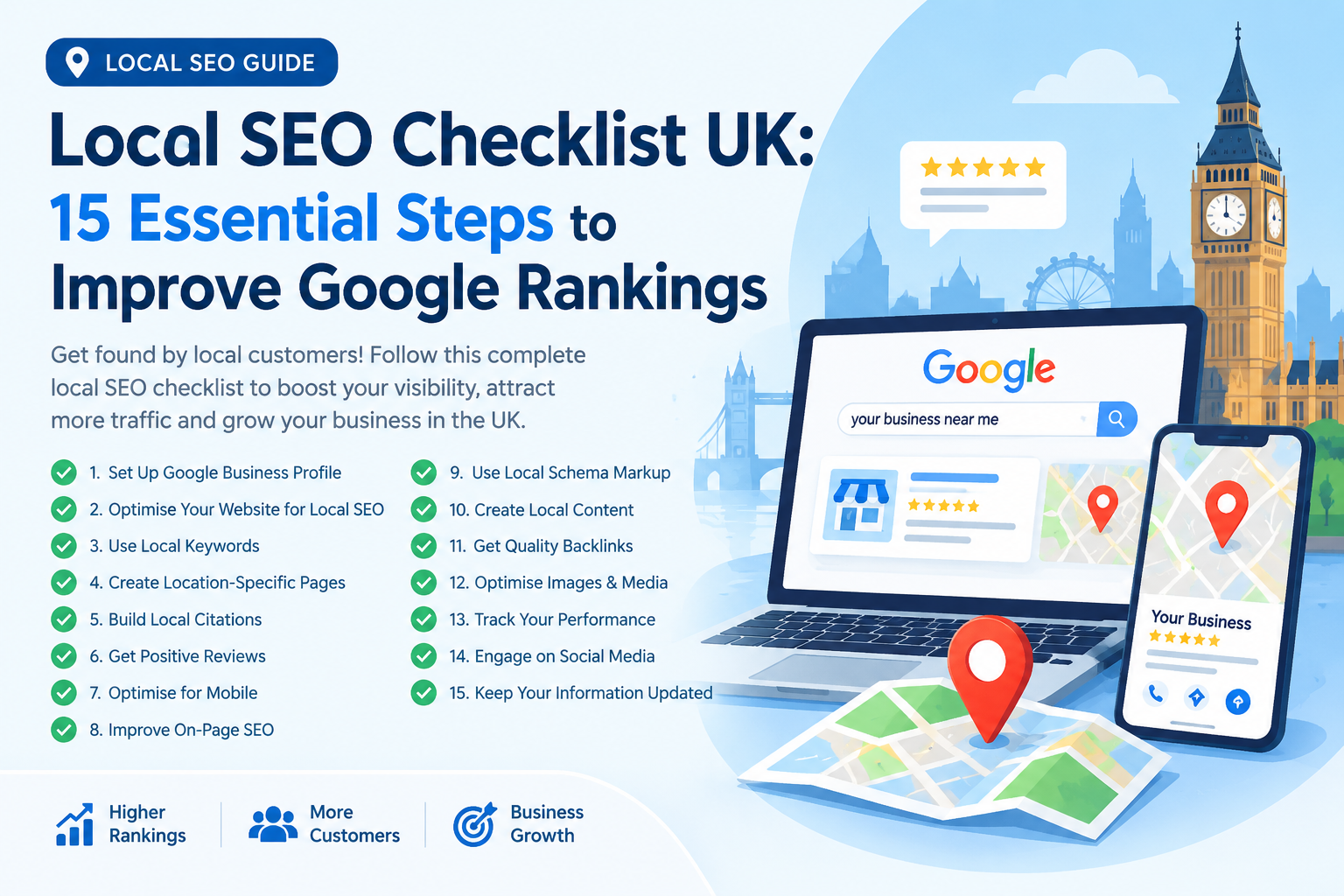
Local SEO is essential for businesses that want to attract customers in their local area. Whether you run a plumbing company, accounting firm, restaurant, digital marketing agency, or retail shop, appearing in local Google search results can help you generate more enquiries and grow your business.
This local SEO checklist UK guide covers 15 practical steps to improve your Google visibility, optimise your website, attract local customers, and strengthen your online presence.
If you want to improve your local search rankings, use this checklist to identify what your business needs to do next.
What Is a Local SEO Checklist?
A local SEO checklist is a list of actions that helps businesses improve their visibility in location-based search results. It includes optimising your Google Business Profile, researching local keywords, improving website content, managing customer reviews, and building relevant local citations.
For UK businesses, a well-organised local SEO checklist can make it easier to compete with other companies targeting the same towns, cities, and service areas.
Why Is Local SEO Important for UK Businesses?
Local SEO helps potential customers discover nearby businesses when they search for products or services online. For example, someone might search for “accountant in Luton,” “plumber near me,” or “digital marketing agency in London.”
Effective local SEO can help your business:
- Improve visibility in Google Search and Google Maps.
- Attract customers who are actively looking for your services.
- Generate more phone calls, website visits, and enquiries.
- Build trust through reviews and accurate business information.
- Compete more effectively with other local businesses.
- Increase opportunities to convert local searches into paying customers.
Follow the local SEO checklist UK businesses can use to build a stronger online presence.
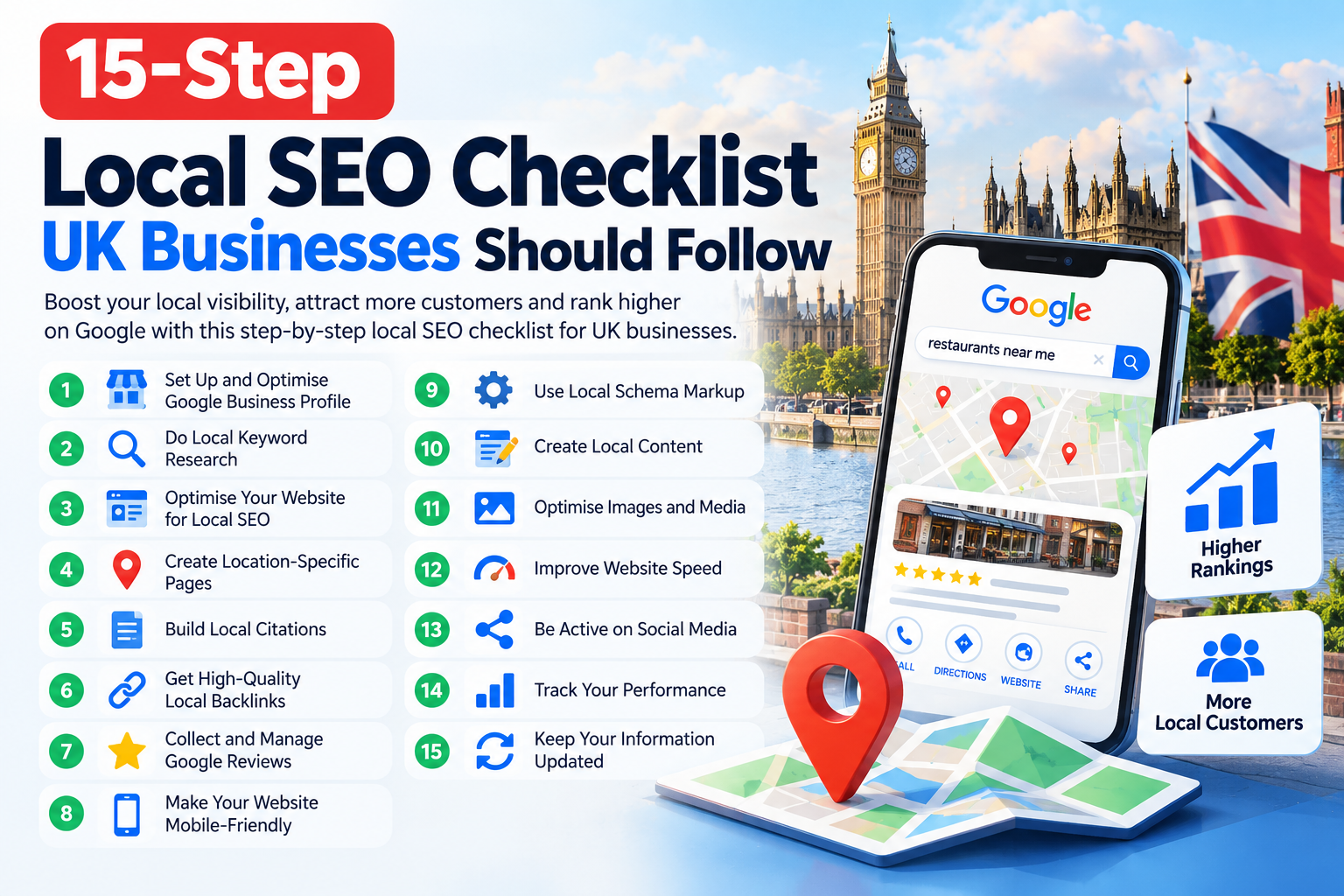
15-Step Local SEO Checklist UK Businesses Should Follow
1. Optimise Your Google Business Profile
Your Google Business Profile is an important part of local SEO. It helps customers find your business details, opening hours, contact information, reviews, and location on Google.
Make sure you:
- Claim and verify your profile.
- Use your real business name.
- Select the most relevant primary business category.
- Add accurate opening hours and contact details.
- Write a clear business description.
- Upload genuine photos of your business, team, products, or completed work.
- Keep your profile updated when information changes.
Avoid adding unnecessary keywords to your business name. Your profile should accurately represent your real-world business.
2. Research Local SEO Keywords
Keyword research helps you understand what potential customers search for when looking for your services.
Start by identifying your main services and combining them with relevant UK locations.
Examples include:
- SEO agency in Luton
- Accountants in Birmingham
- Web design company in Manchester
- Plumber in Milton Keynes
- Digital marketing services in London
Use natural keyword variations throughout your website rather than repeating the same phrase unnecessarily.
Google Search Console can also help you identify queries that already bring visitors to your website.
3. Create Location-Specific Service Pages
If your business serves multiple towns or cities, consider creating dedicated location pages where each page provides genuinely useful, location-specific information.
For example, a UK digital marketing agency might create pages for Luton, Milton Keynes, and London if it genuinely serves customers in those areas.
Each page should include:
- The services available in that location.
- Relevant local customer needs.
- Genuine project examples or testimonials where available.
- Clear contact details and calls to action.
- Useful information that distinguishes the page from other location pages.
Avoid creating large numbers of nearly identical pages simply to target different towns. Thin or repetitive pages provide little value to customers.
4. Optimise Your Website Titles and Meta Descriptions
Your SEO title and meta description help search engines and users understand what each page offers.
Include your primary keyword naturally in the page title, particularly when it accurately describes the page. Write a unique meta description that explains the value of your service.
For example:
SEO title: Local SEO Services in Luton | Grow Your Business
Meta description: Improve your local Google visibility with practical SEO services in Luton. Attract relevant customers and generate more business enquiries.
Avoid using identical titles and descriptions across every page.
5. Ensure Your Website Is Mobile-Friendly
Many customers search for local businesses using smartphones. A website that is difficult to navigate on mobile devices can discourage potential customers from contacting you.
Check that:
- Your website works correctly on smartphones and tablets.
- Text is easy to read.
- Buttons and links are easy to tap.
- Contact information is easy to find.
- Forms work properly on mobile devices.
- Pages load efficiently on different connections.
Test your website using Google’s PageSpeed Insights and review the mobile usability of important pages.
6. Improve Website Loading Speed
Website performance contributes to a better user experience. Slow pages can frustrate visitors and make it harder for them to access important information.
To improve performance:
- Compress and resize large images.
- Use a reliable hosting provider.
- Remove unnecessary WordPress plugins.
- Enable appropriate caching.
- Reduce unnecessary scripts and page elements.
- Use a content delivery network where appropriate.
Check Core Web Vitals and other performance recommendations before making technical changes.
7. Keep Your Business Information Consistent
Your business name, address, phone number, and website details should be accurate wherever they appear online.
Review your information across:
- Google Business Profile.
- Your website’s contact page.
- Relevant UK business directories.
- Industry-specific directories.
- Social media business profiles.
- Trusted local business listings.
Consistency helps customers contact the right business and reduces confusion. If you operate from a service area rather than a customer-facing premises, follow Google’s applicable address-display rules.
8. Collect Genuine Customer Reviews
Customer reviews can help potential customers evaluate your business before contacting you. They are also an important part of building trust in local search.
Encourage genuine customers to leave honest reviews by sending them a direct review link after a successful purchase or completed project.
Remember to:
- Ask customers for honest feedback.
- Respond professionally to positive and negative reviews.
- Address complaints constructively.
- Avoid buying reviews or creating fake testimonials.
- Never offer incentives in exchange for Google reviews.
A consistent process for requesting and responding to reviews can strengthen your reputation over time.
9. Optimise Your Website Content for Local Searches
Your website should clearly explain what you do, who you help, and where you operate.
Include relevant location information on suitable pages, such as your homepage, service pages, and contact page.
For example, a local accounting firm could publish useful content about bookkeeping for UK small businesses, VAT services, or accounting support for businesses in its service area.
Focus on answering real customer questions instead of repeating location keywords excessively.
10. Build Relevant Local Citations
Local citations are online mentions of your business information. They can appear in business directories, professional associations, industry websites, and local business resources.
Prioritise reputable platforms that are relevant to your industry and location.
Your citation-building checklist should include:
- Checking existing listings for incorrect information.
- Updating important business directories.
- Listing your company with relevant professional organisations.
- Identifying trusted local business resources.
- Removing or correcting duplicate and outdated listings where possible.
Quality and accuracy matter more than submitting your details to hundreds of low-quality directories.
11. Use Internal Links Effectively
Internal links connect relevant pages on your website. They help visitors discover related services and make it easier for search engines to understand your site structure.
For example, a blog post about local SEO could link to your local SEO service page, while a location page could link to the relevant service descriptions.
Use descriptive anchor text that tells readers what to expect. Make sure important pages are accessible through sensible navigation and contextual links.
12. Add Relevant Structured Data
Structured data can help search engines understand information about your business and website.
Depending on your business, suitable schema types may include LocalBusiness, Organization, Service, and BreadcrumbList.
Check that your structured data accurately reflects the visible information on your website. Use Google’s Rich Results Test and Schema.org resources to validate appropriate markup.
Structured data does not guarantee enhanced search results or higher rankings, so treat it as one part of your overall SEO strategy.
13. Earn Quality Local Backlinks
Backlinks from relevant, trustworthy websites can support your website’s authority and visibility.
Look for genuine opportunities to earn links through useful content, partnerships, community involvement, and professional relationships.
Potential opportunities include:
- Local business associations.
- Relevant industry organisations.
- Community projects and events.
- Local news coverage.
- Partnerships with complementary businesses.
- Original research or useful local guides.
Avoid buying spammy links or participating in link schemes designed to manipulate search rankings.
14. Track Your Local SEO Performance
You need to measure results to understand whether your SEO activities are working.
Use tools such as Google Search Console and Google Analytics to monitor organic search performance and website engagement.
Track relevant metrics, including:
- Organic clicks and impressions.
- Search queries that bring visitors to your website.
- Performance of important service and location pages.
- Calls, form submissions, and other enquiries.
- Relevant Google Business Profile interactions.
- Qualified leads and conversions.
Where possible, track actual business enquiries rather than relying only on rankings or website traffic.
15. Review and Update Your Local SEO Regularly
Local SEO is an ongoing process. Your competitors, customer needs, website content, and business information may change over time.
Use a regular review schedule to check your progress.
Monthly tasks:
- Review Google Search Console performance.
- Check important business details.
- Respond to customer reviews.
- Monitor website enquiries and conversions.
- Identify pages that need improvement.
Quarterly tasks:
- Review local keyword opportunities.
- Update outdated service content.
- Check important citations and backlinks.
- Review website speed and technical SEO.
- Compare your visibility with relevant competitors.
Consistent improvements can help your business build a stronger local search presence over time.
Local SEO Checklist UK: Quick Summary
Use this quick checklist to review your current local SEO setup.
Claim and optimise your Google Business Profile.
Research relevant local keywords.
Create useful service and location pages.
Improve SEO titles and meta descriptions.
Make your website mobile-friendly.
Improve page loading performance.
Check business information for consistency.
Encourage genuine customer reviews.
Publish useful local content.
Build accurate local citations.
Improve internal linking.
Add relevant structured data.
Earn quality local backlinks.
Track search performance and enquiries.
Review your SEO strategy regularly.
Common Local SEO Mistakes to Avoid
Even if you follow a local SEO checklist UK businesses use, certain mistakes can limit your progress.
Avoid these common problems:
Keyword stuffing: Repeating the same keyword unnaturally can make your content difficult to read.
Fake reviews: Purchased or fabricated reviews can undermine trust and violate platform policies.
Duplicate location pages: Publishing near-identical pages for multiple towns offers little value to visitors.
Incorrect business information: Outdated phone numbers, opening hours, or addresses can confuse customers.
Ignoring mobile users: A website that works poorly on smartphones can lose potential enquiries.
Neglecting performance tracking: Without measurement, you may not know which pages and activities generate results.
Expecting immediate rankings: Local SEO takes time, and results depend on competition, location, website quality, and other factors.
Frequently Asked Questions About the Local SEO Checklist UK
1. What Is a Local SEO Checklist UK Businesses Should Follow?
A local SEO checklist UK businesses should follow includes Google Business Profile optimisation, local keyword research, website improvements, customer reviews, local citations, and performance tracking. These steps help businesses improve their local search visibility and attract relevant customers.
2. Why Is a Local SEO Checklist UK Important for Small Businesses?
A local SEO checklist UK helps small businesses organise their SEO activities and identify areas that need improvement. It provides a practical way to strengthen online visibility, reach local customers, and generate more enquiries.
3. What Should Be Included in a Local SEO Checklist UK?
A complete local SEO checklist UK should include Google Business Profile optimisation, keyword research, mobile-friendly website design, accurate business information, genuine customer reviews, quality backlinks, and regular SEO performance reviews.
4. How Do I Start Using a Local SEO Checklist UK?
Start your local SEO checklist UK by checking your Google Business Profile, reviewing your website’s main service pages, and researching the keywords your customers use. Next, correct inaccurate business information and create a plan for improving your website content.
5. Can a Local SEO Checklist UK Improve Google Maps Rankings?
A local SEO checklist UK can help improve your local search presence by ensuring your business information is accurate, your profile is relevant, and your website supports your services. However, Google Maps rankings depend on relevance, distance, prominence, and other factors, so rankings cannot be guaranteed.
6. How Often Should I Review My Local SEO Checklist UK?
Review your local SEO checklist UK monthly to check business information, customer reviews, website performance, and enquiries. Conduct a more detailed review every three months to identify new keyword opportunities and technical issues.
7. Is Google Business Profile Part of a Local SEO Checklist UK?
Yes. Google Business Profile is an important part of a local SEO checklist UK because it helps eligible businesses manage their information on Google Search and Maps. Keep your business categories, opening hours, services, photos, and contact details accurate.
8. Does a Local SEO Checklist UK Include Keyword Research?
Yes. Keyword research is essential to a local SEO checklist UK. Identify relevant service keywords and location-based searches, such as “accountant in Luton” or “plumber in Manchester.” Use these terms naturally in relevant website content and page titles.
9. Can a Local SEO Checklist UK Help My Website Get More Customers?
Following a local SEO checklist UK can help potential customers discover your services through local search. Useful website content, clear contact information, genuine reviews, and effective calls to action can help turn relevant visitors into enquiries.
10. Do Customer Reviews Matter in a Local SEO Checklist UK?
Yes. Customer reviews are an important reputation-management task in a local SEO checklist UK. Encourage genuine customers to share honest feedback and respond professionally to reviews. Never purchase fake reviews or offer incentives in exchange for Google reviews.
11. How Much Does Local SEO Cost in the UK?
The cost depends on your business goals, competition, number of locations, and the amount of work required. You can complete some local SEO checklist UK tasks yourself, while technical SEO, content creation, and ongoing optimisation may require professional support.
12. Can I Complete a Local SEO Checklist UK Without Hiring an Agency?
Yes. Many local SEO checklist UK tasks can be completed independently, including updating your Google Business Profile, improving website content, checking business listings, requesting genuine reviews, and monitoring Google Search Console.
13. Are Local Citations Necessary for a Local SEO Checklist UK?
Local citations can support your local SEO checklist UK by helping customers find accurate business information across relevant directories and industry websites. Focus on trustworthy, relevant platforms rather than submitting your business to large numbers of low-quality directories.
14. How Long Does It Take to See Results From a Local SEO Checklist UK?
Results vary according to competition, website quality, location, and the work completed. Some improvements may become noticeable within weeks, while stronger organic visibility can take several months or longer. Track progress consistently rather than expecting immediate rankings.
15. What Are the Most Common Local SEO Checklist UK Mistakes?
Common mistakes include keyword stuffing, inaccurate business details, duplicate location pages, fake reviews, poor mobile performance, and ignoring analytics. A well-maintained local SEO checklist UK helps you identify and correct these issues systematically.
16. How Can I Measure the Success of a Local SEO Checklist UK?
Measure your local SEO checklist UK results using Google Search Console, Google Analytics, Google Business Profile performance data, and conversion tracking. Monitor search impressions, organic clicks, relevant enquiries, phone calls, and qualified leads.
17. Is a Local SEO Checklist UK Useful for Service-Area Businesses?
Yes. A local SEO checklist UK is useful for plumbers, electricians, cleaners, consultants, and other service-area businesses. Keep your service areas accurate, explain where you operate, and follow Google’s rules for displaying business addresses.
18. What Is the Best Way to Maintain a Local SEO Checklist UK?
The best approach is to create a repeatable schedule. Check important business information monthly, review website performance, respond to customer feedback, update useful content, and assess your SEO strategy quarterly. Consistency helps you identify opportunities and maintain a strong online presence.
Final Recommendation
Use this local SEO checklist UK as a practical guide for improving your business’s online visibility. Start with the most important tasks, measure the results, and make regular improvements based on customer needs and search performance.
Final Thoughts
Following a practical local SEO checklist UK businesses can use helps you build a structured approach to improving local search visibility. Start with the basics: optimise your Google Business Profile, make your website useful and mobile-friendly, keep your business information accurate, and encourage genuine reviews.
Then build on that foundation with relevant content, quality citations, local backlinks, and regular performance tracking.
Local SEO is not about making every possible change at once. It is about completing the right tasks consistently and measuring which activities help your business attract relevant customers.
Need help with local SEO? Review your website and Google Business Profile, identify the biggest opportunities, and prioritise improvements that support your business goals.