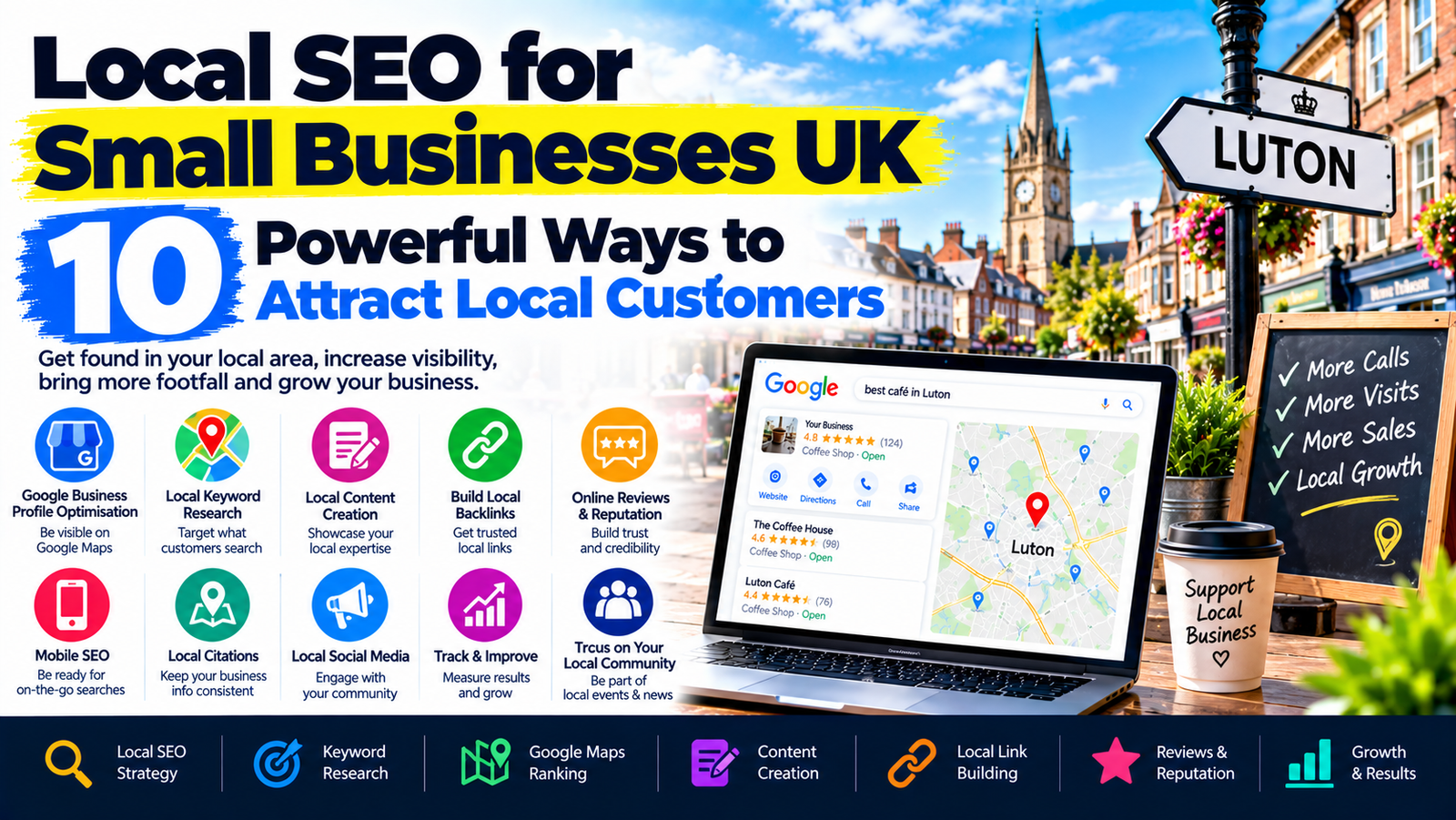
Local SEO for small businesses UK is one of the most effective ways to help local companies improve their Google visibility, attract nearby customers, and generate more enquiries. Whether you run a restaurant, retail shop, cleaning company, law firm, accounting practice, or digital marketing agency, local SEO can help people find your business when they search for products and services in their area.
In the competitive UK market, customers often search online before choosing a local service provider. Optimising your website, Google Business Profile, and local business information can help your company appear in relevant search results and Google Maps.
This guide explains how local SEO works, why it matters, and which strategies small businesses can use to improve their local online presence.
What Is Local SEO for Small Businesses UK?
Local SEO for small businesses UK is the process of optimising a business’s online presence to improve its visibility in location-based searches across the United Kingdom.
For example, potential customers might search for:
- Plumber in Luton
- Best restaurant in Bedford
- Accountant near me
- SEO agency in London
- Electrician in Birmingham
- Cleaning services in Manchester
Local SEO helps businesses target these searches by improving their website content, business listings, customer reviews, local relevance, and overall online presence.
The main objective is to connect your business with people who are actively looking for your products or services in the locations you serve.
Why Is Local SEO Important for UK Small Businesses?
Local SEO is particularly valuable for small businesses that depend on customers from specific towns, cities, or surrounding areas.
An effective local SEO strategy can help your business:
- Improve visibility in Google Search and Google Maps.
- Attract relevant local website visitors.
- Generate phone calls and customer enquiries.
- Increase visits to physical business premises.
- Build trust through genuine customer reviews.
- Compete with larger companies in a specific service area.
- Strengthen your long-term online presence.
For example, a local electrician targeting “electrician in Luton” may attract more relevant enquiries than a website targeting only the broad keyword “electrical services”.
10 Powerful Local SEO Strategies for Small Businesses UK
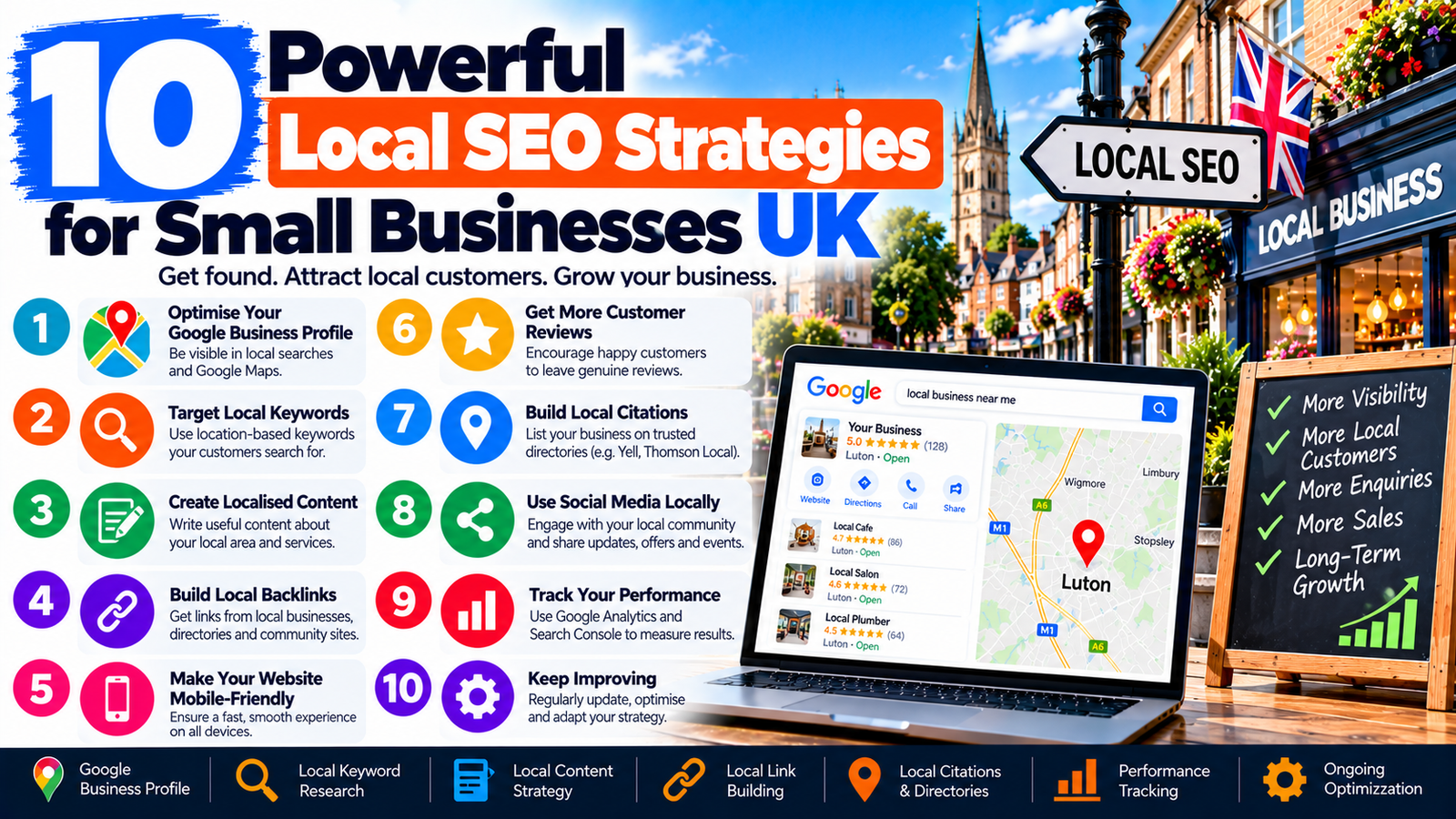
1. Optimise Your Google Business Profile
Google Business Profile is an important part of local SEO. It allows eligible businesses to display information such as their business category, opening hours, services, photos, website, and contact details on Google.
To optimise your profile:
- Choose the most relevant primary business category.
- Add accurate contact information.
- Keep opening hours up to date.
- Describe your services clearly.
- Upload genuine business photos.
- Respond professionally to customer reviews.
- Add relevant updates when appropriate.
Make sure your information is accurate and consistent. Do not add unnecessary keywords to your business name or create misleading business locations.
2. Target Local Keywords
Keyword research helps you understand what potential customers search for when looking for local services.
For local SEO for small businesses UK, focus on relevant combinations of services and locations.
Examples include:
- SEO services Luton
- Plumber in Bedford
- Web design Milton Keynes
- Dentist in Birmingham
- Accountant in London
- Roofing services Manchester
You can also target longer, more specific searches, such as “emergency plumber in Luton” or “affordable website design for small businesses”.
Choose keywords that accurately reflect your services and the areas you genuinely serve. Search intent and relevance are more important than adding a town name to every page.
3. Create Useful Local Landing Pages
Location pages can help businesses target customers in different service areas.
For example, a company serving Bedfordshire and Hertfordshire might create dedicated pages for Luton, Bedford, Watford, and Hemel Hempstead.
Each page should provide useful, location-specific information, including:
- Services available in that area.
- Customer needs and common problems.
- Relevant local examples.
- Frequently asked questions.
- Genuine testimonials, where available.
- Clear contact details and calls to action.
Avoid creating multiple pages with almost identical content. Each location page should offer genuine value to visitors.
4. Improve On-Page SEO
On-page SEO helps search engines understand your website and its relevance to local searches.
Important elements include:
SEO titles: Write clear titles that describe your service and location where relevant.
Meta descriptions: Summarise the page and explain why a potential customer should visit.
Headings: Use organised H1, H2, and H3 headings.
URLs: Keep page addresses short, descriptive, and easy to read.
Internal links: Connect relevant service pages, location pages, and blog articles.
Images: Use descriptive image filenames and appropriate alt text.
For example, a page targeting “local SEO services in Luton” should explain the services offered, the customers they help, and how someone can contact the business.
5. Collect Genuine Customer Reviews
Customer reviews can influence trust and purchasing decisions. They also contribute to the prominence and reputation signals considered in local search.
Encourage satisfied customers to share honest feedback on Google and other relevant review platforms.
Good review management includes:
- Asking customers for honest reviews.
- Making the review process straightforward.
- Responding politely to positive and negative feedback.
- Addressing genuine complaints.
- Avoiding fake reviews or misleading incentives.
Reviews should reflect real customer experiences. Never purchase fabricated reviews or pressure customers to leave only positive feedback.
6. Keep Your Business Information Consistent
Your business name, address, phone number, and website details should be accurate across your online presence.
Check your information on:
- Your website.
- Google Business Profile.
- Relevant UK business directories.
- Industry directories.
- Social media profiles.
- Professional association websites.
Consistency helps potential customers contact you and reduces confusion caused by outdated listings.
Businesses operating from home or serving customers at their locations should follow Google’s applicable rules for business addresses and service areas.
7. Publish Helpful Local Content
Content marketing can help small businesses answer questions and demonstrate relevant expertise.
Consider publishing articles about local customer needs, industry issues, service comparisons, and common problems.
Examples include:
- How to Choose a Reliable Plumber in Bedfordshire.
- A Small Business Guide to Website Design in Luton.
- What Should You Look for in a Local Accountant?
- How Local SEO Helps UK Businesses Attract More Customers.
- Common Roofing Problems in the UK and When to Get Professional Help.
Useful content can attract search traffic, support internal linking, and help visitors understand your services.
Focus on accuracy and usefulness rather than publishing large amounts of repetitive content.
8. Make Your Website Mobile-Friendly
Many local searches take place on mobile devices. Visitors should be able to find your contact information and understand your services without difficulty.
Check that your website has:
- A responsive layout.
- Readable text.
- Clear navigation.
- Clickable phone numbers.
- Simple contact forms.
- Fast-loading pages.
- Accessible buttons.
- Clear service information.
A well-designed mobile experience can make it easier for visitors to become customers.
9. Improve Website Speed and Technical SEO
Technical SEO helps search engines discover, crawl, and understand your website.
Important tasks include:
- Fixing broken links.
- Creating and maintaining an XML sitemap.
- Checking indexing issues in Google Search Console.
- Using HTTPS.
- Improving page speed.
- Fixing duplicate or conflicting pages.
- Optimising images.
- Checking mobile usability.
- Adding appropriate structured data where relevant.
Local business structured data may help search engines understand details about your organisation. However, structured data does not guarantee enhanced search results or higher rankings.
10. Build Relevant Local Backlinks
Backlinks are links from other websites to your website. Relevant, trustworthy links can support your website’s authority and discoverability.
Small businesses can build local connections through:
- Local business associations.
- Relevant industry organisations.
- Community projects.
- Genuine partnerships.
- Local news coverage.
- Sponsorships that provide real community value.
- Useful expert contributions.
- Original research or resources.
Prioritise relevant links and genuine relationships rather than buying large numbers of low-quality backlinks.
How Much Does Local SEO Cost in the UK?
The cost of local SEO depends on your industry, location, competition, website condition, and the services required.
A small business may need basic support with keyword research, Google Business Profile optimisation, on-page SEO, and local listings. A business operating across several locations may need a more extensive campaign with dedicated landing pages, content creation, technical improvements, and ongoing reporting.
Before hiring an SEO provider, ask for a clear breakdown of the work, deliverables, reporting schedule, and fees.
Avoid choosing an agency based solely on the cheapest price or promises of guaranteed first-page rankings.
How Long Does Local SEO Take to Show Results?
Local SEO is an ongoing process, and results vary between businesses.
Some improvements, such as correcting inaccurate business information or fixing technical issues, can be implemented quickly. Meaningful changes in organic rankings, traffic, and enquiries may take several months or longer.
The timeline depends on factors such as:
- Competition in your area.
- Your website’s existing visibility.
- The quality of your content.
- The relevance and accuracy of your business information.
- Customer reviews and reputation.
- Technical website performance.
- Your SEO budget and consistency.
Monitor progress regularly instead of expecting immediate results.
How to Measure Local SEO Performance
Track your performance using tools such as Google Search Console, Google Analytics, and Google Business Profile performance reporting where available.
Useful metrics include:
| Metric | What It Measures |
|---|---|
| Local keyword rankings | Visibility for relevant local searches |
| Organic clicks | Visits from search results |
| Search impressions | How often pages appear in Google |
| Website enquiries | Potential leads generated online |
| Phone calls | Calls attributed to your marketing |
| Direction requests | Interest in visiting your premises |
| Conversion rate | Percentage of visitors completing an action |
| Review activity | Customer feedback and reputation trends |
Focus on business outcomes such as qualified leads, bookings, and sales—not just rankings or website traffic.
Common Local SEO Mistakes to Avoid
Small businesses should avoid these common mistakes:
- Ignoring Google Business Profile.
- Targeting irrelevant local keywords.
- Publishing duplicate location pages.
- Using fake customer reviews.
- Adding keywords unnaturally to website content.
- Leaving incorrect business information online.
- Ignoring mobile users.
- Building low-quality backlinks.
- Neglecting technical SEO.
- Failing to measure leads and conversions.
A consistent, customer-focused approach is more sustainable than shortcuts designed to manipulate search rankings.
How to Choose a Local SEO Agency in the UK
If you need professional support, choose an agency that understands your industry, target locations, and business objectives.
Ask potential providers:
- What local SEO services are included?
- How will you research relevant local keywords?
- Will you optimise my Google Business Profile?
- How will you improve my website’s technical SEO?
- Can you share relevant case studies or examples?
- How will you measure leads and conversions?
- How often will I receive progress reports?
- What work will be completed each month?
A reliable provider should explain its strategy clearly, report honestly, and avoid guarantees of specific rankings.
Frequently Asked Questions About Local SEO for Small Businesses UK
1. What is local SEO for small businesses UK?
Local SEO for small businesses UK helps local companies improve their visibility in Google Search and Google Maps, attract nearby customers, and generate more enquiries through relevant local searches.
2. Why should I invest in local SEO for small businesses UK?
Investing in local SEO for small businesses UK can help your company reach potential customers, improve local search visibility, build trust, and increase enquiries without relying entirely on paid advertising.
3. How does local SEO for small businesses UK work?
Local SEO for small businesses UK works by improving your website, Google Business Profile, local keywords, customer reviews, business listings, and relevant website content to help customers discover your services.
4. How much does local SEO for small businesses UK cost?
The cost of local SEO for small businesses UK depends on your industry, competition, target locations, website condition, and the services included in your SEO campaign.
5. Can local SEO for small businesses UK help a new business?
Yes, local SEO for small businesses UK can help new companies establish an online presence, target relevant location-based searches, and build visibility among potential customers over time.
6. How long does local SEO for small businesses UK take?
Local SEO for small businesses UK may take several months to deliver meaningful improvements. Results depend on competition, website quality, existing rankings, content, and the consistency of your optimisation efforts.
7. Is Google Business Profile important for local SEO?
Yes. An accurate and complete Google Business Profile is an important part of local SEO for small businesses UK because it helps customers discover your business information through Google Search and Maps.
8. Which keywords are best for local SEO?
The best keywords for local SEO for small businesses UK combine relevant services and locations, such as “plumber in Luton”, “accountant in Bedford”, or “SEO agency in London”.
9. Can local SEO for small businesses UK increase website traffic?
Yes. Local SEO for small businesses UK can increase relevant organic traffic by helping your website appear for searches related to your services and the areas you serve.
10. Do customer reviews improve local search visibility?
Genuine customer reviews can support your business reputation and contribute to local search prominence. Encourage honest feedback and respond professionally to both positive and negative reviews.
11. Is local SEO suitable for service-area businesses?
Yes. Local SEO for small businesses UK is useful for eligible service-area businesses, including plumbers, electricians, cleaners, and mobile professionals who travel to customers rather than serving them at a shop.
12. Can I manage local SEO without hiring an agency?
Yes. You can manage basic local SEO for small businesses UK by researching keywords, updating your business profile, publishing helpful content, improving website pages, and collecting genuine reviews.
13. What tools can help with local SEO?
Useful tools include Google Search Console, Google Analytics, Google Business Profile performance reporting, Google Keyword Planner, and reputable SEO platforms for keyword and competitor research.
14. How can I measure local SEO success?
Measure local SEO for small businesses UK using organic clicks, search impressions, local keyword rankings, website enquiries, phone calls, bookings, and completed conversions.
15. Should I hire a local SEO consultant?
A local SEO consultant can help with keyword research, technical improvements, Google Business Profile optimisation, content planning, and performance reporting if you lack the time or expertise to manage these tasks.
16. What is the best local SEO strategy for UK small businesses?
The best local SEO for small businesses UK strategy combines accurate business information, relevant local keywords, useful location pages, genuine customer reviews, mobile-friendly design, technical SEO, and consistent performance tracking.
Final Thoughts
Local SEO for small businesses UK can help local companies improve search visibility, attract relevant customers, and build a stronger online presence. By optimising your website, maintaining accurate business information, publishing useful content, and managing customer reviews, you can create a solid foundation for sustainable local growth.
Start with the basics, track the results, and improve your strategy as you learn more about your customers and their search behaviour. Consistent, helpful, and relevant optimisation is more valuable than chasing quick ranking improvements.