In today’s competitive digital marketplace, businesses need more than a website to attract customers. They need a strong online presence, targeted advertising, valuable content, and a strategy that connects potential customers with the right products or services at the right time. This is where SEO PPC companies can play an important role.
Search engine optimization (SEO) helps businesses improve their visibility in organic search results, while pay-per-click (PPC) advertising helps businesses reach potential customers through paid search and advertising platforms. When these two strategies are planned together, businesses can create a more comprehensive search marketing strategy.
However, choosing the right agency can be challenging. There are hundreds of digital marketing agencies offering SEO and PPC services, but their experience, strategies, pricing, communication, and results can vary significantly.
This guide explains what SEO PPC companies do, how SEO and PPC work together, what services you should expect, how much these services can cost, what questions to ask before hiring an agency, and how to evaluate an SEO and PPC strategy.
What Are SEO PPC Companies?
SEO PPC companies are digital marketing agencies that provide both search engine optimization and pay-per-click advertising services.
SEO is designed to improve a website’s organic visibility on search engines. PPC, on the other hand, involves paying for advertisements that appear on search engines and other advertising platforms.
An SEO PPC company may manage both areas under one digital marketing strategy.
For example, an agency might:
- Research keywords for SEO and PPC
- Optimize website pages
- Create SEO content
- Improve technical website performance
- Build organic search visibility
- Create Google Ads campaigns
- Write PPC advertisements
- Manage advertising budgets
- Optimize bids and targeting
- Track conversions
- Analyze campaign performance
- Improve landing pages
- Provide monthly reports
The exact services vary between agencies, so businesses should carefully review what is included before signing an agreement.
Why Do Businesses Need SEO and PPC?
Search engines are an important source of information for consumers. People often search online before buying a product, booking a service, contacting a company, or visiting a physical location.
For example, someone may search:
“best digital marketing agency”
Another person might search:
“PPC agency for small business”
An eCommerce customer could search:
“buy leather shoes online”
A local customer might search:
“SEO company near me”
These searches represent different stages of the customer journey.
SEO and PPC can help businesses appear for these searches in different ways.
SEO
SEO focuses on improving organic search visibility.
PPC
PPC allows businesses to place paid advertisements for selected searches, audiences, and targeting criteria.
Using both approaches can give businesses more opportunities to reach relevant audiences.
SEO vs. PPC: Understanding the Difference
Although SEO and PPC both focus on attracting users through search and digital advertising, they work differently.
| SEO | PPC |
|---|---|
| Organic search strategy | Paid advertising strategy |
| Focuses on long-term visibility | Can generate traffic quickly after campaigns launch |
| Requires website and content optimization | Requires advertising budget |
| Organic clicks don’t involve a direct per-click ad charge | Advertisers generally pay based on clicks or other campaign objectives |
| Results can take time | Campaign data can be collected quickly |
| Focuses heavily on website authority and relevance | Focuses heavily on targeting, ads, bids, and conversion performance |
Neither approach is automatically suitable for every business.
The right strategy depends on factors such as the company’s goals, industry, competition, budget, website condition, target audience, and customer journey.
How SEO and PPC Work Together
One of the biggest benefits of working with SEO PPC companies is the opportunity to coordinate organic and paid search strategies.
Instead of treating SEO and PPC as completely separate marketing activities, an agency can use insights from one channel to improve the other.
For example, PPC campaigns can generate keyword and conversion data that may help identify commercially valuable search terms.
SEO research can also identify topics and keywords that could be tested through paid campaigns.
This creates a feedback loop:
Keyword Research → SEO → PPC → Data → Conversion Analysis → Optimization
Over time, this information can help businesses understand which search terms, audiences, pages, and messages are producing meaningful results.
Major Services Offered by SEO PPC Companies
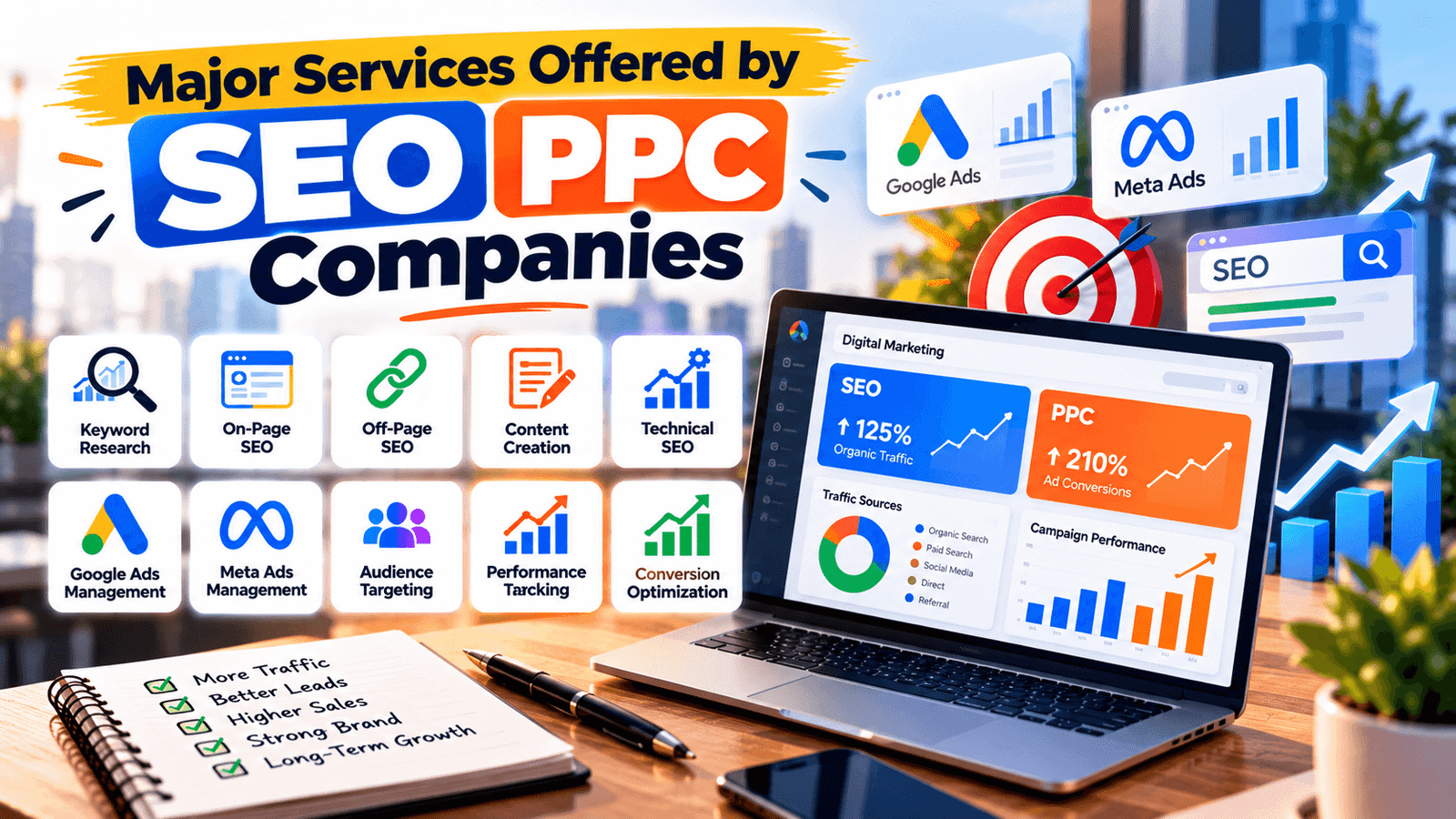
Different agencies provide different packages, but a full-service SEO PPC company may offer several categories of services.
1. SEO Audit
An SEO audit examines the current condition of a website.
An audit may review:
- Website structure
- Indexing
- Technical SEO
- Page speed
- Mobile usability
- Metadata
- Headings
- Internal linking
- Content quality
- Broken links
- Duplicate content
- URL structure
- Image optimization
- Structured data
- Backlinks
The purpose is to identify technical and content-related opportunities.
2. Keyword Research
Keyword research is important for both SEO and PPC.
An agency may examine:
- Search volume
- Search intent
- Competition
- Commercial intent
- Cost per click
- Relevance
- Conversion potential
- Geographic targeting
For SEO, the objective may be to identify topics that can attract relevant organic traffic.
For PPC, the focus may be on keywords that can produce commercially valuable clicks and conversions.
3. On-Page SEO
On-page SEO focuses on optimizing individual website pages.
This can include:
- SEO titles
- Meta descriptions
- H1 headings
- H2 and H3 headings
- Keyword placement
- Content structure
- Internal links
- Image alt text
- URLs
- Search intent
- Content readability
Good on-page optimization should be natural and useful for visitors rather than simply inserting keywords repeatedly.
4. Technical SEO
Technical SEO focuses on the technical foundation of a website.
An SEO PPC company may examine:
- Crawlability
- Indexability
- XML sitemaps
- Robots.txt
- Canonical URLs
- Website speed
- Core Web Vitals
- Mobile usability
- HTTPS
- Redirects
- 404 errors
- Duplicate pages
- JavaScript rendering
- Site architecture
Technical problems can prevent search engines from efficiently discovering and understanding website content.
5. Content Marketing
Content is an important part of modern SEO.
An agency may develop content such as:
- Blog posts
- Buying guides
- Service pages
- Product descriptions
- Comparison articles
- FAQs
- Case studies
- Industry guides
- Landing pages
High-quality content should address genuine user questions and demonstrate relevance to the target audience.
6. Local SEO
Businesses serving specific geographic areas may benefit from local SEO.
Local SEO services can include:
- Google Business Profile optimization
- Local keyword research
- Location pages
- Local citations
- Review strategy
- Local content
- NAP consistency
- Local link building
For example, a business targeting customers in London may optimize for searches related to its services and location.
7. Google Ads Management
PPC management is another major service provided by many SEO PPC companies.
An agency may manage:
- Search campaigns
- Display campaigns
- Shopping campaigns
- Performance Max campaigns
- Remarketing campaigns
- YouTube advertising
- Brand campaigns
- Non-brand campaigns
The exact campaign types depend on the business and its goals.
8. PPC Keyword Research
PPC keyword research helps determine which searches may be appropriate for advertising.
An agency may classify keywords into groups such as:
Informational Keywords
Examples:
- What is PPC marketing?
- How does SEO work?
- SEO tips for beginners
Commercial Keywords
Examples:
- Best PPC agency
- SEO services company
- Digital marketing agency pricing
Transactional Keywords
Examples:
- Hire PPC agency
- Buy SEO package
- PPC management services
Understanding search intent can help an agency create more relevant campaigns.
9. PPC Ad Copywriting
PPC advertisements need to communicate value quickly.
A professional PPC campaign may test different:
- Headlines
- Descriptions
- Calls to action
- Offers
- Benefits
- Features
- Value propositions
For example:
Headline:
Professional PPC Management Services
Description:
Reach relevant customers with carefully managed search campaigns and conversion-focused strategies.
Different messages can be tested to determine which ones generate stronger engagement and conversion performance.
10. Landing Page Optimization
Sending paid traffic to a poorly designed landing page can reduce campaign performance.
An SEO PPC company may review:
- Page loading speed
- Headline relevance
- Call-to-action placement
- Form design
- Mobile usability
- Content clarity
- Trust signals
- Testimonials
- Pricing information
- Navigation
The landing page should closely match the advertisement and search intent.
Why Conversion Tracking Is Important
One of the biggest mistakes businesses can make is measuring PPC success only by clicks.
Clicks tell you that people visited the website.
They do not necessarily tell you whether those visitors became customers.
Conversion tracking can measure actions such as:
- Purchases
- Contact forms
- Phone calls
- Bookings
- Sign-ups
- Downloads
- Quote requests
- Account registrations
For eCommerce businesses, revenue and purchase data can be particularly important.
For service businesses, leads and qualified inquiries may be more useful.
Important PPC Metrics
Professional SEO PPC companies should generally track meaningful campaign metrics rather than focusing on one number.
Click-Through Rate
CTR measures the percentage of impressions that resulted in clicks.
A higher CTR can indicate that an advertisement is relevant to the searcher, although CTR should always be interpreted within the campaign context.
Cost Per Click
CPC represents the amount paid for clicks.
CPC can vary depending on:
- Keyword competition
- Industry
- Location
- Quality
- Ad relevance
- Auction conditions
Conversion Rate
Conversion rate measures the percentage of users who complete a defined conversion action.
Cost Per Conversion
This helps businesses understand how much advertising spend is associated with generating a conversion.
Return on Ad Spend
For businesses that track revenue, ROAS can help compare advertising revenue with advertising spend.
However, ROAS does not necessarily represent total profitability because other business costs may not be included.
How to Choose the Right SEO PPC Company
Selecting an agency should be based on your business requirements rather than simply choosing the company with the lowest price.
1. Define Your Goals
Before contacting agencies, identify what you want to achieve.
Your goals could include:
- Increasing organic traffic
- Generating more leads
- Increasing online sales
- Improving local visibility
- Launching Google Ads
- Reducing wasted advertising spend
- Increasing conversion rates
- Improving website visibility
Clear goals make it easier to evaluate proposals.
2. Examine Their Experience
Look for evidence that the agency understands your type of business.
Questions to consider include:
- Have they worked with similar industries?
- Do they understand your target market?
- Can they explain their process?
- Do they have relevant case studies?
- Can they provide examples of previous work?
Experience does not guarantee results, but it can provide useful context when comparing agencies.
3. Review Their SEO Process
Ask how the agency approaches SEO.
A professional proposal should explain areas such as:
- Technical audit
- Keyword research
- Content strategy
- On-page optimization
- Internal linking
- Authority development
- Reporting
Avoid choosing an agency simply because it promises a specific ranking position.
Search engine rankings can change due to competition, algorithms, search intent, location, personalization, and other factors.
4. Review Their PPC Process
Ask the agency how it manages paid campaigns.
Important areas include:
- Account structure
- Keyword selection
- Negative keywords
- Ad testing
- Audience targeting
- Bid strategy
- Conversion tracking
- Landing pages
- Budget management
- Reporting
The agency should be able to explain these concepts in language you can understand.
5. Ask About Advertising Budget
Agency management fees and advertising budgets are usually separate.
For example:
Agency Management Fee: $500/month
Advertising Budget: $2,000/month
Total monthly marketing expenditure would therefore be $2,500.
Always ask for a clear breakdown of costs before signing a contract.
6. Understand Contract Terms
Before hiring an agency, review:
- Contract length
- Cancellation policy
- Setup fees
- Monthly fees
- Ad spend
- Reporting frequency
- Account ownership
- Creative ownership
- Website access
- Data ownership
Businesses should know what happens to their advertising accounts and data if they stop working with the agency.
7. Look for Transparent Reporting
Good reporting should make it easy to understand what happened during the reporting period.
A monthly report might include:
| Metric | Purpose |
|---|---|
| Organic Traffic | Measures SEO traffic |
| Organic Keywords | Shows search visibility |
| Impressions | Measures exposure |
| Clicks | Measures traffic generated |
| CTR | Measures engagement |
| CPC | Measures click cost |
| Conversions | Measures completed actions |
| CPA | Measures acquisition cost |
| Revenue | Measures tracked sales |
| ROAS | Compares tracked revenue with ad spend |
Common Mistakes to Avoid
Businesses should be careful when evaluating agencies that make unrealistic promises.
Mistake 1: Choosing Only Based on Price
The cheapest agency may not provide the services your business actually needs.
Mistake 2: Expecting Instant SEO Results
SEO typically requires ongoing optimization and content development.
Mistake 3: Measuring Only Traffic
Large amounts of traffic are not necessarily valuable if visitors do not match the target audience or take meaningful actions.
Mistake 4: Ignoring Conversion Tracking
Without reliable tracking, it becomes difficult to determine whether campaigns are generating business outcomes.
Mistake 5: Using the Same Strategy for Every Business
An eCommerce website, law firm, restaurant, SaaS company, and local contractor may require very different strategies.
SEO PPC Companies for Small Businesses
Small businesses often have limited marketing budgets, which makes efficient resource allocation particularly important.
A small business may begin with:
- A focused SEO strategy
- A limited number of PPC campaigns
- Location-based targeting
- High-intent keywords
- Conversion tracking
- Landing-page optimization
- Regular performance reviews
Instead of targeting hundreds of keywords immediately, an agency may focus on the search terms most closely connected to the business’s products or services.
SEO PPC Companies for eCommerce Businesses
eCommerce websites have different requirements from service businesses.
An eCommerce PPC strategy may involve:
- Shopping campaigns
- Product feeds
- Product page optimization
- Remarketing
- Dynamic advertising
- Category-page SEO
- Product keyword research
- Conversion tracking
- Revenue tracking
SEO can help product and category pages appear in organic search results, while PPC can provide paid visibility for products and commercial searches.
SEO PPC Companies for Local Businesses
Local businesses may benefit from combining local SEO with geographically targeted PPC.
For example, a local service company could target searches related to:
- Service + city
- Service + area
- Service near me
- Emergency service + location
The business can also optimize its local search presence and create location-specific website content.
The Role of Data in SEO and PPC
Data should play an important role in digital marketing decisions.
An agency can use analytics to identify:
- Which pages receive traffic
- Which keywords generate visitors
- Which advertisements receive clicks
- Which campaigns produce conversions
- Which landing pages perform well
- Which audiences engage with advertisements
- Where users leave the website
This information can be used to adjust the strategy over time.
How Often Should SEO and PPC Campaigns Be Reviewed?
PPC campaigns often require frequent monitoring because advertising costs and auction conditions can change.
SEO typically requires longer-term analysis because organic rankings and traffic can take time to change.
A business might review:
Weekly
- PPC spend
- Campaign performance
- Search terms
- Conversion issues
- Budget pacing
Monthly
- SEO traffic
- Keyword visibility
- Conversion performance
- Content progress
- PPC results
- Landing-page performance
Quarterly
- Overall strategy
- Budget allocation
- Market changes
- Competitive landscape
- SEO opportunities
- PPC campaign structure
Questions to Ask Before Hiring SEO PPC Companies
Before signing a contract, ask the following questions:
- How long have you been providing SEO services?
- How long have you been managing PPC campaigns?
- Do you have experience in my industry?
- What SEO services are included?
- What PPC platforms do you manage?
- How do you perform keyword research?
- How do you measure conversions?
- How often do you optimize campaigns?
- How frequently will I receive reports?
- Who owns my advertising account?
- Is PPC ad spend included?
- Are landing-page services included?
- Do you provide content creation?
- What is the contract length?
- What happens if I want to cancel?
- How do you communicate campaign updates?
- What metrics will you use to evaluate performance?
- How will you coordinate SEO and PPC?
- Do you provide competitor research?
- What information do you need from my business before starting?
SEO PPC Companies: What Should a Good Strategy Include?
A comprehensive strategy can be organized into several stages.
Stage 1: Research
- Business analysis
- Competitor research
- Audience research
- Keyword research
Stage 2: Website Preparation
- Technical SEO
- On-page optimization
- Landing-page improvements
- Conversion tracking
Stage 3: Campaign Launch
- PPC account structure
- Advertisement creation
- Audience targeting
- Budget allocation
Stage 4: Optimization
- Search-term analysis
- Ad testing
- Keyword optimization
- Landing-page testing
- SEO content improvements
Stage 5: Reporting
- Traffic analysis
- Conversion analysis
- Cost analysis
- Revenue analysis
- Strategic recommendations
This process can be repeated continuously as new data becomes available.
Frequently Asked Questions About SEO PPC Companies
1. What are SEO PPC companies?
SEO PPC companies are digital marketing agencies that provide both search engine optimization and pay-per-click advertising services. They help businesses improve organic search visibility while also managing paid advertising campaigns.
2. How do SEO PPC companies help businesses?
SEO PPC companies can help businesses attract relevant website traffic through organic search and paid advertising. Their services may include keyword research, SEO audits, content optimization, Google Ads management, conversion tracking, landing-page optimization, and performance reporting.
3. Why should I hire SEO PPC companies instead of managing marketing myself?
Working with SEO PPC companies can give businesses access to specialists who understand SEO, PPC advertising, keyword research, analytics, and conversion optimization. This can be useful for businesses that do not have an in-house digital marketing team.
4. How much do SEO PPC companies charge?
The cost of SEO PPC companies varies depending on the services required, business size, industry competition, campaign complexity, location, and advertising budget. SEO fees and PPC management fees are often separate from the actual PPC advertising budget.
5. Do SEO PPC companies manage Google Ads?
Many SEO PPC companies offer Google Ads management as part of their PPC services. This can include keyword research, campaign setup, advertisement creation, audience targeting, bid management, conversion tracking, and ongoing optimization.
6. Can SEO PPC companies help small businesses?
Yes. SEO PPC companies can develop strategies specifically for small businesses. A campaign may focus on local SEO, high-intent keywords, targeted PPC advertising, conversion tracking, and content relevant to a specific geographic market.
7. How long does SEO take to produce results?
SEO generally takes longer than PPC because organic rankings require ongoing optimization, quality content, technical improvements, and authority development. The timeframe can vary depending on competition, website condition, industry, and the overall SEO strategy.
8. Can PPC produce results faster than SEO?
PPC can begin generating impressions and clicks soon after an advertising campaign is approved and activated. However, achieving profitable results depends on factors such as keyword selection, advertising budget, targeting, competition, advertisement quality, and landing-page performance.
9. What should I look for when choosing SEO PPC companies?
When comparing SEO PPC companies, consider their experience, services, communication, reporting, pricing structure, conversion tracking, PPC expertise, SEO methodology, contract terms, and understanding of your industry.
10. Do SEO PPC companies provide monthly reports?
Many SEO PPC companies provide regular reports showing campaign performance. Reports may include organic traffic, keyword visibility, impressions, clicks, CPC, conversions, conversion rate, advertising spend, and other relevant metrics.
11. Do SEO PPC companies guarantee first-page rankings?
Businesses should be cautious about agencies that guarantee specific organic rankings. Search results can change because of competition, search algorithms, user behavior, location, and other factors. A professional SEO strategy should focus on sustainable improvements rather than unrealistic guarantees.
12. What is the difference between SEO and PPC?
SEO focuses on improving a website’s visibility in organic search results, while PPC uses paid advertising to reach users through search engines and other platforms. SEO PPC companies can manage both strategies as part of a broader search marketing plan.
13. Can SEO and PPC be used together?
Yes. SEO and PPC can complement each other. SEO can support long-term organic visibility, while PPC can provide targeted paid traffic and useful campaign data. SEO PPC companies can coordinate both channels to support broader marketing objectives.
14. Do SEO PPC companies help with keyword research?
Yes. Keyword research is commonly included in both SEO and PPC strategies. Agencies may analyze search volume, competition, search intent, commercial relevance, cost per click, and conversion potential to identify suitable keywords.
15. Can SEO PPC companies improve website conversions?
Many SEO PPC companies also provide conversion-focused services. These may include landing-page optimization, call-to-action improvements, website usability recommendations, form optimization, and conversion tracking.
16. Are SEO PPC companies useful for eCommerce businesses?
Yes. eCommerce businesses can use SEO for product and category visibility while using PPC campaigns to promote products through paid search and shopping advertising. An integrated approach can also incorporate product-page optimization and revenue tracking.
17. Can SEO PPC companies provide local SEO?
Many agencies offer local SEO services alongside PPC. Local SEO may include Google Business Profile optimization, location pages, local keyword research, review strategies, and geographically relevant content.
18. How do SEO PPC companies measure success?
The metrics depend on the business objective. Common measurements include organic traffic, keyword visibility, leads, sales, conversion rate, cost per acquisition, advertising spend, revenue, and return on advertising spend.
19. How often should I review my SEO and PPC campaigns?
PPC campaigns often benefit from frequent monitoring because budgets, search terms, competition, and auction conditions can change. SEO is generally evaluated over longer periods, although technical issues and important changes should be addressed promptly.
20. How do I compare different SEO PPC companies?
Create a comparison based on services, experience, pricing, reporting, communication, campaign management, SEO methodology, conversion tracking, contract conditions, and your specific business objectives. This makes it easier to understand what each agency actually provides.
21. Are SEO PPC companies suitable for startups?
Startups can use SEO and PPC depending on their budget and growth objectives. PPC can provide targeted exposure while SEO can help build organic visibility over time. A focused strategy can help avoid spending resources on unnecessary campaigns.
22. What information should I give an SEO PPC company?
Before starting, provide information about your products or services, target customers, geographic market, competitors, website, previous marketing campaigns, advertising budget, conversion goals, and business objectives. This allows the agency to create a more relevant strategy.
23. Should PPC advertising costs be included in agency fees?
Not necessarily. Many SEO PPC companies charge a separate management fee while the business pays the advertising platform directly for media spend. Always ask for a detailed pricing breakdown before signing an agreement.
24. Can SEO PPC companies manage both organic and paid search campaigns?
Yes. This is one of the main benefits of choosing an agency that specializes in both areas. The agency can coordinate SEO and PPC research, keyword strategies, landing pages, conversion tracking, and performance analysis.
25. What makes a good SEO PPC strategy?
A strong strategy should begin with clear business objectives and audience research. It can then combine keyword research, technical SEO, useful content, PPC campaign management, landing-page optimization, conversion tracking, testing, and regular performance analysis.
Final Thoughts
Finding the right SEO PPC companies requires careful research and a clear understanding of your business objectives. SEO and PPC are different marketing channels, but they can complement each other when managed as part of a coordinated search strategy.
SEO can help develop organic visibility, content authority, and long-term search presence. PPC can provide targeted paid exposure and valuable campaign data. When both channels are supported by accurate conversion tracking, relevant keywords, strong landing pages, and continuous optimization, businesses can make more informed digital marketing decisions.
Before hiring an agency, compare its services, experience, pricing structure, reporting process, communication, contract terms, and approach to SEO and PPC. Most importantly, make sure the agency understands your customers, your market, and your specific business goals.
A successful digital marketing partnership is not simply about getting more clicks. It is about attracting the right audience and turning relevant traffic into meaningful business outcomes.