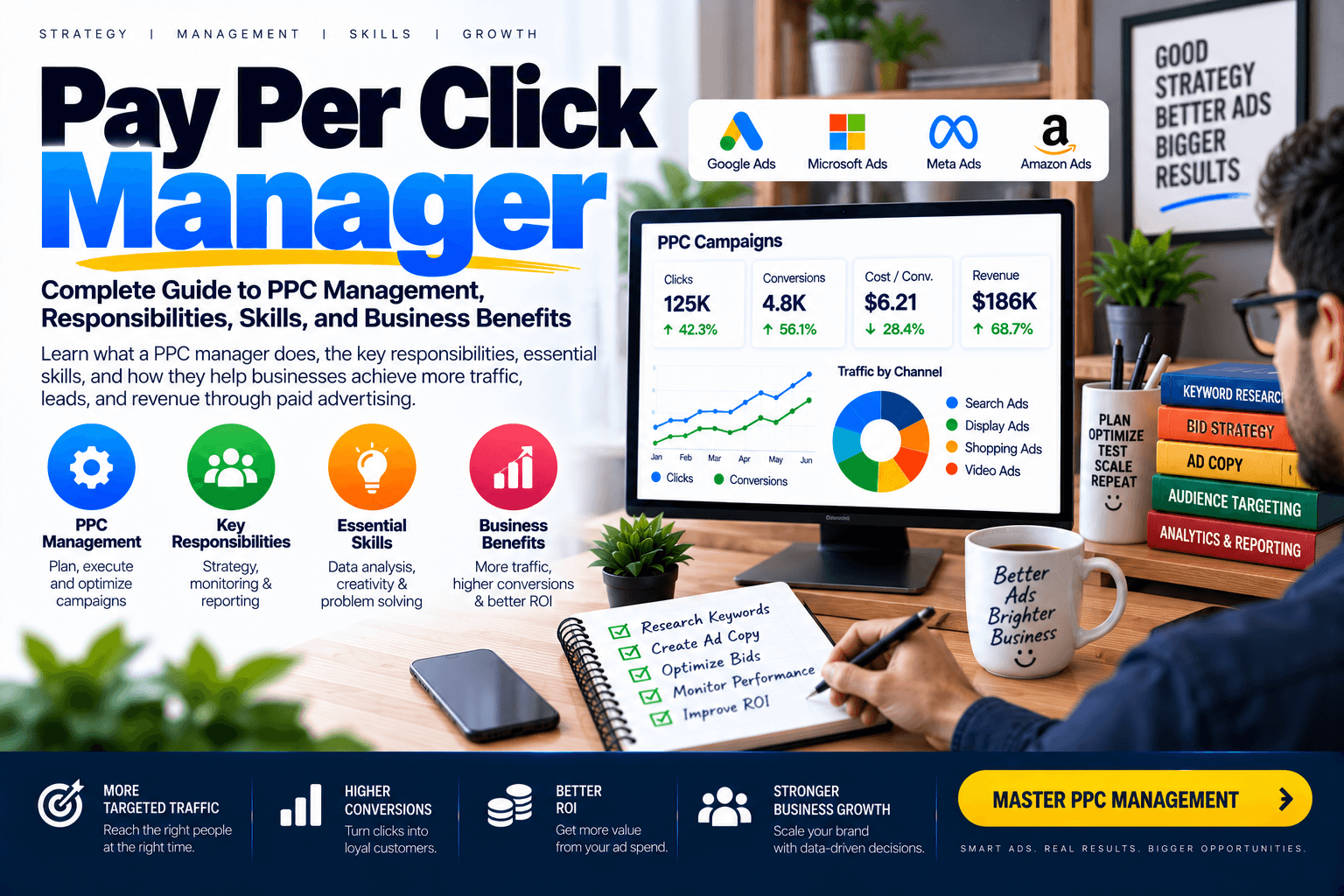
Digital advertising has become one of the fastest ways for businesses to reach potential customers. However, simply launching an online advertisement does not guarantee success. Many companies spend thousands of dollars on paid campaigns but fail to generate profitable results because their campaigns are not properly managed, optimized, or measured.
This is where a Pay Per Click Manager becomes essential.
A Pay Per Click Manager is responsible for creating, managing, analyzing, and improving paid advertising campaigns to help businesses achieve better visibility, more leads, and higher revenue. They combine marketing strategy, analytical thinking, keyword research, audience targeting, and continuous optimization to make advertising budgets work more effectively.
From Google Ads search campaigns to social media advertising, a skilled PPC manager ensures that every click has the potential to contribute toward business growth.
Whether you are a small business owner, an eCommerce brand, a SaaS company, or a large enterprise, working with a professional PPC manager can help you compete in competitive digital markets while avoiding unnecessary advertising costs.
What Is a Pay Per Click Manager?
A Pay Per Click Manager is a digital marketing specialist who manages paid advertising campaigns where businesses pay each time a user clicks on their advertisement.
Their primary responsibility is to maximize campaign performance by attracting the right audience at the right time while maintaining profitable advertising costs.
Unlike traditional advertising methods, PPC provides measurable data. A PPC manager uses this data to understand customer behavior, improve campaigns, and increase return on investment.
A PPC manager typically works with advertising platforms such as:
- Google Ads
- Microsoft Advertising (Bing Ads)
- Meta Ads (Facebook and Instagram)
- LinkedIn Ads
- Amazon Ads
- YouTube Ads
- TikTok Ads
Their role involves both technical campaign management and strategic decision-making.
Why Businesses Need a Pay Per Click Manager
Paid advertising looks simple from the outside: choose keywords, create ads, set a budget, and wait for customers.
However, successful PPC advertising requires advanced knowledge.
Without proper management, businesses often experience:
- High advertising costs
- Low-quality traffic
- Poor conversion rates
- Irrelevant clicks
- Low return on investment
- Poor campaign structure
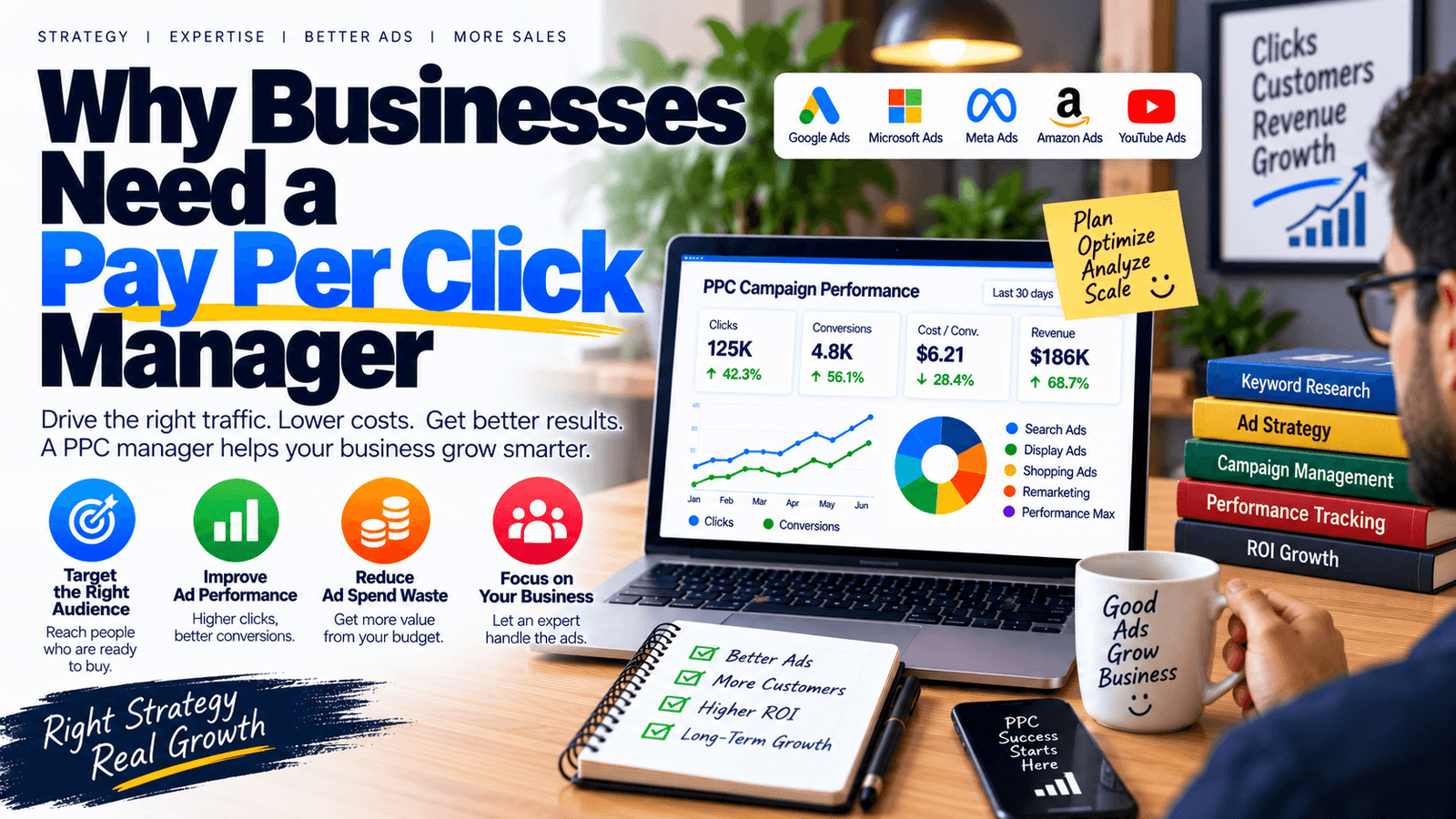
A professional PPC manager helps solve these problems by continuously improving campaign performance.
A PPC Manager Helps Businesses:
Generate More Qualified Leads
A PPC manager focuses on reaching users who are actively searching for products or services.
Through proper keyword targeting and audience research, they attract visitors with higher purchase intent.
For example:
A person searching for “emergency roof repair near me” is more likely to become a customer than someone searching for general roofing information.
Reduce Wasted Advertising Budget
One of the biggest challenges in PPC advertising is wasted spending.
Businesses often lose money because their ads appear for:
- Irrelevant searches
- Low-converting keywords
- Incorrect audiences
- Poorly optimized campaigns
A PPC manager reduces waste by using:
- Negative keyword strategies
- Search term analysis
- Bid adjustments
- Audience exclusions
- Performance monitoring
Improve Return on Investment (ROI)
The goal of PPC is not simply to get clicks. The goal is to generate profitable actions.
A PPC manager focuses on improving:
- Conversion rates
- Cost per acquisition
- Revenue generated
- Return on ad spend
Main Responsibilities of a Pay Per Click Manager
1. PPC Strategy Development
Before launching campaigns, a PPC manager develops a complete advertising strategy.
This includes understanding:
- Business goals
- Target audience
- Customer journey
- Competitors
- Available budget
- Conversion goals
A strong PPC strategy answers questions like:
- Who are we targeting?
- Which keywords should we focus on?
- Which platforms provide the best opportunity?
- How much should we spend?
- What results should we expect?
2. Keyword Research and Selection
Keyword research is one of the foundations of PPC success.
A PPC manager identifies keywords that potential customers use when searching for products or services.
They analyze:
Search Intent
Understanding whether users are:
- Looking for information
- Comparing options
- Ready to purchase
Keyword Competition
Highly competitive keywords may require larger budgets.
Cost Per Click
The manager evaluates whether keywords are profitable.
Conversion Potential
The best keywords are not always those with the highest search volume. They are keywords that generate valuable customers.
3. Campaign Setup and Account Structure
A professional PPC manager creates organized campaigns that allow better control and optimization.
They manage:
- Campaign structure
- Ad groups
- Keyword organization
- Location targeting
- Device targeting
- Audience segmentation
- Budget allocation
A well-structured account improves quality score and makes optimization easier.
4. Creating High-Converting PPC Ads
Writing effective advertisements requires understanding customer psychology.
A PPC manager creates ads that:
- Match user search intent
- Highlight unique benefits
- Build trust
- Encourage clicks
- Improve conversion rates
Common PPC ad elements include:
- Attention-grabbing headlines
- Clear benefits
- Strong calls-to-action
- Relevant descriptions
Examples:
Weak:
“SEO Services Available”
Better:
“Grow Your Traffic With Expert SEO Services”
5. Bid Management and Budget Optimization
PPC platforms use bidding systems where advertisers compete for ad placement.
A PPC manager adjusts bids based on:
- Keyword performance
- Competition
- Conversion data
- Customer value
They may increase bids for profitable keywords and reduce spending on poor-performing ones.
6. Conversion Tracking Setup
Without proper tracking, businesses cannot understand campaign success.
A PPC manager sets up tracking for:
- Form submissions
- Phone calls
- Purchases
- Sign-ups
- Downloads
- Newsletter registrations
Tracking allows businesses to understand which campaigns generate real results.
7. Landing Page Optimization
PPC success does not depend only on advertisements.
The landing page experience also affects conversions.
A PPC manager evaluates:
- Page speed
- Content relevance
- Mobile experience
- Calls-to-action
- User experience
A highly targeted ad with a poor landing page can still fail.
8. Performance Reporting and Analysis
A professional PPC manager provides regular reports explaining:
- Campaign performance
- Spending
- Conversions
- Opportunities
- Areas for improvement
Important PPC metrics include:
Click-Through Rate (CTR)
Measures how often users click after seeing an advertisement.
Cost Per Click (CPC)
Shows the average amount paid for each click.
Conversion Rate
Measures how many visitors complete a desired action.
Cost Per Acquisition (CPA)
Shows the cost of gaining a customer or lead.
Return on Ad Spend (ROAS)
Measures revenue generated from advertising investment.
Difference Between PPC Manager and PPC Specialist
Although the terms are similar, responsibilities can differ.
| PPC Specialist | PPC Manager |
|---|---|
| Handles specific PPC tasks | Manages complete strategy |
| Creates and adjusts campaigns | Oversees campaign direction |
| Focuses on execution | Focuses on performance goals |
| May specialize in one platform | Often manages multiple channels |
A PPC manager usually takes a more strategic role.
Skills of a Successful Pay Per Click Manager
A great PPC manager combines technical and marketing skills.
Important skills include:
Analytical Skills
They must interpret campaign data and identify improvement opportunities.
Google Ads Expertise
Knowledge of:
- Search campaigns
- Display campaigns
- Shopping campaigns
- Performance Max campaigns
Copywriting Skills
They need to create advertisements that attract attention and drive action.
Conversion Optimization Knowledge
Understanding user behavior helps improve landing pages and sales funnels.
Budget Management
They must know how to maximize results without overspending.
Benefits of Hiring a Professional Pay Per Click Manager
Faster Business Growth
Paid advertising allows businesses to appear in front of potential customers immediately.
A PPC manager helps make this traffic more valuable.
Better Targeting
PPC managers use advanced targeting options to reach specific audiences.
Competitive Advantage
Professional management helps businesses compete against companies with larger advertising budgets.
Data-Based Decisions
Instead of guessing, businesses make decisions based on measurable performance data.
How Much Does a Pay Per Click Manager Cost?
PPC management pricing depends on:
- Campaign size
- Advertising budget
- Number of platforms
- Industry competition
- Required services
Common pricing models include:
Monthly Retainer
A fixed monthly fee for ongoing management.
Percentage of Ad Spend
The PPC manager charges based on advertising budget.
Hourly Consulting
Suitable for businesses needing occasional guidance.
How to Choose the Right Pay Per Click Manager
Before hiring a PPC manager, consider:
Check Experience
Look for experience with businesses similar to yours.
Review Previous Results
Ask about:
- Increased conversions
- Reduced costs
- Improved ROI
Understand Their Process
A good PPC manager should explain:
- Research methods
- Optimization strategy
- Reporting process
Look for Transparency
Avoid managers who only provide click reports. Focus on managers who show business results.
Common PPC Management Mistakes to Avoid
Targeting Too Many Keywords
More keywords do not always mean better results.
Ignoring Negative Keywords
Without negative keywords, businesses may pay for irrelevant clicks.
Not Testing Ads
Successful PPC campaigns require continuous testing.
Focusing Only on Traffic
Clicks are not the goal. Conversions are.
Poor Conversion Tracking
Without tracking, optimization becomes guesswork.
Future of PPC Management
The PPC industry continues to evolve with:
- Artificial intelligence
- Automation
- Smart bidding
- Audience-based targeting
- Advanced analytics
However, human strategy remains important.
A PPC manager helps businesses understand data, make strategic decisions, and adapt campaigns to changing customer behavior.
FAQ: Pay Per Click Manager
1. What does a Pay Per Click Manager do?
A Pay Per Click Manager creates, manages, and optimizes paid advertising campaigns to improve traffic quality, increase conversions, and maximize advertising ROI.
2. Why do businesses need a PPC manager?
Businesses need a PPC manager to develop effective advertising strategies, control ad spending, target the right audience, and improve campaign performance.
3. What services does a PPC manager provide?
A PPC manager provides keyword research, campaign setup, ad optimization, bid management, audience targeting, conversion tracking, and performance reporting.
4. How can a PPC manager improve Google Ads campaigns?
A PPC manager improves Google Ads campaigns by optimizing keywords, improving ad copy, adjusting bids, testing strategies, and focusing on profitable search terms.
5. What skills should a professional PPC manager have?
A professional PPC manager should have skills in Google Ads, analytics, keyword research, conversion optimization, campaign strategy, and data analysis.
6. How much does PPC management cost?
PPC management costs vary depending on campaign size, advertising budget, business goals, industry competition, and the level of optimization required.
7. How long does it take to see results from PPC campaigns?
PPC results can appear quickly, but long-term success depends on continuous optimization, testing, and improving campaign performance over time.
8. Can PPC management reduce advertising costs?
Yes. Effective PPC management can reduce wasted spending by improving targeting, removing irrelevant clicks, optimizing bids, and increasing conversion rates.
9. What tools do PPC managers use?
PPC managers commonly use tools such as Google Ads, Google Analytics, Google Tag Manager, keyword research tools, and conversion tracking platforms.
10. What is the difference between a PPC manager and a PPC specialist?
A PPC specialist usually focuses on specific campaign tasks, while a PPC manager handles broader strategy, optimization, reporting, and overall campaign growth.
11. Is hiring a PPC manager worth it for small businesses?
Yes. A skilled PPC professional can help small businesses reach potential customers faster, manage budgets effectively, and generate measurable advertising results.
12. How do PPC managers measure campaign success?
Campaign success is measured using metrics such as conversion rate, cost per click (CPC), cost per acquisition (CPA), click-through rate (CTR), and return on ad spend (ROAS).
Final Thoughts
A Pay Per Click Manager plays a crucial role in helping businesses achieve better results from online advertising. They do much more than create ads—they develop strategies, analyze data, optimize campaigns, control budgets, and improve conversions.
With increasing competition in digital marketing, professional PPC management can help businesses reduce wasted spending, attract qualified customers, and maximize advertising ROI.
For companies investing in paid advertising, hiring an experienced PPC manager can be one of the smartest decisions for long-term growth.