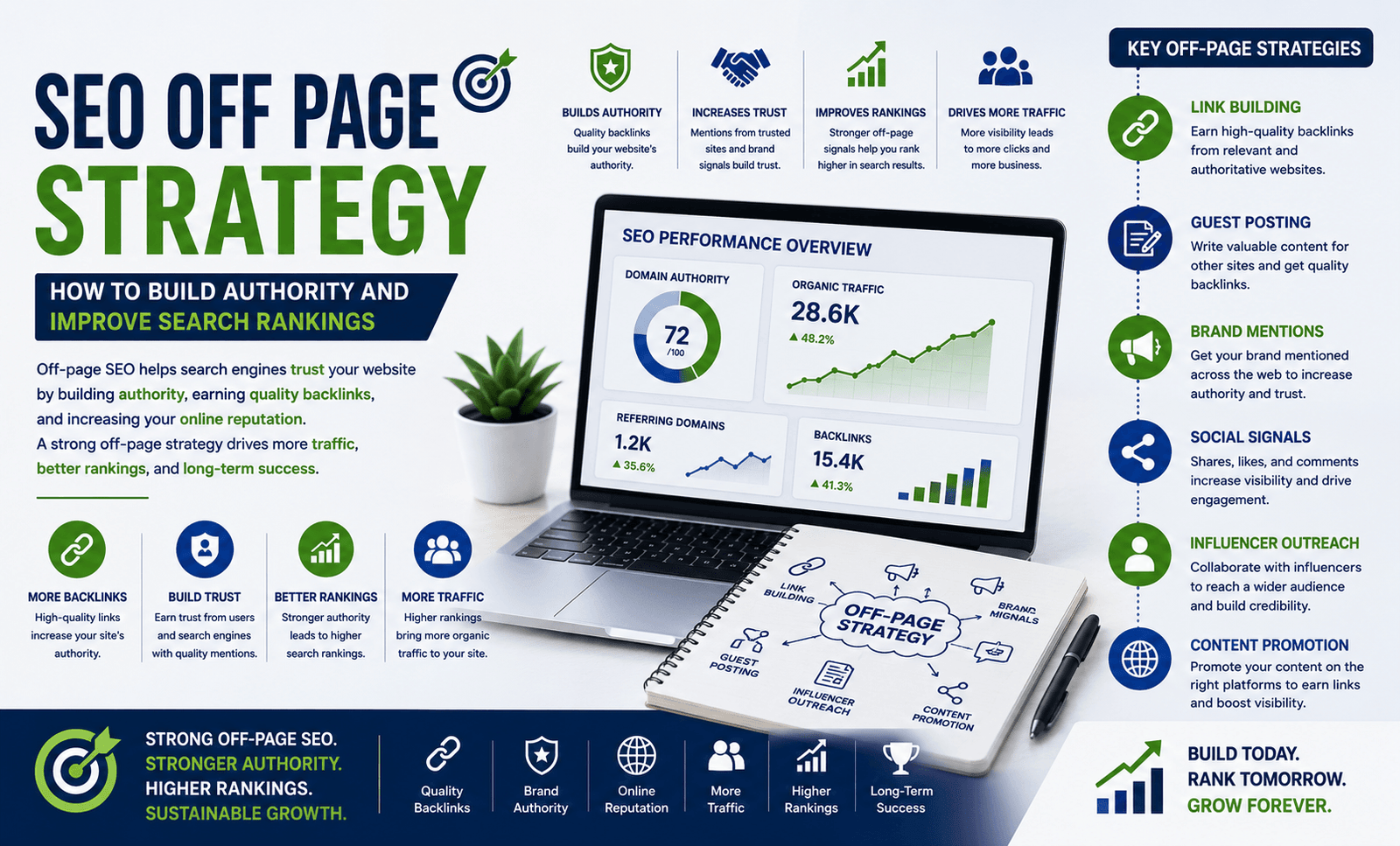
SEO Off Page Strategy is an essential part of improving website authority, search engine rankings, brand visibility, and organic traffic. While on-page SEO focuses on optimizing elements within your website, an effective SEO off page strategy focuses on activities outside your website that strengthen its credibility and reputation.
For SEO professionals, building a successful SEO off page strategy means more than simply acquiring backlinks. It involves earning high-quality links, building brand mentions, using digital PR, developing industry relationships, improving online reputation, and promoting valuable content across relevant platforms.
A well-planned SEO off page strategy can help search engines recognize your website as a trustworthy and authoritative source while also generating referral traffic, qualified leads, and long-term organic growth.
What Is SEO Off Page Strategy?
An SEO off page strategy is a structured approach to improving a website’s search visibility through activities performed outside the website itself.
These activities may include:
- High-quality link building
- Digital PR
- Guest posting
- Brand mentions
- Influencer outreach
- Local citations
- Content promotion
- Online reputation management
- Industry partnerships
- Community engagement
The primary objective of an SEO off page strategy is to increase the authority, relevance, and credibility of your website.
Why Is SEO Off Page Strategy Important?
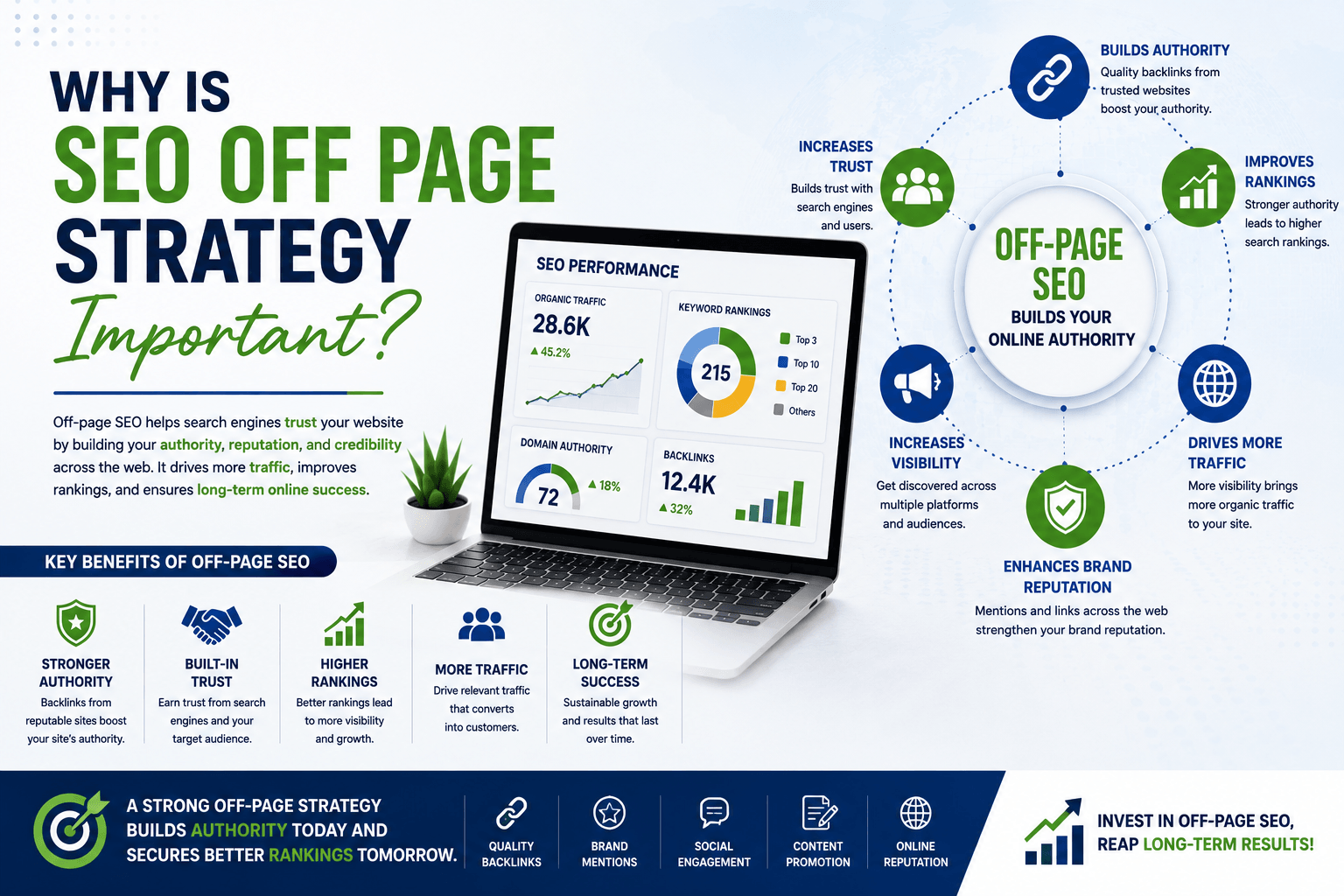
A strong SEO off page strategy provides external signals that demonstrate the reputation and authority of your website.
Search engines do not evaluate websites solely based on their own content. External references, backlinks, brand mentions, and industry recognition can help demonstrate that your website provides valuable and trustworthy information.
An effective SEO off page strategy can help you:
- Improve search engine rankings
- Increase domain authority
- Earn authoritative backlinks
- Generate referral traffic
- Improve brand awareness
- Strengthen industry credibility
- Generate qualified leads
- Increase organic visibility
- Build long-term search authority
The key is to prioritize quality, relevance, and authority instead of focusing only on the number of backlinks.
1. Audit Your Existing Backlink Profile
The first step in building an effective SEO off page strategy is analyzing your current backlink profile.
Review:
- Total referring domains
- Backlink quality
- Linking website relevance
- Anchor text distribution
- Follow and nofollow links
- Lost backlinks
- Competitor backlink gaps
- Potentially harmful links
A backlink audit helps SEO professionals understand the website’s current authority and identify opportunities for improvement.
2. Analyze Competitor Backlinks
Competitor backlink analysis is another important part of an SEO off page strategy.
Analyze websites ranking for your target keywords and identify domains linking to your competitors but not your website.
Look for opportunities from:
- Industry publications
- Business directories
- Resource pages
- News websites
- Partner websites
- Professional associations
- Blogs
- Research websites
Competitor analysis can reveal backlink opportunities that are already proven within your niche.
3. Create Linkable Content Assets
A successful SEO off page strategy requires content that other websites genuinely want to reference.
Create valuable assets such as:
- Original research
- Industry reports
- Statistics pages
- Infographics
- Free tools
- Calculators
- Templates
- Comprehensive guides
- Case studies
- Data visualizations
High-value resources make link acquisition easier because publishers have a legitimate reason to reference your website.
4. Build High-Quality Backlinks
Link building remains one of the most important elements of an SEO off page strategy.
However, backlink quality matters significantly more than quantity.
Focus on earning backlinks from:
- Relevant industry websites
- Trusted publications
- Established blogs
- Professional organizations
- Educational resources
- Business partners
- News websites
Avoid generating hundreds of low-quality links simply to increase backlink numbers.
A contextual backlink from a highly relevant and authoritative website can be considerably more valuable than dozens of irrelevant links.
5. Use Digital PR
Digital PR can strengthen your SEO off page strategy by generating authoritative backlinks, media mentions, and brand exposure.
Digital PR campaigns may include:
- Original surveys
- Industry research
- Expert commentary
- Data studies
- Market reports
- Newsworthy insights
- Trend analysis
Journalists and publishers frequently need reliable statistics, expert opinions, and original research.
Providing these resources can help your website earn valuable editorial mentions.
6. Publish Guest Posts Strategically
Guest posting can still be an effective component of SEO off page strategy when quality is prioritized.
Contribute expert articles to reputable websites within your industry.
Choose websites that have:
- Relevant audiences
- Strong editorial standards
- Genuine organic traffic
- High-quality content
- Established industry credibility
Guest posting should primarily provide value to readers rather than exist solely for backlink acquisition.
7. Reclaim Unlinked Brand Mentions
Another useful SEO off page strategy is converting existing brand mentions into backlinks.
Businesses are frequently mentioned online without receiving a link.
Monitor mentions of:
- Your company name
- Products
- Services
- Executives
- Research
- Statistics
- Tools
When you discover an unlinked mention, contact the publisher and request that they link to the appropriate page on your website.
Because the publisher has already mentioned your business, these opportunities can have higher conversion rates than cold outreach.
8. Recover Lost Backlinks
Lost backlinks can reduce website authority over time.
Monitor your backlink profile and identify links that previously pointed to your website but have disappeared.
Backlinks may disappear because:
- Content was removed
- URLs changed
- Pages were redesigned
- External websites updated their articles
Recover valuable links by restoring pages, implementing appropriate redirects, or contacting publishers with updated URLs.
9. Build Brand Authority
SEO off page strategy should not focus exclusively on backlinks.
Brand authority can also be strengthened through:
- Podcasts
- Webinars
- Interviews
- Conferences
- Industry events
- Professional communities
- Expert commentary
- Social media
- Strategic partnerships
Increasing your brand’s visibility can lead to more searches, mentions, referral traffic, and natural backlinks.
10. Improve Local Off Page SEO
For local businesses, SEO off page strategy should include local authority signals.
Important activities include:
- Business directory listings
- Local citations
- Customer reviews
- Local backlinks
- Community partnerships
- Local sponsorships
- Regional publications
- Chamber of commerce listings
Consistent business information across trusted directories can also support local search visibility.
11. Manage Online Reviews
Online reputation is another important part of an SEO off page strategy.
Businesses should actively:
- Monitor reviews
- Respond to customer feedback
- Encourage legitimate reviews
- Resolve complaints professionally
- Track brand sentiment
Positive customer experiences can strengthen reputation, trust, and conversion rates.
12. Promote Your Content
Publishing excellent content does not automatically generate backlinks.
Content promotion should therefore be incorporated into your SEO off page strategy.
Promote important resources through:
- Email outreach
- Industry communities
- Newsletters
- Partner networks
- Influencer outreach
- Digital PR
- Professional forums
Greater exposure increases the likelihood that publishers, journalists, and industry professionals will discover and reference your content.
How to Measure SEO Off Page Strategy Performance
Track the performance of your SEO off page strategy using meaningful KPIs.
Important metrics include:
Referring Domains
Monitor the number of unique websites linking to your domain.
Backlink Quality
Evaluate the authority, relevance, context, and potential traffic of new backlinks.
Keyword Rankings
Monitor ranking improvements for priority keywords.
Organic Traffic
Measure changes in organic traffic following authority-building campaigns.
Referral Traffic
Track visitors generated directly from external backlinks and mentions.
Brand Mentions
Monitor how frequently your brand appears across online publications and industry conversations.
Leads and Conversions
For lead-generation websites, the most important measurement is whether SEO activity contributes to qualified inquiries and revenue.
SEO Off Page Strategy Mistakes to Avoid
Avoid manipulative or low-quality tactics that may create unnecessary SEO risk.
Common mistakes include:
- Buying bulk backlinks
- Automated backlink generation
- Spammy guest posting
- Irrelevant directory submissions
- Private blog networks
- Comment spam
- Forum spam
- Excessive link exchanges
- Overoptimized anchor text
A sustainable SEO off page strategy should focus on earning genuine authority instead of artificially manipulating ranking signals.
Best SEO Off Page Strategy Framework
A practical SEO off page strategy can follow five stages:
Audit → Research → Create → Promote → Measure
Start by auditing your backlink profile and competitive landscape.
Research the publications, websites, journalists, influencers, and communities that matter within your industry.
Create valuable resources worth referencing.
Promote those assets through outreach, digital PR, partnerships, and content distribution.
Finally, measure backlinks, rankings, organic traffic, leads, and conversions.
Repeat the process consistently to build sustainable authority.
Conclusion
A successful SEO off page strategy is ultimately about building authority, trust, and industry recognition.
High-quality backlinks remain important, but modern off-page SEO should also include digital PR, brand mentions, strategic content promotion, reputation management, partnerships, and relationship building.
SEO professionals should prioritize relevant and authoritative links rather than chasing backlink volume.
When an SEO off page strategy is combined with strong on-page SEO, technical optimization, valuable content, and conversion-focused landing pages, it can significantly improve organic visibility and long-term business growth.
Looking for a Professional SEO Off Page Strategy?
Building a successful SEO off page strategy requires consistent research, competitor analysis, outreach, digital PR, and high-quality link acquisition.
If your website is struggling to build authority, attract quality backlinks, or compete for valuable search terms, our SEO specialists can develop a customized strategy based on your industry, competitors, and business objectives.
Frequently Asked Questions About SEO Off Page Strategy
1. What is an SEO Off Page Strategy?
An SEO Off Page Strategy is a set of activities performed outside your website to improve its authority, credibility, and search engine visibility. It typically includes link building, digital PR, brand mentions, guest posting, local citations, content promotion, and online reputation management.
2. Why is SEO Off Page Strategy important?
An effective SEO Off Page Strategy helps search engines understand the authority and trustworthiness of your website. High-quality backlinks, brand mentions, and industry recognition can support better rankings, increased referral traffic, stronger brand visibility, and more qualified leads.
3. What are the best off-page SEO techniques?
Some of the most effective off-page SEO techniques include high-quality link building, digital PR, guest posting, competitor backlink analysis, broken link building, unlinked brand mention reclamation, influencer outreach, content promotion, and local citation building.
4. Is link building part of SEO Off Page Strategy?
Yes. Link building is one of the most important components of an SEO Off Page Strategy. However, modern off-page SEO also includes brand building, PR, reputation management, partnerships, content distribution, and other activities that increase a website’s authority and visibility.
5. How do backlinks help SEO?
Backlinks can act as external endorsements of your content. When relevant and authoritative websites link to your pages, they can help strengthen your website’s perceived credibility and authority. High-quality backlinks can also generate referral traffic and improve content discovery.
6. How long does off-page SEO take to show results?
Off-page SEO is generally a long-term process. Some campaigns may generate improvements within a few weeks or months, while competitive industries can require several months of consistent link building, digital PR, and authority development before significant results become visible.
7. What makes a high-quality backlink?
A high-quality backlink typically comes from a trustworthy, relevant, and authoritative website. The link should appear naturally within useful content and be contextually related to your website or industry. Relevance and editorial quality are usually more important than backlink quantity.
8. What is the difference between on-page SEO and off-page SEO?
On-page SEO focuses on elements within your website, including content, headings, internal links, keyword optimization, and metadata. Off-page SEO focuses on external authority signals such as backlinks, brand mentions, digital PR, citations, reviews, and industry relationships.
9. Can off-page SEO increase website traffic?
Yes. A strong SEO Off Page Strategy can increase traffic in several ways. Better authority can support improved search visibility, while backlinks and media mentions can generate referral traffic directly from external websites.
10. How can I measure SEO Off Page Strategy results?
You can measure the effectiveness of your SEO Off Page Strategy by tracking referring domains, backlink quality, organic rankings, organic traffic, referral traffic, brand mentions, lead generation, conversions, and revenue influenced by organic search.
11. Is guest posting still effective for off-page SEO?
Guest posting can still be effective when articles are published on reputable and relevant websites. The primary focus should be providing useful expertise to the publisher’s audience rather than publishing low-quality articles solely to acquire backlinks.
12. How can digital PR improve off-page SEO?
Digital PR can help businesses earn editorial backlinks and brand mentions from news websites, industry publications, journalists, and authoritative platforms. Successful campaigns can improve brand awareness, referral traffic, credibility, and overall website authority.
13. Are social media links important for off-page SEO?
Social media links do not necessarily provide the same SEO value as editorial backlinks, but social platforms can help distribute content, increase brand exposure, attract referral traffic, and improve the chances of content being discovered and referenced by publishers.
14. What off-page SEO practices should be avoided?
Avoid practices such as buying large quantities of low-quality backlinks, automated link building, private blog networks, spammy directory submissions, excessive link exchanges, comment spam, irrelevant guest posting, and overoptimized anchor text.
15. How often should an SEO Off Page Strategy be reviewed?
An SEO Off Page Strategy should be reviewed regularly, ideally every month or quarter depending on campaign size. SEO professionals should monitor new and lost backlinks, competitor activity, referring domains, rankings, traffic, brand mentions, and lead-generation performance.