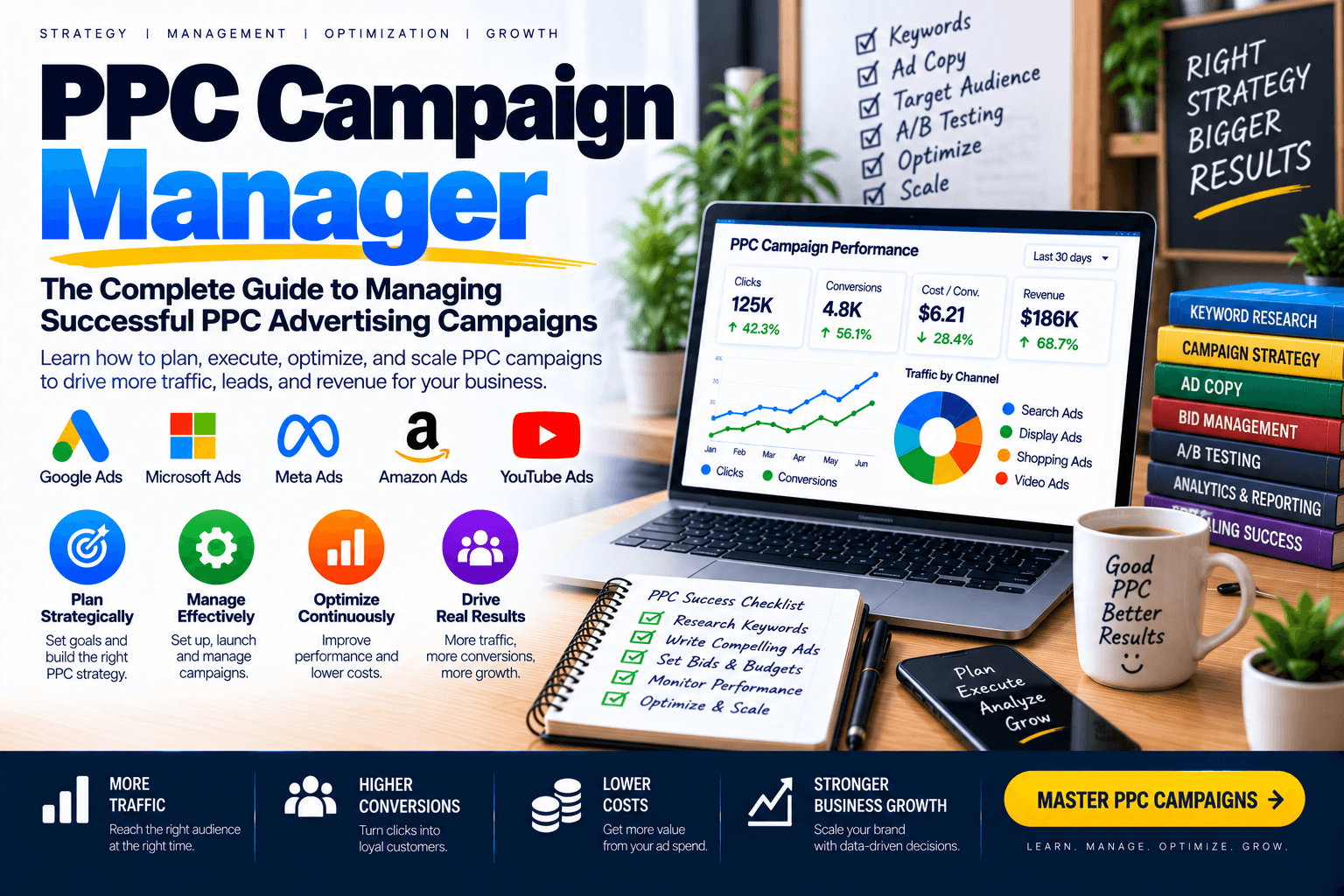
In the modern digital marketplace, businesses are constantly competing for attention. Having a website alone is no longer enough to attract customers. Companies need effective marketing strategies that can place their products and services in front of the right audience at the right moment.
This is where PPC advertising becomes valuable.
Pay-per-click (PPC) advertising allows businesses to display ads on search engines, social media platforms, and other online channels while paying only when someone clicks on their advertisement. However, running successful PPC campaigns requires more than simply creating an ad and setting a budget.
This is where a PPC Campaign Manager becomes essential.
A PPC Campaign Manager is a digital advertising professional responsible for planning, creating, managing, monitoring, and optimizing paid advertising campaigns to achieve specific business goals. Their main objective is to generate high-quality traffic, increase conversions, and maximize return on investment (ROI).
Whether a company wants more leads, online sales, app downloads, or brand awareness, a skilled PPC campaign manager ensures that advertising budgets are used effectively.
What Is a PPC Campaign Manager?
A PPC Campaign Manager is a specialist who manages paid advertising campaigns across platforms such as:
- Google Ads
- Microsoft Advertising
- Meta Ads (Facebook and Instagram)
- LinkedIn Ads
- Amazon Ads
- YouTube Ads
- Display advertising networks
Their responsibility is not only launching advertisements but also continuously improving campaign performance through research, testing, and data analysis.
A professional PPC campaign manager understands:
- Customer search behavior
- Keyword targeting
- Audience segmentation
- Advertising platforms
- Conversion tracking
- Budget optimization
- Performance analytics
Their role connects marketing strategy with measurable business results.
Why Businesses Need a PPC Campaign Manager
Many businesses invest thousands of dollars into paid advertising but fail to achieve profitable results because campaigns are not properly managed.
A PPC campaign manager helps businesses avoid common problems such as:
- Spending money on irrelevant clicks
- Targeting the wrong audience
- Using ineffective keywords
- Creating poor-performing advertisements
- Ignoring conversion tracking
- Missing optimization opportunities
A professional manager ensures every part of the PPC campaign works together.
For example:
A business selling premium fitness equipment may receive thousands of website visitors through advertising. However, if the campaign targets people who are not interested in buying fitness products, the company wastes money.
A PPC campaign manager analyzes customer intent and creates campaigns that attract users who are more likely to convert.
Responsibilities of a PPC Campaign Manager
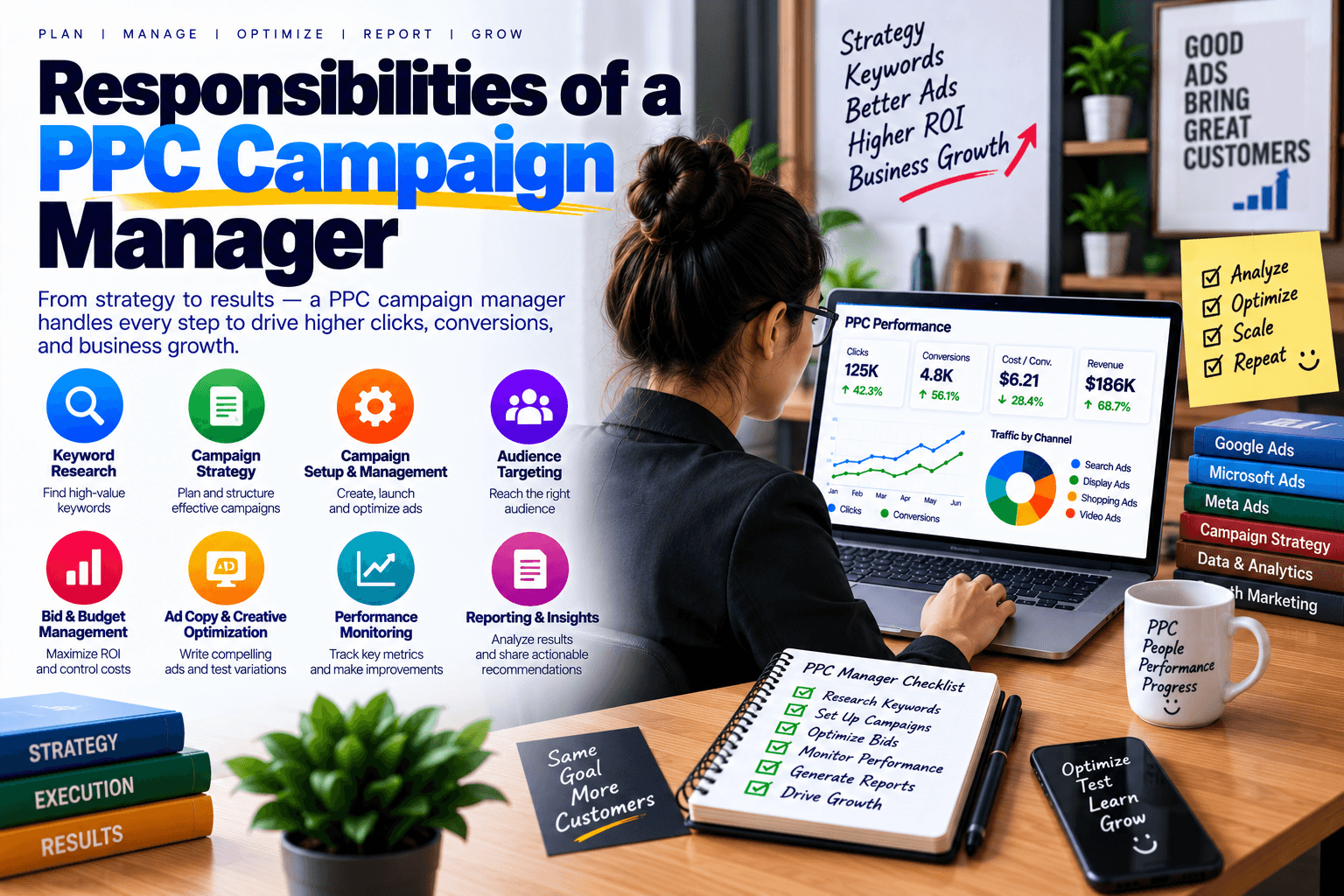
A PPC campaign manager performs several important tasks throughout the campaign lifecycle.
1. Understanding Business Goals
Before creating any campaign, a PPC manager must understand the company’s objectives.
Different businesses have different goals:
Lead Generation Goals
Examples:
- Getting contact form submissions
- Receiving phone calls
- Increasing consultation requests
Ecommerce Goals
Examples:
- Increasing product sales
- Improving shopping conversions
- Increasing revenue
Brand Awareness Goals
Examples:
- Increasing visibility
- Growing website traffic
- Introducing a new product
Understanding goals helps determine:
- Campaign type
- Budget allocation
- Target audience
- Success metrics
2. Developing a PPC Strategy
A successful PPC campaign begins with a strong strategy.
A PPC campaign manager creates a plan that includes:
- Target audience research
- Competitor analysis
- Keyword planning
- Budget distribution
- Advertising platforms
- Conversion goals
A well-designed strategy ensures that advertising efforts are focused on achieving measurable outcomes.
3. Keyword Research and Analysis
Keyword research is one of the most important responsibilities of a PPC campaign manager.
The right keywords connect businesses with potential customers.
A PPC manager analyzes:
- Search volume
- Competition
- Cost per click (CPC)
- Search intent
- Conversion potential
For example:
A company offering emergency plumbing services should not only target broad keywords like:
“plumber”
because this may attract many irrelevant searches.
Instead, a PPC manager may target:
- emergency plumber near me
- 24 hour plumbing service
- local plumbing repair
These keywords indicate stronger buying intent.
Types of PPC Keywords
Informational Keywords
Users are looking for information.
Examples:
- How does SEO work?
- Best marketing strategies
Commercial Keywords
Users are researching products or services.
Examples:
- Best CRM software
- Top web design company
Transactional Keywords
Users are ready to take action.
Examples:
- Buy running shoes online
- Hire PPC agency
A professional PPC manager understands the difference between these keywords and uses them strategically.
4. Creating High-Converting PPC Ads
Writing effective advertisements requires both creativity and data analysis.
A PPC campaign manager creates ads that:
- Match user search intent
- Highlight business benefits
- Encourage clicks
- Increase conversions
A strong PPC advertisement usually includes:
Attention-Grabbing Headline
The headline should immediately communicate value.
Example:
“Professional Website Design Services For Growing Businesses”
Clear Description
The description explains why customers should choose the business.
Strong Call-To-Action
Examples:
- Get Free Consultation
- Start Your Project Today
- Request a Quote
5. Landing Page Optimization
Many businesses focus only on advertisements but ignore landing pages.
A PPC campaign manager understands that successful campaigns require both:
- Good advertisements
- Effective landing pages
A landing page should have:
- Clear messaging
- Fast loading speed
- Mobile-friendly design
- Simple navigation
- Strong call-to-action
- Trust signals
Even if an advertisement receives many clicks, poor landing page experience can reduce conversions.
6. Managing PPC Budgets
Budget management is a critical part of PPC campaign management.
A PPC manager decides:
- Daily advertising budget
- Keyword bidding limits
- Campaign priorities
- Budget distribution
They monitor spending to ensure the company receives maximum value.
For example:
If one campaign generates high-quality leads at a lower cost, more budget may be allocated to that campaign.
If another campaign spends money without conversions, it may need adjustment or removal.
7. Bid Management and Optimization
PPC platforms use bidding systems where advertisers compete for ad placement.
A PPC campaign manager manages:
- Maximum CPC bids
- Automated bidding strategies
- Keyword bids
- Audience bids
Common bidding strategies include:
- Maximize clicks
- Maximize conversions
- Target CPA
- Target ROAS
- Manual CPC
The right strategy depends on business goals.
8. Conversion Tracking Setup
Without proper tracking, businesses cannot understand whether campaigns are successful.
A PPC campaign manager sets up tracking for:
- Website purchases
- Form submissions
- Phone calls
- Newsletter signups
- App downloads
Common tracking tools include:
- Google Analytics
- Google Tag Manager
- Conversion tracking systems
Accurate tracking allows businesses to make better decisions.
9. PPC Campaign Monitoring
A PPC campaign requires continuous monitoring.
A PPC manager regularly checks:
- Click-through rate (CTR)
- Conversion rate
- Cost per click (CPC)
- Cost per acquisition (CPA)
- Quality Score
- Return on ad spend (ROAS)
Monitoring helps identify problems and improvement opportunities.
10. A/B Testing PPC Campaigns
Testing is essential for improving advertising performance.
PPC managers test:
- Different headlines
- Ad descriptions
- Images
- Landing pages
- Audience targeting
- Offers
Example:
Version A:
“Get Professional Accounting Services”
Version B:
“Save Time With Expert Accounting Support”
After testing performance, the better-performing version can receive more budget.
Important PPC Metrics Every Campaign Manager Tracks
Click-Through Rate (CTR)
CTR measures how many people click an advertisement after seeing it.
Higher CTR usually indicates better ad relevance.
Cost Per Click (CPC)
CPC shows how much advertisers pay for each click.
Lower CPC can improve campaign efficiency.
Conversion Rate
Conversion rate shows the percentage of visitors who complete desired actions.
Examples:
- Purchase
- Form submission
- Phone call
Cost Per Acquisition (CPA)
CPA measures the cost required to acquire one customer or lead.
Return on Ad Spend (ROAS)
ROAS measures advertising profitability.
A higher ROAS means better campaign performance.
PPC Campaign Manager Tools
Professional PPC managers use various tools to research, manage, and optimize campaigns.
Advertising Platforms
- Google Ads
- Microsoft Ads
- Meta Ads Manager
- LinkedIn Campaign Manager
Analytics Tools
- Google Analytics
- Google Tag Manager
- Looker Studio
Keyword Research Tools
- Google Keyword Planner
- SEMrush
- Ahrefs
- SpyFu
Reporting Tools
- Data Studio dashboards
- Custom PPC reports
PPC Campaign Manager vs PPC Specialist
Although these terms are often used interchangeably, there can be differences.
A PPC Specialist usually focuses on specific tasks such as:
- Keyword research
- Ad creation
- Bid adjustments
A PPC Campaign Manager typically handles broader responsibilities:
- Strategy development
- Budget planning
- Campaign management
- Reporting
- Team coordination
How Much Does a PPC Campaign Manager Cost?
The cost depends on:
- Experience level
- Campaign size
- Advertising budget
- Industry complexity
- Service scope
Common pricing models include:
Monthly Management Fee
A fixed monthly amount for managing campaigns.
Percentage of Ad Spend
The manager charges a percentage of advertising budget.
Performance-Based Pricing
Payment depends on campaign results.
How to Choose the Right PPC Campaign Manager
Before hiring a PPC professional, consider:
Experience
Look for someone with experience managing similar campaigns.
Certifications
Google Ads certifications can demonstrate platform knowledge.
Transparency
A good manager provides clear reports and explains decisions.
Data-Driven Approach
Successful PPC management depends on analysis, not guesswork.
Common PPC Campaign Mistakes
Ignoring Negative Keywords
Negative keywords prevent unwanted clicks.
Poor Audience Targeting
Incorrect targeting wastes advertising budget.
Not Testing Ads
Without testing, campaigns cannot improve.
Tracking Wrong Goals
Clicks are not always the main goal. Conversions matter more.
Ignoring Mobile Users
Many searches happen on mobile devices, so campaigns must be optimized accordingly.
The Future of PPC Campaign Management
The future of PPC is becoming increasingly automated and data-driven.
Artificial intelligence is changing how campaigns are managed through:
- Automated bidding
- Smart targeting
- Predictive analytics
- AI-generated ad suggestions
However, human expertise remains important because businesses still need strategic thinking, creativity, and customer understanding.
Conclusion
A PPC Campaign Manager is an essential professional for businesses that want to grow through paid digital advertising. They combine marketing knowledge, analytical skills, and platform expertise to create campaigns that generate measurable results.
From keyword research and advertisement creation to budget management and performance optimization, PPC campaign managers help businesses reach the right customers while maximizing advertising investment.
As competition continues to increase online, professional PPC campaign management will remain one of the most effective ways for businesses to achieve sustainable digital growth.